Complete Overview of Swimming Lessons for Motor Development Delay or DCD: How to Help Your Child Progress
Summary
- A motor development delay means a child moves less smoothly than expected for their age. DCD is the medical term for a persistent form of this.
- Worldwide, about five percent of children have DCD. It has nothing to do with intelligence.
- In the water, you see difficulty with floating, kicking, looking underwater, or lying on the back. Breaststroke is especially challenging.
- Small steps, lots of repetition, and success experiences help more than harder practice. Forcing backfires.
- Almost every child with a motor delay can learn to swim, it just often takes longer. As long as that is not certain, stay close to the water.
Almost every child obtains their A diploma within about two years. With your child, it doesn’t seem to be going smoothly. The kicking doesn’t come naturally, the breaststroke just won’t come together, and on the side you see peers making progress. You wonder if it will ever work out.
Usually, it does, just at a different pace. Maybe your child has a motor development delay or the more persistent form called DCD. In this overview, you’ll read what that means, how to recognize it, and how to truly help your child progress at home and during lessons.
What is a motor development delay?
A motor development delay is not a disease but a description: a child moves less skillfully than expected for their age. Everyday tasks like hopping, catching a ball, cutting, or standing on one leg require visibly more effort. And it is becoming more common. Trade magazine ZwembadBranche cites a survey among 70,000 children at 428 primary schools showing that motor skills are declining. Swimming instructors notice that children more often start lessons with a delay and that simple movements like floating and kicking are difficult for more children.
Ordinary clumsiness or a real delay?
Every child is clumsy sometimes and children develop unevenly. With a real delay, the difference with peers is large, you see it in multiple areas simultaneously, and it does not improve automatically with practice. It is about the combination: noticeable, broad, and persistent.
DCD, the medical term
If the delay is significant and persistent, a doctor can diagnose DCD, the abbreviation for developmental coordination disorder. The British NHS describes it as a condition where a child moves less well than expected and appears clumsy. Early milestones such as crawling, walking, and feeding themselves often occur later than average.
How common is it?
Worldwide, about five percent of children have DCD. This figure comes from a systematic review in 2024 that combined data from 29,213 children. The researchers found a prevalence of five percent, with a higher percentage among children born prematurely or with low birth weight. So in an average class, there are one or two children with DCD.
How does a delay develop?
Sometimes there is one clear cause, more often it is a combination. For DCD, risk factors are known: being born prematurely before the thirty-seventh week, low birth weight, or a family member with the same problems. But a motor delay can also simply arise from too little movement experience: children who climb, run, jump, and throw less build fewer basic skills on which new movements build. Therefore, the picture of a delay is never complete without asking how much a child moves daily.
What a delay is not
A motor delay says nothing about intelligence and DCD has nothing to do with laziness. Children with DCD often want to participate very much, but their body does not cooperate naturally. Misunderstanding this leads to demanding more instead of practicing differently. Then the exact opposite of what you want happens.
Signs: how to recognize a motor development delay
At home and school
Look for patterns, not a single accident: difficulty tying shoelaces, cutting, drawing, throwing a ball, riding a bike without training wheels, or frequent tripping. Some children avoid such activities, making it seem like they don’t want to. Also ask the teacher how gym class is going, because that is often where you see it first.
In and around the pool
The National Council for Swimming Safety describes the stumbling blocks children with a motor disability encounter on the way to their swimming diploma: not daring to walk in the water without support, insufficient breath control, not daring to look underwater, not daring to lie on their back, many compensatory movements, and too little propulsion. If you recognize two or three of these in your child, that is a strong indication.
When to look further
The general practitioner or youth health care can refer to pediatric physiotherapy or occupational therapy. That does not have to be a label: a therapist gives you concrete exercises and can observe how it goes in lessons. If your child does reasonably well at school but struggles with swimming, discuss it anyway. Swimming lessons simply demand different skills than any school subject.
Why swimming lessons are extra challenging for these children
Swimming demands everything at once
Learning to swim is one of the most complex motor tasks a child experiences. With breaststroke alone, arms and legs move oppositely, and each arm and leg also does something different. For a child who struggles to coordinate separate movements, this is not a matter of paying more attention but a fundamentally harder task.
Longer learning means longer risk
Until a child can really swim, water remains a risk. Those who take longer with lessons are therefore dependent on supervision longer. That is not a disaster if you know it; it just means you stay consciously nearby, even in shallow water. You can read more about this in our water safety overview for parents.
Frustration is lurking
Children compare themselves mercilessly with each other. When they see others succeed while they do not, shame sets in. Forcing or becoming stricter makes it worse: under stress, a child tenses up, and a tense body does not learn. Parent association Balans, which advocates for children with developmental problems, puts it simply: forcing and pushing backfire and only increase the fear.
Swimmigo · Swim lesson app
Free for parents
Follow your child's swimming progress, see where you stand and report absences in the app.

How to help your child progress: the approach that works
Almost every child with a motor delay can learn to swim. This is not optimism but the reality of swim schools that work with it. The recipe is always the same: smaller steps, more repetition, a different explanation, and success. Here’s how to approach it. On the Swimmigo page for parents you can find more about how to track your child’s progress.
Ensure a broad movement base
A child does not learn to swim only in the water. The more varied a child moves, the easier it picks up new movements. Let them bike, climb, jump, balance, and play outside. The World Health Organization advises children from five years old to move moderately to intensively for at least an hour daily, and worldwide eighty percent of youth do not reach this level. Little movement also means fewer opportunities to gain motor experience. This also applies in the water: let your child move a lot so they discover through experience how resistance and propulsion work.
Small steps and lots of repetition
In treating DCD, the advice is clear, and it works just as well in swimming lessons: break difficult movements into small parts and practice them regularly. First only kicking, then only arms, then the combination. Where another child understands after three tries, your child may need ten. That is not failure but the pace that fits this child.
Practice at home, but keep it playful
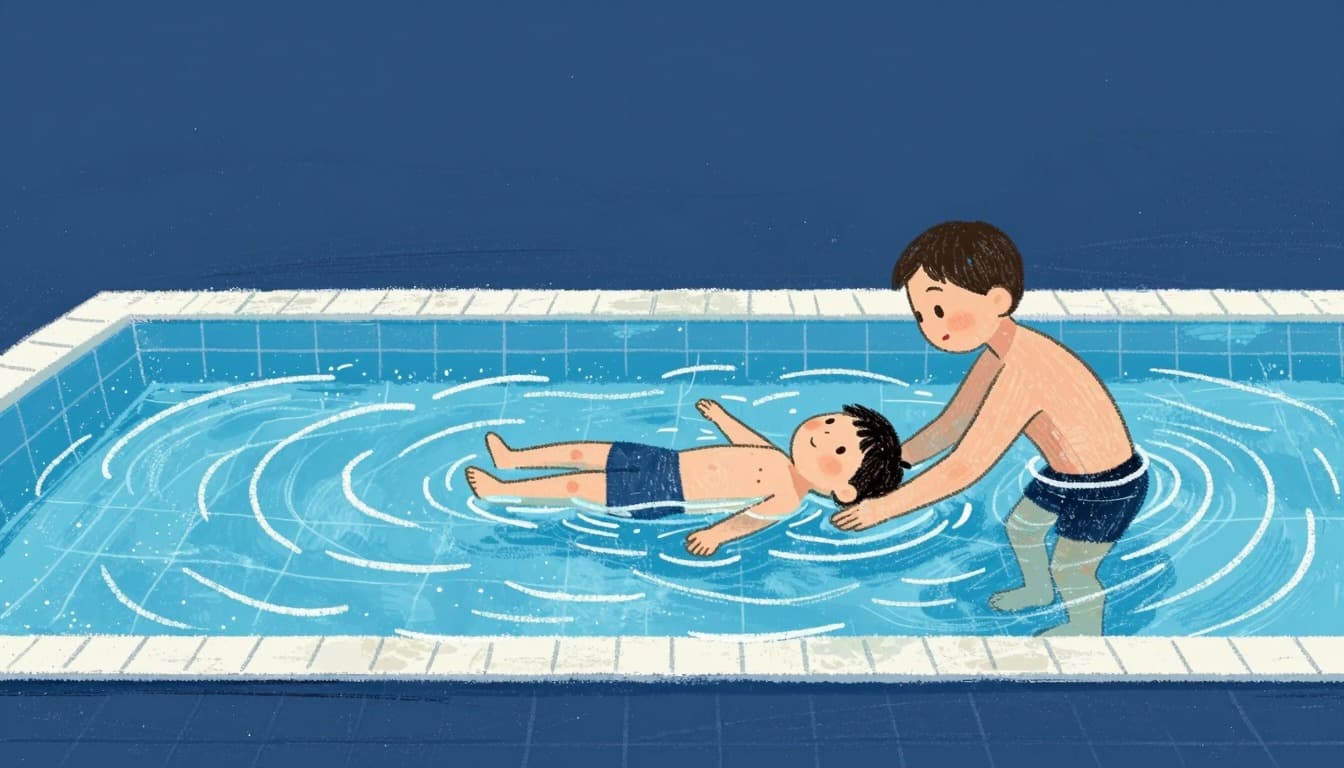
In the bath, you can work on parts that are difficult in lessons without pressure: water on the face, blowing bubbles, eyes underwater, floating on the back with your hand under the head. Keep it short and playful and stop at the first resistance. A child who experiences at home that they can do something relaxed enters the lesson differently.

Choose a swim school that can differentiate
Not every swim school is the same. Ask at registration how they handle children who need more time, whether a slower track is possible, and if your child will have a fixed instructor. Changing faces cost a child with a motor delay extra energy. A school that truly differentiates is worth its weight in gold.
Consider extra guidance
Especially at the start, a small group or individual lesson can make a difference. This way, a child builds basic skills without constant comparison to faster classmates and often then joins the regular lesson.
Work together with school and therapist
If there is already guidance through pediatric physiotherapy or occupational therapy, bring that approach to the swimming lessons. A therapist can precisely explain which exercises suit this child and how to teach something, and the swim instructor builds on that. Using the same approach on both sides speeds progress noticeably.
Compare your child with themselves
Write down what your child could not do last month: three seconds floating, eyes underwater, first meters without help. Compare only with that list and never with the neighbor’s child. Celebrating small milestones works better than waiting for the big diploma. An overview of sub-skills helps: on the Swimmigo level page you see how skills are built in small steps. This way, even in difficult moments, you see progress. Swim schools that track what already works per exercise, for example with a student tracking system, can make these sub-steps visible for you and the child.
What a good swim instructor does differently
As an instructor, you can make the difference between a child who gives up and one who perseveres. It does not require complicated methods, but a different perspective. On Swimmigo’s instructor page you can see how to track progress per student.
Signal early and talk with parents
Those who see many children over the years recognize the pattern: the child who persistently struggles with floating, kicking, or moving arms and legs simultaneously. Discuss it neutrally with the parents, with concrete examples, and ask how it goes at home and school. Early signaling prevents frustration, withdrawal, and loss of confidence.
Give experiences instead of endless explanations
The information cards from the National Council for Swimming Safety work from implicit learning: you name the goal, not the technique. Instead of demonstrating endlessly, let children gain many different experiences so they discover how to get a grip on the water themselves. Those who experience grip and balance feel safe, and only then does the calm to learn arise.
Break down and postpone technique
Break a stroke into separate exercises: first only legs, then only arms, then the combination. ZwembadBranche advises instructors to postpone teaching perfect technique and first work on water feeling, with variations on the propulsion surfaces: hands as cups, fists, fingers spread, movements big and small, slow and fast. It sounds simple, but it is exactly what these children need.
Ensure every child experiences success
Children learn fastest when something succeeds. Choose exercises where the child can quickly experience success and build on that. A compliment, a thumbs-up, or a sticker in the right place is not sugarcoating for a child who lags behind everywhere but fuel. Swim schools that work a lot with children with developmental problems often let the instructor swim along with the children and celebrate every step.
Keep the child’s pace
The group must progress and the diploma must be earned, you feel that pressure as an instructor too. But for this child: taking time now wins time later. A child who feels safe and experiences success ultimately makes bigger steps than a child who tenses up behind the facts for weeks.
Water safety as long as it is not certain yet
Stay close to the water
As long as your child does not have a diploma, supervision is the only real safety measure. Especially for a child who matures motorically later, you should not rely on almost being able to swim. Shallow water is not safe water. Go with them to the pool, also outside lessons, and stay within arm’s reach as long as your child is not self-reliant.
Don’t count on it will come
The temptation is great to think swimming will come naturally or that your child will suddenly catch up later. Sometimes that happens, but don’t assume it. Keep going to the water and keep practicing, in lessons and outside, until it is really certain.
Open water is a different world
A pool is manageable, a lake, river, or sea is not. Currents, cold, depth, and murky water demand much more from a child than the pool. If swimming skills are still fragile, keep children close to you in open water and use flotation aids that truly match the level. An overview of which aids are safe can be found in our overview of swimming aids and flotation devices.
Swimmigo · Swim lesson app
Free for parents
Follow your child's swimming progress, see where you stand and report absences in the app.
Conclusion
A motor development delay or DCD does not mean your child cannot learn to swim, but it does require more time, repetition, and patience. Recognize the signs early, choose a swim school that can differentiate, and let your child move a lot in varied ways at home. Celebrate the small steps, not just the diploma. And as long as swimming is not yet certain, stay close to the water: that presence is the most important safety measure there is.
Sources
- WHO: Physical activity fact sheet, June 26, 2024
- Systematic review and meta-analysis: prevalence of DCD in children, 2024
- NHS: Developmental coordination disorder (dyspraxia) in children, accessed September 2026
- ZwembadBranche: motor development delay in children calls for action, accessed September 2026
- National Council for Swimming Safety: stumbling blocks with a physical or motor disability, accessed September 2026
- Balans: learning to swim with confidence and pleasure, tailored swimming lessons, accessed September 2026

Bob van Soest
As an expert in operating sports facilities (such as swimming pools) and developer of, among others, Swimmigo.com, I am passionately committed to making swimming lessons simpler, more fun and more insightful for parents, swimming instructors and everyone who wants to learn to swim.
Frequently Asked Questions
Discover Swimmigo
The all-in-one app for swimming lesson progress. For parents, swim schools, and adult swimmers.