CompleteOverviewofWaterSafetyforParents:HowtoProtectYourChildInandAroundWater[2026]
![Complete Overview of Water Safety for Parents: How to Protect Your Child In and Around Water [2026]](/_next/image?url=https%3A%2F%2Fzvblogpostimages.s3.eu-west-3.amazonaws.com%2FAUTOMATISCH_UPLOAD%2F1_0b2c9cbda640.jpg&w=3840&q=75&dpl=dpl_FEcJLWFaZFj4CsT2F159aPzMcoRK)
Summary
- Worldwide, 300,000 people die annually from drowning: children under 5 make up nearly a quarter of all victims
- Water safety does not start at the pool but at home: a toddler can drown in just 5 centimeters of water
- Swimming lessons are essential but not a guarantee: children with a diploma still need supervision in open water
- Technology like Swimmigo gives parents real-time insight into their child's swimming skills and which safety milestones have been achieved
- With the right knowledge, supervision, and tools, you turn water from an enemy into a place of fun and confidence
TLDR
Water fascinates children but is also dangerous. Worldwide, 300,000 people drown annually, and children under 5 make up nearly a quarter of all drowning victims. Most parents think drowning only happens in swimming pools, but the reality is different: a toddler can drown in just 5 centimeters of water. This overview explains how you as a parent can integrate water safety into family life from day one. From the bathroom at home to the surf on vacation: with the right knowledge and tools, you give your child a safe start in the water.
According to the World Health Organization (WHO), drowning is the third leading cause of death among children aged 5 to 14 worldwide. More than 800 people die from drowning every day. These are numbers no parent wants to read. But precisely because the risks are so great, awareness is the first and most important step. This article provides a complete overview: from the statistics to concrete measures, from swimming lessons to technology that helps you track your child's progress.
Why Water Safety Is Life-Saving
Drowning happens quickly and silently. Unlike in movies, there is no splashing or screaming: a child who is drowning quietly sinks underwater. Consciousness is lost within 20 to 60 seconds. Irreversible brain damage occurs within 2 to 5 minutes. This makes water safety not an optional topic but an absolute priority for every parent.
Shocking Global Statistics
The WHO estimates that about 300,000 people drown worldwide each year. Children under 5 years old make up nearly 25 percent of these victims. In the 1 to 4-year age group, drowning is the fourth leading cause of death. For children aged 5 to 14, drowning ranks third. More than 90 percent of drownings occur in low- and middle-income countries, but even in wealthy countries with extensive swimming programs, drowning remains a real danger.
In the United States, the CDC reports that drowning is the leading cause of death for children aged 1 to 4. In Australia, a country with a strong swimming culture, 323 people still drowned in the 2023-2024 fiscal year, including 17 children under 4 years old. The lesson is clear: even in countries where swimming lessons are common, water safety remains a challenge.
Drowning in the Netherlands and Belgium
In the Netherlands, an average of 88 people drowned annually between 2014 and 2023, according to CBS data. About 10 percent of these are children under 10 years old. The number of drownings in the Netherlands fluctuates but shows no structural decline, a worrying sign for a water-rich country with 17 million inhabitants and more than 2,000 official swimming locations.
The National Council for Swimming Safety (NRZ) warns that obtaining a swimming diploma does not automatically mean a child is water safe. Safe swimming is a combination of skills, knowledge of dangers, and constant supervision. Especially open water, lakes, rivers, and the sea require extra vigilance, even for children who have been taking swimming lessons for years.
Why Young Children Are at Greatest Risk
Children between 1 and 4 years old are at the highest risk of drowning. There are several reasons for this. Toddlers have a large head relative to their body, which raises their center of gravity. When they lean forward near a pond or pool, they easily topple over. Their muscle strength is insufficient to pull themselves back up. Moreover, toddlers have no sense of danger: water is fun, exciting, and inviting. They do not see the difference between a shallow paddling pool and a deep lake.
Another underestimated risk is 'silent drowning' at home. A bucket of water, an unattended tub, or an open bathroom door can be fatal. In countries like Japan and Australia, bathtub drownings among young children are a known phenomenon. These tragedies are almost always preventable with simple measures.
Water Safety Starts at Home
Many parents associate water danger with the pool or the sea. But the first risks are literally inside the home. Water safety begins in the bathroom, the garden, and even the bucket you use to mop the floor.
Dangers In and Around the House
A toddler can drown in less than 5 centimeters of water. This means a full bucket, an unattended bath, or an inflatable pool in the garden can be life-threatening. Never leave young children unattended in the bath, not even 'just for a moment' to answer the phone. Keep bathroom doors closed and use child locks on toilets where possible.
The Red Cross advises always staying within arm's reach of children under 4 years old when they are in or near water. This also applies to tubs, fountain basins, and rain barrels. A child can disappear underwater within 30 seconds: a quick glance at your phone is already too long.
Inflatable Pools and Garden Ponds: Underestimated Risks
An inflatable pool in the garden is the center of family fun in summer. But every year, dozens of children end up in the hospital due to accidents with garden pools. The biggest mistake parents make? Not emptying the pool immediately after use. A toddler who walks into the garden early in the morning and falls into yesterday’s water is a classic and tragic scenario.
Garden ponds pose a permanent risk. A sturdy cover or fencing around the pond is not a luxury but a necessity. In the United Kingdom, the Royal Society for the Prevention of Accidents (RoSPA) estimates that 5 to 10 children drown in garden ponds annually. The solution is simple: cover, fence off, or fill in until your child is old enough.
Bathroom Safety for Young Children
The bathroom is the most dangerous room in the house for young children regarding water. Drain the bath immediately after use. Store buckets and basins out of your child's reach. Use non-slip mats, not only for comfort but also because slipping in water causes panic. And stay with your child: leaving a baby or toddler alone in the bath is never safe, not even with a bath seat. Bath seats give a false sense of security: children can slip out or tip over.
Water Safety During Swimming Lessons
Swimming lessons are the most important investment in your child's water safety. But swimming lessons alone are no guarantee. Research by the NRZ shows that children who have just obtained their diploma are not automatically safe in all water situations. It takes an average of 6 to 12 months after obtaining the A diploma before swimming skills are sufficiently automated.
What a Good Swim School Does for Safety
A good swim school integrates safety into every lesson. That means: clear agreements about where children may go before the lesson starts, a fixed meeting place, and a certified instructor for a maximum of 8 children. During a trial lesson, pay attention to how instructors handle supervision: do they walk along the edge while children are in the water? Do they regularly count heads? Do they address children running along the edge?
More and more swim schools use digital tools to share safety information with parents. With an app like Swimmigo, you not only see if your child was present today but also which safety skills, such as orienting underwater, floating on the back, and swimming to the edge, are already mastered. This transparency helps parents practice purposefully at home.
The Role of Supervision During Lessons
You as a parent also play a role in safety during swimming lessons. Stay present during the lesson, especially for children under 6 years old. Don’t sit in the cafeteria with a coffee but stay at the poolside. You not only get to know the instructor and see how your child is treated, but you are also an extra pair of eyes. The instructor pays attention to the whole group; you watch your child.
If you see something that feels unsafe, speak to the instructor or swim school management. A professional swim school values involved parents. Safety is a shared responsibility.
Signs That Your Child Is Becoming Water Safe
Water safety is a process, not a switch that flips when a diploma is earned. Watch for these signs indicating your child is becoming safer in water:
- Your child independently floats on their back and stays calm there, even if water covers their face
- They can orient underwater: open eyes, determine direction, and swim to the surface
- Your child recognizes dangers: spontaneously mentions that a jetty can be slippery or that the sea is rough today
- They can swim a short distance with clothes on, a crucial skill tested in the swimming diploma trajectory
- Your child does not panic when unexpectedly going underwater but follows the learned steps
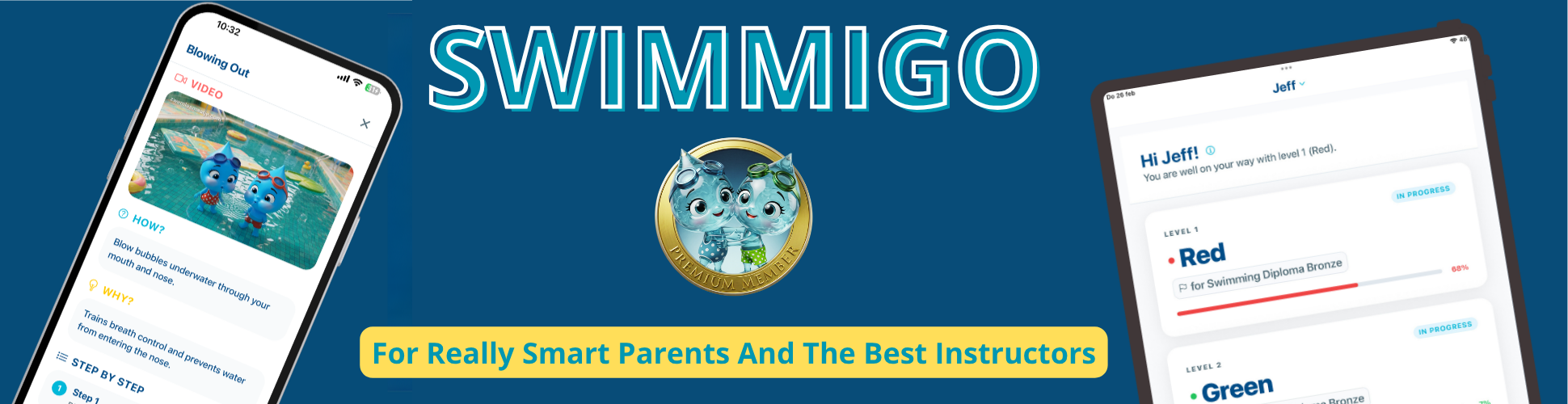
With Swimmigo, you track these milestones per skill. The app uses a 7-color level system (Red to Gold) with a total of 86 skills, many directly related to water safety. This way, you know exactly where your child stands without waiting for a parent-teacher meeting or report.
Open Water: Sea, Lake, and River
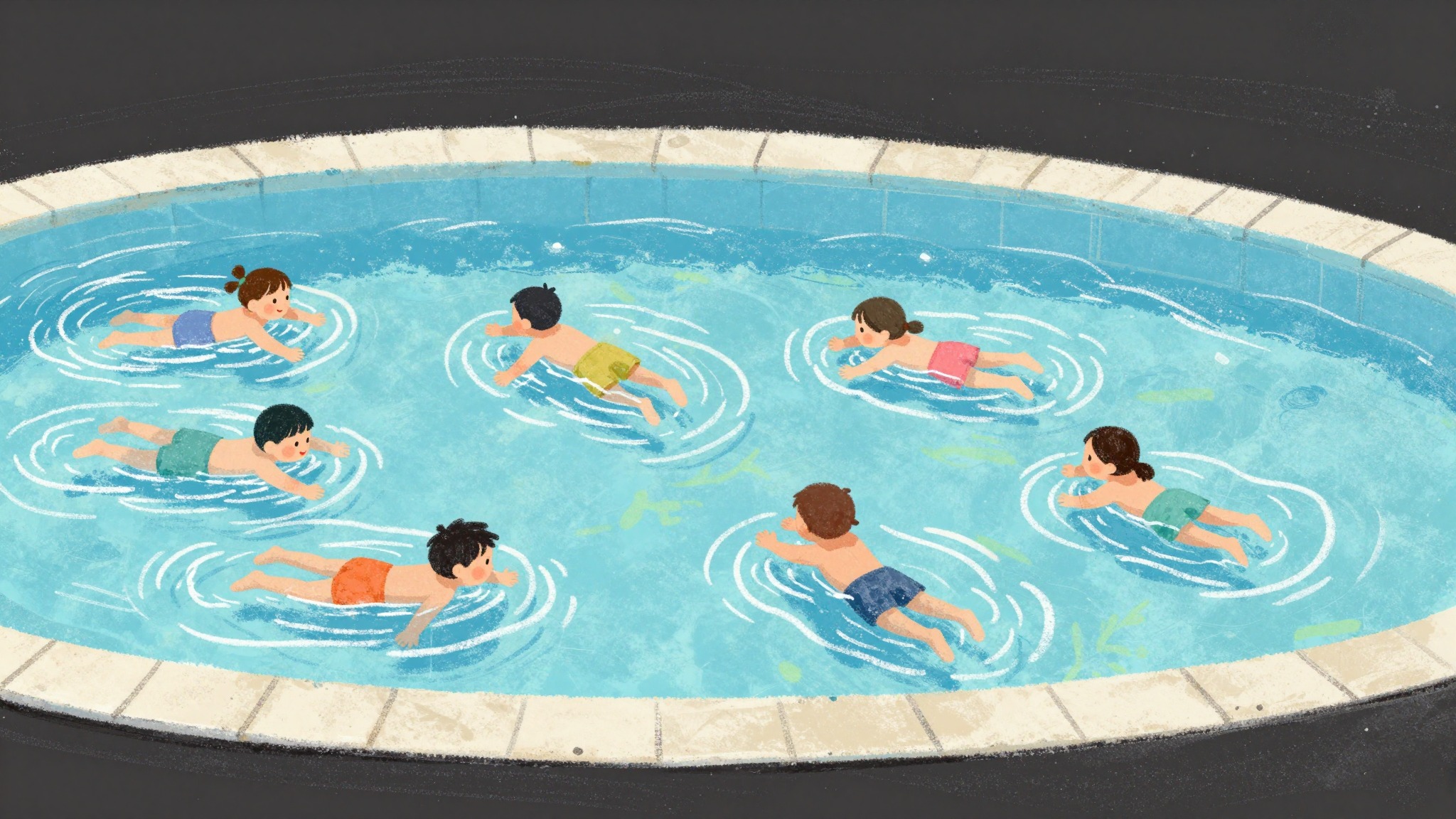
The swimming pool is a controlled environment: clear water, a flat bottom, no current, and supervision at the edge. Open water is completely different. Currents, tides, temperature differences, poor visibility, and unexpected depths make open water unpredictable. Even a child with a B or C diploma can get into trouble in open water.
Differences Between Pool and Open Water
In a pool, you see the bottom and know the depth. In a lake or river, the water is murky or dark. Your child cannot see the bottom and is startled by the depth. Currents in rivers are often stronger than they appear: a branch floats calmly on the surface while a strong undertow may be present underwater. The sea has tides, rip currents, and sudden waves that can surprise a child.
Temperature is an underestimated factor. In Dutch outdoor waters, the water rarely warms above 20 degrees Celsius even in summer. After 10 to 15 minutes, a child cools down: muscles stiffen, breathing speeds up, and reaction time decreases. Hypothermia starts faster than most parents think.
Currents, Tides, and Hypothermia
Rip currents are the main cause of drowning at sea. A rip current is a strong seaward flow that forms between sandbanks. Even good swimmers cannot swim against it. Teach your child not to panic in a rip current but to swim parallel to the shore until the current weakens. This seems counterintuitive, as the child wants to return to shore, but it is the only way out of a rip current.
In lakes and ponds, cold water is the biggest enemy. Especially in deep ponds, the temperature can drop dramatically per meter. An unexpected cold shock causes reflexive breathing that leads to water entering the lungs. Always let children enter the water calmly, not jumping or diving into unknown water.
Vacation Tips for Water Safety
Supervision tends to relax on vacation. The pool at the holiday home is not fenced. The beach has no lifeguard. The hotel pool is deeper than at home. A few simple rules make the difference:
- Assign one adult as 'water watcher' who actively supervises, not half-looking at a phone
- Check water depth, bottom structure, and presence of rescue equipment upon arrival at the holiday destination
- Let children swim where a lifeguard is present, and still watch yourself
- Always use a certified life jacket in open water, not inflatable armbands that can deflate or slip off
- Agree that your child never swims alone, even if they already have a diploma
How Technology Helps with Water Safety
Water safety is about knowledge, supervision, and skills. Modern technology makes it easier than ever to gain insight into your child's swimming ability. Where you used to rely on a semi-annual parent meeting, you now see in real time the steps your child is taking.
Viewing Real-Time Progress as a Parent
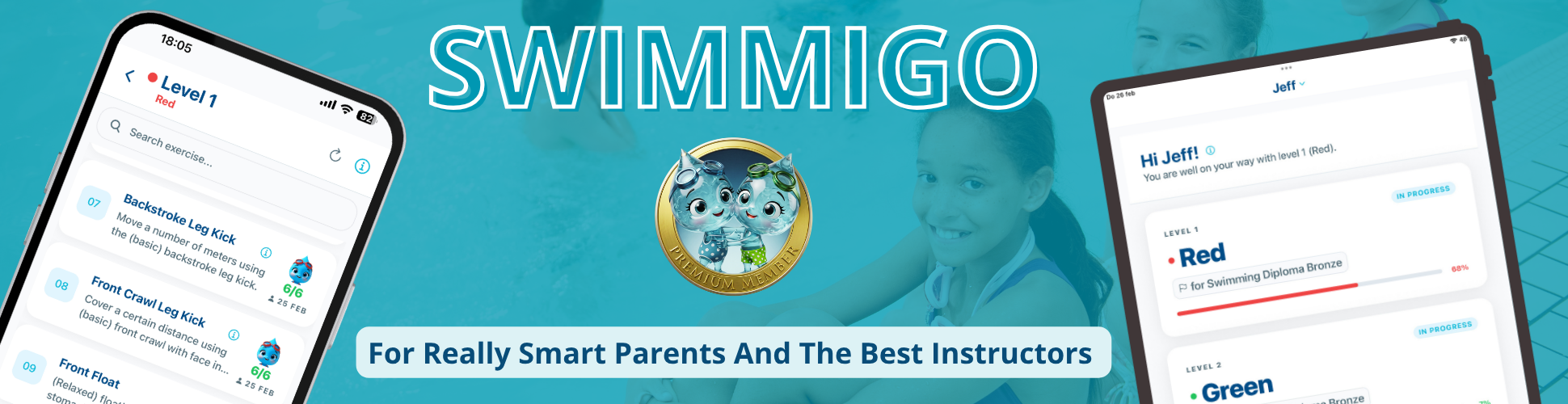
With Swimmigo, you as a parent get immediate insight into your child's progress via a personal dashboard. You see per exercise, from water treading to swimming underwater, whether your child masters the skill. The 7 levels (Red to Gold) with 86 skills are transparent: you understand exactly where your child stands and what the next step is.
This insight is more than a report. It enables you to practice purposefully at home. Know that your child still struggles with floating on their back? Practice it together in shallow water during a family outing. See that the breaststroke is not yet smooth? Ask the instructor for extra attention. You as a parent are no longer a spectator but an active partner in the swimming journey.
Swimming Levels and What They Really Mean
The National Swimming Diplomas (A, B, C) in the Netherlands are an internationally recognized system consisting of a progression from basic skills to self-reliance in various water situations. The A diploma focuses on safe movement in a swimming pool. The B diploma adds skills such as swimming longer distances and rescuing yourself in deeper water. The C diploma, also called 'water safe,' includes situations with waves, currents, and clothing.
But advanced swimming trajectories also exist outside the Netherlands. In Australia, for example, a child often goes through 10 to 15 levels before being considered 'water safe.' In the United Kingdom, swim schools work with the Swim England framework with 7 stages. What all these systems have in common: they recognize that water safety is more than just swimming a few laps.
Swimmigo works with a universal 7-color level system that is internationally applicable, from the Netherlands to Spain and from Germany to France. The app is available in 5 languages (NL, EN, DE, FR, ES) and is used worldwide by swim schools. This means your child progresses according to a consistent system, regardless of where you live or go on vacation.
Conclusion
Water safety is not a one-time lesson but an ongoing process that begins with the first encounter with water and never really ends. Swimming lessons lay the foundation, but you only become truly water safe through experience, supervision, and continuous awareness. The statistics from WHO, CDC, and NRZ underline that drowning is a global problem that concerns every family, in every country and at every income level.
With tools like Swimmigo, you see exactly where your child stands and which safety skills still need attention. The combination of good swimming lessons, active parental supervision, and real-time insight through technology turns water from a source of fear into a place where your child moves with confidence and joy. Because ultimately, that is what it’s about: your child diving into the water safely, skillfully, and confidently, in any water and any country.
Discover for yourself how Swimmigo makes your child safer in the water. Check out the features or create a free account at swimmigo.com/instructors.
Frequently Asked Questions About Water Safety
Frequently Asked Questions from Parents
Frequently Asked Questions from Swim Schools
Sources
- WHO: Drowning Fact Sheet, 2025
- CDC: Drowning Prevention, 2025
- National Council for Swimming Safety (NRZ), consulted July 2026
- Red Cross: Water Safety, 2025
- CBS: Deaths by Drowning in the Netherlands, 2014-2023
- RoSPA: Garden Pond Safety, United Kingdom
- Royal Life Saving Australia: National Drowning Report 2024, 2024

Bob van Soest
As an expert in operating sports facilities (such as swimming pools) and developer of, among others, Swimmigo.com, I am passionately committed to making swimming lessons simpler, more fun and more insightful for parents, swimming instructors and everyone who wants to learn to swim.
Frequently Asked Questions
Related articles
![Integrating Water Safety into Every Swimming Lesson: Practical Toolkit for Swim Instructors [2026]](/_next/image?url=https%3A%2F%2Fzvblogpostimages.s3.eu-west-3.amazonaws.com%2FAUTOMATISCH_UPLOAD%2F1_0e5feb460a4e.jpg&w=3840&q=75&dpl=dpl_FEcJLWFaZFj4CsT2F159aPzMcoRK)
Integrating Water Safety into Every Swimming Lesson: Practical Toolkit for Swim Instructors [2026]
10 concrete water safety exercises for every swim instructor. From floating with clothes on to buddy checks: build life-saving reflexes in swimming lessons.
![Water Safety on Vacation: How to Keep Your Child Safe in Open Water, in Any Country [2026]](/_next/image?url=https%3A%2F%2Fzvblogpostimages.s3.eu-west-3.amazonaws.com%2FAUTOMATISCH_UPLOAD%2F1_780f0a54801b.jpg&w=3840&q=75&dpl=dpl_FEcJLWFaZFj4CsT2F159aPzMcoRK)
Water Safety on Vacation: How to Keep Your Child Safe in Open Water, in Any Country [2026]
How do you keep your child safe in open water on vacation? Learn to recognize dangers of the sea, lake, and river, discover international warning systems, and check your water safety checklist.
![School Swimming Disappears: How to Ensure Your Child Still Learns to Swim [2026]](/_next/image?url=https%3A%2F%2Fzvblogpostimages.s3.eu-west-3.amazonaws.com%2FAUTOMATISCH_UPLOAD%2F1_951649b9ec15.jpg&w=3840&q=75&dpl=dpl_FEcJLWFaZFj4CsT2F159aPzMcoRK)
School Swimming Disappears: How to Ensure Your Child Still Learns to Swim [2026]
School swimming is disappearing from more and more municipalities. Here's how to ensure your child learns to swim safely and how you can track their progress yourself, even without school swimming.
Discover Swimmigo
The all-in-one app for swimming lesson progress. For parents, swim schools, and adult swimmers.