Teaching Your Child to Swim Yourself and Practicing at Home: Is It Possible Without Swimming Lessons?
Summary
- Becoming water confident and practicing basic skills can be done by any parent, at home and in the pool.
- Truly learning to swim according to a national standard belongs to a certified swim school; a home diploma does not exist.
- Self-practice works best in short sessions, aligned with the lesson material and always within arm’s reach.
- In the Netherlands swimming lessons are not legally regulated; choose a school with an NRZ license for the national swimming diplomas.
- With the seven levels and 86 skills in the free Swimmigo app, parents see exactly what their child needs to practice at home.
Your child is on a waiting list, the monthly price of swimming lessons adds up, and on social media you see parents claiming their child swims after six weeks without school. The thought quickly arises: can I just teach my child to swim myself? And conversely: maybe as an adult you want to learn to swim yourself but don’t dare to join a group lesson. In both cases, the question is the same: how far can you really get without swimming lessons?
The short answer: further than you think, but not as far as you hope. Becoming water confident, getting used to water, and practicing many skills can be done perfectly by a parent, at home and in the pool. Truly learning to swim is different from sitting in the water without fear, and a swimming diploma is different from being able to survive in a pool. What self-learning to swim does and does not entail, which exercises are proven effective, and how to combine self-practice with swimming lessons, you will read below.
Can you teach your child to swim yourself?
Yes, partly, and that part is bigger than many parents think. Everything related to water familiarization and basic skills you can do yourself as a parent, provided you approach it safely and playfully. The part you cannot do yourself is delivering a water-safe child according to a national standard, because that involves a diploma, an exam, and years of experience.
What you as a parent can do yourself: becoming water confident
Being water confident means a child feels comfortable in and under water: eyes open underwater, blowing bubbles, floating, jumping, righting themselves. This is not magic but play and repetition. Parents who regularly go into the pool with their child from a young age see their child progress much more easily through the first swimming lesson phases later. Swim schools recognize this immediately: children who are already water confident can start lessons directly with real skills instead of having to spend months overcoming fear and adjustment.
You can start this part at home long before your child is ready for swimming lessons. Showering without fear, getting the head wet, playing in a toddler pool, singing songs while water goes over the face. It sounds simple and it is, but it is the foundation on which a swim school later builds.
What you cannot do yourself: a diploma and lifesaving swimming
Here the honest story becomes important. A swimming diploma is not a certificate of 'can swim a lap', but a set of demonstrated skills that together form swimming safety: entering water, diving, floating, swimming for a certain time, swimming with clothes on, resting in deep water. This is assessed by an examination committee, not a parent standing by the poolside with the best intentions.
Moreover, in the Netherlands swimming lesson offerings and diploma issuance are not yet legally regulated. Anyone can offer swimming lessons and issue their own diploma. There is a bill, the Swimming Skills Act, to change this and legally anchor the national swimming diploma, but as long as that law is not in place, parents must choose critically themselves. The National Council for Swimming Safety issues licenses to swim schools that work according to national requirements and are allowed to issue the National Swimming Diplomas. A school without that license can teach well but cannot issue a nationally recognized diploma. Always check this before enrolling your child.
Why 'giving swimming lessons yourself' often fails
The reason many parents stop practicing themselves is not lack of love or time, but lack of structure. A professional swimming lesson has a build-up: each skill builds on the previous one, and an instructor sees which skill is not yet automated. Without that structure, noise arises: your child does a bit of everything, learns bad habits that are hard to unlearn later, and after a few weeks you no longer know what you are actually doing. Practicing without a goal feels after a while like swimming without direction, and then most families drop out.
Learning to swim yourself without lessons: how does it work in phases?
Whether you want to teach your child to swim or learn to swim yourself as an adult, the build-up is the same worldwide. First, the body must get used to water, then floating and breath control, and only then follow the swimming strokes. This order is not a Dutch invention but the core of swim education in every country, and it applies to children and adults.
Phase 1: becoming water confident
This phase is all about trust: head underwater, eyes open, blowing bubbles, going down and up, playing in shallow water. A child afraid of water does not learn to swim, no matter how good the exercises are. That is why this phase is mainly play: diving for objects, walking through the water like a crocodile, making rain with hands. Anyone who skips this phase and wants to learn strokes immediately builds on quicksand.
Phase 2: floating and breath control
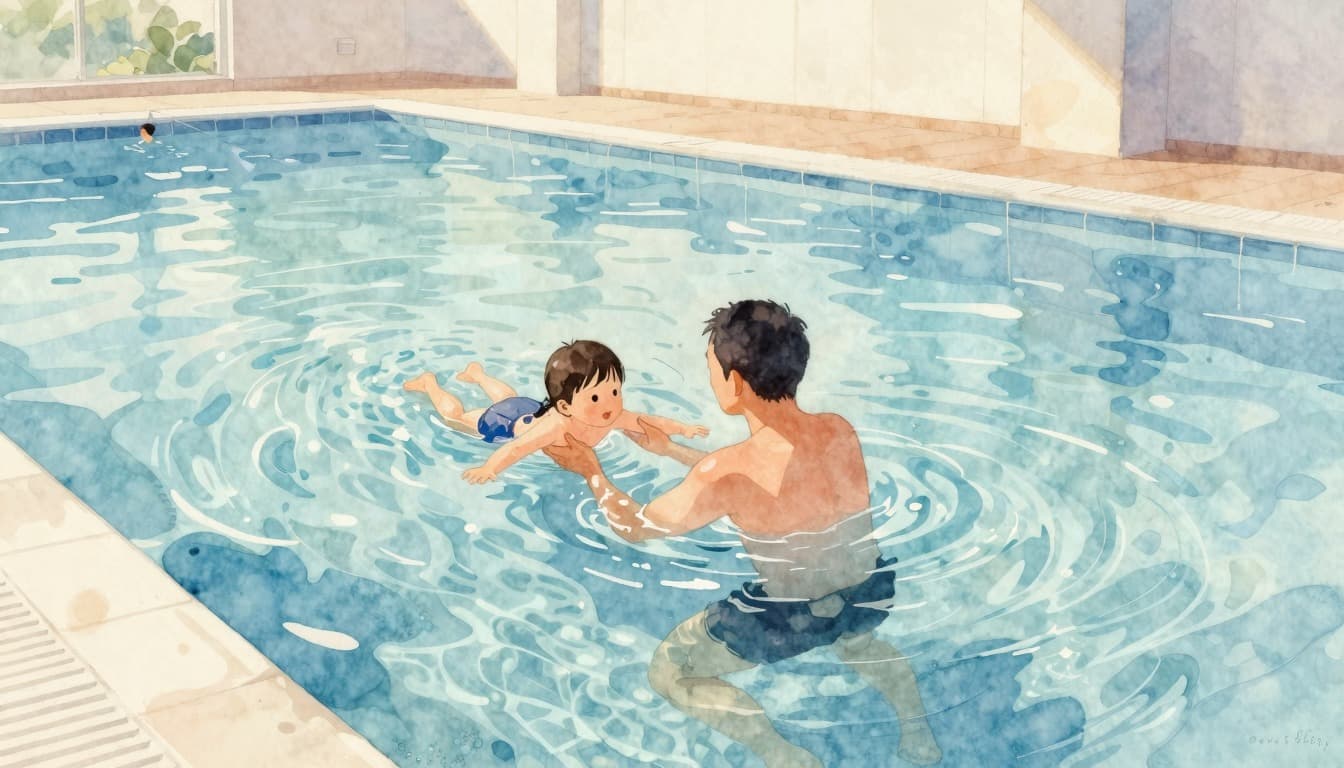
Floating is the basis of all swimming strokes. Whoever can float on their back can always breathe and never panics. Whoever can float on their stomach can then add legs and arms without drowning in their own movements. Practice this calmly and without time pressure: first with help of a hand under the back, then alone, then with movements added. Breathing is the second foundation here: exhaling underwater, turning the head for air, maintaining a calm rhythm. For children this works best through games, for adults through clear small steps.
Phase 3: from skills to swimming strokes
Only when floating and breathing become automatic are legs and arms added. First one movement at a time, then combined, then over increasingly longer distances. Whether your child learns freestyle, breaststroke, or a combination depends on the swim school’s method; other countries have different traditions. The underlying skills are identical everywhere. A handy rule of thumb for home: a child can only learn a stroke if they can float relaxed for ten seconds, otherwise all energy goes to survival instead of technique.
Swimmigo · Swim lesson app
Free for parents
Follow your child's swimming progress, see where you stand and report absences in the app.

Practicing swimming lessons yourself: exercises that work at home and in the pool
You can practice swimming lessons yourself in two places: at home without water and in the pool. At home you mainly train breathing, rhythm, and self-confidence. In the water you train floating, floating with movement, and the first skills. Both are valuable as long as you practice in short sessions and aligned with what the swimming lesson requires.
Dry practice without water
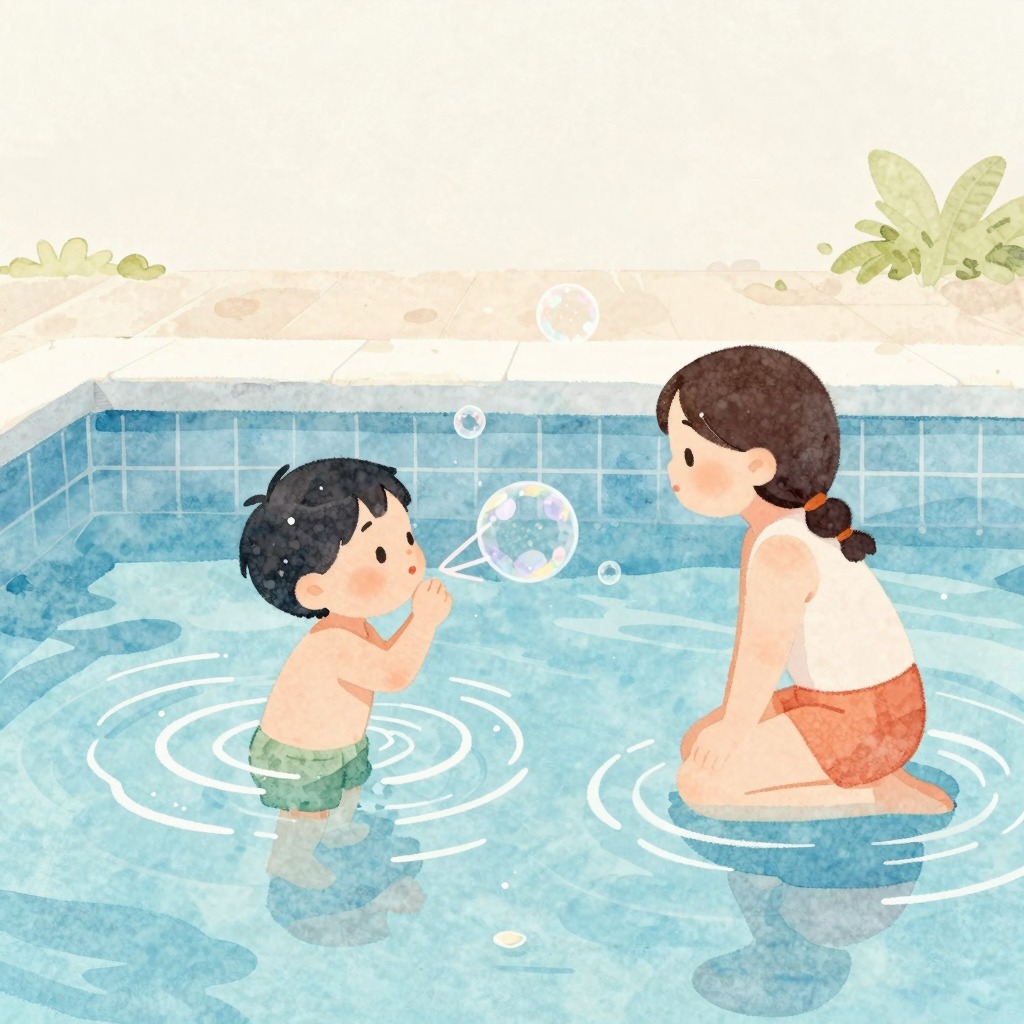
At home you can achieve quite a lot without a drop of water. Have your child lie on the floor and imitate the leg movement of freestyle, rhythmically and without bending the knees too much. Let them rotate arms as if wading through water. Blow bubbles together in a basin or during bathing. Practice exhaling underwater by first blowing out above water as if blowing out a candle and then repeat that in the bath. These dry exercises seem simple but ensure the body already knows the movements before water is involved, which saves a huge amount of panic and chaos in the real pool.
In bath and pool: game forms that really work
In the water the rule is: the more play, the more repetition. Exercises that work and that you as a parent can safely guide:
- Blowing bubbles and looking underwater: whoever blows bubbles the longest or collects the most toys from the bottom wins.
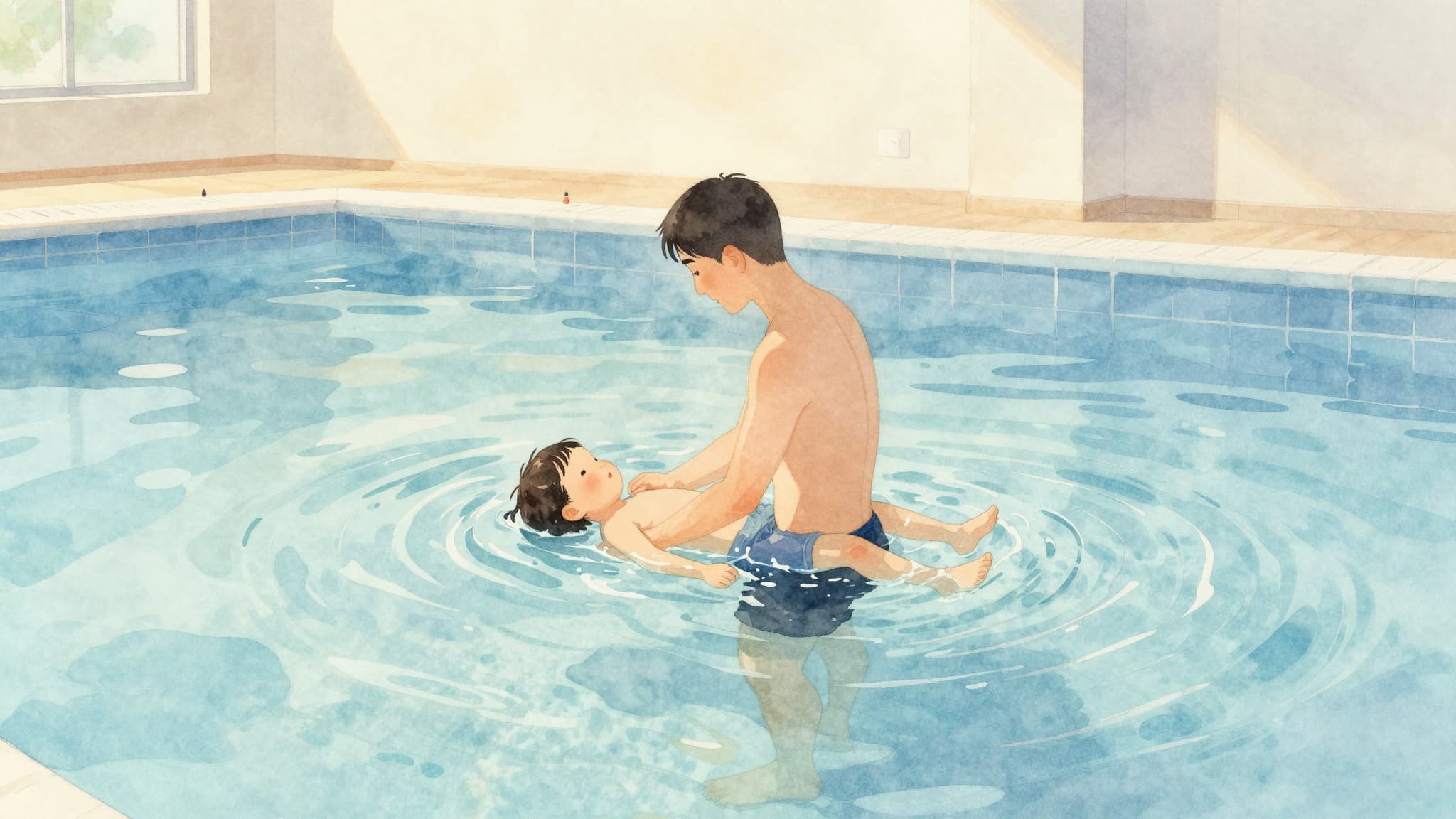
- Floating like a starfish on the back: first with your hand under the back, then increasingly longer alone.
- Jumping from the edge and righting yourself again: the basis of self-rescue in shallow water.
- Floating on the stomach with the face in the water and then exhaling calmly: the precursor to every stroke.
- Swimming short distances between you and the edge, with a diving ring or a high five as a reward at the end.
Keep each practice session short: ten to fifteen minutes is enough for young children. Always stop before the child has had enough, because a child who has to leave the water crying will be less motivated next time. Repetition beats duration: three times a week for fifteen minutes beats one long afternoon per month.
How often should you practice for results?
Swim schools see the same every week: children who practice at home or in the pool besides their lessons pick up new skills faster and maintain their level better. One or two extra moments per week, outside the lesson, is enough to make a noticeable difference. The most important thing is that the practice matches the lesson material: ask the instructor what your child is working on and practice exactly that one skill instead of trying everything randomly.
Safe practice: the rules that really matter
Safety comes first, and especially with self-practice drowning is the risk nobody sees coming. Children drown silently and quickly, even in shallow water and even if other people are nearby. The rules are simple: always stay within arm’s reach of a child who cannot swim, never leave a child alone in the bath or pool, not even for a moment, and never rely on flotation aids as a rescue device. Swim bands and arm floats give children a false sense of security and can even be dangerous; a child who always relies on bands never learns how water really feels. Choose consciously which aid you use when and know what each aid can and cannot do.
What a good swim school adds that you cannot
Everything above you can do yourself, but it is no replacement for swimming lessons. A good swim school adds three things that are structurally missing at home: a national standard, an independent eye, and a complete learning path.
A diploma with national standards
The numbers show why that matters. According to the Mulier Institute, in 2024 about 14 percent of children aged 6 to 12 had no swimming diploma at all, roughly four children per class of thirty. In the lowest income groups that number is much higher at 33 percent than in the highest, where 5 percent do not obtain a diploma. Worldwide drowning is the fourth leading cause of death among children aged 1 to 4 and the third among children aged 5 to 14, with an estimated 300 thousand deaths per year, reports the World Health Organization. The number of drownings decreased worldwide by 38 percent between 2000 and 2021, but children under 15 still bear almost half of the global drowning burden, according to the WHO global drowning prevention report. In the Netherlands, 100 residents drowned in 2025, and in the past ten years the average was 93 per year, mostly in open water, reports the CBS. These are not numbers to scare with, but to show that swimming safety is not a home project: it is a skill with life-saving consequences.
An instructor who really sees your child
An instructor sees in half an hour what you overlook in a month: a crooked arm position, breathing that comes just too late, a child who acts brave but is secretly scared. That independent view is exactly why a swim school adds value. A parent wants the child to be proud and have fun; an instructor also wants every movement to be correct, because a mistake ingrained early costs months to unlearn later. If in doubt, feel free to ask what your child is working on and why. A good swim school can explain that clearly, and the bad ones cannot, and that distinction is worth gold to you as a parent.
Progress you as a parent can simply follow
The old days, when your child after half a year said 'probably did something new again', are fortunately over. More and more swim schools work with an app in which every skill is tracked. In Swimmigo for example, swim schools work with seven levels and 86 concrete skills, and parents see after every lesson exactly which exercises their child already masters and what the next step is. That suddenly makes self-practice very concrete: you no longer have to guess what to do at home because you just see it. The app is free for parents and works in five languages, also for families who have just arrived in the Netherlands and do not speak a word of Dutch yet.
This is how you make sure your child practices the right things
Targeted practice beats a lot of practice. A child at level three who has just learned to float gains nothing from an afternoon practicing breaststroke at the edge. They benefit from twenty minutes of back floating, blowing bubbles, and short pieces of stomach floating with exhaling. How do you know what the next step is? By following your child’s progress in the swim school’s app or simply by asking the instructor every few weeks.
For parents: from 'just doing something' to targeted practice
In Swimmigo you as a parent see per level which skills there are and which your child already masters. Suppose your child has completed all exercises of level two and now has to work on back floating: then you know you don’t have to swim laps at home but should playfully work on floating on the back, in the bath and in the pool. This way every free swim on the weekend automatically becomes an opportunity for targeted practice without it feeling like extra lessons. After a holiday or break, you also immediately see if any skills have slipped and can refresh those before lessons start again.
For swim schools and instructors: make parents home coaches
This principle also works the other way: a swim school that gives parents insight into progress gets free home coaches. Parents who see their child still needs to practice three skills for the next level will naturally start working on those. It also prevents the classic poolside annoyance: parents practicing against the lesson material and confusing children. Whoever gives parents the same language and levels as instructors use ensures everyone swims in the same direction. Swimmigo is built for this: instructors track progress, parents watch along and practice targeted at home, and the school keeps overview in one system.
Can adults learn to swim themselves?
For adults too: getting used to water and practicing yourself is possible, becoming a water-safe swimmer yourself is another story. Many adults who never learned to swim mainly suffer from fear and shame, and those do not disappear by struggling alone in a pool. A good approach for adults is a combination: a few lessons with an instructor experienced with adult beginners to build the basics and confidence, and self-practice in between to automate the skills. For a complete step-by-step plan, read the overview of swimming lessons for adults, which also addresses fear, performance anxiety, and the choice between group and private lessons.
Common mistakes in self-practice and how to avoid them
Self-practice is good, but a few common mistakes can negate the effect. These are the biggest:
- Starting swimming lessons while the child is not yet water confident. Solve that first with play and familiarization, otherwise lessons become a weekly battle.
- Swimming with bands as standard. A child who always relies on flotation aids does not develop a water feel and learns a wrong body posture.
- Practicing against the lesson material. Ask what the next skill is and practice exactly that instead of running your own program.
- Too long and too little. Weekly marathons don’t work; short, regular sessions do.
- Continuing despite fear or resistance. A child who cries or an adult who tenses up learns nothing. Stop, do something fun in the water, and try again next time.
- Not tracking progress. Without overview no one knows where you stand, and motivation disappears. A simple overview of skills, in an app or on paper, keeps everyone sharp.
The golden rule is simple: practice along with the lesson, not against it, and always refer doubts to the instructor. Those who do this can make the difference between waiting a year or a year and a half for the diploma with just a few fifteen-minute sessions per week.
Swimmigo · Swim lesson app
Free for parents
Follow your child's swimming progress, see where you stand and report absences in the app.
Sources
- Mulier Institute: more and more children in the Netherlands obtain all three swimming diplomas, swimming skills of vulnerable children lag behind, consulted September 2026
- CBS: higher risk of drowning among children not born in the Netherlands, July 2026
- Eerste Kamer: initiative proposal Dobbe, Swimming Skills Act, under consideration 2026
- World Health Organization: Global status report on drowning prevention 2024, December 2024
- World Health Organization: fact sheet drowning, consulted September 2026
- VeiligheidNL: all about swimming lessons, consulted September 2026

Bob van Soest
As an expert in operating sports facilities (such as swimming pools) and developer of, among others, Swimmigo.com, I am passionately committed to making swimming lessons simpler, more fun and more insightful for parents, swimming instructors and everyone who wants to learn to swim.
Frequently Asked Questions
Related articles
Teaching Your Child to Float: How to Do It in Small Steps
Floating is the foundation of every swimming stroke. With this step-by-step plan, you will teach your child to float on their stomach and back, safely and playfully, at home or in the pool.
Swimming Diploma in Two Weeks: Does Turbo Swimming Lesson Really Work?
Turbo swimming lessons or holiday courses: can your child get a swimming diploma in two weeks? This is what an accelerated program looks like, what it costs, and for whom it works.
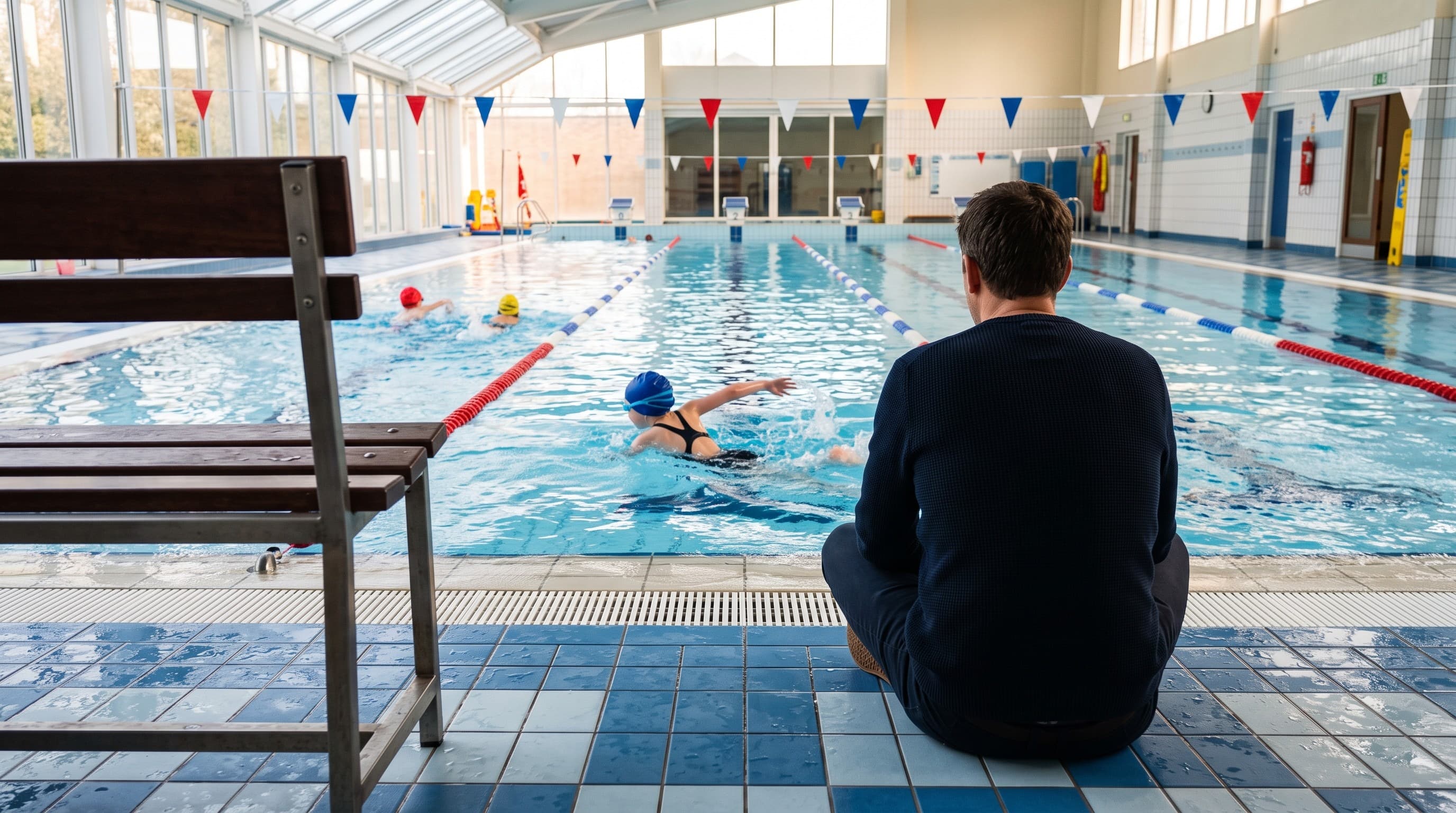
Teaching Your Child to Swim When You Can't Swim Yourself: What You Can Do
Your child goes to swimming lessons while you cannot swim yourself. This is how you follow the progress, practice at home, and arrange supervision without entering the water.
Discover Swimmigo
The all-in-one app for swimming lesson progress. For parents, swim schools, and adult swimmers.