Complete Overview of Adult Swimming Lessons: Learning to Swim at a Later Age [2026]
![Complete Overview of Adult Swimming Lessons: Learning to Swim at a Later Age [2026]](/_next/image?url=https%3A%2F%2Fzvblogpostimages.s3.eu-west-3.amazonaws.com%2FAUTOMATISCH_UPLOAD%2F1_7d236bfb1ff6.jpg&w=3840&q=75&dpl=dpl_HNfPD3TqcZ6YivYMd3CXCgSrAu42)
Summary
- In the Netherlands, 10 percent of 20 to 54 year olds do not have a swimming diploma, and worldwide around 300,000 people drown annually, including adults.
- Group lessons for adults cost around 39 euros per month in 2026; the median of four providers studied is 38.80 euros.
- In the Netherlands, anyone can give swimming lessons, so choose a provider with the NRZ National Swimming Diploma License.
- Adults often pick up technique faster than children; fear and shame are the biggest obstacles, not the ability to learn.
- Even as a parent, you can still learn to swim; your child sees your example and you track your own progress with the free Swimmigo app.
You are not the only one who cannot swim as an adult. In the Netherlands, 10 percent of people between 20 and 54 years old do not have a swimming diploma, and among 65 to 79 year olds, that is even 40 percent. In England, one in three adults cannot swim 25 meters. Yet it often feels like everyone around you can, which makes the step to swimming lessons bigger than it actually is.
This overview is for everyone who wants to learn to swim as an adult, whether because you never learned it before, because you have aquaphobia, or because you have children who swim and you don’t want to just sit on the sidelines. You will read what adult swimming lessons cost, how long they take, what to look for when choosing a provider, and how to take the first step.
Why Many Adults Cannot Swim
Not being able to swim as an adult is not uncommon; it is a worldwide phenomenon. The reasons differ per person and per country, but the pattern is recognizable everywhere.
Worldwide Figures
The World Health Organization (WHO) estimates that around 300,000 people drown annually. Drowning is one of the leading causes of death from unintentional injury, and 92 percent of those drownings occur in low- and middle-income countries. Men are more than twice as likely to drown as women. At the same time, there is good news: since 2000, the number of drownings has decreased by 38 percent. Learning to swim works, and it is never too late to start.
Figures in the Netherlands
Even in a water-rich country like the Netherlands, the figures are persistent. According to the National Council for Swimming Safety (NRZ), 10 percent of 20 to 54 year olds do not have a swimming diploma, and among 65 to 79 year olds, that is 40 percent. The most recent CBS figures for 2025 show that last year 132 people drowned in the Netherlands, of whom 100 were residents. Three quarters of them were men, and people over 60 form the largest group of victims.
Why It Didn’t Happen Earlier
Most adults who cannot swim have a concrete reason for it. Sometimes school swimming disappeared before it was their turn. Or there was no money for swimming lessons at home, or the nearest swimming school was too far away. People who grew up abroad often come from countries without a swimming culture and end up here in a country where water is everywhere. And sometimes there simply was never anyone to take them along. None of these reasons say anything about you as a person, and all of them can be solved.
Why Swimming Is Worth It
Safety for Yourself and Your Family
Swimming is primarily a safety skill. Those who cannot swim face a much greater risk if they unexpectedly end up in water. In the Netherlands, most drownings happen to adults, not children, and many of those accidents occur in open water. Learning to swim reduces that risk in every situation: in a pool, at the beach, on a boat, or along the canal bank.
Good for Body and Mind
Swimming is also one of the few sports that trains your entire body without stressing your joints. It improves your fitness, muscles, and lungs, and the WHO recommends adults to engage in at least 150 minutes of moderate-intensity physical activity per week. Swimming counts fully towards that. Additionally, many adults who learn to swim notice their self-confidence grows, not only in the water but also outside of it.
Swimmigo · Swim lesson app
Free for parents
Follow your child's swimming progress, see where you stand and report absences in the app.

Learning to Swim as an Adult: How to Approach It
Step 1: Choose a Provider with the NRZ License
In the Netherlands, in principle anyone can give swimming lessons and issue swimming diplomas. That sounds nice, but it also means quality varies greatly. Therefore, choose a swimming school with the National Swimming Diploma License from the NRZ. Such a provider works with a fixed lesson plan, certified instructors, and recognized diplomas, and is monitored for quality.
Step 2: The Intake and Your Level Group
Most swimming schools start with an introduction or intake. You tell what you can do, what scares you, and what you want to achieve, and the instructor places you in a group that fits your level. In a beginner group for adults, everyone is in the same boat: people who never learned to swim, people who once could but have forgotten, and people with aquaphobia.
Step 3: What You Learn During the Lessons
Adult lessons usually follow the same structure as the Zwem-ABC for children: first floating and treading water, then breaststroke and backstroke, and eventually swimming with clothes on. That last part is important because in a real emergency you won’t be wearing a swimsuit. Sport in Tilburg practices with clothes from the start, precisely to build that confidence.
Group Lessons, Private Lessons, or Women-Only Lessons
Most adults start in a group, which is also the most affordable option. Those who want to progress quickly or have a lot of fear can better take a few private lessons to get used to it and then switch to a group. Some swimming schools also offer lessons exclusively for women, often in a quiet pool and with a female instructor. For many women, that is exactly the push needed to start.
What Do Adult Swimming Lessons Cost in 2026?
Prices for adult swimming lessons vary by municipality and provider. Group lessons for adults cost around 39 euros per month in 2026. The median of the rates below is 38.80 euros per month; this is the middle amount when all prices are lined up, giving a fairer picture than the average because a single expensive provider can quickly raise the average.
Price Comparison
| Provider | Type of Subscription | Price per Month |
|---|---|---|
| Municipality of The Hague | Monthly subscription, 18 years and older | 31.60 euros |
| Sport in Leiden | Adult swimming lessons, per 4 weeks | 35.50 euros |
| Sport in Tilburg | Adult swimming lesson subscription | 42.10 euros |
| Optisport Almere, De Vrijbuiter | Adult swimming lessons, 1 month | 67.00 euros |
| Median | Group lessons for adults | 38.80 euros |
All amounts come from the official rate pages of the providers. The Hague publishes its rates for 2026; the others index their prices annually. Always check the current rates with the provider near you, as the differences are large.
What the Costs Consist Of
Besides the monthly fee, many swimming schools charge one-time fees. The Hague charges 12.50 euros registration fee, Leiden 16.90 euros, and Tilburg charges 20 euros administration costs. The exam for a diploma costs 17.50 euros per diploma at Sport in Leiden. Also consider swimwear and goggles; expensive equipment is not needed for most lessons.
Financial Support if You Can’t Afford It
Can’t pay the lesson fees? There is help. The Adult Fund for Sport and Culture pays the lesson fees for adults living below or near the subsistence level, in cooperation with the NRZ. This is not an exceptional situation: more than a million people in the Netherlands cannot afford sports. Unfortunately, only 31 percent of municipalities have such a scheme, so check with your municipality what is possible.
How Long Does It Take to Learn to Swim?
It Depends on Three Things
There is no fixed number of lessons for adults. How quickly you learn depends on your starting level, how often you go per week, and whether fear plays a role. Someone who has never been in the water and also has aquaphobia logically needs more time than someone who used to swim but has forgotten.
A Realistic Expectation
The provider can give you a realistic estimate after the intake, because the pace depends on your starting point. Adults often pick up technique faster than children because they understand explanations better and can practice more purposefully. For convenience, expect a trajectory of several months up to about a year for the A diploma. More important than the number of weeks is that you keep going; those who go weekly always make progress.
Shame and Aquaphobia: The Mental Side
You Are Really Not the Only One
The same stories keep appearing on swimming forums and social media. Adults from 19 to well into their 60s write that they are ashamed to go to swimming lessons, that they are afraid of others’ looks, that they feel too old. The 43-year-old Helen Mbaziira from England told Swim England how she still learned to swim because she wanted to get into the water with her daughters. Her biggest obstacle was not the water but the fear of what others would think of her.
Aquaphobia Can Be Trained Away
Aquaphobia is not a character flaw; it is your body’s reaction to an unfamiliar environment. Instructors who work with adults specialize in this. The build-up goes step by step: first getting used to the water, then wetting your face, then floating with aids, and only then real swimming strokes. All at your own pace, without anyone rushing you.
How to Make the First Lessons Easier
A few practical things help enormously. Go to the pool early the first time so you can calmly get used to the environment. Honestly tell the instructor what you find scary; he or she has heard it many times before. And set small goals: this lesson my face underwater, next lesson floating one meter. Every lesson is a victory, even if it is small.
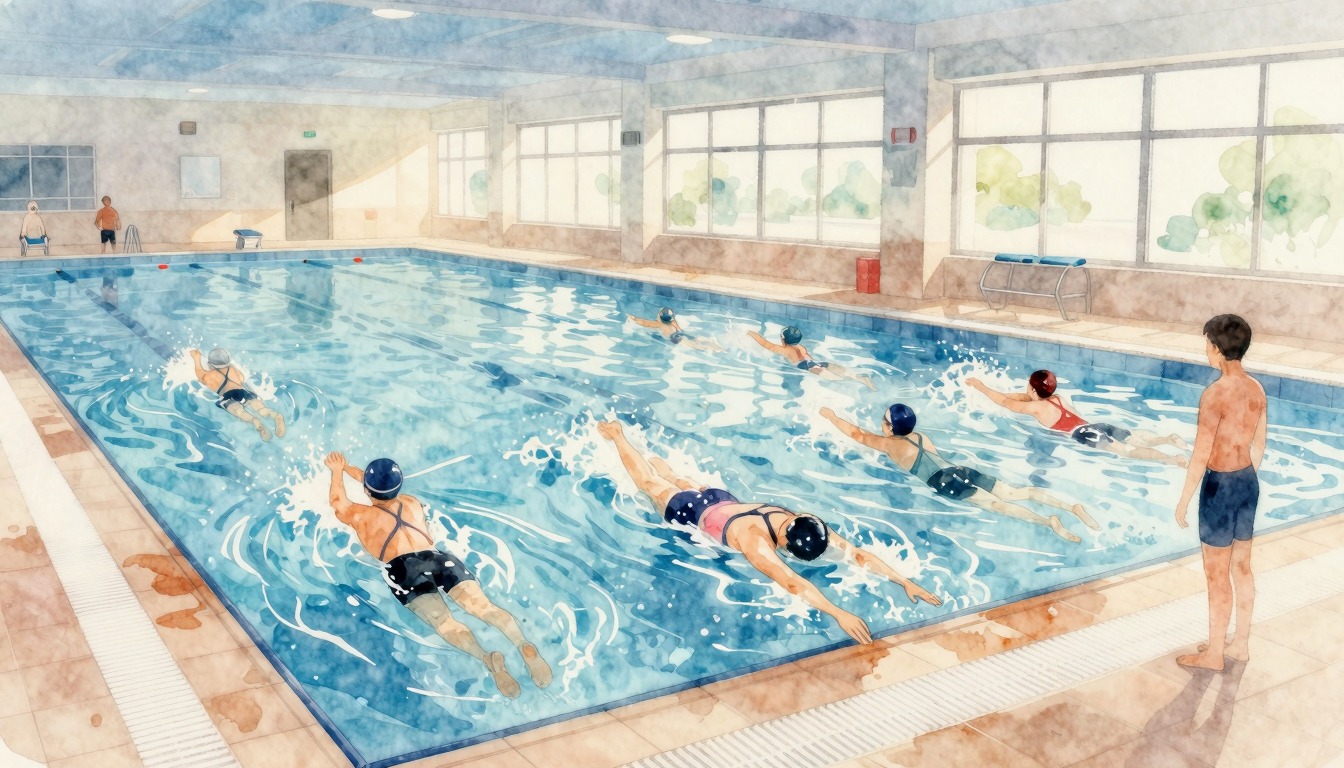
From Diploma to Open Water
A Diploma Is Not a Free Pass
A swimming diploma means you can save yourself in a pool. Open water is another story, and that applies to adults just as much as to children. NOS spoke with swimming coaches who train adults who have never swum in open water, even though they have their diplomas. Cold water, waves, no bottom under your feet: your body reacts differently than in a heated pool. In the Netherlands, 132 people drowned last year, and most open water accidents happen to adults.
How to Safely Get Used to Open Water
Build it up safely. Never go into the water alone, choose a calm day and a place with supervision, and use a life jacket or floatation aid at first. The basic rules are the same everywhere: don’t swim after drinking alcohol, don’t swim during thunderstorms, and don’t go further into the water than you can return. Those who obtain the C diploma have learned to save themselves in open water without current; for many adults, that is a nice end goal.
Even as a Parent, You Can Still Learn to Swim
The Example You Set
Children look up to their parents. If you stay on the sidelines because you don’t dare, children pick that up faster than you think. The opposite also works: parents who learn to swim themselves give their children the strongest signal that swimming is important. Many swimming schools offer simultaneous lessons for parent and child, or you simply arrange it in the same pool while your child is working on their B or C diploma.
Keep Track of Your Own Progress
The same applies to adults: what you track improves. With the free Swimmigo app, you keep track of your own progress or that of your children, with seven levels from red to gold and 86 skills spread over those levels. You see exactly what you have mastered and what the next step is, and each level comes with a free certificate. The app is available in five languages because not being able to swim or learning again is a problem in every country.
Want to know more? See how the seven levels of Swimmigo work, read what the app does for parents and instructors, or check out the student tracking system.
Learning to swim as an adult is not only possible; it is one of the best investments in your own safety you can make. It takes time and sometimes you have to overcome your shame, but with the right provider, a realistic budget, and a plan, you will make it. And who knows, maybe soon you will swim along with your children instead of sitting on the sidelines.
Swimmigo · Swim lesson app
Free for parents
Follow your child's swimming progress, see where you stand and report absences in the app.
Sources
- WHO: Drowning, factsheet, May 2026
- WHO: Physical activity, factsheet, accessed August 2026
- National Council for Swimming Safety: New CBS figures emphasize the importance of continued attention to swimming safety, July 24, 2026
- National Council for Swimming Safety: Financial support for adult swimming lessons, March 25, 2021
- All about swimming lessons: Adult swimming lessons, accessed August 2026
- Swim England: New statistics reveal more than 14 million adults in England cannot swim, October 22, 2019
- NOS: When people become anxious in the sea, they behave like a land animal, August 19, 2019
- Sport in Leiden: Swimming lesson costs, accessed August 2026
- Sport in Tilburg: Adult swimming lessons, accessed August 2026
- Municipality of The Hague: Swimming lesson costs, rates 2026, accessed August 2026
- Optisport: Adult swimming lessons, De Vrijbuiter Almere pool, accessed August 2026
- Adult Fund for Sport and Culture: Swimming safety for adults, NRZ and VWSC join forces, 2021

Bob van Soest
As an expert in operating sports facilities (such as swimming pools) and developer of, among others, Swimmigo.com, I am passionately committed to making swimming lessons simpler, more fun and more insightful for parents, swimming instructors and everyone who wants to learn to swim.
Frequently Asked Questions
Discover Swimmigo
The all-in-one app for swimming lesson progress. For parents, swim schools, and adult swimmers.