EardrumTubesandSwimmingLessons:CanYourChildJustGetintheWater?[2026]
![Eardrum Tubes and Swimming Lessons: Can Your Child Just Get in the Water? [2026]](/_next/image?url=https%3A%2F%2Fzvblogpostimages.s3.eu-west-3.amazonaws.com%2FAUTOMATISCH_UPLOAD%2F1_a1f22621c7b9.jpg&w=3840&q=75&dpl=dpl_GWyfLj8UVegbQ18STkVQms8Vj7LD)
Summary
- By age four, more than 80% of children have had glue ear at least once, and some of them get eardrum tubes.
- With tubes, your child may swim normally, even with the head underwater. Earplugs are rarely needed.
- In the first 10 to 14 days after surgery, no water may enter the ear, so no swimming lessons then. After that, the rule is lifted.
- Diving and deep underwater are best avoided, and with an ear discharge skip the lesson.
- What the swim school records in the student file determines whether your child continues where they left off after a two-week break.
An eardrum tube is a plastic tube about a millimeter in size, yet it can affect two weeks of your swimming lesson schedule. Children who get tubes are usually exactly at the age when they are taking swimming lessons. Parents hear three different pieces of advice during this period: no swimming at all, swimming with earplugs, or just continuing as if nothing is wrong. And the swim school faces the same question: what do you note in the file and what do you tell the parents?
Below is what the Dutch guidelines, research, and ENT practice say about tubes and water. This way your child does not unnecessarily stand still for weeks, and water does not enter the ear at times when it really should not.
Why children get eardrum tubes
Glue ear or recurring ear infections
Tubes come into play with two complaints. The first is glue ear, medically called otitis media with effusion: fluid behind the eardrum without an acute infection. Children hear worse because of this, sometimes for months on end. The second is a series of middle ear infections that keep recurring. The NHG Standard counts children with at least three infections in six months or four in a year in this group. In the first six months after surgery, children have on average two fewer ear infections, reports the OLVG, and with glue ear they almost always hear better immediately.
This happens to many children, not just a few
By the age of four, more than 80% of children have had at least one episode of glue ear, according to the NHG Standard Otitis media with effusion in children. The general practice sees most cases between 0 and 4 years, with about 17 new cases per thousand children per year. In half of the children, the fluid disappears spontaneously within three months, and in three quarters within six months. The group that has long-term problems is therefore a minority. It is precisely these children who get tubes.
What the tube does and how long it stays in
The ENT specialist makes a small incision in the eardrum, sucks out the fluid, and inserts a tube into the hole. This tube keeps the opening free so that fluid from the middle ear can drain and the air pressure behind it remains normal. The operation takes 10 to 15 minutes, is done under anesthesia, and your child goes home the same day. The tube naturally falls out after 6 to 12 months and grows out of the ear, usually without you noticing. Sometimes a second set is needed. In about 3 out of 100 children, the hole does not close afterward.
Swimming with tubes: what the advice says
The question that always comes up
ENT doctors write in the Dutch Journal for Ear-Nose-Throat Medicine that the swimming question almost immediately arises in the consultation room, precisely because the operation takes place at an age when children are learning to swim. The advice varies widely, from complete avoidance of water with earplugs to no precautions at all. Behind all these advices is the same assumption: water would enter the middle ear through the tube. In practice, this rarely happens, and even more rarely leads to an ear infection.
What Thuisarts tells parents
Thuisarts, the patient information from the Dutch College of General Practitioners, is short and clear. With eardrum tubes, your child may shower and wash hair. Your child can swim normally, even with the head underwater. Earplugs are not necessary when swimming, but if you or your child find them comfortable, they may be used. There are two exceptions: diving is better avoided because children with tubes can get dizzy, and with an ear discharge it is better not to swim.
The first two weeks after surgery are different
Immediately after the procedure, a stricter rule applies. The OLVG advises not to swim for the first 10 days so that the tube can properly attach to the eardrum. Other hospitals maintain 14 days. This is the only period during which swimming lessons really do not take place. After that, the restriction is completely lifted and your child swims just like any other child in the group.

What research shows about tubes and swimming
The meta-analysis of eleven studies
The NHG Standard refers to a meta-analysis of 11 studies on swimming with eardrum tubes. It found no difference in the occurrence of middle ear infections between children who swim, with or without ear protection, and children with tubes who do not swim at all. The conclusion in the standard is as brief as it is remarkable: there is no reason to discourage children with otitis media with effusion from swimming. Diving seems theoretically unwise, and swimming during an ear discharge is discouraged.
Earplugs: small effect, but discomfort
The Cochrane review on water protection with tubes includes two studies with a total of 413 children. In one study, children with earplugs had 0.84 ear infections per year instead of 1.2. In the second study, there was no difference between using or not using earplugs. The researchers call the evidence limited. The ENT doctors in the NTvKNO follow this line: earplugs and avoiding water provide hardly any extra protection and mainly cause costs, discomfort, and unrest among parents and children.
Why you may still hear different advice
International guidelines do not recommend standard swimming restrictions for children with tubes. Water protection can be considered by ENT doctors for children with recurring ear infections or when swimming in heavily polluted water. So if your ENT doctor or swim school says something different than the main line, it is not a mistake by either party. The difference lies in the assessment for this one child. If in doubt, ask what the advice means for your child: is submerging allowed, is jumping from the side allowed, and how long does the restriction apply?
When swimming really is not possible
| Situation | Can your child swim? | What helps |
|---|---|---|
| First 10 to 14 days after surgery | No, not even head underwater | Wait until the tube is attached to the eardrum |
| Ear discharge | No, better not | Ear drops from the doctor, then gradually build up again |
| Diving and deep underwater | Swimming yes, diving preferably no | Prevent dizziness caused by stimulation of the inner ear |
| Regular swimming lessons in chlorinated water | Yes, including submerging | Nothing extra needed, earplugs allowed but not required |
| Natural water, sea or lake | Yes, with extra caution | Choose official swimming water that is monitored |
An ear discharge
About half of the children with tubes get an ear discharge at some point: fluid comes out of the ear, usually without many complaints. The Pharmacotherapeutic Compass advises against swimming with an ear discharge, and this also applies to a dry eardrum perforation. The reason is not so much infection but dizziness: stimulation of the inner ear can make a child spin. Showering and bathing are allowed because almost no water enters the middle ear then. An ear discharge caused by tubes is treated with ear drops from the doctor.
Diving and deep underwater
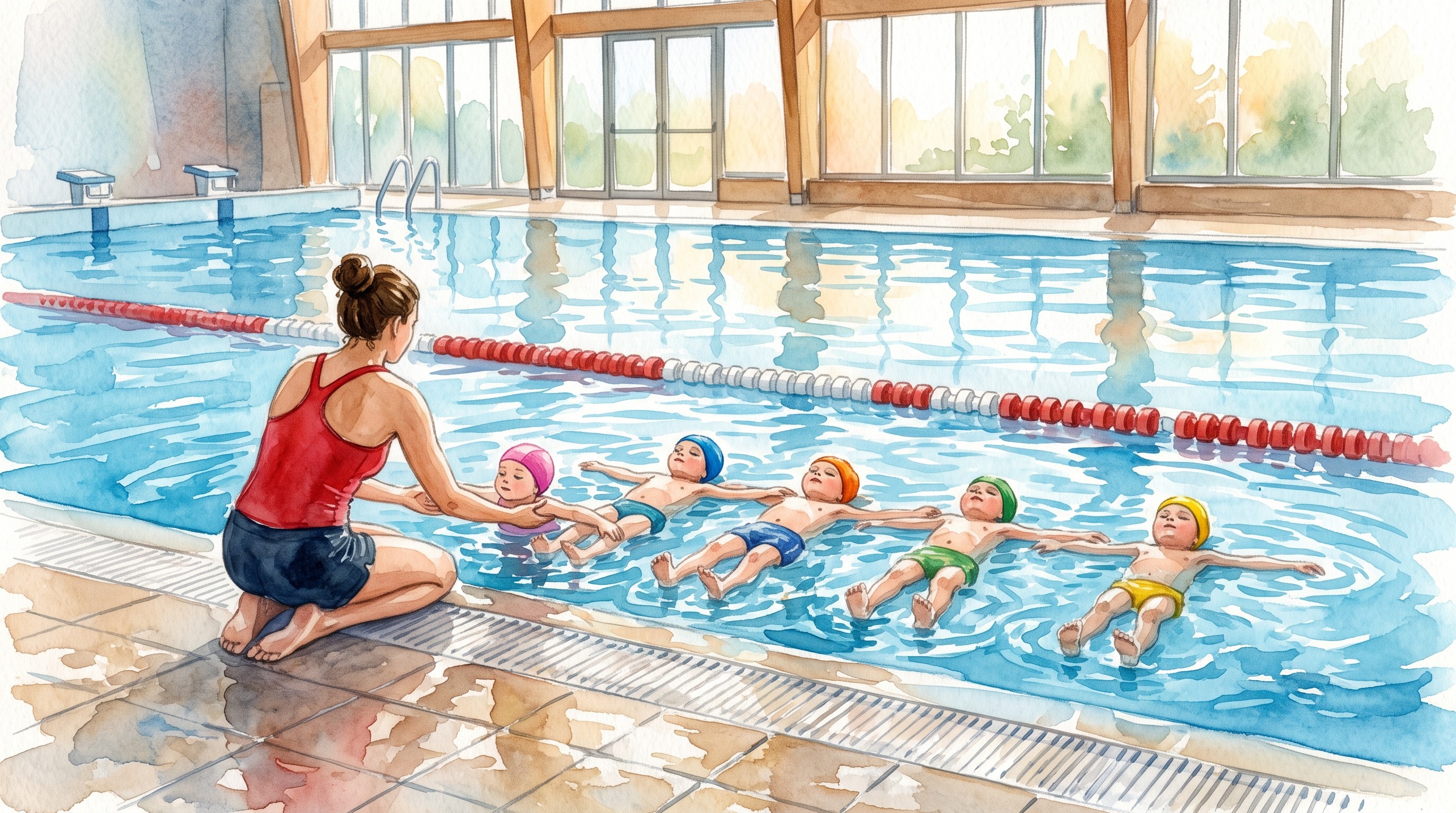
There are more diving moments in a swimming lesson than you as a parent might think: jumping from the side, through a hoop, submerging to retrieve an object. For a child with tubes, these are moments to skip. That does not mean the child does nothing during the lesson. The instructor can offer the same skill without the dive or let your child do an exercise on the side. Discuss it beforehand so you do not have to stay during the lesson.
Natural water, sea and vacation
In natural water, the risk lies elsewhere. The GGD writes that swimming in natural water can cause ear infections due to a bacterium found in fresh and salt water, with itching, ear pain, fluid discharge, and temporary hearing loss as symptoms. Therefore, choose an official swimming spot where water quality is monitored and watch for warning signs. For a child with sensitive ears or who just had an ear infection, earplugs in open water are not superfluous.
What this means for your child's swimming lessons
Discuss it beforehand with the swim school
The operation is no reason to cancel swimming lessons, but it is worth informing them. One message with three details is enough: the date of the operation, the advice given by the ENT doctor or hospital, and what your child may and may not do according to that advice. The swim school then immediately sees whether it concerns two weeks or a longer period, and whether diving is temporarily omitted. This way no one at reception has to reconstruct a medical story.
Adjust exercises without singling out your child
Most swimming lesson programs work with a fixed progression from water familiarization to technique. Diving and submerging are a small part of that. An instructor can replace that part with a variant on the side or let the child watch briefly and then join the next exercise again. It is important that the adjustment is noted because a child who skips the dive with tubes should not suddenly have to do it in the next lesson with another instructor.
Maintain progress if your child cannot swim for two weeks
Two weeks without swimming lessons does not mean progress is lost. What you as a parent want to know is where your child exactly was, what is still open, and whether the thread is picked up again in the first lesson afterward. This only works if progress is recorded per skill and not just in the head of one instructor. In the Swimmigo app, the instructor notes per student which of the 86 skills have or have not been achieved, with the level build-up from 0 to 6 attached. If your child returns after a break, the lesson starts with the exercise that was still open.
Can your child watch during the break?
Many children find it difficult to sit on the side for two weeks while their group goes into the water. Ask the swim school if your child may watch or participate dry, for example during explanations on the side. This keeps the rhythm of the week intact. For the parent, it is also practical: you keep the lesson time, and after the surgery permission your child simply returns to the same group.
For swim instructors: what to record and coordinate
Put it in the student file, not just in your head
As soon as a parent reports that tubes have been placed, you want to be able to find three things: the date of the operation, when the child may get back in the water, and which exercises are temporarily omitted. In Swimmigo, this is stored with the child, in the same environment as progress and notes. A colleague who takes over the group immediately sees it and does not have to guess why a student skips the dive exercise.
One short message instead of explanations at the door
Parents' questions come at varying times, often at reception or via a message on Sunday evening. You can type the same answer repeatedly or send one message that parents keep. With the messaging function, you see if the message has been read, and notifications translate with the parent's language. For families who do not speak Dutch at home, this prevents many misunderstandings. Also read how other schools handle this in the overview of digital parent communication in swimming lessons.
Keep your team aligned
Tubes stay in for six months to a year, and during that period there is sometimes a different instructor for the group. If the note is only known to the regular instructor, it goes wrong at the first replacement. So record the agreement in the file, with the date the restriction ends. In a school with multiple instructors and locations, this is the difference between a child swimming safely and a child accidentally going into the water with an ear discharge.
Worldwide: ear infections are one of the most common childhood complaints
What the WHO says about preventable hearing loss
The World Health Organization explicitly names chronic ear infections and fluid in the middle ear as causes of hearing loss in children. Almost 60% of hearing loss in children results from preventable causes. Worldwide, 95.1 million children between 5 and 19 years live with hearing loss. Fluid behind the eardrum and recurring ear infections are therefore not a Dutch peculiarity, and the treatment with a tube is the same procedure worldwide.
Why this is an issue everywhere
In every country where children learn to swim, the same question arises. Only the advice around water differs per institution and per doctor, and that is exactly where it goes wrong for families who move or are on vacation. Parents who communicate with the swim school in another language often miss the nuance between "may swim normally" and "may not get water in the ear." Clear agreements in their own language and recorded in one place, instead of in a conversation at reception, prevent a child from unnecessarily missing lessons. Swimmigo is therefore available in five languages, with notifications in the parent's language.
Conclusion
For most children with eardrum tubes, little changes in swimming lessons. The first 10 to 14 days after surgery are the only period when you really have to wait, and after that diving and an ear discharge remain the two moments when you pause briefly. Write down the operation date and the doctor's advice in the student file, send the parents one short message, and the swimming lessons continue without anyone having to investigate the medical story again.
Want to know how to arrange this as a swim school? See what parents see in the app, how you work as an instructor or the student tracking system. The levels and skills can be found in the overview of swimming levels, and the full functionality in the feature overview. Want to read more on this topic? Also check swimmer's ear in children and swimming lessons with a cold.
Sources
- Thuisarts (NHG): Eardrum tubes, how they help your child, consulted September 2026
- NHG Standard Otitis media with effusion in children, third revision (PDF), Dutch College of General Practitioners
- Cochrane Review: Water precautions for prevention of infection in children with ventilation tubes, updated 2025
- NTvKNO: What do you advise for swimming after tubes?, 25 June 2026
- OLVG: Eardrum tubes in your child, updated 20 July 2026
- Pharmacotherapeutic Compass: Otitis media acuta, revised November 2025
- WHO: Deafness and hearing loss fact sheet, 3 March 2026
- GGD Environment: Swimming water and blue-green algae, health complaints after swimming, consulted September 2026
- NHS: Ear infections, revised 16 January 2025
Bob van Soest
As an expert in operating sports facilities (such as swimming pools) and developer of, among others, Swimmigo.com, I am passionately committed to making swimming lessons simpler, more fun and more insightful for parents, swimming instructors and everyone who wants to learn to swim.
Frequently Asked Questions
Related articles
![Swimmer's Ear in Children: How to Prevent Ear Pain After Swimming Lessons [2026]](/_next/image?url=https%3A%2F%2Fzvblogpostimages.s3.eu-west-3.amazonaws.com%2FAUTOMATISCH_UPLOAD%2F1_c46e581d096a.jpg&w=3840&q=75&dpl=dpl_GWyfLj8UVegbQ18STkVQms8Vj7LD)
Swimmer's Ear in Children: How to Prevent Ear Pain After Swimming Lessons [2026]
Swimmer's ear is an inflammation of the ear canal that often occurs after swimming. Here's how to recognize it in your child, prevent it, and treat it. [2026]
![Can My Child with Asthma Swim? How to Approach Swimming Lessons Safely [2026]](/_next/image?url=https%3A%2F%2Fzvblogpostimages.s3.eu-west-3.amazonaws.com%2FAUTOMATISCH_UPLOAD%2F1_f517784b370a.jpg&w=3840&q=75&dpl=dpl_GWyfLj8UVegbQ18STkVQms8Vj7LD)
Can My Child with Asthma Swim? How to Approach Swimming Lessons Safely [2026]
Can your child with asthma swim? Yes, usually. Here’s how to approach swimming lessons safely: doctor’s advice, medication, chlorine smell, and what the instructor needs to know [2026]
![Complete Overview of Swimming and Health for Children: How to Keep Your Child Healthy In and Around the Pool [2026]](/_next/image?url=https%3A%2F%2Fzvblogpostimages.s3.eu-west-3.amazonaws.com%2FAUTOMATISCH_UPLOAD%2F1_babb0737688b.jpg&w=3840&q=75&dpl=dpl_GWyfLj8UVegbQ18STkVQms8Vj7LD)
Complete Overview of Swimming and Health for Children: How to Keep Your Child Healthy In and Around the Pool [2026]
Swimming is healthy for children but also has risks: swimmer's ear, warts, chlorine smell, and stomach flu. Here's how to keep your child healthy in and around the pool [2026]
Discover Swimmigo
The all-in-one app for swimming lesson progress. For parents, swim schools, and adult swimmers.