From shallow to deep water: when your child is ready for the deep end [2026]

Summary
- The move to the deep end comes only once your child can breathe out underwater, float and get upright again independently.
- In the Swim England curriculum, the first jump into deep water comes in stage 5, along with thirty seconds of treading water.
- Children aged six to ten often overestimate their swimming ability, especially during exercises in deep water.
- Practise in small steps by the edge: the jump is the end of the build-up, not the beginning.
- No swimming skill replaces supervision by an adult who can swim.
When is your child ready for the deep end?
Your child swims happily around the shallow end, but stops at the edge of the deep end. They stand there, look at the water and want to go back. Most swimming instructors will recognise this, and it rarely means anything is wrong with your child. Moving into deep water takes skills that cannot be tested in the shallow end: breathing calmly with their head underwater, floating and getting upright again on their own, and staying above water for a while without a pool floor under their feet.
In the Swim England curriculum, the first jump into deep water comes in stage 5, the fifth phase of the programme, along with thirty seconds of treading water. In the American Red Cross programme, deep water comes after the first levels, once the basic strokes are in place. Two different systems, the same sequence: technique and calm first, deep water afterwards.
That is also why it is best not to push. A child put into deep water too early may learn that the water cannot be trusted. A child who takes the step once the basics are in place gains a skill they can carry with them for life.
What "deep" actually means
Depth is not a single number
For a six-year-old, water 1.30 metres deep is already deep: they can no longer stand, and their head goes under if they try to find the bottom. In many public pools, the deep end starts at around that depth, while competition pools are two metres deep or more. For swimming lessons, the difference matters little. The question is not how deep the water is, but whether your child can float and breathe without a pool floor beneath them.
The boundary depends on what your child can do, not on a line on the tiles
Some pools have a clear line where the deep end begins, while others slope gradually. A child hesitating at the boundary is not dawdling. They are trying to work out whether they can still stand. Swimming instructors often use that moment deliberately: first with one hand on the edge, then a little farther out, then back again. This helps a child learn that depth is something they can handle, not something that happens to them.
The skills that need to come first
There are four things a child needs to be able to do before deep water becomes safe and enjoyable. They come up in this order during swimming lessons, and all four can be practised at home or in a shallow pool.
1. Breathing out calmly with their head underwater
Holding their breath feels safer to many children, but it can keep them tense. A child who breathes out underwater comes up with empty lungs and can breathe in straight away. That one difference can mean the difference between gasping for air and swimming on calmly. Practise in the bath or the shallow end: head in, blow bubbles, head out. Ten times in a row is plenty.
2. Floating and getting upright again independently
Floating is the foundation for everything to do with deep water. More important than floating itself is getting back: from their back to their front, or from their front to an upright position. A child who stays floating and does not know how to turn over can panic, even in shallow water. Always practise turning over too.
3. Treading water without support
Treading water means keeping your head above water without the pool floor or a swimming aid. It takes more energy than it looks. In the English curriculum, thirty seconds is the benchmark at stage 5. For a seven-year-old, that is a considerable challenge, and it is exactly the skill that makes a difference when there is nothing to hold on to.
4. Moving through the water without feeling the bottom
Swimming in deep water feels different from swimming in the shallow end, even when the stroke is the same. Children work harder without realising it when they cannot feel the bottom. Help your child swim short distances along the edge, going one metre farther each time. It is not about distance, but about feeling that they can do it.
How swimming schools build up to the transition
Jumping into the deep end is a test requirement, not a trick
Stage 5 of Swim England includes three different jumps into deep water and thirty seconds of treading water. That is no coincidence: the jump tests whether a child is willing to try, while the seconds afterwards test whether they can manage in the water. A child who jumps and swims straight to the edge has learned something different from a child who jumps and stays afloat calmly.
Swimming in clothes comes later
In the same curriculum, swimming in clothes comes in stage 6, after deep water has been introduced. That makes sense. Wet clothes make everything harder, and you do not want to add that challenge before a child is comfortable in deep water without them. Once the basics are in place, swimming in clothes is one of the most useful things your child can learn.
What the instructor sees that you cannot see from the poolside
From the viewing area, you can see whether a child is smiling and making progress. The instructor can see whether a child is holding their breath, whether they tread water with their legs or only their arms, and whether they stay calm after a jump or immediately scramble for the edge. That is the difference between actually being ready for deep water and appearing ready from the sidelines.
Swimmigo · Swim lesson app
Free for parents
Follow your child's swimming progress, see where you stand and report absences in the app.


Why children hesitate at this particular step
Thinking you can do it is not the same as being able to do it
Research among children aged six to ten shows that they often overestimate their own swimming ability. In a study in the International Journal of Environmental Research and Public Health, children's estimates differed from what they could actually do for most skills. Scores fell most sharply in the more difficult situations: entering deep water, swimming underwater and moving in the water while wearing clothes.
It works both ways. One child says they can definitely do it and jumps without thinking. Another senses they are not ready and would rather stay at the edge. In both cases, it helps to have them demonstrate the skill in small steps rather than asking whether they dare.
The first time without the pool floor
Children rely on their feet. Once the bottom disappears, so does their safety net, and the question arises: what if I cannot do it? That is a healthy question. You do not need to talk them out of it. You can answer it with skills: I can breathe out, I can float, I can tread water, I can get back to the edge.
A child who can already swim but is still afraid
This happens more often than you might think, and it is not a contradiction. Swimming in shallow water is a different challenge from swimming over two metres of water. Some children have built their entire technique around knowing they can stand. When that certainty disappears, their technique may briefly fall apart. Repetition usually helps more than persuasion. If the fear extends beyond the deep end, read our overview of fear of water in children and its effect on swimming lessons.
How to help your child prepare at home and at the pool
Start at the edge, not with the jump
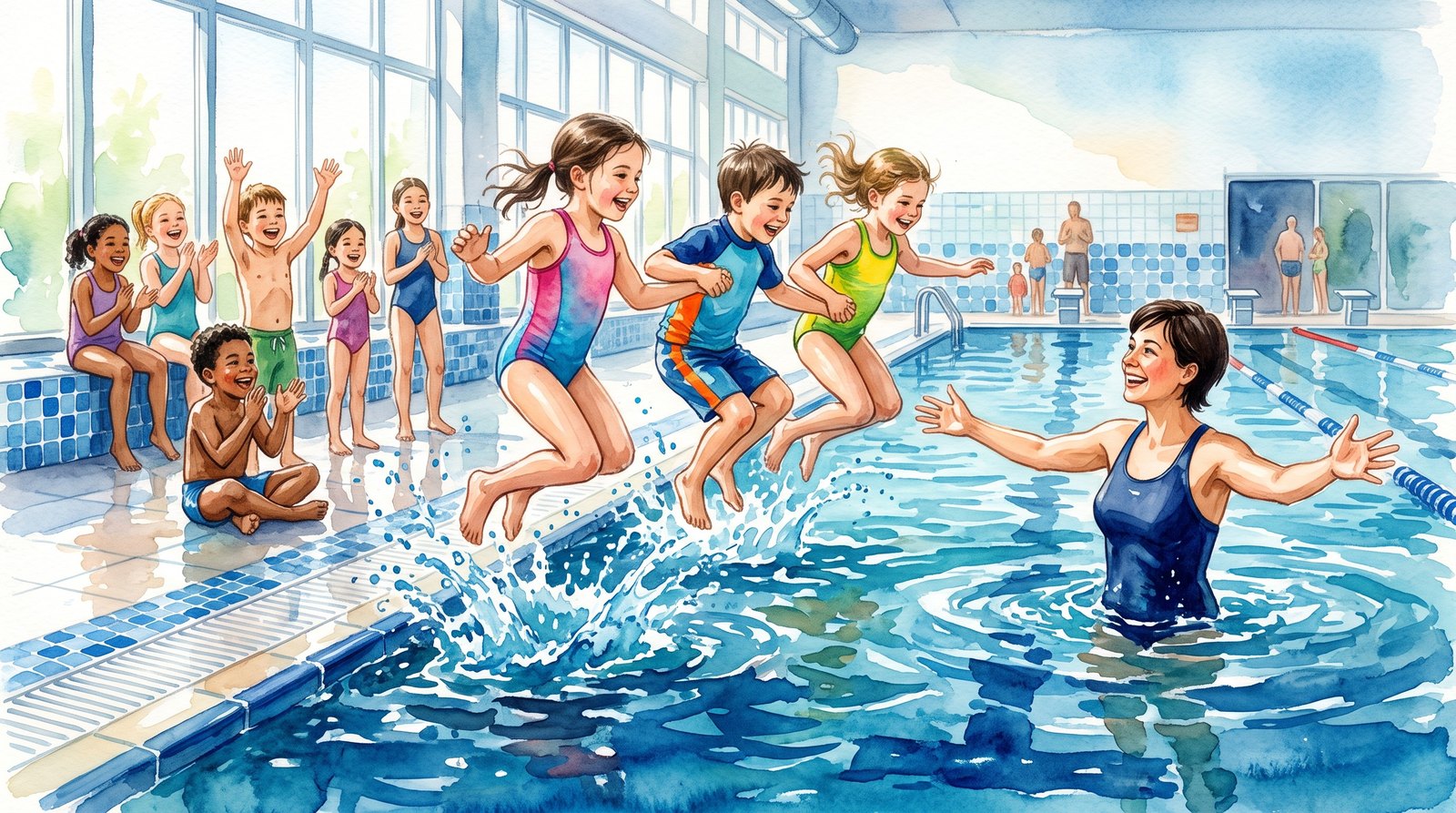
The jump is the end of the build-up, not the beginning. First let your child hold on to the edge over deep water, then let go with one hand, then with both hands, and only then try a jump. Each successful step makes the next one feel smaller.
Short sessions work better than long ones
Two minutes of practice when your child is keen will achieve more than pushing on for half an hour. Children learn these skills in small chunks. It is better to stop while things are still going well than when they go wrong, because otherwise your child may remember an unpleasant experience rather than a success.
What not to do
Do not throw your child into the deep end to show them they can manage. With a frightened child, that almost always has the opposite effect. Do not go into the deep end with your child simply to show them it is safe if they cannot yet tread water: they need to build confidence in their own abilities. And never leave your child unsupervised in the deep end, even if they have just earned their swimming certificate.
Ask a swimming instructor to check in occasionally
You do not have to pay for every practice session to know whether your child is doing well. A swimming instructor can spot in ten minutes what you might miss over months, and can identify exactly which step is still missing. A useful middle ground is to practise together and have an instructor check progress from time to time.
Safety in deep water
No skill replaces supervision
The researchers behind the study above are clear: parents and carers need to know that no swimming skill replaces supervision, especially at this age. That also applies to a child who has completed stage 5. The World Health Organization reports approximately 300,000 drowning deaths worldwide each year, with children under five accounting for nearly a quarter of them.
What your child needs to do if they unexpectedly fall into deep water
Falling into water is not the same as jumping. There is no preparation, no countdown and no chance to hold your breath beforehand. What helps is the sequence taught in lessons: surface, breathe out, turn onto your back or tread water upright, calmly call for help and make your way to the side. This sequence can be practised, and it is more important than any particular stroke.
Supervision that really is supervision
An adult who can swim and does nothing but watch. Put the phone away and save conversations at the poolside for later. The WHO identifies adult supervision as one of the basic measures to prevent drowning, and that applies especially in water where a child cannot stand.
How swimming instructors can tell when a child is ready
Include the transition to deep water as a separate skill in your programme
If the jump into deep water is recorded only as a final score, you cannot see where a child is getting stuck. Record the transition in smaller steps: holding on to the edge, letting go, treading water without support, jumping and staying calm, and swimming back to the side. A smiley score from 0 to 6 for each exercise shows where each child stands, even when you have twenty children in the pool. In the seven levels and 86 skills, each of those steps has its own place, so a jump into deep water does not remain just a final score.
Show parents what still needs work
Parents often ask why their child is not yet allowed in the deep end. With a score for each skill, the conversation changes: you can point to the exercise that is not yet at the required level, rather than simply explaining that the child is not ready. In Swimmigo, parents can see progress for each exercise in their own language, cutting the number of discussions at reception in half.
Use small groups when things get challenging
The first jump into deep water is when your attention is needed most. Schedule that exercise in a small group or have a second person watching from the side. The WHO explicitly identifies a safe ratio of participants to supervisors as a condition for swimming lessons, and it matters even more in deep water than in other exercises.
Swimmigo · Swim lesson app
Free for parents
Follow your child's swimming progress, see where you stand and report absences in the app.
Conclusion
Moving into the deep end is not about bravery, but about having the right skills in place first: breathing out calmly, floating, treading water and getting to the side independently. Swimming schools around the world build towards it in a similar way, with the jump into deep water as a test rather than a starting point. Practise in small steps, ask an instructor to check in occasionally and treat supervision as a task in its own right.
Sources
- Swim England: Learn to Swim Stage 5 Award, 2019
- Swim England: Learn to Swim Stage 1 to 7 Awards
- American Red Cross: Swimming Lessons for Kids
- Costa et al.: Perceived and Real Aquatic Competence in Children from 6 to 10 Years Old, International Journal of Environmental Research and Public Health, 2020
- WHO: Drowning, fact sheet, 2026

Bob van Soest
As an expert in operating sports facilities (such as swimming pools) and developer of, among others, Swimmigo.com, I am passionately committed to making swimming lessons simpler, more fun and more insightful for parents, swimming instructors and everyone who wants to learn to swim.
Frequently Asked Questions
Related articles

Learning breaststroke: why the legs do not cooperate and what you can practice at home [2026]
The kick remains the hardest part of breaststroke. This is what the movement really looks like, these mistakes are visible from the side, and this is what you can practice dry at home.

Learning backstroke: from floating on your back to backcrawl, and where it goes wrong [2026]
Learning backstroke starts with lying calmly on your back. This explains how the learning path builds up, four mistakes you spot from the side, and what you can practice dry at home.

Learn to Swim Front Crawl: Arms, Breathing and Rhythm Step by Step [2026]
Learning front crawl starts with body position and rolling. Build up arm movements, breathing and rhythm step by step, and learn to spot four common mistakes from the poolside.
Discover Swimmigo
The all-in-one app for swimming lesson progress. For parents, swim schools, and adult swimmers.