Learn to Swim Front Crawl: Arms, Breathing and Rhythm Step by Step [2026]

Summary
- Learning front crawl starts with body position, rolling and breathing out calmly. The arms come later.
- In the Swim England programme, ten metres of front crawl is the benchmark at stage 5, with six relaxed breaths at stage 6.
- Lifting the head to breathe pushes the hips down and reduces speed.
- Small kicks from the hips support the stroke. Kicking hard mainly uses energy.
- Progress by skill tells you more than a level name, and parents can see it in the app.
A child learning front crawl almost always gets stuck at the same point: their head comes up to take a breath, and the rest of their body sinks. Build up floating, gliding and rolling first, and a calm length follows once those foundations are in place. Focus on the arms straight away, and the child may be hanging on to the side, out of breath after fifteen metres.
Front crawl is the fastest stroke, and many swimmers use it for swimming lengths. For a child, it is harder than it looks. The arms work in turn, the body rotates with them, and breathing happens just as the head is already turning. Coordinating all three is why front crawl comes relatively late in many swimming programmes.
Why front crawl is the hardest stroke to learn
Backstroke has one big advantage: the face stays above water, so breathing is always possible. In front crawl, your face is in the water, and you have to choose and plan when to breathe. A child who holds their breath until their head is above water will struggle after ten metres.
Rolling and breathing happen at the same time
The body rotates a little with each arm stroke, about a quarter turn. Breathing follows that rotation: instead of coming up, you roll a little further until your mouth clears the water. A child who learns to roll before learning to breathe can use a movement they already know. A child who learns to breathe by lifting their head will have to unlearn that movement later.
Breathing is deliberately introduced later
The Swim England programme asks swimmers to complete ten metres of front crawl to the organisation's standard at stage 5. Stage 6 adds something that looks small: front crawl with at least six relaxed breaths. Only then does breathing become a requirement in its own right, often much later than learning to float. This order reflects how children learn. Breathing during a stroke is considered the hardest coordination task in swimming, and asking for it too early can leave a child gasping and stopping.
What each stage of the programme requires
| Programme stage | What your child demonstrates | Distance |
|---|---|---|
| Stage 3 | Moving forward on the front after pushing off from the wall, with a gentle kick and arms by the sides | 10 m |
| Stage 4 | Kicking on the front, with an aid such as a float if needed | 10 m |
| Stage 4 | First short-distance front crawl, in Swim England's separate swimming skills award | 5 m |
| Stage 5 | Front crawl using arms and legs to the organisation's standard | 10 m |
| Stage 6 | Front crawl with at least six relaxed breaths, plus a push-off from the wall on the side that turns into front crawl | 10 m |
The table only shows what a child must demonstrate at each stage. What happens between those stages matters more: a child who can kick ten metres at stage 4 without lifting their head already has much of front crawl in place. The arms tend to follow naturally.
Why some schools start front crawl early
There is no international standard for the order in which strokes are taught. Schools that start with front crawl usually do so because children are already used to putting their faces underwater and because it is the stroke they will use most later on. Other schools start with backstroke, where breathing takes no extra effort. Both approaches work. In either case, children who struggle with front crawl almost never do so because they lack strength.
Body position and rolling first, arms second
Before a child starts the arm stroke, the water should be able to support them without any effort. Their body position determines how much resistance they face, and that resistance affects how long they can keep swimming.
The head sets the body line
Swim England describes the position precisely: eyes looking forward and down, head in line with the body, water between the eyebrows and hairline, and the body lying flat with a slight slope towards the hips so the kick stays underwater. A child who lifts their chin pushes their hips down and swims with the brakes on.
The body rolls, with the hips turning less than the shoulders
The hips and shoulders rotate with the stroke, with the shoulders turning further than the hips. A child who turns only their shoulders will twist awkwardly. A child who does not rotate at all keeps their arm stiff and moves little water backwards with a short pull.
Exercise: side position with one arm extended
Have your child lie on their side with the lower arm extended forward and their head in line with it. Ask for six gentle kicks, then a turn onto the other side. The face stays pointing towards the bottom, and the child breathes only when the head turns with the body. This exercise does more for front crawl than ten lengths using the arms because it links rotation and breathing without adding the arm stroke.
What to watch for from the poolside
Good front crawl starts out looking uneventful: little splashing, a child gliding quietly through the water and a head that barely moves. If you see lots of splashing and a child slowing down after ten metres, the head is almost always the first thing to address.
Swimmigo · Swim lesson app
Free for parents
Follow your child's swimming progress, see where you stand and report absences in the app.


The arm stroke in four parts
An arm stroke has four phases that can be practised separately. Teaching them in order keeps things manageable. Trying them all at once can leave a child windmilling their arms.
Hand entry between the centre line and shoulder
The hand enters the water between the centre of the head and the shoulder line, thumb first and palm angled slightly outwards. If the hand crosses the centre line, your child will sway from side to side. If it enters too wide, they lose the backward pull.
Reach first, then pull
A mistake seen in almost every child: the hand enters the water and starts pulling straight away. That wastes the first few centimetres. The hand should glide a little further forward before building pressure.
The pull alongside the body
Underwater, the arm makes an hourglass-shaped movement: forward, towards the middle of the body and back out towards the thigh. The forearm and hand work together to hold the water, not just the palm. If the elbow drops, your child pushes with a flat hand and loses much of their propulsion. U.S. Masters Swimming lists a dropped elbow as one of the most common mistakes among adult swimmers, and it is common in children too.
Recovery with a high elbow
The arm leaves the water at the hip, the elbow points upwards and the hand stays relaxed alongside the body. A low, wide swing takes time and throws your child off balance. Ask for a relaxed hand rather than a straight arm, because tension in the hand carries through to the shoulder.
Breathing without interrupting the stroke
Breathing is part of the rotation itself. Once your child understands that, the gasping goes away.
Turn instead of lifting
A head that comes up pushes the hips down and makes the shoulders swing from side to side. Your child faces increasing resistance and tires more quickly. Swim England puts it simply: the higher the head rises, the deeper the legs sink.
One ear in the water, one eye just above it
While breathing, one side of the face stays in the water. The head turns with the shoulder and the mouth clears the water to the side, without the chin lifting. Many children turn too far and look at the ceiling. Have them look at the edge of the pool or at you to keep the turn small.
Breathe out first, then breathe in
The air needs to be exhaled underwater. A child who only breathes out above water has no time to breathe in before their head goes back down, so they hold their breath during the next stroke. For more detail on teaching this, see breathing during swimming lessons.
Every three strokes is a good start
Breathing every three strokes means your child alternates between the left and right sides. This keeps the stroke balanced and prevents them from pulling towards the same side every time. If they need air more often, they can breathe more often. A regular rhythm matters more than a fixed number.
The legs: small, quick kicks
The arms do most of the work. The kick keeps the body high and supports the rotation, and that is often where children run into trouble.
Two, four or six kicks per arm stroke
The kicking rhythm makes little difference to technique. Two or four kicks per arm stroke work well at a relaxed pace, while six kicks are common among swimmers looking for more speed. The number of kicks says nothing about their quality.
Relaxed ankles, slightly bent knees
The kick comes from the hips, with relaxed ankles and a slight bend in the knee. Children who make a cycling motion from the knees push water downwards and make little forward progress. A short cue works well in lessons: small kicks, toes underwater, legs close together.
Kicking hard uses energy without adding speed
When a child kicks harder to go faster, their body sinks and they run out of breath. Instead, ask them to kick more gently and breathe out for longer. They will usually settle into a straighter position on their own.
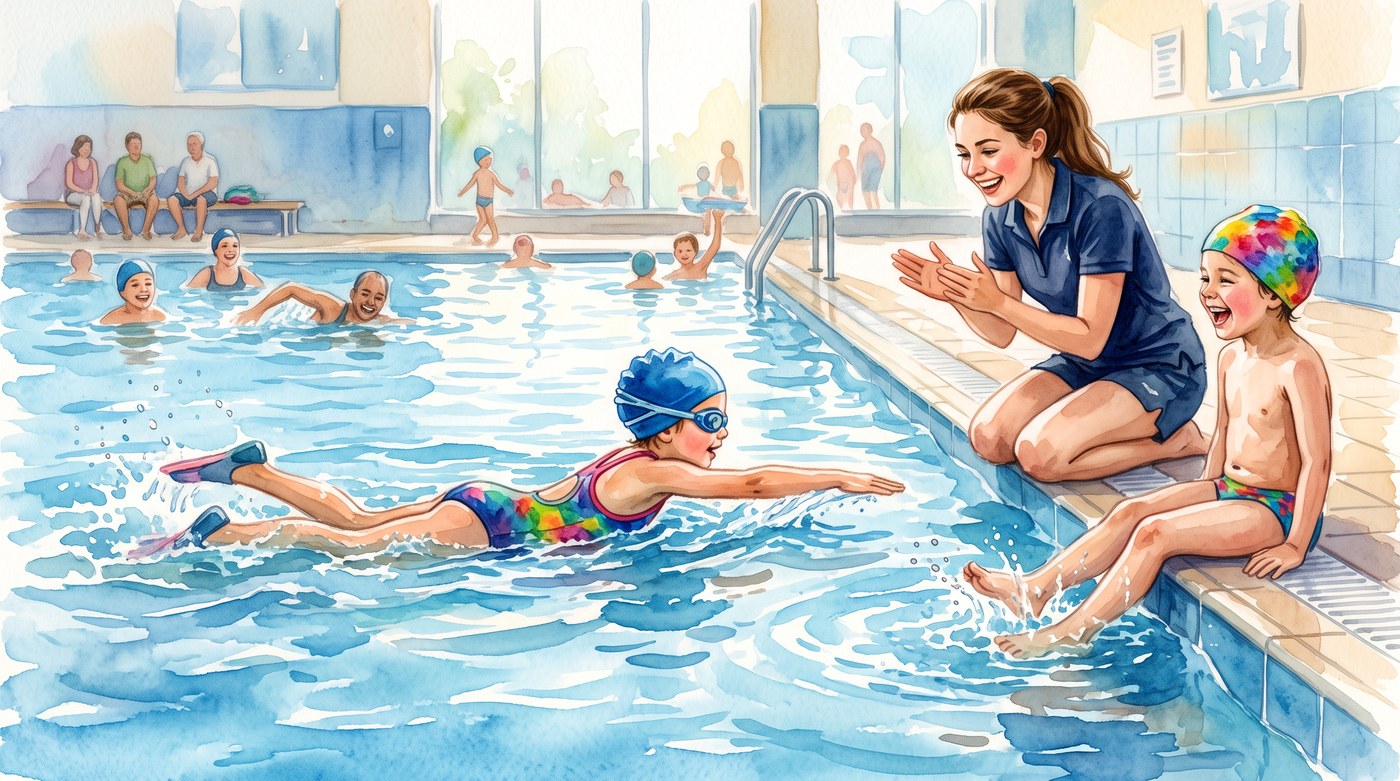
Mistakes you can spot from the poolside
Four things show up in almost every child starting front crawl. You can recognise them from the side without having studied swimming technique.
The head lifts when breathing
The child looks forward instead of sideways, the chin rises and the legs sink. A reference point to the side can help, along with asking them to look at the tiles while breathing.
The elbow drops
Underwater, the elbow stays high while the forearm pushes water backwards. If the elbow drops immediately, only the hand pushes. From the side, this looks like an arm doing very little while the child works hard.
The hand crosses the centre line on entry
A hand entering across the centre of the head makes your child sway. This often happens because the child uses their arm to find direction instead of their eyes. A tile or a line on the bottom as a target usually helps.
The legs sink
Sinking legs are almost always a result of the head position or a child using too much force. Do not work on the legs while the head is still lifting. Address body position first, then the kick.
What you can practise at home and in shallow water
You can practise the foundations of front crawl without a pool, as long as your expectations are realistic. At home, you can learn the arm path and rhythm. A feel for the water comes from being in it.
On dry land: the arm path and rotation
Have your child stand on a mat, leaning slightly forward, and slowly bring one arm forward past the ear, back alongside the body and forward again with a high elbow. Then repeat with the other arm. Ten relaxed repetitions on each side do more than a quarter of an hour of calling instructions at the pool.
In the water: three exercises
Start on the side with one arm extended, kicking six times on each side. Next, try the catch-up position: one arm stays extended forward until the other reaches the ear, and only then do the arms switch. Third, swim three strokes without breathing and turn to breathe on the fourth. Keep each set short and stop before your child gets tired.
What to leave to the instructor
Arm timing, elbow angle and the moment of breathing are rarely easy to judge from the side. Ask the instructor how your child is progressing and what you can repeat at home. That is more useful than correcting what you think you can see.
How long it takes for your child to swim front crawl
There is no reliable average. What you can look at are the factors that affect the pace of learning.
What determines the pace
Research involving children aged 6 to 9 shows that learning front crawl and backstroke is strongly associated with body awareness, static balance and buoyancy. In that 2023 study, these abilities were much more strongly associated with learning the strokes than dexterity, so the researchers identified them as predictors. For parents, this has a practical meaning: a child who still struggles to lie still will benefit more from balance exercises than extra arm strokes.
Why distance without a breathing rhythm is not swimming competence
A 2024 study of fifty 12- and 13-year-olds shows how this can go wrong. The boys swam a distance but did not maintain a breathing rhythm. They covered the metres but were unable to keep breathing calmly while swimming. The researchers do not call that swimming competence. In lessons, this means six relaxed breaths are a better measure than completing a length.
What being ready looks like
A child is ready when they can swim ten metres of front crawl with a steady head, a rotating body and breaths they can plan themselves. Whether that takes months or a year depends on their foundations, lesson frequency and how much they swim between lessons. The levels and skills show the steps involved.
Tracking progress by skill
With front crawl, a level name tells you surprisingly little. A child can be at level five and still lift their head to breathe, or swim a relaxed front crawl while other parts of the stroke still need work.
A level says little about one stroke
A level summarises dozens of exercises. Looking at individual skills shows where the difficulty really lies: hand entry, rotation, breathing out or kicking. That is also why a conversation about one exercise can be more useful than a conversation about a badge.
What you can see in Swimmigo
Swimmigo uses seven levels and 86 skills, and the instructor scores each exercise with a smiley from 0 to 6. Parents can see their child's progress in the app without standing at the poolside for every lesson, and they receive a notification when their child moves up a level. The app is free for parents. Swimming schools and independent instructors can start with a free demo, then choose a Solo or School subscription with a 30-day free trial.
Talking to the instructor
Ask which exercise needs attention now and what you can repeat at home. An instructor who scores individual skills can answer straight away. For a school, that also means a colleague can take over without losing information.
Safe practice: three rules
The WHO records around 300,000 drowning deaths worldwide each year, nearly a quarter of them among children under five. Drowning is the third leading cause of death among children aged 5 to 14. These figures describe populations, not your child, but they explain why practice should always be supervised. The American Red Cross summarises water competency as entering the water, getting a breath, staying afloat, changing position, swimming a distance and getting out again. Front crawl is one part of that.
Always have someone present who can swim
A child who panics may not find their way back to the side, even in shallow water. Practise with supervision, preferably in a lifeguarded pool. A lake or the sea is not a practice area for a child still working on their stroke, even if the water seems warm and calm.
No underwater breath-holding contests
Staying underwater for as long as possible is not a swimming skill. Children who play this game learn to keep going when their body has already wanted to stop. Instead, teach your child to breathe out calmly and come up in good time.
Stop before your child gets tired
A child who can no longer maintain a straight body position after twenty minutes will mainly remember that the water is tiring. Short, frequent sessions work better, especially in the first few months.
Conclusion
Learning front crawl starts with body position, rolling and breathing out calmly, with the arms coming later. A child who keeps their head steady and lets their body rotate can swim a length without gasping. A child taught to rely on strength first will have to unlearn that habit later.
At home, practise the arm path and rhythm. Ask the instructor about what you cannot see from the side. Read more about stroke order in which swimming stroke your child learns first, about leg movements in learning breaststroke, and about lying on the back in learning to swim backstroke. Swimming schools can find information about planning and scoring on the instructors page.
Swimmigo · Swim lesson app
Free for parents
Follow your child's swimming progress, see where you stand and report absences in the app.
Sources
- Swimming.org: Improving your front crawl technique, 1 October 2018
- Swim England: Learn to Swim Stage 4, 29 November 2019
- Swim England: Learn to Swim Stage 5, 29 November 2019
- Swim England: Learn to Swim Stage 6, 29 November 2019
- U.S. Masters Swimming: Freestyle, the complete guide, accessed 19 November 2026
- Petrea et al.: Influence of psychomotor skills on learning swimming strokes in children aged 6 to 9, Children, 2023
- Rejman et al.: Breathing rhythm during front crawl with and without swimming goggles, Scientific Reports, 2024
- American Red Cross: Water safety and water competency, accessed 19 November 2026
- WHO: Drowning fact sheet, 1 May 2026
Bob van Soest
As an expert in operating sports facilities (such as swimming pools) and developer of, among others, Swimmigo.com, I am passionately committed to making swimming lessons simpler, more fun and more insightful for parents, swimming instructors and everyone who wants to learn to swim.
Frequently Asked Questions
Related articles

Learning breaststroke: why the legs do not cooperate and what you can practice at home [2026]
The kick remains the hardest part of breaststroke. This is what the movement really looks like, these mistakes are visible from the side, and this is what you can practice dry at home.

Learning backstroke: from floating on your back to backcrawl, and where it goes wrong [2026]
Learning backstroke starts with lying calmly on your back. This explains how the learning path builds up, four mistakes you spot from the side, and what you can practice dry at home.

From shallow to deep water: when your child is ready for the deep end [2026]
Your child swims happily in the shallow end but stops at the deep end. Learn which skills come first, how swimming schools build up to the transition and what you can do.
Discover Swimmigo
The all-in-one app for swimming lesson progress. For parents, swim schools, and adult swimmers.