LanguageBarrierinSwimmingLessons:HowExpatParentsStayInvolvedinTheirChild’sSwimmingProgress[2026]
![Language Barrier in Swimming Lessons: How Expat Parents Stay Involved in Their Child’s Swimming Progress [2026]](/_next/image?url=https%3A%2F%2Fzvblogpostimages.s3.eu-west-3.amazonaws.com%2FAUTOMATISCH_UPLOAD%2F1_11cf99860af9.jpg&w=3840&q=75&dpl=dpl_8HBmXj8pyjjziKcbXKHvXrtJMU4a)
Summary
- Expat parents miss crucial progress information about their child’s swimming lessons because all communication is in Dutch.
- The language barrier leads to uncertainty, missed swimming diplomas, and even safety risks: worldwide, 300,000 people drown annually.
- With multilingual tools like Swimmigo, available in 5 languages, you can track swimming progress in your own language and stay fully involved.
- Swimming instructors also benefit: multilingual communication reduces misunderstandings and increases trust from international parents.
- Your child learns to swim faster when you understand what’s going on: involved parents are the biggest predictor of swimming success.
TLDR
- Expat parents miss crucial progress information about their child’s swimming lessons because all communication is in Dutch.
- The language barrier leads to uncertainty, missed swimming diplomas, and even safety risks: worldwide, 300,000 people drown annually, with children under 5 being the most vulnerable.
- With multilingual tools like Swimmigo, available in 5 languages, you can track swimming progress in your own language and stay fully involved.
- Swimming instructors also benefit: multilingual communication reduces misunderstandings and increases trust from international parents.
- Your child learns to swim faster when you understand what’s going on: involved parents are the biggest predictor of swimming success.
The Hidden Problem for Expat Parents in Swimming Lessons
You’ve moved to the Netherlands for work, love, or adventure. Childcare is arranged, school is found, and you’re starting to find your way in Dutch life. Then you hear from a colleague or neighbor: "Is your child already on the waiting list for swimming lessons?"
Waiting list? Swimming lessons? Diplomas? Welcome to Dutch swimming culture, a maze of rules, terms, and expectations that are completely incomprehensible to newcomers. And the worst part: if you don’t speak the language, you’re completely on your own.
Research from the World Health Organization shows that approximately 300,000 people drown worldwide each year. Children under 5 make up nearly a quarter of all drowning victims. In a water country like the Netherlands, with its canals, ditches, and ponds, swimming safety is not a luxury but an absolute necessity. And this applies to every child, regardless of the language spoken at home.
Dutch Swimming Lessons: A System Expat Parents Don’t Understand
In the Netherlands, swimming lessons are not an optional after-school activity. It’s a national ritual with the Zwem-ABC as the holy grail: Diplomas A, B, and C. Children typically start at age five and take two years to complete all diplomas. The waiting lists are legendary: 14 to 20 months is not uncommon, as the expat platform Dispatches Europe reports.
For expat parents, this system is a black box. Communication from the swimming school comes in Dutch: "Your child practiced water treading and breaststroke today." Without knowledge of these terms, you as a parent are completely sidelined. You don’t know if your child is progressing, if there are problems, or when the next diploma is in sight.
Why the Language Barrier in Swimming Lessons Is Truly Dangerous
This is not only frustrating, it’s potentially dangerous. If you as a parent don’t understand that your child struggles with water treading or cannot float safely, you can’t do targeted exercises at home. You can’t assess if your child is safe in open water during summer holidays. And you miss the signs that your child might be developing a fear of water.
The numbers don’t lie. According to the WHO, drowning is the third leading cause of death worldwide for children aged 5 to 14. In Europe, thousands of children drown annually, often during holiday periods when they enter unfamiliar waters. The language barrier between swimming schools and expat parents creates a dangerous information gap that directly undermines children’s swimming safety.
How the Dutch Zwem-ABC Works: A Crash Course for International Parents
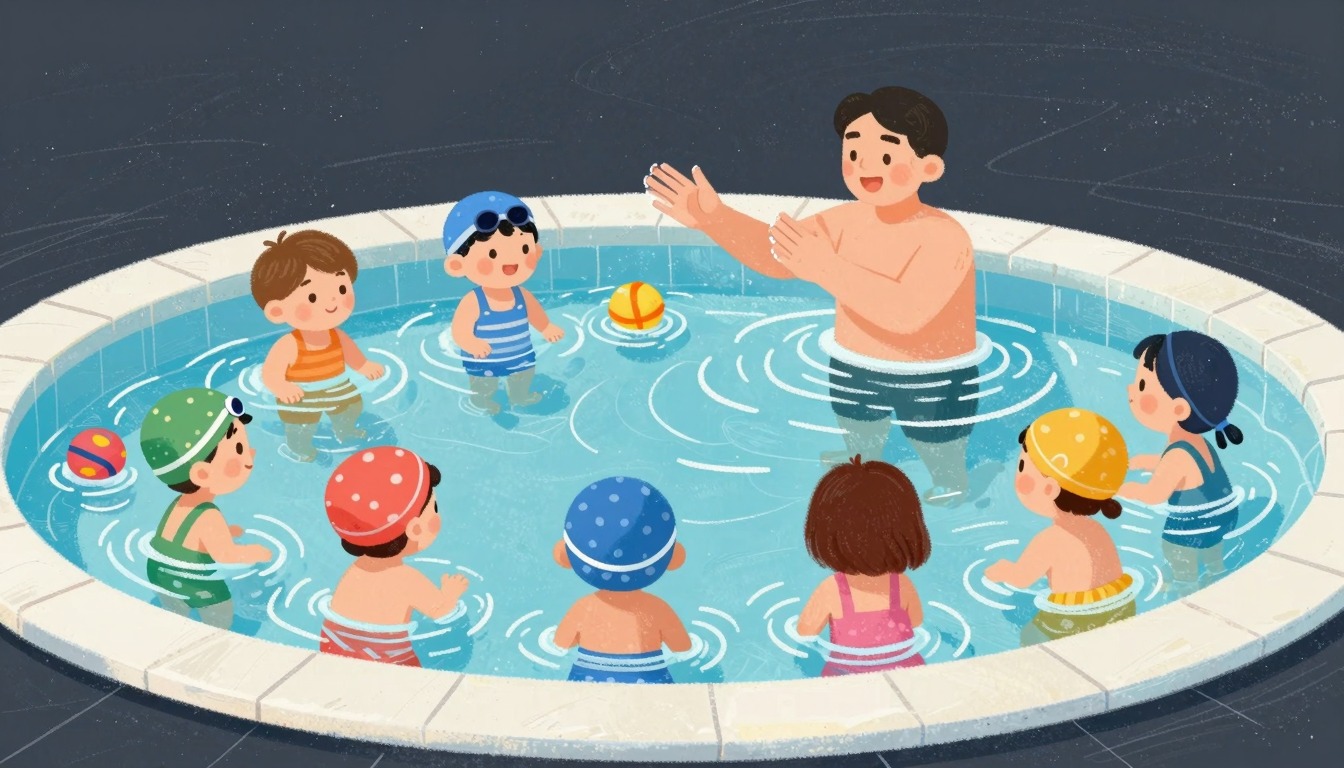
To understand why the language barrier is such a problem, you first need to understand the Dutch swimming lesson system. The Zwem-ABC consists of three diplomas:
- Diploma A: The basic diploma. Your child can swim 50 meters breaststroke and backstroke, swim through an underwater hole, and tread water. With this diploma, your child may swim independently in indoor pools. Average duration: 12 to 18 months.
- Diploma B: Advanced skills. Swimming longer distances, diving, and swimming clothed with shoes. Average duration: 3 to 4 months.
- Diploma C: The full package. Swimming with winter clothes, prolonged water treading, underwater orientation, and rescue skills. This is the level that truly makes children water safe, also in open water like lakes and the sea. Average duration: 3 to 4 months.
As an expat parent unfamiliar with these terms, these are empty words. You have no frame of reference for what "water treading with clothes" means or whether your child is ready for it. The swimming school sends updates in Dutch, and you struggle with Google Translate to understand if there are concerns.
The Five Biggest Pain Points for Expat Parents in the Dutch Swimming Lesson Journey
Based on experiences from hundreds of international parents in the Netherlands, these are the most common frustrations:
1. You don’t know what happens during the lesson. You drop your child off at the pool, wait an hour, and pick them up again. What happened during that hour? No idea. The instructor speaks Dutch and you can’t ask targeted questions.
2. You can’t gauge progress. Is your child almost ready for Diploma A? Do you have to wait another year? Without insight into progress, you plan vacations, birthday parties, and weekends around an uncertain timeline.
3. You miss diploma moments. The swimming school announces the diploma date in Dutch. Expat parents often miss this announcement, so they are not present at the diploma ceremony. A milestone in your child’s life that you unintentionally skip.
4. You can’t practice at home. Without understanding which exercises your child needs to do, you can’t support them at home or in the holiday pool. While research shows that parental involvement is the biggest predictor of swimming success.
5. You feel excluded from the swimming school community. Other parents chat in the changing room, exchange tips, and celebrate diplomas together. You stand by and don’t understand. The social aspect of swimming lessons, which is natural for Dutch parents, remains closed to you.
What Language Barriers Do to Your Child’s Swimming Motivation
The impact of the language barrier doesn’t stop with you as a parent. Your child also feels the consequences. Children who don’t fully understand the swimming instructor’s instructions become frustrated. They see other children progressing and wonder why they are stuck.
An American expat mother wrote on her blog Stitched in Color about her daughter’s swimming lesson experience in the Netherlands: "Mostly Elora enjoyed her lessons, though there were moments in the learning process which she found frightening." That "frightening" moment could have been prevented if there had been better communication between the swimming school and parents.
Children who get stuck due to language problems develop resistance to swimming lessons faster. They associate the pool with frustration instead of fun and progress. And swimming lessons should be a safe, playful environment where language doesn’t matter.
Why Visual Progress Breaks Through the Language Barrier
The solution to the language barrier in swimming lessons is not requiring instructors to speak English. That’s unrealistic and unnecessary. The real solution is visual, multilingual progress tracking.
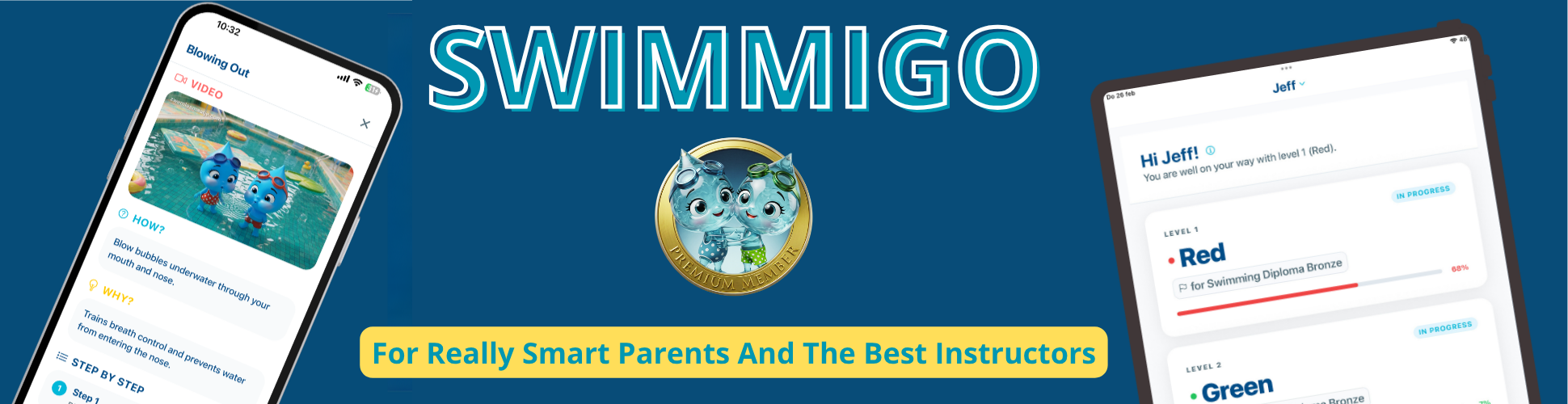
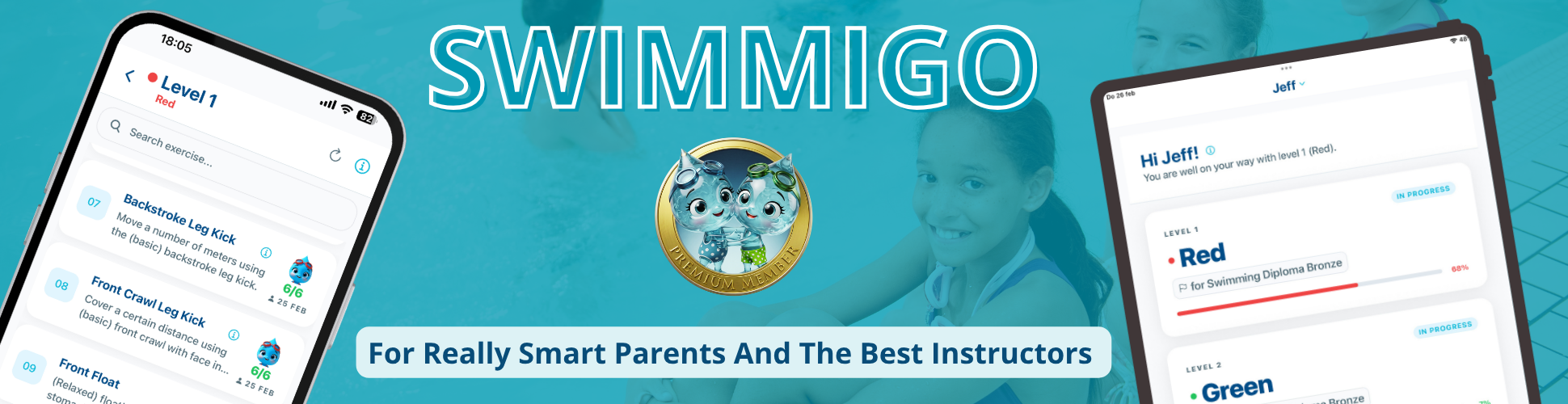
Research on child development shows that visual feedback is universal. A green smiley, a full progress bar, or a shiny badge means the same in every language: well done, keep it up. This principle is at the core of Swimmigo’s approach. The platform uses a 7-level system (Red to Gold) with 86 specific skills tracked per exercise. Parents see exactly where their child stands in their own language (English, German, French, Spanish, or Dutch).
For swimming instructors, nothing changes in their workflow. They register scores in Dutch. The platform automatically translates to the parent’s language. No extra work, no translation errors, and full transparency for all parties.
How Multilingual Swimming Progress Works in Practice
Imagine you are a French parent in Amsterdam. Your six-year-old daughter has just completed her first month of swimming lessons. Instead of a Dutch email you don’t understand, you open the Swimmigo app and see in French:
- Water confidence: 3 out of 6 smileys green.
- Floating on the stomach: 4 out of 6 smileys green.
- Breaststroke jump: 2 out of 6 smileys green.
You now know exactly where your daughter stands without reading a single Dutch word. You can practice the breaststroke jump at home over the weekend and know that floating on the stomach is almost mastered. When the instructor promotes her to the next level, you get a push notification in French. You are fully involved, in your language, without the swimming school needing to be multilingual.
The International Swimming Lesson Revolution: Not Just for the Netherlands
This problem is not unique to the Netherlands. In Germany, Turkish parents struggle with the "Seepferdchen" swimming diploma. In France, English-speaking expats in Paris face the same language barrier with the "savoir-nager" certification. In Spain, British families on the Costa del Sol miss crucial swimming safety information because everything is in Spanish.
The WHO emphasizes that swimming education and water safety training are the most effective interventions against drowning in children. But these interventions only work if parents understand what is happening. A multilingual platform like Swimmigo, which makes swimming progress available in 5 languages, bridges the gap between local swimming education and the international families who depend on it.
In cities like Berlin, Barcelona, and London, hundreds of thousands of international families have children taking swimming lessons in a language the parents do not fully master. The solution that works in the Netherlands is universally applicable.
What Swimming Instructors Can Do to Support Expat Families
As a swimming instructor, you don’t need to be a language wizard to serve international parents well. A few simple adjustments make a world of difference:
Use universal gestures during instructions. Demonstrating is always better than explaining, especially with children who don’t speak the language. Combine this with clear hand signals understood in every culture.
Register progress digitally. With a tool like Swimmigo, you record scores per skill with one tap on your phone. The app automatically translates to the parent’s language. You work in Dutch, parents read in their own language.
Send visual summaries. A screenshot of smileys and progress bars says more than a Dutch text parents can’t read. Images are universal.
Be patient and welcoming. A smile and thumbs up to an expat parent in the pool hall costs nothing but means everything. It signals: your child is welcome here, even if we don’t speak the same language.
Three Practical Steps for Expat Parents: Applicable Today
Are you an expat parent and do you recognize these frustrations? Here are three concrete actions you can take immediately:
Step 1: Ask for visual reporting. After the lesson, approach the instructor and ask with gestures or in English how it went. Most swimming instructors appreciate involved parents.
Step 2: Use a multilingual app. Install Swimmigo on your phone and ask the swimming school to track scores in the app. It’s free for schools and parents, and you switch to your language with one tap.
Step 3: Build a swimming lesson network. Find other expat parents at your pool. Exchange experiences, translate for each other, and celebrate each other’s diploma moments. Together you are stronger than alone.
How Swimmigo Bridges the Gap Between Swimming Schools and International Parents
Swimmigo was built with one mission: to make swimming progress transparent and accessible for everyone, regardless of language or budget. The platform is 100% free for both swimming instructors and parents. No subscription, no hidden costs, no strings attached.
The app supports five languages (Dutch, English, German, French, and Spanish) and works with a visual 7-level system from Red to Gold. Each skill is tracked with smileys from 0 to 6, so you see at a glance how far your child has come. Push notifications keep you informed of level increases, and at levels 5, 6, and 7 your child receives a personalized swimming diploma with name, date, and level.
For swimming instructors, Swimmigo offers practical tools: create groups, add and move students with swipe gestures, multi-instructor collaboration, and even a marketing toolkit with flyers, social posts, and certificates. All free, because swimming safety should not be a business model.
Conclusion
A language barrier should never be the reason you as a parent don’t know how your child’s swimming lessons are going. Swimming safety is too important to muddle through with Google Translate and vague gestures. With multilingual tools like Swimmigo, you stay fully involved, in your own language, and help your child achieve their swimming diploma faster and safer. Because involved parents are the engine behind every swimming hero.
Discover More About Swimmigo
- Swimmigo for Parents
- Swimmigo for Swimming Instructors
- The 7 Swimming Levels of Swimmigo
- All Features of Swimmigo
Sources
- WHO: Drowning Fact Sheet, May 2026. Global drowning statistics and prevention strategies.
- Dispatches Europe: Why swim school in the Netherlands will cost you thousands, 2025. Experiences of expat parents with Dutch swimming lessons, waiting lists, and costs.
- Stitched in Color: Expat Chronicles: the Swim Diploma, October 2024. Personal account of an American mother about her daughter’s swimming lesson experience in the Netherlands.
- WHO: World Drowning Prevention Day, 2025. UN resolution on global drowning prevention and the role of swimming education.

Bob van Soest
As an expert in operating sports facilities (such as swimming pools) and developer of, among others, Swimmigo.com, I am passionately committed to making swimming lessons simpler, more fun and more insightful for parents, swimming instructors and everyone who wants to learn to swim.
Frequently Asked Questions
Related articles
Best Age to Start Swimming Lessons
Discover practical tips to determine the right age for swimming lessons and prepare your child well.

Recognizing Early Signs of Dropout in Swimming Lessons
Learn practical ways to recognize and prevent early dropout in swimming lessons for better progress and safety.
![Help, my child wants to quit swimming lessons: how to break the motivation dip as a parent [2026]](/_next/image?url=https%3A%2F%2Fzvblogpostimages.s3.eu-west-3.amazonaws.com%2FAUTOMATISCH_UPLOAD%2F1_18565defe386.jpg&w=3840&q=75&dpl=dpl_8HBmXj8pyjjziKcbXKHvXrtJMU4a)
Help, my child wants to quit swimming lessons: how to break the motivation dip as a parent [2026]
Your child wants to quit swimming lessons? Discover the hidden causes of motivation dips and how micro-goals and Swimmigo can keep your child motivated for the diploma.
Discover Swimmigo
The all-in-one app for swimming lesson progress. For parents, swim schools, and adult swimmers.