TeachingSwimmingtoChildrenwithADHDandAutism:PracticalToolsforSwimInstructors[2026]
![Teaching Swimming to Children with ADHD and Autism: Practical Tools for Swim Instructors [2026]](/_next/image?url=https%3A%2F%2Fzvblogpostimages.s3.eu-west-3.amazonaws.com%2FAUTOMATISCH_UPLOAD%2F1_09a8d1d9c113.jpg&w=3840&q=75&dpl=dpl_8HBmXj8pyjjziKcbXKHvXrtJMU4a)
Summary
- Children with ADHD and autism have an increased risk of drowning; worldwide drowning is the leading cause of death among autistic children who wander away from home
- With small adjustments in your lesson structure, communication, and environment, you make swimming lessons safe and effective for neurodivergent children
- Structure, visual support, and stimulus reduction are the three pillars for successful swimming lessons for children with ADHD and autism
- Swimmigo’s visual progress system helps instructors track what works and what doesn’t per skill, without administrative hassle
Why Swimming Lessons for Children with ADHD and Autism Deserve Extra Attention
As a swim instructor, you often face the challenge of teaching children with diverse needs. Two groups that require specific attention are children with ADHD and children with autism spectrum disorder (ASD). These children do not necessarily learn to swim more slowly, but they learn differently. Their sensory processing, concentration ability, and social interaction function in ways that the standard swimming lesson program is not always designed for.
The statistics on water safety underline how important this topic is. In the Netherlands, the National Council for Swimming Safety (NRZ) reported 132 accidental drownings in 2025. Worldwide, drowning is one of the leading causes of death among children, and research shows that children with autism have a significantly increased risk. The American National Autism Association states that drowning accounts for about 91% of deaths in children with autism under 14 years old who wander away from a safe environment. These figures make it clear: swimming lessons for these children are not just a skill, but a life-saving necessity.
Swimmigo is available in five languages and is used worldwide by swim instructors facing these challenges. The principles in this article are universally applicable, whether you teach in a pool in Amsterdam or a swim school in Sydney.
The Brain of a Child with ADHD in the Pool: What Really Happens?
A swimming pool is a special environment for every child: the sound of splashing water, the echo of voices against tiled walls, the smell of chlorine, and the physical sensation of water on the skin. For a child with ADHD, this sensory cocktail is extra intense.
The Impact of the Pool Environment on Concentration
Children with ADHD have difficulty filtering stimuli. In a pool, sounds, movements, and visual stimuli constantly come at them. While a neurotypical child can distinguish the instructor's voice from background noise, a child with ADHD hears a cacophony of equally loud signals. This is not a matter of 'not wanting to listen' but neurological sensory processing.
Why Structure Makes the Difference
The ADHD brain thrives on clear, predictable structures. A swimming lesson that follows the same pattern every week offers the mental support these children need to learn. Start each lesson with the same warm-up, use fixed spots at the pool edge, and clearly announce transitions between exercises. A student tracking system like Swimmigo makes it easy to keep track of which exercises have been done per lesson, so the structure remains consistent week to week, even if a colleague takes over the lesson.
Movement as an Ally, Not an Enemy
Children with ADHD have an intrinsic need for movement. Instead of fighting this, you can channel this energy. Let them splash around between exercises, take a dive, or do a short 'energy release'. The water is a perfect environment for this: jumping, diving, and kicking are both swimming skills and outlets.
Children with Autism in the Pool: A World of Difference
Where ADHD mainly manifests in attention regulation and impulse control, the challenge with autism often lies in sensory processing, communication, and predictability. The pool can be both a magical and a frightening place for an autistic child.
Recognizing and Preventing Sensory Overload
Autistic children can be over- or under-sensitive to sensory input. The sudden temperature change when entering the water, the acoustics of the swimming hall, the bright lighting, the texture of the pool edge: each can be overwhelming experiences. Watch for signs of overload: hands over ears, looking away, freezing, or rapid breathing. Gradually build up exposure to new stimuli and give the child space to indicate when it becomes too much.
Clear, Literal Communication
Autistic children often take language literally. So don’t say "we’re going to look underwater" if you mean "we’re going to hold our head under water with eyes open." Avoid figurative language, sarcasm, and vague instructions. Use short, concrete sentences: "Put your hands on the edge. Stretch your legs. Kick with your feet." This approach helps all children in the group, not just those with autism.
Visual Support for Every Exercise
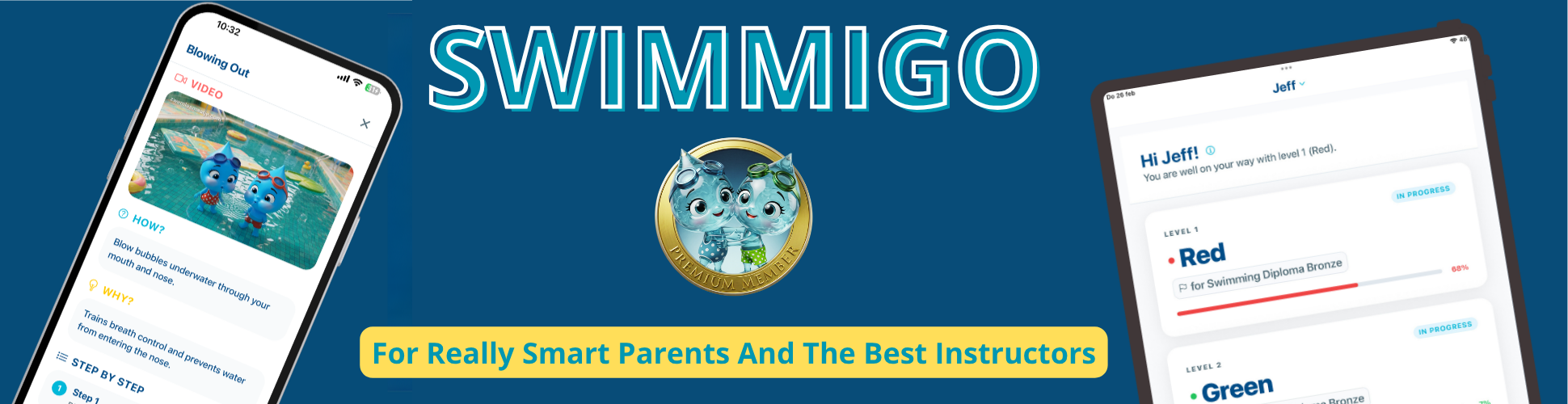
Many autistic children are visual thinkers. A picture of the exercise on a whiteboard at the pool edge, a demonstration by the instructor, or a visual step-by-step plan makes the task concrete. Swimmigo’s smiley system (0 to 6 stars per skill) also offers a direct, visual way to show progress without verbal explanation. The child sees at a glance: I already master this exercise, I still need to work on this one.
Practical Didactics: How to Adapt Your Swimming Lesson
The theory is clear, but how do you put this into practice in a swimming lesson with sometimes eight to twelve children in the water? Below are six concrete tools you can apply tomorrow.
1. The Power of Predictability
Hang a visual lesson plan at the pool edge: pictograms of the exercises in the order they will be done. Children with autism and ADHD find support in knowing what’s coming. When an exercise is finished, turn the pictogram over or remove it. This gives a sense of control and reduces fear of failure.
2. Incorporate One-on-One Instruction Within the Group
Try to include a short moment of individual attention in every lesson, even if it’s only thirty seconds. Direct, personal instruction reaches children with ADHD much better than a general group assignment. This doesn’t have to come at the expense of the rest of the group: while you guide one child, the others practice a familiar skill independently.
3. Reward, Don’t Punish
Children with ADHD receive many corrections in daily life. Make the swimming lesson a place where success is central. Explicitly name what goes well: "How great that you stopped immediately when I raised my hand!" instead of only reacting to mistakes. A visual reward system (stickers, stamps, or in Swimmigo: an extra smiley for exceptional progress) works wonders for motivation.
4. The Right Group Composition
Not every child with ADHD or autism thrives in a standard group lesson. Some children flourish in a smaller group (three to four children), others benefit from one-on-one attention. Consult with parents about what works at school and translate that to the swimming lesson context. A student tracking system makes it easy to see in which group composition a child makes the most progress.
5. Water as a Sensory Aid
Water has unique sensory properties: it provides resistance and pressure, which has a calming effect for many children with autism and ADHD. Use this to your advantage. Let children who become overwhelmed float on their back for a moment, or give them an exercise where they have to push themselves through the water. The hydrostatic pressure acts like a natural 'hug' that calms the nervous system.
6. Collaborate with Parents: The Key to Success
Parents of children with ADHD and autism are often experts in what works and what doesn’t for their child. Actively ask about strategies that are effective at home and school. Which reward systems work? Which sensory triggers should you avoid? What language does the child understand? This five-minute investment at the start of the lesson trajectory saves you weeks of trial and error in the water.
Water Safety: Extra Vigilance for Neurodivergent Children
The combination of water and reduced risk awareness requires extra alertness from the swim instructor. Children with ADHD are impulsive and may suddenly jump into the water without waiting for instructions. Children with autism can become fixated on one element (for example, the light play on the water surface) and fail to notice the rest of the environment, including dangers.
Water Acclimatization with Extra Patience
Never force the first step into the water. Let the child get used to it at their own pace: first sitting at the edge with feet in the water, then standing on the first step, and only then fully in the water. For some autistic children, just touching the water can be an overwhelming experience. Give them the time they need and celebrate every small step forward.
Clear Safety Rules with Visual Support
Make safety rules explicit and visual: a red sign means 'wait at the edge', a green sign means 'you may enter the water'. Repeat these rules at the start of every lesson. For children who respond little or not at all to verbal instructions, visual signals are often more effective than words.
The Role of Technology in Adapted Swimming Education
A digital student tracking system is not a replacement for good didactics but can significantly enhance it. For children with ADHD and autism, continuously and accurately tracking progress is extra important because progress often occurs in small, non-linear steps.
Progress per Skill, Not per Level
Where a neurotypical child moves in a fairly straight line from level to level, the progress of a child with ADHD or autism often looks different. One week the leg kick is perfect but the arm movement fails; the next week it’s the other way around. A system that scores per individual skill (like Swimmigo’s 86 skills across 7 levels) provides a much more accurate picture than a system that only reports at diploma level.
Involving Parents in Real Time
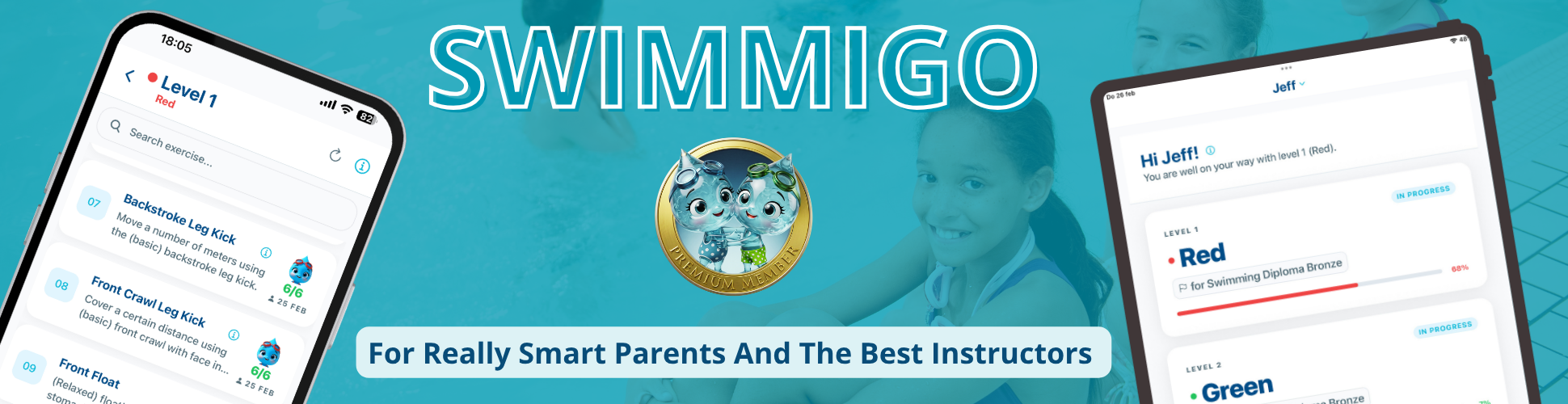
For parents of children with ADHD and autism, insight into swimming lesson progress is especially valuable. They can practice targeted skills at home, and the positive feedback you share via the app acts as a powerful motivator. Swimmigo’s parent portal shows the smiley score per exercise, so parents see their child is making progress, even if the pace differs from peers.
Inclusion in Swimming Lessons: Every Instructor Can Do It
More than 1 in 20 children worldwide has ADHD and about 1 in 100 children has some form of autism. As a swim instructor, you will inevitably encounter these children, even if you don’t actively ask. The adjustments you make for these children improve the lesson quality for all children: clearer instructions, more structure, and visual support are universal didactic improvements.
Small Adjustments, Big Difference
You don’t have to overhaul your entire lesson program. Start with three small adjustments: a visual lesson plan at the pool edge, shorter and more concrete instructions, and a fixed start and end ritual. Observe how children respond and build from there. Most swim instructors who implement these adjustments report not only better results with children with ADHD and autism but also less unrest in the whole group.
Want to know more? See how Swimmigo for parents works, discover the features for swim instructors, or read more about the free student tracking system that scores per skill.
Conclusion
Children with ADHD and autism have just as much right to safe and enjoyable swimming education as any other child. The practical adjustments needed do not require expensive materials or complicated training, but above all understanding, patience, and a structured approach. With the combination of didactic skills and a user-friendly student tracking system like Swimmigo, you give these children not only a life-saving skill but also a place where they can flourish at their own pace.
Sources
- National Council for Swimming Safety: CBS reports 132 accidental drownings in 2025, July 2025
- National Autism Association: Autism and Safety Facts, wandering and drowning prevention, 2024
- World Health Organization (WHO): Drowning fact sheet, global drowning statistics and prevention, 2025
- Autism Speaks: Water safety and drowning prevention for children with autism, 2025
- Royal National Lifeboat Institution (RNLI): Children's water safety, practical drowning prevention advice, 2025

Bob van Soest
As an expert in operating sports facilities (such as swimming pools) and developer of, among others, Swimmigo.com, I am passionately committed to making swimming lessons simpler, more fun and more insightful for parents, swimming instructors and everyone who wants to learn to swim.
Frequently Asked Questions
Related articles
![How to Motivate Children Stuck at the Same Swimming Level: Practical Tips for Instructors [2026]](/_next/image?url=https%3A%2F%2Fzvblogpostimages.s3.eu-west-3.amazonaws.com%2FAUTOMATISCH_UPLOAD%2F1_ac831cb13894.jpg&w=3840&q=75&dpl=dpl_8HBmXj8pyjjziKcbXKHvXrtJMU4a)
How to Motivate Children Stuck at the Same Swimming Level: Practical Tips for Instructors [2026]
Practical tips for swim instructors to motivate children who are stuck at a swimming level. Discover how small adjustments and the 0-6 smiley system can lead to significant progress.
![How Visual Progress Systems Boost the Motivation of Swimming Students: From Stars to Smileys [2026]](/_next/image?url=https%3A%2F%2Fzvblogpostimages.s3.eu-west-3.amazonaws.com%2FAUTOMATISCH_UPLOAD%2F1_0d5ccbf68313.jpg&w=3840&q=75&dpl=dpl_8HBmXj8pyjjziKcbXKHvXrtJMU4a)
How Visual Progress Systems Boost the Motivation of Swimming Students: From Stars to Smileys [2026]
Discover how visual progress systems like stars, smileys, and badges enhance the motivation of swimming students. Practical tips for swim instructors.
![How to Effectively Teach Swimming to Adult Beginners: A Practical Guide for Swim Instructors [2026]](/_next/image?url=https%3A%2F%2Fzvblogpostimages.s3.eu-west-3.amazonaws.com%2FAUTOMATISCH_UPLOAD%2F1_311d6586a746.jpg&w=3840&q=75&dpl=dpl_8HBmXj8pyjjziKcbXKHvXrtJMU4a)
How to Effectively Teach Swimming to Adult Beginners: A Practical Guide for Swim Instructors [2026]
Adult beginners require a different swimming lesson approach than children. Discover the 5 biggest challenges and practical exercises for instructors.
Discover Swimmigo
The all-in-one app for swimming lesson progress. For parents, swim schools, and adult swimmers.