HowtoEffectivelyTeachSwimmingtoAdultBeginners:APracticalGuideforSwimInstructors[2026]
![How to Effectively Teach Swimming to Adult Beginners: A Practical Guide for Swim Instructors [2026]](/_next/image?url=https%3A%2F%2Fzvblogpostimages.s3.eu-west-3.amazonaws.com%2FAUTOMATISCH_UPLOAD%2F1_311d6586a746.jpg&w=3840&q=75&dpl=dpl_8HBmXj8pyjjziKcbXKHvXrtJMU4a)
Summary
- Worldwide, 300,000 people drown annually (WHO, 2026): swimming lessons for adults literally save lives, not only in the Netherlands but in every country with open water
- Adult beginners have different fears and a different learning process than children: shame, fear of failure, and years of water phobia require a specific didactic approach
- The 5 biggest challenges in adult swimming lessons are: shame, stiffness, breath control, buoyancy, and conditioning anxiety
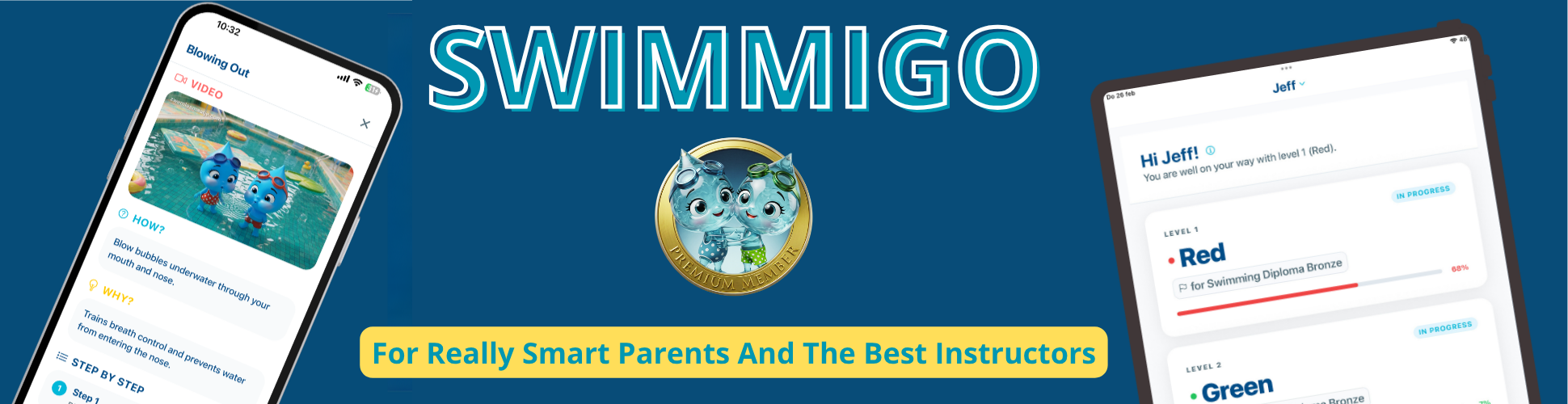
- With a free student tracking system like Swimmigo, you can monitor each adult student's progress across 7 levels and 86 skills, including notes for the specific approach
- In this article: practical exercises, communication tips, and a step-by-step plan for your first lesson with an adult beginner
TLDR
- Worldwide, 300,000 people drown annually (WHO, 2026): swimming lessons for adults literally save lives, not only in the Netherlands but in every country with open water
- Adult beginners have different fears and a different learning process than children: shame, fear of failure, and years of water phobia require a specific didactic approach
- The 5 biggest challenges in adult swimming lessons are: shame, stiffness, breath control, buoyancy, and conditioning anxiety
- With a free student tracking system like Swimmigo, you can monitor each adult student's progress across 7 levels and 86 skills, including notes for the specific approach
- In this article: practical exercises, communication tips, and a step-by-step plan for your first lesson with an adult beginner
Why swimming lessons for adults are not 'children's lessons for grown-ups'
Most swim instructors are trained to teach children. The methodologies, exercises, communication style: everything is tailored to a child's brain that learns playfully and experiences little shame. But applying the same approach to a 45-year-old office worker who has never been in the water without fear will hit a wall.
According to CBS figures for 2024, an average of 91 residents drown annually in the Netherlands due to accidents, with those over 60 at the highest risk. EenVandaag reports that 3 out of 10 elderly people say they swim poorly, and 35% of those over 65 swim without any diploma. This is not just a Dutch problem: the WHO reports that drowning is the fourth leading cause of death worldwide among children aged 1 to 4, but also significantly increases among adults due to climate change, flooding, and open water recreation.
Swimmigo is available in 5 languages and is used worldwide by swim instructors who teach both children and adults. The principles in this article are universally applicable, whether you teach in an Amsterdam indoor pool, a German recreation center, or a Spanish coastal town.
The 5 biggest challenges with adult beginners: and how to address them
1. Shame: 'I'm too old to learn this'
Adult beginners often enter the pool with a heavy dose of shame. They feel watched, consider themselves clumsy, and compare themselves to the toddlers happily splashing in the adjacent pool. This shame is the biggest barrier to learning. As an instructor, your first task is not technical but psychological: create a safe environment where failure is allowed. Explicitly state that most adult beginners have the same feelings. Tell them you have guided dozens of adults who started with exactly the same tension. Normalize the fear, only then can you work on technique.
2. Physical stiffness: adult bodies move differently
Children are flexible, their joints supple, their muscles relaxed. Adults who have sat behind a desk for years have stiff shoulders, a locked neck, and limited hip mobility. This directly affects swimming strokes: a breaststroke leg movement requires external hip rotation that many adult beginners simply do not have. Therefore, start each lesson with dryland mobility exercises: shoulder rolls, hip openers, ankle circles. In the water: let them first get used to the feeling of weightlessness by slowly walking through the shallow pool, arms wide, feet consciously placing down.
3. Breath control: the biggest technical hurdle
For children, blowing bubbles is a game. For adults, exhaling underwater is often terrifying. The feeling of losing control is intense, and the reflex to hold the breath is deeply ingrained. The key is gradual buildup. Start dry: breathe in for 4 counts through the nose, out for 6 counts through the mouth. Do this 10 times. Then at the pool edge: chin on the water surface, only lips underwater, gently blowing out. Next, nose underwater, mouth above: exhale through the nose. Only when this is comfortable: whole face underwater. Never force it. An adult who gets water in once and panics is three steps back in confidence.
4. Buoyancy: trusting your body in the water
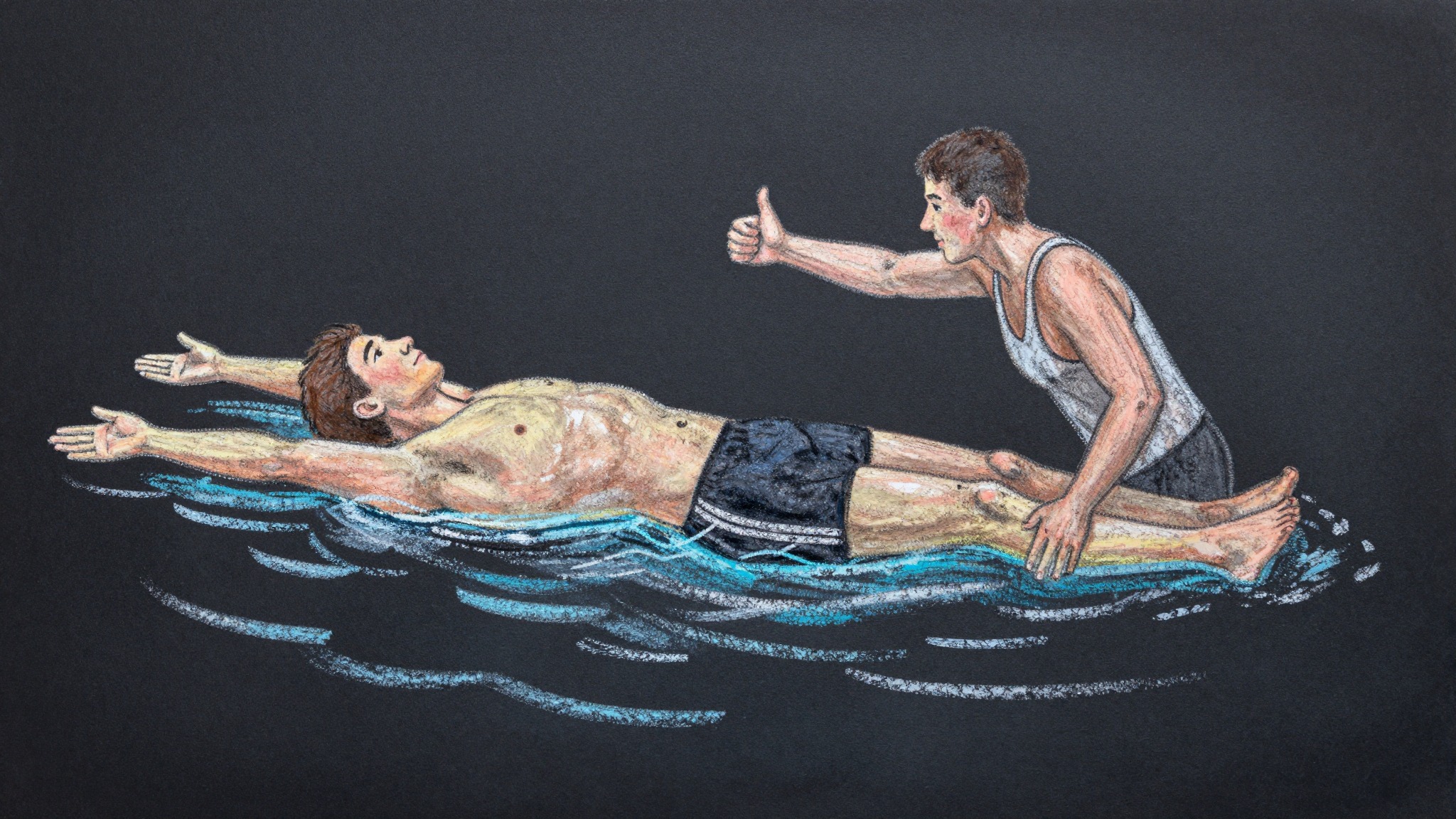
Many adult beginners genuinely believe they are 'too heavy' to float. This is physiologically almost never true, but the belief runs deep. Let them discover this themselves with a simple exercise: the 'jellyfish float.' Lie on your back in shallow water, arms and legs wide, head tilted back as if staring at the ceiling. You as instructor support only the back of the head with two fingertips: enough to give confidence, too little to actually carry. Most beginners float fully independently within 30 seconds. The moment they realize this is a turning point in their self-confidence.
5. Conditioning anxiety: unlearning the panic reflex
Adults who have had a bad experience in the water (near-drowning, rough swimming lessons as a child, being forced to dive) have a conditioned panic reflex. This reflex is not rational: the body reacts with a stress response before the brain can intervene. These beginners need more time, not less. Work in extremely small steps. Celebrate every milestone as if it were an Olympic medal. Use the Swimmigo app to visually record this micro-progress: a smiley from level 1 to level 2 is a huge achievement for this student. Make that visible.
Practical exercises for the first 3 lessons
Lesson 1: Water acclimation and building trust
The first lesson is about one thing: letting the student leave with a positive feeling. Start with 10 minutes of getting to know each other at the pool edge. Ask about previous experiences, fears, and goals. Really listen. Then enter the water together, shallow. Walk calmly back and forth, feel the resistance of the water. Do the 'bubbles at the edge' exercise (lips in the water, gently blowing out). End with the jellyfish float on the back, with support. Finish with a concrete compliment and one thing to practice at home: wet the face under the shower and breathe calmly.
Lesson 2: Floating and propulsion
Now that trust is there, work on buoyancy. Repeat the jellyfish float, but extend the time without support. Introduce the 'superman float': lie on the stomach, arms stretched forward, legs stretched backward, face in the water. This is intense for many beginners: be present, maintain eye contact underwater with goggles. Work on leg movement: holding the pool edge, legs slowly up and down. No breaststroke yet: focus on a relaxed, flowing movement from the hips.
Lesson 3: Combining breathing with movement
This is where it all comes together. Start standing at the side: 3 breaststroke arm strokes in place, then turn head and inhale, face back and exhale. Keep practicing this dry until the rhythm feels natural. Then enter the water and do the same, first standing still, then slowly walking through the shallow pool. The key is calmness: if breathing remains steady, the body relaxes and the technique comes naturally.
How to track progress with adult students
Why a student tracking system is essential for adults
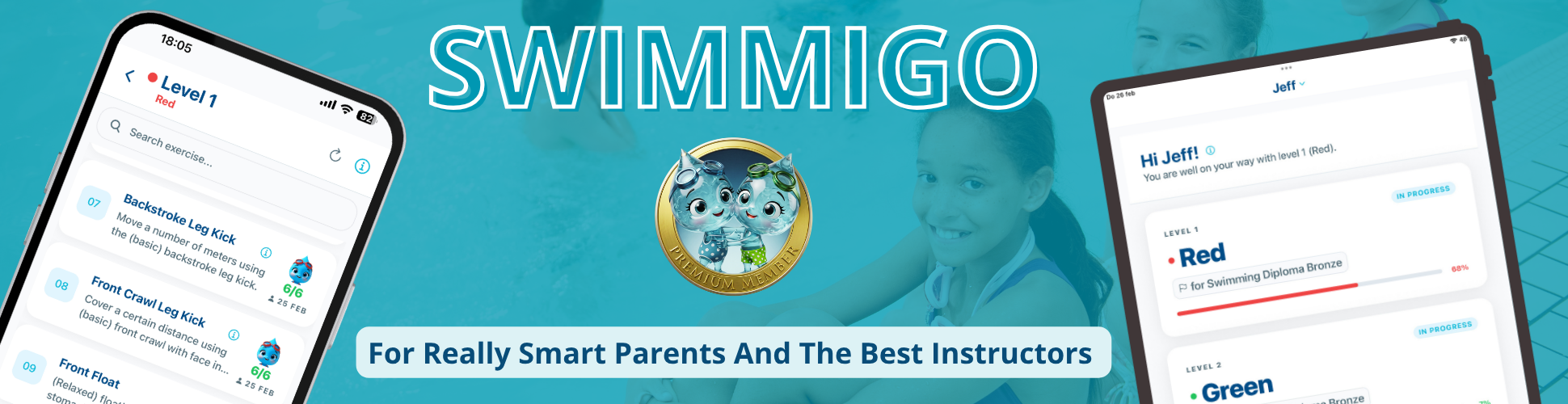
With children, parents want to see progress. With adults, it is the student themselves who needs insight. Adult beginners are often critical of themselves, underestimate their progress, and forget how far they have come. A visual student tracking system solves this. With Swimmigo, you work with 7 colored levels (Red through Gold) and 86 concrete skills that you can score per student from 0 to 6 smileys. The adult student watches along on their own screen and sees exactly which skills they master and where work is still needed.
Away from paper lists: digital registration during the lesson
Many swim instructors still scribble scores on a wet piece of paper at the pool edge. With adults, this backfires: it feels school-like and childish. A quick swipe on your phone or tablet during the lesson is more discreet and professional. Moreover, you immediately have an overview of the complete swimming lesson progress of all your students, both children and adults, in one dashboard.
Adding notes for personalized guidance
Every adult student has a unique learning path. One gets stuck on breathing, another does not dare to let go of the edge. In Swimmigo, you add a short note to each skill: 'Breathing panicky during breaststroke, next lesson focus on calm exhaling at the edge.' At the next lesson, or when handing over to a colleague, all context is immediately available. No information loss, no frustration for the student.
Communication with adult students: what to say and what not to say
Avoid patronizing language
Adults are not big children. Address them as equal participants in a learning process. 'Good job, kid!' or 'Look what you can already do!' works for a 7-year-old but feels humiliating for a 50-year-old professional. Use neutral, respectful language: 'Your breathing was calmer than last week, that is exactly the progress we are looking for.' Be specific in your compliments, not childish.
Provide insight into the 'why'
Children do an exercise because the teacher says so. Adults want to understand why they are doing something. Explain: 'We practice back floating because later during breaststroke breathing you need to be able to rest on your back when you get tired.' An adult who understands the purpose practices more motivated and remembers the technique better.
Actively ask for feedback
Adult students have opinions about what works and what doesn’t for them. Ask at the end of each lesson: 'Which exercise felt most comfortable today? Which did you find most challenging?' This feedback helps you as an instructor to adjust the next lesson, and it gives the student a sense of control over their own learning process.
Common mistakes in swimming lessons for adults
Wanting to go too fast
A pitfall almost every instructor falls into: speeding up the lesson because the student 'gets it now anyway.' A child who masters a skill wants to move on immediately. An adult needs repetition, not for technique but for confidence. Stay at the same skill for at least two lessons, even if the technique is already good. The second lesson consolidates confidence.
Physically touching without permission
With children, a hand on the back to correct posture is normal. With adults: always ask first. 'May I adjust your shoulders?' is a small phrase that makes a big difference in the feeling of safety. This applies to all instructors worldwide: respect for physical boundaries is universally and culturally important.
Focusing only on technique, not on mindset
An adult beginner who is afraid does not learn. Period. You can demonstrate the most beautiful breaststroke in the world, but if the student is tense, nothing comes of it. Spend at least as much attention on relaxation exercises, breathing techniques, and positive reinforcement as on the strokes themselves. A relaxed student with mediocre technique is safer in the water than a tense student with perfect technique.
Group lessons versus private lessons: what works better for adults?
The power of group lessons: peer support
Adult beginners who take lessons together discover they are not the only ones with water fear. This is enormously powerful. Peer contact normalizes the fear and creates a mutual support structure. Organize group lessons for a maximum of 4 to 6 adults of similar level. Too large groups backfire: personal attention disappears and shame increases.
The power of private lessons: full focus on individual blocks
Some adults have such specific fears that a group is overwhelming. A 1-on-1 setting gives you the space to work fully tailored. The downside is the lack of peer contact, and the costs are higher. With Swimmigo, you can still give private students a sense of progress: the app shows the same levels and skills as in group lessons, and the student sees their own growth in graphs.
How to attract new adult students as a swim school
Communicate that you specialize in adults
Many adult non-swimmers think swimming lessons are 'for children.' They don’t even look for options because they assume none exist. Make it explicitly clear on your website and social media that you guide adult beginners. Use photos of real adult students (with permission), not stock photos of smiling toddlers. The message should be: 'You are not alone, you are welcome, and we know how to help you.'
Offer a free trial lesson or introductory meeting
The step to the pool is huge for many adult beginners. Lower the threshold with a no-obligation introduction: no commitments, no swimwear needed, just a chat at the pool edge. Show the water, explain how the lessons work, reassure. This 20-minute investment often results in a student who otherwise would never have come.
Practical step-by-step plan for your first swimming lesson with an adult
Before the lesson: preparation
Send a short, friendly email or message a day before: 'We look forward to seeing you tomorrow at 10:00 at pool X. Bring a towel and swimwear you feel comfortable in. We’ll start calmly in the shallow pool. See you tomorrow!' This confirmation reduces no-shows, which are high among anxious beginners.
During the lesson: the structure
Minutes 0 to 5: welcome and chat at the pool edge. Minutes 5 to 15: dryland mobility exercises. Minutes 15 to 30: water acclimation in the shallow pool, walking, blowing bubbles, floating with support. Minutes 30 to 40: first leg movement at the edge. Minutes 40 to 45: closing, compliment, homework assignment (practice under the shower).
After the lesson: recording and follow-up
Immediately after the lesson, open Swimmigo and check off the achieved skills. Add a short note about the progress. The adult student receives a push notification on their phone with the update. Send a short message that same evening: 'Great first lesson today! Your jellyfish float was almost fully independent. Next week we’ll build on that.' This aftercare is the difference between a student who returns and one who drops out.
Conclusion
Teaching swimming to adult beginners is one of the most rewarding tasks you can have as a swim instructor. You don’t just teach a technical skill; you literally give someone the key to safety in and around water. The approach requires patience, psychological insight, and a different didactic method than with children, but the impact is enormous. With a free tool like Swimmigo, you make progress visible to your student, save administrative time, and build a professional swim school that also welcomes adult beginners.
Ready to get started?
- Create a free instructor account on Swimmigo
- View the 7 levels and 86 skills
- Discover all features for swim instructors
Frequently Asked Questions
General questions about swimming lessons for adults
Frequently asked questions from adult beginners
Frequently asked questions from swim instructors
Sources
- WHO: Drowning fact sheet, May 2026. Global drowning statistics and prevention strategies.
- CBS: 146 people drowned in 2024, July 2025. Dutch drowning figures by age group and region.
- EenVandaag: 3 out of 10 elderly say they swim poorly, 2024. Opinion panel research among those over 65 about swimming ability.
- U.S. Masters Swimming: Adult Learn-to-Swim Volunteer Teacher Guide, methodologies for teaching adults to swim.
- National Council for Swimming Safety (NRZ), Dutch organization for swimming safety policy and prevention.

Bob van Soest
As an expert in operating sports facilities (such as swimming pools) and developer of, among others, Swimmigo.com, I am passionately committed to making swimming lessons simpler, more fun and more insightful for parents, swimming instructors and everyone who wants to learn to swim.
Frequently Asked Questions
Related articles
![How to Motivate Children Stuck at the Same Swimming Level: Practical Tips for Instructors [2026]](/_next/image?url=https%3A%2F%2Fzvblogpostimages.s3.eu-west-3.amazonaws.com%2FAUTOMATISCH_UPLOAD%2F1_ac831cb13894.jpg&w=3840&q=75&dpl=dpl_8HBmXj8pyjjziKcbXKHvXrtJMU4a)
How to Motivate Children Stuck at the Same Swimming Level: Practical Tips for Instructors [2026]
Practical tips for swim instructors to motivate children who are stuck at a swimming level. Discover how small adjustments and the 0-6 smiley system can lead to significant progress.
![How Visual Progress Systems Boost the Motivation of Swimming Students: From Stars to Smileys [2026]](/_next/image?url=https%3A%2F%2Fzvblogpostimages.s3.eu-west-3.amazonaws.com%2FAUTOMATISCH_UPLOAD%2F1_0d5ccbf68313.jpg&w=3840&q=75&dpl=dpl_8HBmXj8pyjjziKcbXKHvXrtJMU4a)
How Visual Progress Systems Boost the Motivation of Swimming Students: From Stars to Smileys [2026]
Discover how visual progress systems like stars, smileys, and badges enhance the motivation of swimming students. Practical tips for swim instructors.
![Teaching Swimming to Children with ADHD and Autism: Practical Tools for Swim Instructors [2026]](/_next/image?url=https%3A%2F%2Fzvblogpostimages.s3.eu-west-3.amazonaws.com%2FAUTOMATISCH_UPLOAD%2F1_09a8d1d9c113.jpg&w=3840&q=75&dpl=dpl_8HBmXj8pyjjziKcbXKHvXrtJMU4a)
Teaching Swimming to Children with ADHD and Autism: Practical Tools for Swim Instructors [2026]
Practical tools for swim instructors teaching children with ADHD and autism. From sensory processing to water safety, with concrete tips.
Discover Swimmigo
The all-in-one app for swimming lesson progress. For parents, swim schools, and adult swimmers.