HowVisualProgressSystemsBoosttheMotivationofSwimmingStudents:FromStarstoSmileys[2026]
![How Visual Progress Systems Boost the Motivation of Swimming Students: From Stars to Smileys [2026]](/_next/image?url=https%3A%2F%2Fzvblogpostimages.s3.eu-west-3.amazonaws.com%2FAUTOMATISCH_UPLOAD%2F1_0d5ccbf68313.jpg&w=3840&q=75&dpl=dpl_2Ynk5cY6jv9wUPiBxprwVAgs8ZUK)
Summary
- Visual progress systems such as stars, smileys, and badges make abstract progress tangible for children aged 3 to 12
- Research shows that gamification elements like visual feedback significantly increase intrinsic motivation in children
- A digital smiley system with 6 levels provides both instructors and parents immediate insight into swimming lesson progress
- Swimmigo combines visual badges with push notifications upon level upgrades, keeping parents and children actively engaged
TLDR
- Visual progress systems such as stars, smileys, and badges make abstract progress tangible for children aged 3 to 12
- Scientific research shows that gamification, including visual feedback, significantly increases intrinsic motivation in children
- A digital smiley system with 6 levels provides both instructors and parents with immediate, real-time insight into swimming lesson progress
- Swimmigo combines visual badges with push notifications upon level upgrades, keeping children and parents actively engaged in all 5 languages
Why Visual Progress Is Indispensable in Swimming Lessons
A child learning to swim makes small steps forward every week. One lesson they manage to float a little longer, the next lesson the arm movement becomes smoother. For a child of 4 or 5 years old, these small improvements are barely noticeable. They look at the end goal – that diploma on the wall – which can still take months or even years. According to NRZ and the Mulier Institute, nearly four out of ten children aged 6 to 12 obtained the full Zwem-ABC in 2024. This means the remaining children are still on a path that requires a lot of perseverance.
This problem is not unique to the Netherlands. Worldwide, parents and instructors face the same challenge: how do you keep a child motivated for weeks while the end goal seems far away? The solution lies in visual progress systems. By making every small step visible – whether with stickers, stars, smileys, or digital badges – a child receives tangible proof of growth every week. And that proof is exactly what is needed to keep going.
The Psychology Behind Visual Feedback
Children aged 3 to 12 mostly think concretely. Abstract concepts like 'progress' or 'skill' are hard to understand without visual support. A smiley changing from neutral to happy, a star being added, or a badge being 'unlocked' translates abstract progress into something a child can see and feel.
A 2023 systematic review in PMC showed that gamification elements, including visual progress indicators, significantly increase student motivation and engagement. The effect is strongest in younger children and for repetitive tasks. Swimming lessons fit perfectly into this category: practicing the same strokes weekly, swimming laps, refining technique. Visual feedback breaks the monotony.
Also, recent research from December 2025 confirms that learners prefer tools that visualize learning progress and provide actionable feedback over competitive elements like leaderboards or rankings. This is relevant for swimming lessons: it’s not about who is fastest, but about who sees that they are growing.
From Stickers to Apps: The Evolution of the Progress System
Twenty years ago, the ultimate progress system consisted of a sticker sheet and a pen. The instructor stuck a sticker on a card, and parents saw once a month how their child was doing. It worked, but had limitations: stickers get lost, cards are forgotten, and the information was always at least a week old.
Today, we have digital systems that provide real-time insight. The essence is the same – visual feedback on performance – but the execution has radically improved. Parents open an app and immediately see what their child learned in the last lesson. Instructors tap on their phone and the whole group is updated. No paperwork, no lost stickers, no guesswork.
This digital transition is not just a convenience consideration. The WHO reports that drowning is the third leading cause of unintentional injury worldwide, with children aged 1 to 4 as the highest risk group. Faster, more efficient swimming lessons – enabled by better progress tracking – literally save lives. An instructor who immediately sees which student is falling behind can intervene faster.
The Smiley System: Simple Yet Effective
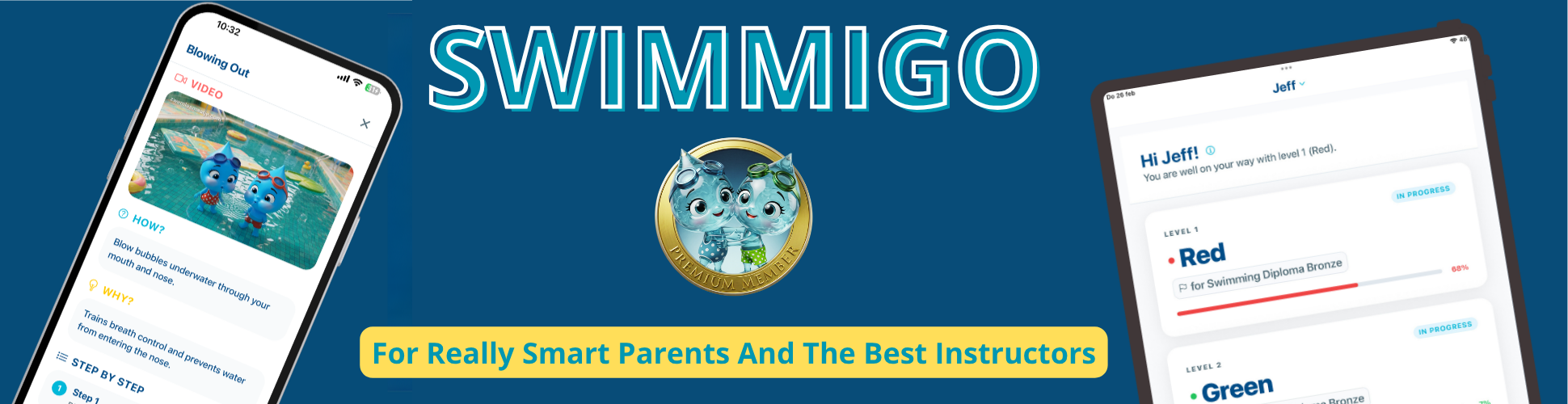
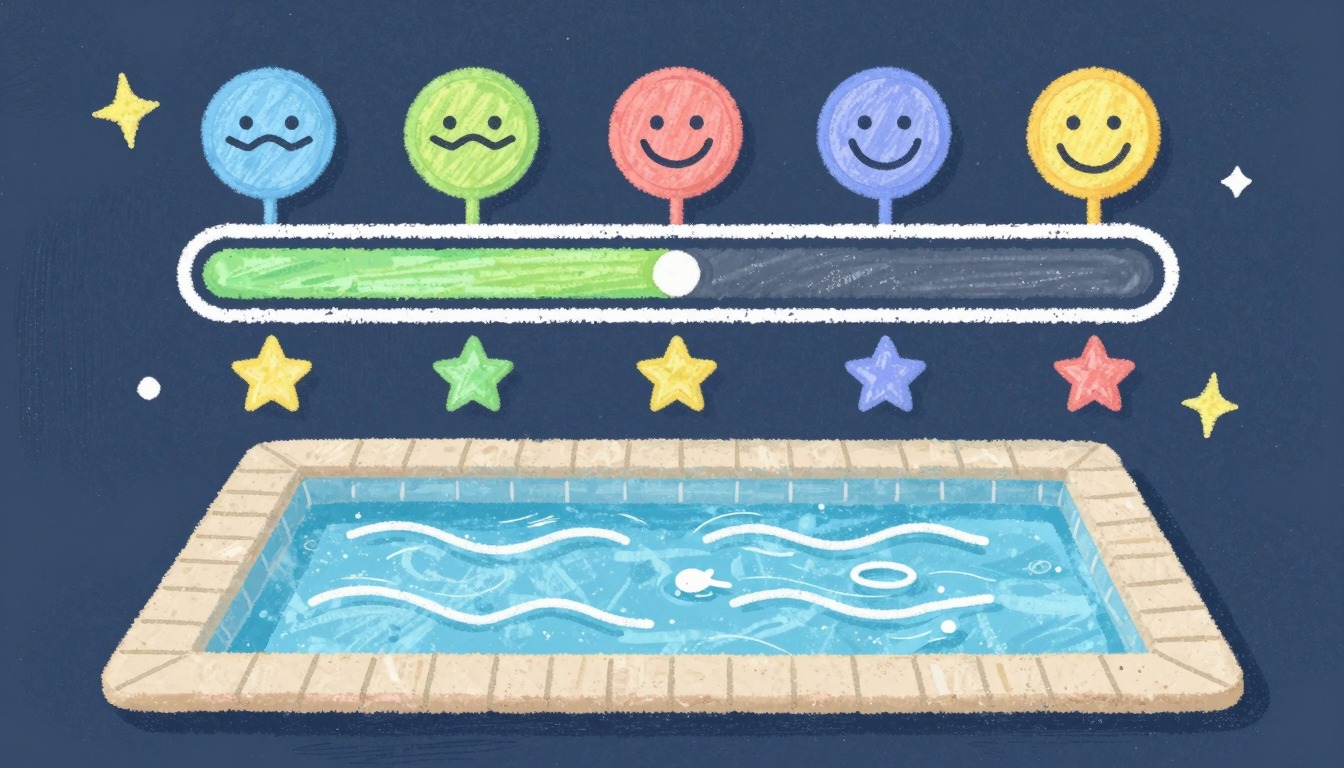
Swimmigo uses a 0 to 6 smiley system. For each skill, the student receives a score from 0 (not started) to 6 (perfectly executed). This system is deliberately kept simple, and that is exactly why it is so effective. A 4-year-old child does not understand what 'sufficient' or 'insufficient' means on a report. But a happy smiley versus a neutral smiley? Every child understands that immediately.
For instructors, the smiley system offers another advantage: speed. Between two lesson parts, you swipe on your phone and the score is recorded. No score sheets, no complicated forms, no administration that eats into lesson time. In a sector where instructors typically guide 30 children per week, every second you can spend in the water instead of on the sidelines counts.
7 Levels, 86 Skills: Structure as a Motivator
The strength of Swimmigo’s system lies not only in the smileys but in the structure around them. The platform divides swimming skills into 7 clear levels: Red, Orange, Yellow, Green, Blue, Purple, and Gold. Each level builds on the previous one, and each level has a visual badge that the child 'earns'.
This structure gives children a sense of direction. They know exactly what the next step is and can track their own progress via the parent app. For parents, it is equally valuable: instead of a vague 'it’s going okay' from the instructor, they get a detailed overview of exactly which skills their child masters and which still need work.
The result is a positive feedback loop: the child sees progress, gets excited, practices better, sees more progress. The instructor only needs to keep track of the scores, and the system does the rest.
Push Notifications as an Extra Motivation Boost
An underestimated element of digital progress systems is the push notification. When a child reaches a higher level in Swimmigo, both parents receive a notification on their phone: 'Emma has advanced to Green level!' That notification is more than just an alert. It’s a shared moment of success that encourages parents to talk with their child, give compliments, and give swimming lessons a prominent place in family life.
For instructors, this is indirectly valuable as well. Parents who are actively involved in their child’s swimming progress ensure more motivated students. And motivated students progress faster, leading to shorter trajectories and less dropout. It’s a win for everyone.
Diplomas and Certificates: The Tangible End Goal
At levels 5, 6, and 7 (Blue, Purple, and Gold), Swimmigo automatically generates a personalized swimming diploma. Name, date, level, and a unique design that matches the achievement. Not a generic template, but a real diploma that can be hung on the wall.
For the lower levels (Red through Green), there is a free swimming certificate. This is also customizable with the child’s name. The idea is simple: every level is a milestone to celebrate. Not only the final A, B, or C diploma counts, but every step along the way.
The Instructor as the System’s Hub
No matter how well a visual progress system is designed, the instructor remains the key link. The smiley or badge is the visual proof, but the instructor’s verbal feedback gives it meaning. 'Look Emma, last week you had a 3 on your backstroke and now a 5. How much you’ve grown!' combines the system’s power with the human touch.
Practically, this means instructors must fill in their scores with care. A quick swipe is convenient, but it only works if the assessment is accurate. Swimmigo’s system is designed so that entering scores literally takes seconds, allowing instructors to spend that time in the water giving personal feedback.
Multilingual and Worldwide: Progress Without Language Barriers
An often overlooked aspect is the language barrier. In a country like the Netherlands, the number of expat families and non-Dutch-speaking parents is growing. Swimmigo is available in Dutch, English, German, French, and Spanish, meaning an instructor enters scores in their own language, but parents view progress in their native language. The visual nature of the smileys also bridges any language barrier: a happy smiley means the same in every language, whether you swim in Amsterdam, Berlin, or Barcelona.
This international approach makes Swimmigo not only suitable for Dutch swim schools with expat students but also for swim schools worldwide looking for a free, user-friendly student tracking system.
Group Management: Overview at a Glance
For instructors managing multiple groups, overview is just as important as individual scores. Swimmigo shows per group who is at which level, who is at risk of falling behind, and who is ready for the next step. Moving students between groups is done with a swipe gesture. Group organization becomes child’s play instead of administrative hassle.
Also for swim schools with multiple instructors and locations, the system provides a solution. Every instructor works in the same environment, sees the same data, and can seamlessly continue where a colleague left off. No handover moments where information is lost, no double administration, no 'which instructor was Emma with again?'
Data and Growth: Statistics That Help the Swim School
Besides daily practice, Swimmigo also offers insight on a macro level. How long do students typically take to move from Green to Blue? At which skill do most children temporarily drop off? Are there seasonal patterns visible in progress? This data helps swim schools optimize their lesson programs and identify weak spots in the method.
For a sector that traditionally works little with data, this is a revolution. Instructors who have taught 'by feel' for years now get objective numbers that confirm their intuition or provide surprising new insights. And the best part: this data is automatically generated as a byproduct of daily scoring. No extra work, just extra insight.
Free: Because Safety Shouldn’t Have a Subscription
Perhaps the most remarkable thing about Swimmigo is that it is completely free. No subscription fees, no hidden costs, no premium tier you have to buy for the best features. In a market where student tracking systems quickly cost tens of euros per month, this is a conscious choice. The World Health Organization recognizes drowning prevention as a global priority and tools that contribute to better swimming lessons should not have financial barriers.
This philosophy aligns with the mission of independent swim instructors and small swim schools: they want the best for their students but have no budget for expensive software packages. Swimmigo gives them the same professional tools as large chains, without costing them a cent.
Conclusion
Visual progress systems are not toys: they are a proven effective method to keep children motivated during the often months-long swimming lesson journey. Whether you work with stickers on a poster or with a digital app like Swimmigo, the principle remains the same: make progress visible, celebrate small successes, and give both child and parent the feeling that every swimming lesson counts. In a world where swimming safety literally saves lives, every improvement in the learning process is one we must not overlook.
Want to Know More About Swimmigo?
- Swimmigo for Parents: real-time insight into your child’s swimming lesson progress
- Swimmigo for Instructors: free tools for group management, scoring, and communication
- All Features: discover the complete overview of the platform
- Swimming Levels: from Red to Gold, the full structure of the level system
- How It Works: a visual walkthrough from registration to automatic diploma
Sources
- NRZ: More and More Children in the Netherlands Obtain Swimming Diplomas A, B, and C, November 2025
- WHO: Drowning Fact Sheet, updated 2024
- PMC: Examining the Effectiveness of Gamification as a Tool Promoting Student Motivation, 2023
- arXiv: Gamification with Purpose, What Learners Prefer to Motivate Their Learning, December 2025
- WHO: World Drowning Prevention Day, July 25, annually
- Mulier Institute: More Children Obtain All Three Swimming Diplomas, 2025

Bob van Soest
As an expert in operating sports facilities (such as swimming pools) and developer of, among others, Swimmigo.com, I am passionately committed to making swimming lessons simpler, more fun and more insightful for parents, swimming instructors and everyone who wants to learn to swim.
Frequently Asked Questions
Related articles
![How to Motivate Children Stuck at the Same Swimming Level: Practical Tips for Instructors [2026]](/_next/image?url=https%3A%2F%2Fzvblogpostimages.s3.eu-west-3.amazonaws.com%2FAUTOMATISCH_UPLOAD%2F1_ac831cb13894.jpg&w=3840&q=75&dpl=dpl_2Ynk5cY6jv9wUPiBxprwVAgs8ZUK)
How to Motivate Children Stuck at the Same Swimming Level: Practical Tips for Instructors [2026]
Practical tips for swim instructors to motivate children who are stuck at a swimming level. Discover how small adjustments and the 0-6 smiley system can lead to significant progress.
![How to Effectively Teach Swimming to Adult Beginners: A Practical Guide for Swim Instructors [2026]](/_next/image?url=https%3A%2F%2Fzvblogpostimages.s3.eu-west-3.amazonaws.com%2FAUTOMATISCH_UPLOAD%2F1_311d6586a746.jpg&w=3840&q=75&dpl=dpl_2Ynk5cY6jv9wUPiBxprwVAgs8ZUK)
How to Effectively Teach Swimming to Adult Beginners: A Practical Guide for Swim Instructors [2026]
Adult beginners require a different swimming lesson approach than children. Discover the 5 biggest challenges and practical exercises for instructors.
![Teaching Swimming to Children with ADHD and Autism: Practical Tools for Swim Instructors [2026]](/_next/image?url=https%3A%2F%2Fzvblogpostimages.s3.eu-west-3.amazonaws.com%2FAUTOMATISCH_UPLOAD%2F1_09a8d1d9c113.jpg&w=3840&q=75&dpl=dpl_2Ynk5cY6jv9wUPiBxprwVAgs8ZUK)
Teaching Swimming to Children with ADHD and Autism: Practical Tools for Swim Instructors [2026]
Practical tools for swim instructors teaching children with ADHD and autism. From sensory processing to water safety, with concrete tips.
Discover Swimmigo
The all-in-one app for swimming lesson progress. For parents, swim schools, and adult swimmers.