HowtoBuildTrustasaSwimInstructorwithAnxiousChildren:PracticalStep-by-StepGuide[2026]
![How to Build Trust as a Swim Instructor with Anxious Children: Practical Step-by-Step Guide [2026]](/_next/image?url=https%3A%2F%2Fzvblogpostimages.s3.eu-west-3.amazonaws.com%2FAUTOMATISCH_UPLOAD%2F1_c786774efa71.jpg&w=3840&q=75&dpl=dpl_FJwcKYU1WneRMMovk4KpoLXjy37E)
Summary
- Three out of ten children experience fear of water: it is not an exception but a common reality in every swim class group
- Anxious children do not learn by 'just doing' but through a structured step-by-step plan of detecting, calming the nervous system, and stacking micro successes
- With the Swimmigo smiley system (0 to 6) and digital progress files, you transparently build trust with both child and parent
- The techniques in this article work universally: the human stress response to water is the same in every country and language
TLDR
Anxious children take on average two to three times as much lesson time as confident students. This step-by-step guide gives you concrete techniques to build trust without slowing down the group's progress.
Introduction: the silent problem in every swim class group
You recognize it immediately: a child clinging to the edge, refusing to enter the water, or freezing as soon as the water reaches their shoulders. Fear of water in children is not the exception but the rule. About 3 in 10 children experience some degree of fear of water, according to research by Ouders van Nu. For you as a swim instructor, this is a daily reality that affects your lesson pace, group dynamics, and ultimately the swimming progress of all students.
The good news? Fear of water is not a fixed personality trait. It is a learned response and can therefore be unlearned. Academic research from Bowling Green State University (Khatchaturian et al., 2022) shows that building a trusting relationship and allowing the child to experience control are the two most decisive factors for swimming success in anxious students.
This article provides you with a complete, practice-oriented step-by-step plan to build trust with anxious children. Not theory from a textbook, but techniques you can apply in the water tomorrow. And this is not only a Dutch challenge: worldwide, about 300,000 people drown annually, of which children under 5 years old make up nearly a quarter, reports the World Health Organization (WHO, 2026). Every swim instructor who helps an anxious child overcome the threshold contributes to reducing these numbers, whether you teach in the Netherlands, Germany, France, Spain, or England. The platform Swimmigo is available in all these 5 languages and is used worldwide by swim instructors who tackle exactly this challenge.
Why traditional approaches fail with anxious children
1. The 'just do it' principle backfires
"Just jump in, you'll get used to it." This approach is not only ineffective, it is downright harmful. In anxious children, forced exposure activates the stress response system: heart rate up, muscle tension increases, breathing becomes shallow. A child in this state cannot physically learn new motor skills. The brain is in survival mode, not learning mode. What you should do instead: calm the nervous system first before introducing skills.
2. The pitfall of extra attention
Your intuition says: more attention for the anxious child. But too much focus can achieve the opposite. The child feels watched, group pressure increases, and anxious behavior is unintentionally reinforced because it attracts attention. The art is to provide support without putting the child in the spotlight.
3. Ignoring processing speed
Anxious children process instructions more slowly. Not because they are less intelligent, but because their working memory is partly occupied by anxiety. If you give three instructions in a row ("grab the board, put your head in the water, kick your legs"), an anxious child may only register the first. One instruction at a time, with space for processing, is the key.
The step-by-step plan: from fear to trust in 5 phases
Phase 1: Detect and acknowledge (the first lesson)
Before you do anything, you must first observe. Watch for these signals upon arrival: does the child stay close to the parent? Avoid eye contact with you? Look at the water as if it is a threat? In the water: does the child squeeze the edge until knuckles turn white? Keep shoulders raised (stress posture)? Are lips or legs trembling? The first, most important step is acknowledgment. Name what you see without judgment: "I see that you find this scary. That’s okay. Today we will just see what you like." This simple sentence measurably reduces the stress response: the child feels seen and taken seriously.
Phase 2: Calm the nervous system
An anxious nervous system is like a smoke detector going off at a candle flame. You must first turn off the alarm before proceeding. Three proven techniques: Blowing exercises at the edge: let the child blow bubbles on the water as if blowing out birthday candles. This activates the vagus nerve, the brake on the stress system. Counting games: "How many blue tiles do you count on the bottom?" Cognitive distraction shifts focus from fear to curiosity. Water familiarization through hands: start not with submersion but with hands in the water, splashing with fingers. The brain progressively associates water with 'safe' instead of 'danger'.
Phase 3: Stack micro successes
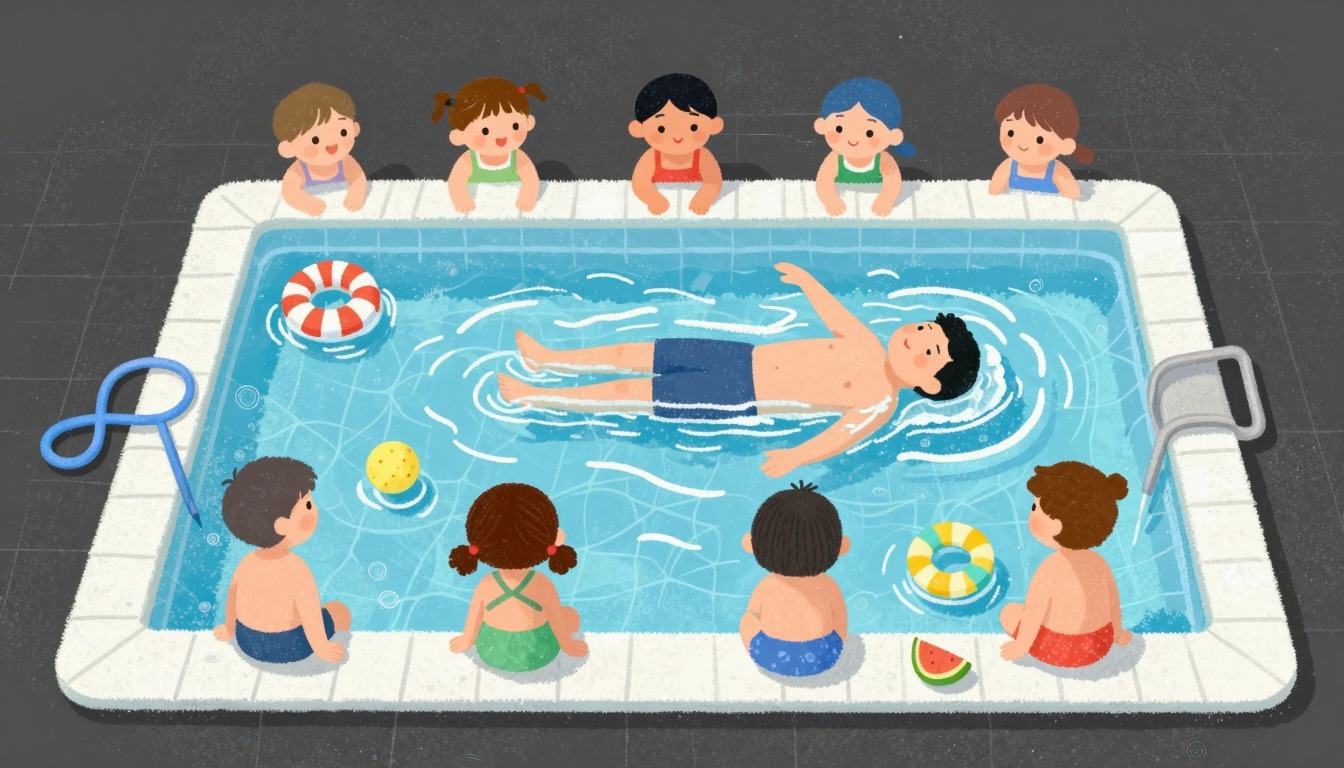
The core of building trust is accumulating positive experiences. Every successful action, no matter how small, strengthens the child's belief in their own ability. The step-by-step plan works like a staircase where each step is a safe success: Step 1: sitting on the edge with feet in the water (2 minutes). Step 2: standing on the stairs up to hip height. Step 3: walking along the edge up to chest height. Step 4: holding the edge with two hands, wetting the head. Step 5: holding the edge with one hand, floating on the stomach with a board. Step 6: holding the board and kicking legs, instructor stays within arm's reach. Document each step. In a tool like Swimmigo you can track progress per skill and visually show the child how far they have come, which is a powerful motivator.
Phase 4: Use group dynamics as medicine
One-on-one guidance for an anxious student works short term, but the goal is integration into the group. There are opportunities you as an instructor can actively use: Pair the anxious child with a confident buddy. Children learn faster from peers than adults. The buddy demonstrates, the anxious child first observes and then imitates. Let the group celebrate successes: "Look everyone, Anna just put her head underwater for the first time!" Group applause reinforces positive feelings and normalizes the process. Use circle games where each child takes a turn doing something. The anxious child sees others first, can anticipate what is coming, and joins when ready. No one is forced, everyone is invited.
Phase 5: Facilitate the transition from 'must' to 'want'
The holy grail: the moment the child swims not because the teacher says so, but because they want to. You achieve this by giving autonomy within clear boundaries: Build in choice moments: "Shall we float first or jump first?" The child experiences control over the situation. Let the child name what they already can do: "What have you learned today?" The child verbalizes their own progress. Spark curiosity instead of demanding performance: "Would you like to know how it feels to look underwater?" instead of "Now you go underwater."
Common mistakes and how to avoid them
6. Wanting to go too fast
The biggest mistake instructors make: thinking the child is 'over it' after one good lesson and immediately taking them to the deep end next lesson. Building trust is not a straight line but a zigzag. A setback after a challenging exercise is normal and part of the process. Keep returning to the last achieved success level and build from there.
7. Unintentionally labeling the child
"Liam is our scaredy-cat, he’ll stay by the stairs a while longer." Such labels, however well-intentioned, have a self-fulfilling prophecy effect. The child hears it, internalizes it, and behaves accordingly. Speak in possibilities, not limitations: "Liam is working on water familiarization on the stairs today" instead of "Liam is still afraid."
8. Forgetting the parent component
Anxious children often have anxious parents. The child looks not only at you during the lesson but also at the parent in the stands. If that parent watches tensely, arms crossed, frowning, the child registers that and confirms the fear. Tip: invite the parent for a short conversation after the lesson. Tell them what went well and ask them to watch relaxed. As simple as it sounds: a smiling parent in the stands significantly speeds up the trust process.
Digital tools that make a difference
9. Make progress visible for child and parent
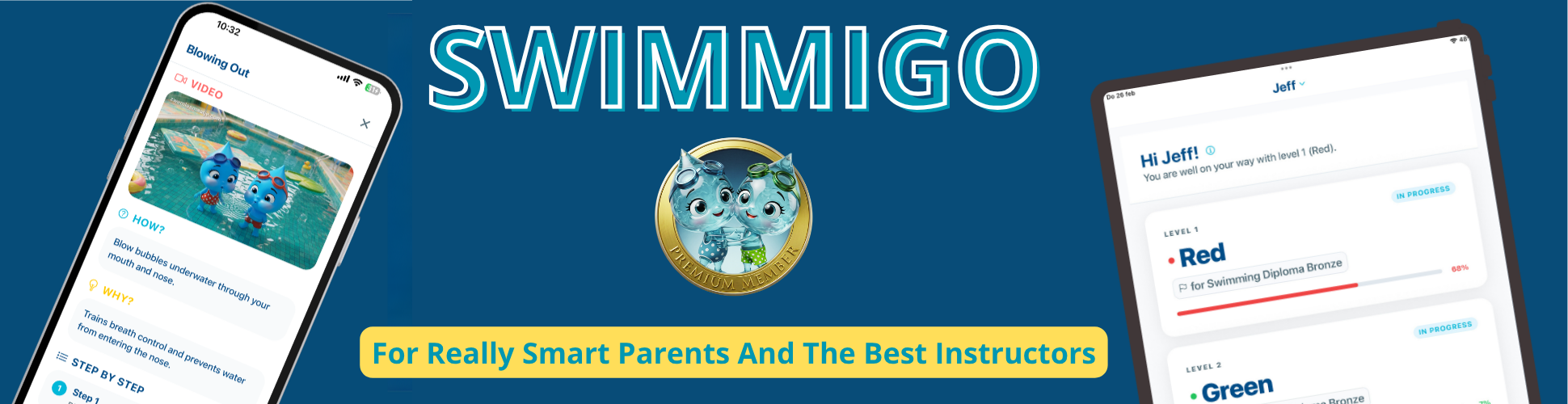
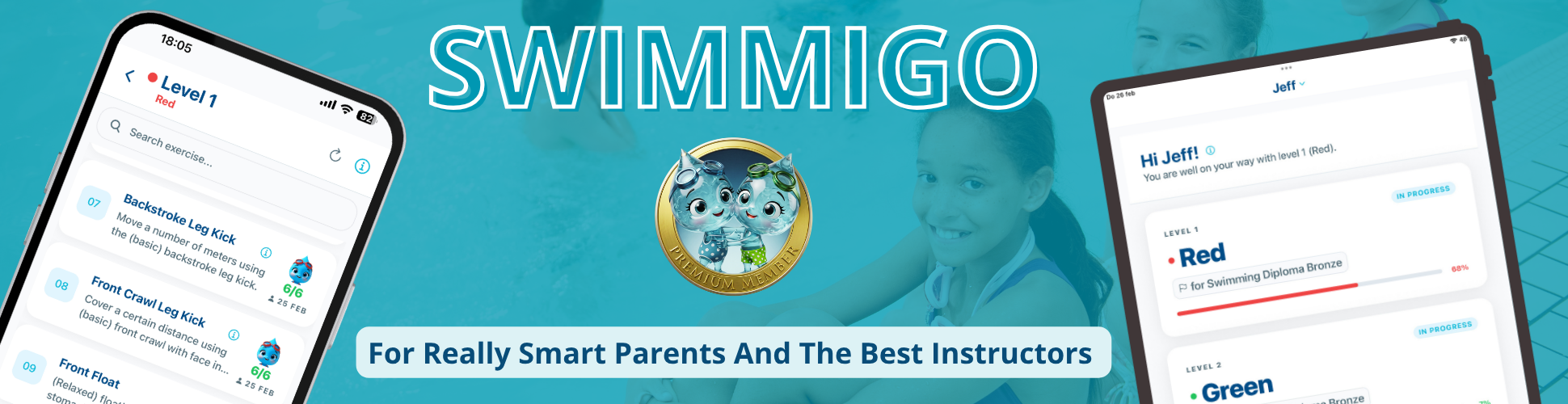
A child who cannot easily put feelings into words can point to a smiley. Swimmigo works with a 0 to 6 smiley system per skill. For an anxious child, seeing that first colored smiley is a breakthrough. For the parent in the stands, real-time insight into progress via the parent app is reassuring and prevents the dreaded "What did you learn today?" question after the lesson.
10. Lesson handover without information loss
Anxious children suffer most from instructor changes. A new face in the water means for them: explaining your fears again, rebuilding trust, proving what you already can do again. With a digital tool like Swimmigo, you transfer the complete progress file including notes on what works and what doesn’t for this specific child. Colleagues see at a glance: "Ah, Anna is on step 3, works well with visual instruction, finds water kicking scary, does better after a blowing exercise." That saves weeks of buildup time.
From local practice to global standard
11. The universal nature of fear of water
Whether you teach in Amsterdam, Berlin, Paris, Madrid, or London: an anxious child in the water shows the same signals everywhere. The tight shoulders, fixed gaze, shallow breathing: the human stress response is universal. That is why this step-by-step plan works in every country, language, and swim school. The WHO emphasizes in its latest report that swimming skills are the most effective intervention against drowning, regardless of geographic or socioeconomic context. It all starts with one thing: trust in the water.
12. Swimmigo as a shared language among instructors worldwide
Swimmigo’s 0 to 6 smiley system transcends language barriers. Whether your instructor speaks Dutch, English, German, French, or Spanish: the smileys are the same for everyone, the progress file is standardized, and the methodology is consistent. In a world where swim schools increasingly work internationally, with expat families and holidaymakers from all over Europe, that uniformity is priceless. A child taking lessons in Spain and going to a Dutch outdoor pool in summer: the instructor sees at a glance where the child stands.
Conclusion
Building trust with anxious children is not a matter of talent but of technique. With the right approach, detection, and patience, you can turn any anxious child into a confident swimmer. The step-by-step plan of detecting, calming the nervous system, stacking micro successes, utilizing group dynamics, and stimulating autonomy works in every language and country. Combine this with a digital tool like Swimmigo that makes progress visible and transferable, and as an instructor, you have everything in hand to deliver not only water-safe children but also children who enjoy going into the water.
Discover what Swimmigo can mean for your swim school
- Swimmigo for instructors: 100% free student tracking system, planning tools, and parent communication
- All features: from group management to certificates and marketing toolkit
- The 7 levels and 86 skills: from Red (water familiarization) to Gold (fully water safe)
- How does Swimmigo work?: an interactive tour of the platform
Frequently Asked Questions from Swim Instructors
Frequently Asked Questions from Parents
Frequently Asked Questions from Swim Schools
Sources
- WHO: Drowning Fact Sheet : May 2026. Global drowning statistics and prevention strategies
- CBS: 100 residents drowned in 2025, mostly 60+ : May 2026
- National Council for Swimming Safety: Swimming Safety : definition of swimming safety and National Standard
- Khatchaturian et al. (2022): Swimming Without Fear: Equitable Instruction : International Journal of Aquatic Research and Education : academic research on building trust with anxious swim students
- Aqua-Tots Swim School: 7 Tips to Help Kids Overcome a Fear of Water : practical techniques for instructors and parents
- Ouders van Nu: Fear of Water in Your Child : practical figures on prevalence of fear of water in children
Bob van Soest
As an expert in operating sports facilities (such as swimming pools) and developer of, among others, Swimmigo.com, I am passionately committed to making swimming lessons simpler, more fun and more insightful for parents, swimming instructors and everyone who wants to learn to swim.
Frequently Asked Questions
Related articles
![Adaptive Swimming: How Free Tools Help Instructors Eliminate Waiting Lists [2026]](/_next/image?url=https%3A%2F%2Fzvblogpostimages.s3.eu-west-3.amazonaws.com%2FAUTOMATISCH_UPLOAD%2F1_c80b500e1024.jpg&w=3840&q=75&dpl=dpl_FJwcKYU1WneRMMovk4KpoLXjy37E)
Adaptive Swimming: How Free Tools Help Instructors Eliminate Waiting Lists [2026]
Instructors in adaptive swimming face pressure from growing waiting lists. Discover how free tools like Swimmigo assist with administration, progress tracking, and parent communication.
![How Visual Progress Systems Boost the Motivation of Swimming Students: From Stars to Smileys [2026]](/_next/image?url=https%3A%2F%2Fzvblogpostimages.s3.eu-west-3.amazonaws.com%2FAUTOMATISCH_UPLOAD%2F1_0d5ccbf68313.jpg&w=3840&q=75&dpl=dpl_FJwcKYU1WneRMMovk4KpoLXjy37E)
How Visual Progress Systems Boost the Motivation of Swimming Students: From Stars to Smileys [2026]
Discover how visual progress systems like stars, smileys, and badges enhance the motivation of swimming students. Practical tips for swim instructors.
Discover Swimmigo
The all-in-one app for swimming lesson progress. For parents, swim schools, and adult swimmers.