HowtoMotivateChildrenStuckattheSameSwimmingLevel:PracticalTipsforInstructors[2026]
![How to Motivate Children Stuck at the Same Swimming Level: Practical Tips for Instructors [2026]](/_next/image?url=https%3A%2F%2Fzvblogpostimages.s3.eu-west-3.amazonaws.com%2FAUTOMATISCH_UPLOAD%2F1_ac831cb13894.jpg&w=3840&q=75&dpl=dpl_8HBmXj8pyjjziKcbXKHvXrtJMU4a)
Summary
- Discover why children sometimes remain stuck at the same swimming level for months and what you as an instructor can do about it
- Learn how small adjustments in your lesson structure make a world of difference in motivation and enjoyment
- Use Swimmigo’s 0-6 smiley system to make subtle progress visible for both child and parent
- Get level-specific exercises for the most common stumbling blocks from Red to Gold
Why Does a Child Get Stuck at the Same Swimming Level?
You know the situation: a student who remains stuck at the same level for weeks, sometimes months. You give the same instructions, adjust your lesson, but the breakthrough doesn’t come. As a swim instructor, this can be frustrating, but for the child it’s even worse. They feel the stagnation, see classmates moving on, and gradually lose the joy of swimming lessons. This overview provides practical tools to break this vicious cycle.
The Frustration of Stalled Progress
Children who get stuck often experience mixed feelings: they want to succeed, but they can’t. This shows in reluctance, clownish behavior in the water, or silent withdrawal. As an instructor, your task is not only to guide the technique but also to see the emotional side of the learning process. A child who has been at Orange for three months while friends move on to Yellow doesn’t need instruction but trust.
Common Causes of a Plateau
A swimming lesson plateau rarely has a single cause. Usually, it’s a combination of factors: a specific technical skill that just doesn’t work (for example, exhaling underwater), a fear not yet fully overcome, or simply a lack of self-confidence. Sometimes the cause lies outside the water: fatigue from a busy school week, tension at home, or a negative previous swimming experience. If you as an instructor only look at technique, you miss three-quarters of the picture.
How to Recognize a Motivation Plateau in Your Students?
Not every child who pauses briefly is demotivated. Some children just need more time to anchor a skill. The real alarm signal is when the joy disappears. Here are the concrete signs to watch for.
Physical Signals in the Water
A child becoming demotivated often shows it physically: hanging on the side, swimming slower than usual, exaggerated shivering as if cold, or splashing wildly to avoid the exercise. Also pay attention to breathing: children holding tension breathe high and fast. A relaxed child breathes low and calm. These physical signals are often the first indication that more is going on than just technique.
Behavioral Changes in the Lesson
Besides physical signals, you see behavioral changes. The child asks to go to the toilet more often, suddenly acts very hyperactive or withdraws, reacts grumpily to instructions, or starts distracting other children. Sometimes a child literally says "I can’t do it" or "I’ll never succeed." These are not whining statements: they are distress signals that self-confidence has taken a serious hit.
Practical Strategies to Get Children Moving Again
Now comes the most important part: what can you as an instructor concretely do to help a stuck child move forward? The following four strategies have proven effective for swimming lesson plateaus, regardless of the child’s level.
Break the Skill into Smaller Steps
A child stuck on "face in the water" may need 20 micro-steps instead of one big step. Start with the chin in the water. Then the mouth. Then blowing on the water surface. Then one count underwater. Then two counts. By breaking the skill into tiny victories, you build not only technique but especially self-confidence. Every micro-step is a success moment.
Vary with Playful Exercise Forms
Repeating the same exercise every lesson in the same way backfires for a child with a plateau. Vary with game forms: let them dive through a hoop instead of "go underwater," use diving rings as treasures on the bottom, organize a relay where they have to blow on a ping pong ball. Learning through play reduces performance pressure and makes the lesson fun again. And fun is the engine of progress.
Give Targeted Compliments, Not General Encouragement
"Well done" is an empty encouragement. What was good? Specifically name what you saw: "I saw you dared to put your chin a little further in the water than last week" or "Your arms were fully stretched this time during the glide." Targeted feedback shows the child that you truly see the small progress. That builds trust between you and the student, and trust is the foundation of every learning step.
Work with Short-Term Goals and Celebrate Every Milestone
A diploma or level transition is too far away for a child with a plateau to serve as motivation. Therefore, set goals for this lesson: "Today we will practice until you dare to stay underwater for three counts" or "At the end of the lesson, you will show mom how far you can float." Celebrate every achieved goal, no matter how small, with a high five, a sticker, or just a genuinely proud look. These micro-celebrations are the fuel that drives a stuck child.
The Power of Visible Progress
One of the biggest frustrations for children and parents is that progress in swimming lessons often remains invisible. A child can work hard for weeks on the breaststroke leg movement, but as long as the diploma isn’t earned, no one sees that progress. This is where digital tools make a difference.
The 0-6 Smiley System: Capturing Subtle Progress
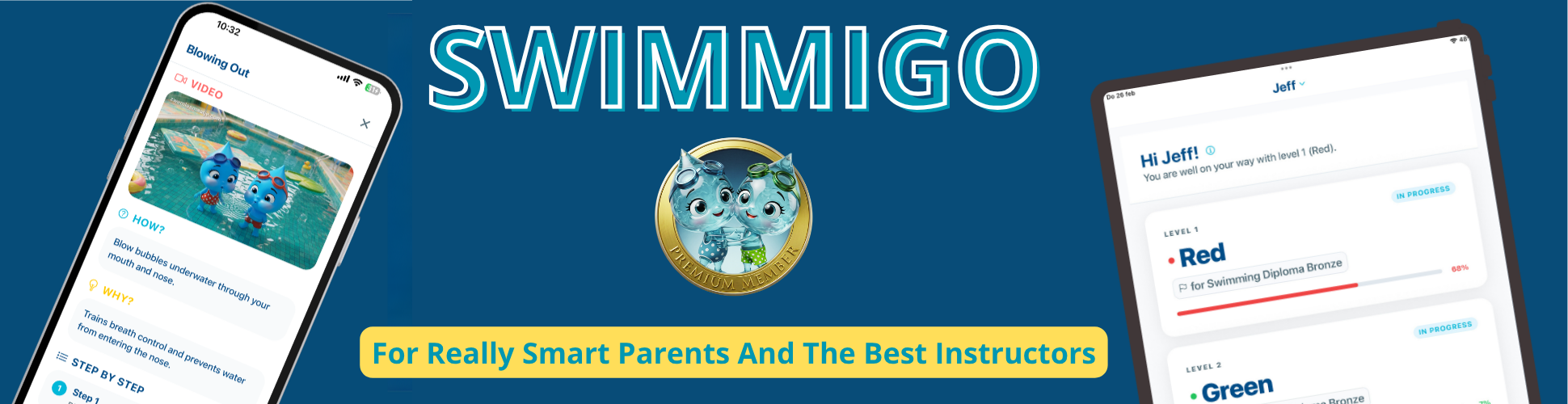
Swimmigo uses a 0 to 6 smiley system to track skills. Where traditional methods only register "achieved/not achieved," this system shows nuance: did the breaststroke leg movement go from a 2 to a 3 last week? Then there is progress, even if the skill isn’t fully achieved yet. For a child who is stuck, this is a revelation: suddenly they see black on white (or rather: smiley on smiley) that progress is happening. That visibility is often the key that unlocks the lock.
Digital Logbooks: Let Children See Their Own Growth
With Swimmigo, every instructor has access to a digital logbook per student. Pull up this logbook at the start of the lesson and show the child: "Look, last month you were at 1 for exhaling, now at 3. You’re moving forward!" This gives the child a sense of ownership over the learning process. It’s no longer a vague "it’s going okay," but concrete proof of growth. For parents who doubt whether the swimming lessons are effective, this logbook is also invaluable for parent communication.
Level-Specific Obstacles and Solutions
Each level has its own typical stumbling blocks. Below you’ll find the most common plateau situations per color, with concrete exercises you can apply directly in your next lesson.
From Red to Orange: Water Fear and Face in the Water
The biggest stumbling block in this phase is water fear, specifically daring to put the face in the water. The classic mistake is forcing it, which only increases the fear. Instead, work on water familiarization with a mirror exercise: let two children stand opposite each other and pull faces with their noses just above the water. Then chin in the water. Then blowing on the water. Take 3 to 4 lessons for this calmly. Swimmigo helps you track per child how far they are in this water familiarization, so you don’t have to remember every lesson who has taken which step.
From Green to Blue: The Breaststroke Breakthrough
The transition from single backstroke and freestyle to breaststroke is a big hurdle for many children. Coordinating arms and legs simultaneously is complex, and children get frustrated if it doesn’t work immediately. The solution is isolation: practice the leg movement separately at the side, practice the arm movement separately with a kickboard, and only combine when both parts score sufficiently on the 0-6 system. Use Swimmigo to track leg and arm scores separately, so the child sees both parts growing before the combination is addressed.
From Indigo to Gold: Building Endurance
The last stumbling block is often not technical but a conditioning problem: simply maintaining longer distances. Children who swim technically well drop back in technique due to fatigue and thus don’t meet the final standard. The solution here is interval training in game form: let them swim two lengths, then 30 seconds of a water game as a reward, then two lengths again. Gradually build up the number of lengths per interval. With Swimmigo’s group functionality, you can easily track which children need to work on endurance and which are ready for the final test.
Involve Parents in the Motivation Process
You can be as motivated as an instructor, but without parental support the effect remains limited. Parents are the most important cheerleaders of their child but often don’t know how to help without interfering with the lesson.
Give Parents Concrete Tips for Between Lessons
Parents want to help but don’t know how. Give them concrete, simple suggestions: "Let your child practice blowing on the water in the bath this week" or "Go swimming freely together on Saturday and only practice floating, no breaststroke." Concrete tips prevent parents from well-meaning but clumsy coaching on the wrong skills. The Swimmigo parent app gives parents real-time insight into which skill their child has practiced this week, so they know exactly where to connect.
Use the Parent App for Real-Time Updates
With the free Swimmigo parent app, parents see exactly where their child stands on each of the 86 skills across 7 levels. When you update the scores after the lesson, parents receive a push notification upon progress. This is priceless for children with a plateau: where parents previously only heard "it’s going okay," they now see "ah, exhaling went from 2 to 3." Such concrete positive updates turn skeptical parents into the biggest supporters of the learning process and of you as an instructor.
Sources

Bob van Soest
As an expert in operating sports facilities (such as swimming pools) and developer of, among others, Swimmigo.com, I am passionately committed to making swimming lessons simpler, more fun and more insightful for parents, swimming instructors and everyone who wants to learn to swim.
Frequently Asked Questions
Related articles
![How Visual Progress Systems Boost the Motivation of Swimming Students: From Stars to Smileys [2026]](/_next/image?url=https%3A%2F%2Fzvblogpostimages.s3.eu-west-3.amazonaws.com%2FAUTOMATISCH_UPLOAD%2F1_0d5ccbf68313.jpg&w=3840&q=75&dpl=dpl_8HBmXj8pyjjziKcbXKHvXrtJMU4a)
How Visual Progress Systems Boost the Motivation of Swimming Students: From Stars to Smileys [2026]
Discover how visual progress systems like stars, smileys, and badges enhance the motivation of swimming students. Practical tips for swim instructors.
![How to Effectively Teach Swimming to Adult Beginners: A Practical Guide for Swim Instructors [2026]](/_next/image?url=https%3A%2F%2Fzvblogpostimages.s3.eu-west-3.amazonaws.com%2FAUTOMATISCH_UPLOAD%2F1_311d6586a746.jpg&w=3840&q=75&dpl=dpl_8HBmXj8pyjjziKcbXKHvXrtJMU4a)
How to Effectively Teach Swimming to Adult Beginners: A Practical Guide for Swim Instructors [2026]
Adult beginners require a different swimming lesson approach than children. Discover the 5 biggest challenges and practical exercises for instructors.
![Teaching Swimming to Children with ADHD and Autism: Practical Tools for Swim Instructors [2026]](/_next/image?url=https%3A%2F%2Fzvblogpostimages.s3.eu-west-3.amazonaws.com%2FAUTOMATISCH_UPLOAD%2F1_09a8d1d9c113.jpg&w=3840&q=75&dpl=dpl_8HBmXj8pyjjziKcbXKHvXrtJMU4a)
Teaching Swimming to Children with ADHD and Autism: Practical Tools for Swim Instructors [2026]
Practical tools for swim instructors teaching children with ADHD and autism. From sensory processing to water safety, with concrete tips.
Discover Swimmigo
The all-in-one app for swimming lesson progress. For parents, swim schools, and adult swimmers.