HowtoGiveEffectiveFeedbackDuringSwimLessons:PracticalTechniquesforSwimInstructors[2026]
![How to Give Effective Feedback During Swim Lessons: Practical Techniques for Swim Instructors [2026]](/_next/image?url=https%3A%2F%2Fzvblogpostimages.s3.eu-west-3.amazonaws.com%2FAUTOMATISCH_UPLOAD%2F1_115e08c74d58.jpg&w=3840&q=75&dpl=dpl_8HBmXj8pyjjziKcbXKHvXrtJMU4a)
Summary
- Effective feedback accelerates the learning process of swim students and strengthens their self-confidence
- Young children (3-6 years) respond best to task-oriented, direct compliments
- Older children (6-12 years) benefit from process-oriented feedback and feedforward
- Avoid feedback on the person and focus on concrete observable behavior
You stand at the edge of the pool. A six-year-old is doing the breaststroke for the fifth time, but the arm movement is still not correct. You hesitate: do you say something, or let it go? And if you say something, how do you deliver it without ruining the child's enjoyment? Giving feedback during swim lessons is perhaps the most underestimated part of the job. It’s not just about correcting what’s wrong. It’s about the precise moment, the right words, and the tone that helps a child move forward instead of discouraging them.
A scientific review study by Minkels and colleagues (2025) shows that swim instructors worldwide extensively use verbal techniques: instruction, explanation, description, and feedback. Yet, surprisingly little evidence-based guidance exists on which type of feedback works best for which age. This overview fills that gap with practical techniques you can apply in your lesson tomorrow.
Why Effective Feedback Makes a Difference
Feedback is not just a compliment or a correction. It is the bridge between what a student does and what you want them to learn. In the water, where sound distorts and children get distracted quickly, every word counts twice. Good feedback gives a child support: this I did well, this I need to watch, this is how I proceed.
1. The Difference Between Feedback and Feedforward
The terms are often used interchangeably, but the distinction is essential. Feedback looks back: "You kept your arms too bent during the breaststroke." Feedforward looks ahead: "Try next time to stretch your arms forward as if you are pushing a big ball away." Research by Hattie and Timperley shows that feedforward is more effective for learning outcomes than purely retrospective feedback because it provides a concrete next step. For swim instructors, this means: briefly name what you saw, but spend most breath on what the student will do now.
2. The Four Levels of Feedback
According to the model also used by sports coaches, there are four levels on which feedback can be given:
- Task-oriented: "You went underwater with your chin on your chest." This tells a child exactly what they did well or what can be improved about the exercise itself.
- Process-oriented: "I saw you tried three times again when it didn’t work." This emphasizes effort and approach, not just the result.
- Self-regulating: "What felt different when you kept your legs straighter?" This encourages children to think about their own learning process.
- Personal: "You are such a champ in the water!" This feels nice but is the least effective. It tells a child nothing about what to repeat or improve.
The first three levels lead to demonstrably better swimming results. The fourth level feels good but does not guide. Use personal compliments sparingly and always supplement them with task- or process-oriented information.
3. Positive Reinforcement: Why It Works
The Houston Swim Club, one of the largest swim schools in the United States, describes positive reinforcement as the core of their teaching method. Children who feel encouraged participate more actively, set higher goals for themselves, and retain skills better. This is not a soft approach but a proven learning mechanism. A child who hears "Your breaststroke was much calmer today than last week" knows exactly what to hold on to. A child who only hears "No, not like that" loses track.
4. The Pitfall of Excessive Praise
Too many general compliments make feedback worthless. If every jump is "great," a child does not learn the difference between a mediocre and a good execution. Be specific. "Your hands stretched nicely forward" is a compliment that gives direction. "Super good!" is a shout that teaches nothing. This applies in Dutch pools just as well as in swim schools in Germany, France, or Spain. The need for concrete feedback is universal.
Feedback per Age Group: What Works for Whom
A toddler of three, a schoolchild of seven, and a teenager of twelve have completely different needs for guidance. What motivates one can block another. Here is a practical overview based on sports pedagogical research on feedback per age category.
5. Toddlers (3-5 years): Learning Through Play
Children under five learn mainly through imitation and play. Task-oriented feedback works best but keep it extremely simple and visual. Don’t say "Stretch your legs further back," but "Make a long candle with your legs." Link every correction to a concrete image the child already knows. Use your voice as an instrument: cheerful and energetic with success, calm and inviting with tension. A four-year-old benefits more from your intonation than from the exact words you choose.
6. Preschoolers and Young Schoolchildren (5-7 years): Direct Instructions
In this group, the awareness of "right" and "wrong" develops. Children want to do well and constantly look to you for confirmation. Give task-oriented feedback immediately after the exercise, not only after the lesson. The working memory of a six-year-old is short. "Your head went nicely underwater, now also let your shoulders drop" combines a compliment with a concrete next step.
7. Schoolchildren (7-9 years): Building Self-Confidence
From seven years old, children develop the ability to reflect on their own actions. This is the moment to introduce process-oriented feedback. Ask: "What felt different about your backstroke compared to last week?" Let children name what they notice themselves. Sports coaches see that children in this age group grow enormously when you give them responsibility for small choices: "Which exercise do you want to do again first, the leg kick or the arm stroke?"
8. Older Children (9-12 years): Stimulating Self-Regulation
From nine years old, children can think more abstractly about their swimming movements. Now self-regulating feedback works best: "How did you know your breathing went better today?" This forces a child to analyze their own process. Combine it with feedforward: "What will you do differently at the turn next week?"
Practical Feedback Techniques for in the Pool
9. The 4G Model in the Water
The 4G model (Behavior, Feeling, Consequence, Desired behavior) is a proven method from education that lends itself well to swim lessons:
- Behavior: "I saw that during the backstroke you kept throwing your head back instead of letting it float calmly."
- Feeling: "Because of that, your hips sank, and swimming with low hips costs twice as much energy."
- Consequence: "If you keep your head calmly in place, your body will naturally stay high in the water."
- Desired behavior: "Try the next lap as if there is a little pillow under your head that you must not sink through."
This model works for all ages, but adjust the wording. For a four-year-old, replace "hips" with "bottom" and "energy" with "strength."
10. The Sandwich Method: Good, Better, Good
Start with what goes well, then name the improvement point, and finish with encouragement. "Your leg kick gets stronger every week. Now let’s see if you can also keep your arms stretched, then you’ll swim even faster. You’re already quite far, I know you can do this too." This method prevents a child from feeling attacked and keeps motivation high.
11. Gestures Over Words
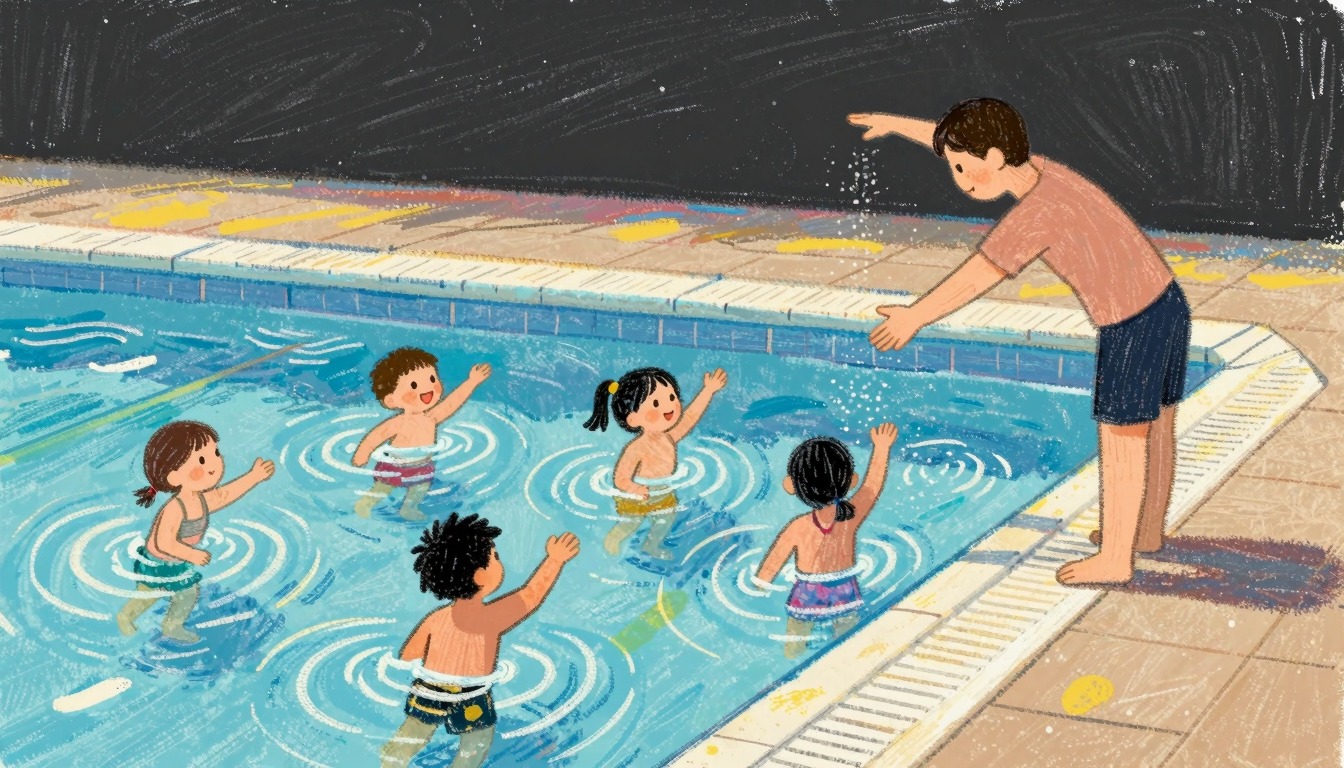
Noise in the pool is a practical barrier. Use agreed hand gestures. A thumbs up means "this is going well," a flat hand pointing down means "slower," a circular motion with your index finger means "again." These non-verbal signals are universal: they work in the Netherlands, Germany, France, Spain, and England without translation. In busy lessons with multiple levels, gestures are often more effective than shouting over the water.
12. Timing: Immediate or Delayed?
Immediate feedback works for young children and physical corrections. You correct a wrong arm movement immediately, otherwise the pattern becomes ingrained. Delayed feedback works better for older children who can handle self-reflection. Ask after the lesson: "What did you think went better today than last week?" This strengthens the self-regulating ability they need to eventually swim independently.
13. Feedback in Group Lessons: Seeing Everyone
In a group of eight to twelve children, it’s impossible to give every student feedback after every lap. Choose consciously: give two children per lesson extensive personal feedback and alternate the next lesson. The others get short, functional instructions. Use a digital tool like Swimmigo to track skills per student, so you know who needs extra attention this week and who is on track.
Swimmigo is available in five languages and is used worldwide by swim instructors and parents. The app lets you track scores per student on 86 skills, divided over seven levels from Red to Gold. This way, you see at a glance which exercise a child struggles with and where your feedback has the most impact.
14. Dealing with Fear of Failure and Hesitation
Some children freeze when corrected, no matter how kindly you deliver it. For anxious children, a different approach works: first let them tell what they felt. "What happened to your breathing when you went underwater?" From there, confirm what went well and steer with one small improvement point. Never give a list of three or four corrections at once. One thing at a time is the golden rule for anxious students, in every country and language.
Conclusion
Effective feedback is the engine of every swim lesson. It’s not about shouting louder or praising more often, but about the right words at the right moment, tailored to the child’s age and level. Task-oriented for toddlers, process-oriented for schoolchildren, and self-regulating for the older group. Always combine a concrete compliment with a clear next step. Use gestures if the noise is too loud and alternate extensive feedback consciously in group settings. With these techniques, you help every child progress faster, with more joy, and lasting self-confidence through the swim lesson.
Discover how Swimmigo helps you keep track of feedback per student: https://swimmigo.com/instructors
Frequently Asked Questions About Feedback During Swim Lessons
Sources
- Minkels, C., van der Kamp, J., de Vries, R., & Beek, P.J. (2025). Learning how to swim in 5- to 12-year-old children: a scoping review of evidence-based motor learning methods. Frontiers in Sports and Active Living, 7, 1505301., February 12, 2025
- Houston Swim Club: The importance of positive reinforcement in swim lessons, February 6, 2023
- Wij-leren.nl: Feedback: meaning and examples (4G model, Pendleton method), consulted July 2026
- Sportjeal: Feedback, Feedforward and Motivation per Age Group (Hattie & Timperley model), December 3, 2024

Bob van Soest
As an expert in operating sports facilities (such as swimming pools) and developer of, among others, Swimmigo.com, I am passionately committed to making swimming lessons simpler, more fun and more insightful for parents, swimming instructors and everyone who wants to learn to swim.
Frequently Asked Questions
Related articles
![How to Motivate Children Stuck at the Same Swimming Level: Practical Tips for Instructors [2026]](/_next/image?url=https%3A%2F%2Fzvblogpostimages.s3.eu-west-3.amazonaws.com%2FAUTOMATISCH_UPLOAD%2F1_ac831cb13894.jpg&w=3840&q=75&dpl=dpl_8HBmXj8pyjjziKcbXKHvXrtJMU4a)
How to Motivate Children Stuck at the Same Swimming Level: Practical Tips for Instructors [2026]
Practical tips for swim instructors to motivate children who are stuck at a swimming level. Discover how small adjustments and the 0-6 smiley system can lead to significant progress.
![How Visual Progress Systems Boost the Motivation of Swimming Students: From Stars to Smileys [2026]](/_next/image?url=https%3A%2F%2Fzvblogpostimages.s3.eu-west-3.amazonaws.com%2FAUTOMATISCH_UPLOAD%2F1_0d5ccbf68313.jpg&w=3840&q=75&dpl=dpl_8HBmXj8pyjjziKcbXKHvXrtJMU4a)
How Visual Progress Systems Boost the Motivation of Swimming Students: From Stars to Smileys [2026]
Discover how visual progress systems like stars, smileys, and badges enhance the motivation of swimming students. Practical tips for swim instructors.
![How to Effectively Teach Swimming to Adult Beginners: A Practical Guide for Swim Instructors [2026]](/_next/image?url=https%3A%2F%2Fzvblogpostimages.s3.eu-west-3.amazonaws.com%2FAUTOMATISCH_UPLOAD%2F1_311d6586a746.jpg&w=3840&q=75&dpl=dpl_8HBmXj8pyjjziKcbXKHvXrtJMU4a)
How to Effectively Teach Swimming to Adult Beginners: A Practical Guide for Swim Instructors [2026]
Adult beginners require a different swimming lesson approach than children. Discover the 5 biggest challenges and practical exercises for instructors.
Discover Swimmigo
The all-in-one app for swimming lesson progress. For parents, swim schools, and adult swimmers.