ExpandingYourSwimSchooltoMultipleLocations:HowtoKeepPlanning,Progress,andCommunicationonTrack[2026]
![Expanding Your Swim School to Multiple Locations: How to Keep Planning, Progress, and Communication on Track [2026]](/_next/image?url=https%3A%2F%2Fzvblogpostimages.s3.eu-west-3.amazonaws.com%2FAUTOMATISCH_UPLOAD%2F1_3933760d00ae.jpg&w=3840&q=75&dpl=dpl_DioN4WA1ca9cW2mb7DMMpr5iGDvW)
Summary
- Full groups and waiting lists are often the moment to consider a second location.
- One central system for planning, progress, and communication prevents each location from having its own approach.
- Instructors teaching at multiple pools need shared progress tracking and clear agreements.
- Swimmigo is free and tracks all your locations, groups, and levels in one place.
Your swim school is doing well. The groups are full, there’s a waiting list, and you increasingly hear the same question: do you also teach at that other pool? That’s when the itch starts. A second location. What many swim instructors encounter afterward is not the teaching itself, but the chaos of two schedules, two administrations, and instructors who can’t see each other.
That chaos can be prevented. A growing swim school mainly needs one thing: systems that work the same way at every location. Below, I’ll guide you through the steps that make the difference, from the moment you decide to expand to the day your team teaches at three pools simultaneously.
When is your swim school ready for a second location?
Not every full schedule means you should expand. Sometimes it’s smarter to organize your current schedule more efficiently. But there are signals that don’t lie.
Full groups and waiting lists are a signal, not a problem
Do you turn children away every period because the groups are full? Then there is more demand than you can serve at one pool. That demand exists everywhere. The Mulier Institute calculated that the share of Dutch children aged 6 to 16 without a swimming diploma doubled between 2018 and 2022, from 6 to 13 percent. Worldwide, drowning is one of the leading causes of death among children aged 1 to 14, according to the World Health Organization. Every parent on your waiting list is looking for the same thing: a child who learns to swim safely.
Growth and scaling are not the same
Growth means you add more: more instructors, more hours, more pools, and your costs grow accordingly. Scaling means you increase revenue without your costs rising at the same rate. The latter only works if you don’t have to rebuild administration and planning for each location. This insight is applied by swim schools worldwide as soon as they open a second pool.
Check your administration before expanding
Before booking a second pool, look at how you currently work. Do you use loose notes and a spreadsheet? Then a second location quickly becomes a second administration, and that’s exactly where swim schools get stuck. A simple rule of thumb: if you already spend more than a few hours a week on planning, cancellations, and parent messages, your system is not ready for a second location.
One system for all your locations
The foundation of a swim school with multiple locations is simple: everything you track, you track in one place. Planning, progress, and communication should not depend on which pool a child happens to have lessons in.
Planning that works across all pools
A parent calling to reschedule a lesson doesn’t want to hear that the group only exists in pool B in the system. Your planning must show at any time which groups are where, which instructor is where, and where there is still space. This also makes it easier to plan with limited pool capacity, without having to compare three separate schedules.
Tracking progress consistently everywhere
A child swimming in pool A on Monday and pool B on Wednesday must see the same scores. That only works if you track levels and skills the same way, regardless of where the lesson takes place. If you use a smiley system at one location and a paper card at another, you’ll lose children in your own administration.
Parent communication that doesn’t differ by location
Parents immediately notice when one location sends WhatsApp messages and the other doesn’t. A consistent way of communicating, from cancellations to level upgrades, ensures every parent has the same experience. That not only reduces irritation but also saves you hours of explaining.
Bringing your team along in the growth
More locations almost always means more instructors. And with that comes a new challenge: how do you ensure everyone teaches the same way and knows the same agreements?
Instructors teaching at multiple locations
Many swim instructors teach at multiple pools, either as freelancers or employed by a swim school. For them, it’s crucial they can immediately see the progress of a group, even if they didn’t teach that group the week before. Anyone who can’t access a child’s logbook starts each lesson by figuring out who is where.
Onboarding new colleagues without quality loss
A second location often requires new instructors. They want to quickly know how you work: which levels you use, how you track scores, how you communicate with parents. A shared system means a new colleague sees the group’s status on day one, instead of having to shadow for weeks to catch up.
Make sure everyone knows the same agreements
Write down how you handle cancellations, make-up lessons, and level transitions. The shorter and clearer, the better. A growing swim school cannot afford a location that maintains its own rules.
Administration that grows with you
Administration is where growing swim schools lose the most time. The good news: this is also the easiest to automate.
Hours, groups, and levels in one place
Once you work at multiple locations, counting hours, moving students, and tracking levels becomes a job in itself. Software that handles this for you saves about fifteen hours per month on administration, according to the international swim school industry. Those are hours you get back for teaching or growing your school.
What a good system saves you
The figures below come from the international swim school industry and show where the gains lie:
| Aspect | Benchmark |
|---|---|
| Time spent on administration per month | About 15.5 hours less with management software |
| Administration costs as part of expenses | Around 3.5 percent is healthy |
| Administrative work with self-service registrations | About 30 percent less |
| Student retention per year | More than 75 percent is a strong signal |
These numbers are benchmarks, not promises. They mainly show that a swim school that scales can only succeed with a system that grows with it.
Parents don’t notice the growth
The best growth is the growth parents don’t feel. They just want their child to progress, whether the school has one pool or five.
The same app, at every location
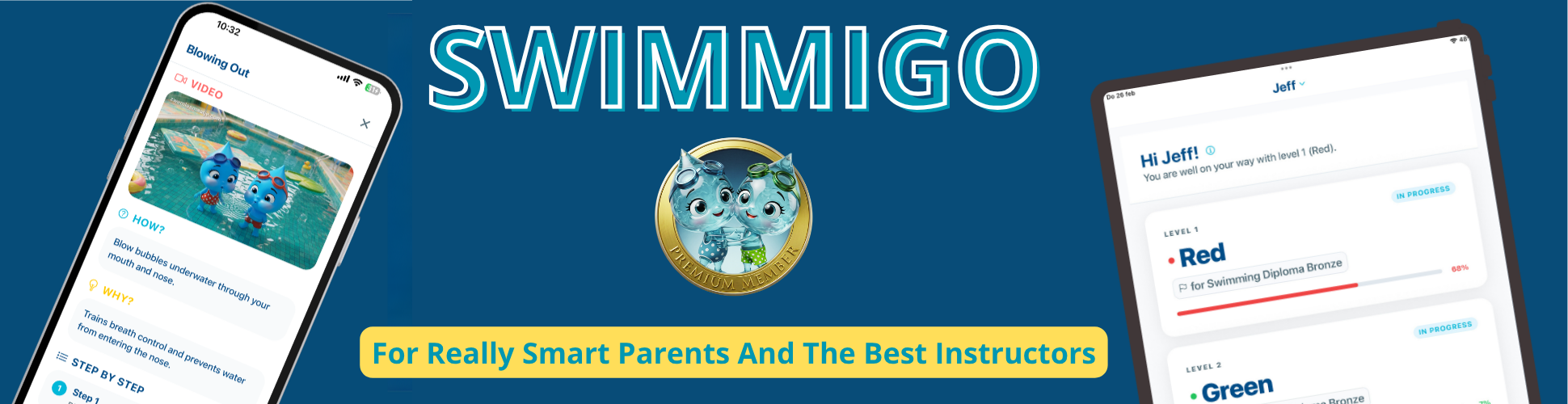
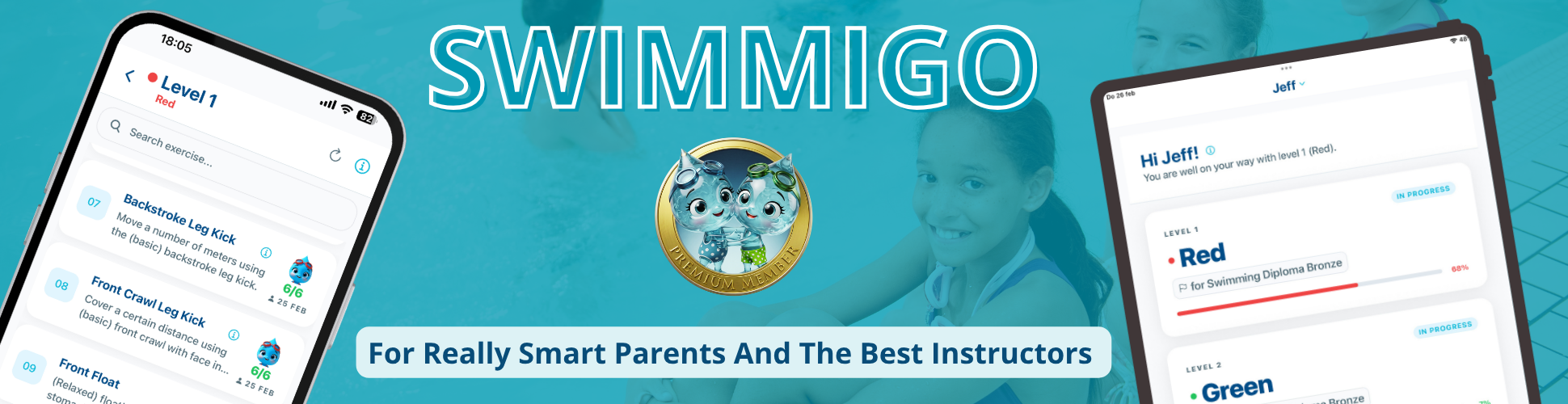
With Swimmigo, parents see the same thing at every location: progress per exercise, levels, and notifications when a level is upgraded. For a swim school with multiple pools, that’s worth gold. You don’t have to explain a different app or portal per location.
Progress that follows your child, wherever they have lessons
If a family switches to your other pool, they take their entire swim history with them, without you having to retype anything. That’s true continuity.

Conclusion
A swim school with multiple locations doesn’t have to mean extra chaos. The difference lies in one thing: systems that work the same at every pool, from planning to progress and parent communication. Those who have this in order grow without losing control, anywhere in the world.
Further reading
- Swimmigo for instructors: all free tools at a glance
- The student tracking system for swim schools with multiple locations
- The levels and skills from red to gold
Sources
- World Health Organization (WHO): Drowning fact sheet, consulted 2026
- Mulier Institute: Percentage of children without swimming diploma doubled, 2023
- National Council for Swimming Safety: More children obtaining swimming diplomas A, B, and C, 2025
- Statistics Netherlands: Higher risk of drowning among children not born in the Netherlands, 2026
- Sportimea: How to scale your swim school into a multi-location business, 2025

Bob van Soest
As an expert in operating sports facilities (such as swimming pools) and developer of, among others, Swimmigo.com, I am passionately committed to making swimming lessons simpler, more fun and more insightful for parents, swimming instructors and everyone who wants to learn to swim.
Frequently Asked Questions
Related articles
![How to Motivate Children Stuck at the Same Swimming Level: Practical Tips for Instructors [2026]](/_next/image?url=https%3A%2F%2Fzvblogpostimages.s3.eu-west-3.amazonaws.com%2FAUTOMATISCH_UPLOAD%2F1_ac831cb13894.jpg&w=3840&q=75&dpl=dpl_DioN4WA1ca9cW2mb7DMMpr5iGDvW)
How to Motivate Children Stuck at the Same Swimming Level: Practical Tips for Instructors [2026]
Practical tips for swim instructors to motivate children who are stuck at a swimming level. Discover how small adjustments and the 0-6 smiley system can lead to significant progress.
![How Visual Progress Systems Boost the Motivation of Swimming Students: From Stars to Smileys [2026]](/_next/image?url=https%3A%2F%2Fzvblogpostimages.s3.eu-west-3.amazonaws.com%2FAUTOMATISCH_UPLOAD%2F1_0d5ccbf68313.jpg&w=3840&q=75&dpl=dpl_DioN4WA1ca9cW2mb7DMMpr5iGDvW)
How Visual Progress Systems Boost the Motivation of Swimming Students: From Stars to Smileys [2026]
Discover how visual progress systems like stars, smileys, and badges enhance the motivation of swimming students. Practical tips for swim instructors.
![How to Effectively Teach Swimming to Adult Beginners: A Practical Guide for Swim Instructors [2026]](/_next/image?url=https%3A%2F%2Fzvblogpostimages.s3.eu-west-3.amazonaws.com%2FAUTOMATISCH_UPLOAD%2F1_311d6586a746.jpg&w=3840&q=75&dpl=dpl_DioN4WA1ca9cW2mb7DMMpr5iGDvW)
How to Effectively Teach Swimming to Adult Beginners: A Practical Guide for Swim Instructors [2026]
Adult beginners require a different swimming lesson approach than children. Discover the 5 biggest challenges and practical exercises for instructors.
Discover Swimmigo
The all-in-one app for swimming lesson progress. For parents, swim schools, and adult swimmers.