DealingwithDifficultParents:PracticalConversationTechniquesforSwimInstructors[2026]
![Dealing with Difficult Parents: Practical Conversation Techniques for Swim Instructors [2026]](/_next/image?url=https%3A%2F%2Fzvblogpostimages.s3.eu-west-3.amazonaws.com%2FAUTOMATISCH_UPLOAD%2F1_25a283ef8f1d.jpg&w=3840&q=75&dpl=dpl_GWyfLj8UVegbQ18STkVQms8Vj7LD)
Summary
- Angry or concerned parents are a top-3 stress factor for swim instructors: 81% of schools faced unwanted parent behavior.
- Active listening, the I-message, and reframing to a shared goal are proven techniques that immediately de-escalate conversations.
- The best prevention is proactive communication: contact parents before they do and share real-time progress insight via an app.
Why the Poolside Can Sometimes Be an Emotional Hotspot
You know the feeling. You are waist-deep in water, focused on a group of toddlers just learning to float, and from the stands you feel a burning stare. After the lesson, a parent waits for you with crossed arms and a sentence starting with "I want to discuss something..."
Difficult conversations with parents are part of the job. Research by RTL Nieuws from 2026 shows that 81% of Dutch primary schools have dealt with unwanted behavior from parents in the past five years: from excessive criticism to verbal intimidation. A quarter of teachers experienced verbal violence or intimidation within one year. The swimming sector is no different: the combination of emotional involvement, time investment, and money makes the poolside a place where tensions can run high.
This is not a typically Dutch problem. Worldwide, sports instructors and swim teachers report that parent contact is one of the most stressful parts of their job. The American Psychological Association reports that one-third of parents rate their daily stress as extremely high. Parents are under pressure: they work, organize, plan, and want the best for their child. Swimming lessons are a safety investment, but for many parents, it mainly feels like an expensive, time-consuming obligation with uncertain results. You see weekly progress in the water; they only see the price tag and ask, "When will my child be ready?"
Swimming Lessons Feel Like an Existential Investment for Parents
For a parent, swimming lessons are not a hobby. It is a survival skill. Approximately 300,000 people drown worldwide annually, reports the World Health Organization, and children under five are at the greatest risk. Parents may not know these numbers, but they do have the gut feeling: if my child doesn’t learn to swim, they are in danger. This makes every conversation about progress, delay, or a missed lesson emotionally charged in a way you don’t see in soccer training or piano lessons.
Moreover, swimming lessons are a significant financial effort in many countries. In the Netherlands, an average swimming lesson trajectory quickly costs between 1,200 and 1,800 euros per child. In countries without subsidized school systems, such as the United States or the United Kingdom, these amounts are even higher. Parents invest hundreds to thousands of euros, bring their child weekly to the pool, spend hours in the waiting area, and rightly want to know what it yields. When feedback is missing or unclear, uncertainty turns into frustration.
The Gap Between What You See and What Parents Think
As an instructor, you see ten, twenty, sometimes thirty children per day. You know that a child who stays on the same level for three weeks is not "standing still" but working on a specific skill like exhaling underwater or the correct arm stroke. For a parent watching from the stands, the picture is different: "My child has been doing the same thing for months."
This perception gap is universal. In every pool, in every country, parents struggle with a lack of insight into what happens during the lesson. Nicolette Smale, freelance swim instructor and communication trainer for the swimming sector, puts it sharply: "Don’t make assumptions. What seems logical to you doesn’t have to be logical to parents." A child is not a computer you can just program. Learning motor skills in water takes time, and you must actively communicate that message.
Parental Stress Is Increasing Worldwide
The context in which you work as a swim instructor has changed in recent years. A large-scale study by The Ohio State University in 2022 found that 66% of working parents suffer from burnout symptoms. The APA reports that parents of children under 18 consistently experience more stress than adults without children. In 2023, a third of American parents indicated their stress level was extremely high, compared to 20% of the general population.
Parents bring that stress to the pool. A father who just had a tough workday, quickly picked up his child from after-school care, and sits hungry in the stands is not at his best. A mother worrying that her child is taking longer in swimming lessons than friends arrives emotionally charged. These are not excuses for unwanted behavior but explanations. Seeing the full picture helps you respond better.
Cultural Expectations Differ by Country
Swimmigo is used by swim instructors in the Netherlands, Belgium, Germany, France, Spain, and beyond. What is a normal parental reaction in one country can be perceived as boundary-crossing in another. In the United States, an assertive, demanding parental attitude is more common than in Scandinavia. In Mediterranean countries, family honor plays a bigger role. In Germany, directness is the norm, which can come across as blunt to a Dutch instructor.
Peter de Vries, expert in parental involvement, points out that assertiveness is a hallmark of our time: "We must correct parents who cross boundaries, but also realize this is a sign of the times. Every professional must be aware of their own fears. Why are you so affected by a highly emotional parent?"
What Difficult Parent Interactions Do to You
Before looking at solutions, first consider the impact. An unpleasant parent conversation is not just an incident: it seeps into your mood, your self-confidence, and ultimately your job satisfaction.
The Cumulative Effect of Daily Confrontations
As a swim instructor, you are physically under pressure: hours in warm water, repetitive movements, constant use of your voice. On top of that come social demands: motivating children, managing behavior, and after each lesson being ready for parents who have questions about progress. A cumulative burden that can weigh heavily.
A previous blog post about burnout among swim instructors already showed that the combination of physical strain, emotional work, and administration are the main risk factors. A quarter of teachers report that persistent criticism (12%) and unjust accusations (11%) are the most common forms of boundary-crossing behavior by parents. When this becomes structural, you start doubting your abilities. You ask yourself if you are suited for this profession.
When Frustration Affects Your Enjoyment of Teaching
The vicious circle is recognizable to every experienced instructor: a difficult conversation makes you insecure, you start teaching differently, the atmosphere in the group changes, which leads to new complaints from parents. The isolation of the profession reinforces this. Many swim instructors work solo, without team meetings or peer supervision. There is no one beside you in the water to ask if you handled it well.
De Vries describes how professional pain "goes through the heart and does not linger," but that requires practice, self-reflection, and collegial support. The first step is to acknowledge that difficult parent interactions do not mean you fail as an instructor. It means you work in a profession where you deal daily with people and emotions, and that is inherently complex.
7 Conversation Techniques That Make a Difference
Below are techniques from professional literature, training for sports coaches, and the practical experience of dozens of swim instructors worldwide. No psychology degree needed: these are concrete, repeatable actions you can use in every lesson.
1. Listen First, Respond Later
Active listening sounds simple but is underestimated. It means giving the parent space to tell their story fully, without already defending yourself in your head. Applied Sport Psychology describes active listening as a four-step process: encouraging the speaker with short questions, validating without necessarily agreeing, paraphrasing the core message, and jointly naming the center of the conflict.
In practice, you do this by maintaining eye contact, nodding, and summarizing: "If I understand correctly, you are worried that your daughter has been at the same level for three months and you wonder if something is wrong. Is that correct?" That one sentence shows you have listened, and that is often half the solution.
2. Use the I-Message Instead of the You-Accusation
One of the most underestimated techniques in conflict communication is the I-message. Instead of "You don’t understand how long swimming lessons take," say "I find it difficult when assumptions are made about how the lesson program works." You take responsibility for your own experience without attacking the other. This immediately lowers the parent's defensive reaction because you share rather than blame.
Sports psychology confirms that 70% of our communication is non-verbal. Your facial expression, body posture, and tone say more than your words. An open posture, relaxed shoulders, and calm voice prevent a conversation from escalating before you even start content-wise.
3. Ask Questions, Don’t Immediately Give Answers
Swim instructors are practical: you see a problem and want to solve it. But with emotional parental reactions, that reflex backfires. Nicolette Smale advises: "Don’t fall into the trap of wanting to quickly give an answer. Often it’s better to ask several questions first before proposing a solution."
Questions like "What exactly did you hear from your child about the lesson?" or "When did you notice the motivation drop?" give you context and show the parent you are genuinely interested. Parents don’t find this annoying; they like talking about their child and see these questions as a sign of involvement.
4. Dare to Ask for Time to Think
"May I think about it for a moment?" is one of the most powerful sentences you can use. Many instructors feel pressure to come up with a perfect answer immediately, but a rushed response often makes situations worse. A parent prefers a good answer they have to wait for over a quick and wrong one. The art is then to follow up on your promise: "I will call you tomorrow afternoon with a concrete plan." And then actually do it.
5. Reframe from Complaint to Shared Goal
A parent’s complaint is almost always wrapped in frustration, but there is a legitimate concern underneath. "My child isn’t learning anything here" usually means "I worry whether my child is safe in the water." "You don’t pay attention to my child" often means "I see no evidence of progress."
By reframing the complaint to the shared goal, you take the sting out of the confrontation. For example, say: "I hear that you want your child to progress faster. I want that too. Let’s look together at what we can do and what is needed to take the next step." You are no longer opponents but partners with the same goal.
6. Set Boundaries on Behavior Without Breaking the Relationship
Some parents go too far. A parent who yells at you in front of other children, sends threatening emails, or systematically undermines your authority: that behavior must be bounded. De Vries learned from his deputy director how to do this: "Are you willing to acknowledge that you have crossed a line? That doesn’t mean we don’t want to listen to you. But first, we need a basis of respect."
The core is that you disapprove of the behavior but maintain the relationship. You don’t say "you are a difficult parent" but "the way you are speaking to me now makes it difficult to have a good conversation about your child." You invite restoration instead of forcing a final break.
7. Offer a Concrete Follow-Up Appointment
A conversation only has value if something comes out of it. Always end with a concrete agreement: "I will pay extra attention to her kick in the next two lessons and then send you a message with my observations." Or: "Let’s sit down briefly after Tuesday’s lesson in three weeks, then I’ll show you what she can do by then."
Concrete agreements do two things: they give the parent confidence that action is being taken, and they give you a clear timeline so the conversation doesn’t drag on endlessly.

How Technology Can Relieve the Parent Relationship
The conversation techniques above help in the moment, but the best solution is to make the conversation less often necessary. That can be done by structurally giving parents insight into their child’s progress, so frustration does not build up into an explosion at the poolside.
Real-Time Progress Insight Makes Conversations Factual
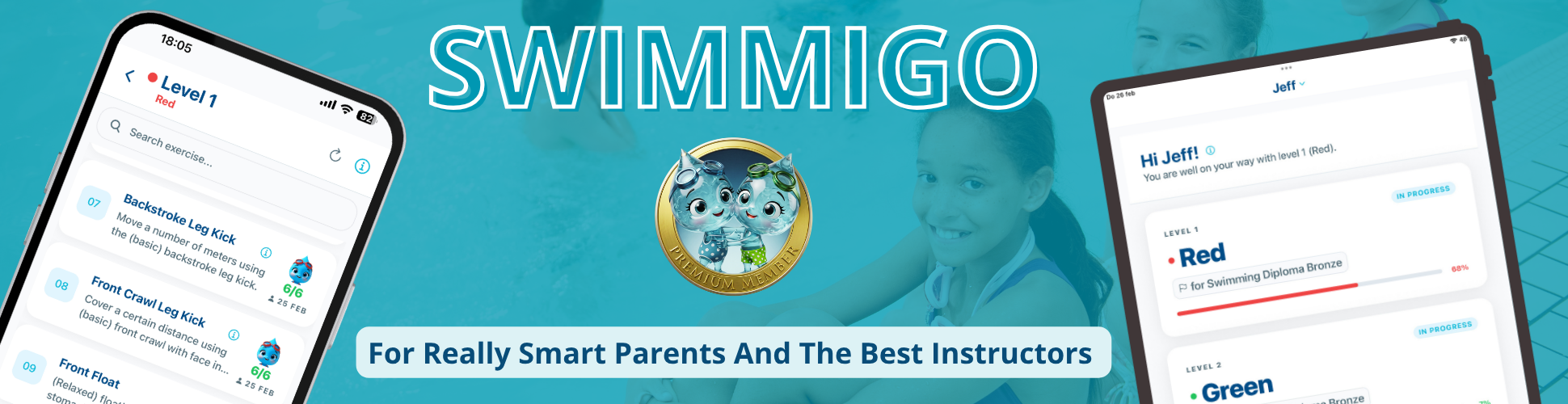
Imagine a parent can see on their phone after every lesson what their child practiced that day, which skill was updated, and what still needs work. No more surprises, no "I thought it was going well?", no imagined stagnation. Swimmigo offers exactly that: a free app where swim instructors can track scores per student on 86 skills, divided over 7 levels. Parents see real-time progress, receive push notifications on level increases, and can practice targeted points at home.
When a parent still stands at the poolside with a question, the conversation is factual instead of emotional: "I see she is still at 2 smileys for floating, what can I practice with her at home?" That is a very different conversation than "Why can’t my child swim yet?"
One Channel Instead of Personal WhatsApp Groups
One of the biggest sources of parental frustration is not the swimming lesson itself but the communication around it. Messages in personal groups get lost, notes are not read, cancellations come too late. Swimmigo centralizes communication in one environment: cancellations, make-up lessons, messages from the instructor, and progress updates all come in the same place. For you as an instructor, this saves hours of administration per week. For the parent, it saves searching and miscommunication.
Prevention Is Easier Than Repair
The seven techniques above are for when things have already gone wrong. Equally important is what you do before tensions rise.
Set Clear Expectations at the Start
The first lesson is the moment to set the tone. Explain how long an average swimming lesson trajectory takes, what the levels mean, how you communicate about progress, and what parents can and cannot expect from you. Smale emphasizes: "Give clear information. Explain what you do, why, and what you expect from parents and their child."
Make this part of your standard procedure. A start email or a short introductory meeting explaining that swimming lessons typically last 12 to 24 months, that children learn in jumps and plateaus, and that you send a progress update every month: this saves you dozens of difficult conversations later.
Contact Parents Before They Do
The most powerful preventive move you can make: contact parents before they raise the alarm. If you notice a child stays on the same level for a long time, has a motivation dip, or struggles with a specific exercise, send a short message: "I see Lisa finds the breaststroke difficult; we will practice the leg movement extra in the coming lessons. I will keep you informed."
Smale puts it aptly: "If you are ahead in seeking contact, it gives parents a sense of involvement. When parents approach you while you have already noticed progress isn’t going well, you are quickly 1-0 behind."
Conclusion
Difficult parents are not a sign that you fail as a swim instructor. They are a byproduct of a profession where you work with children’s safety, parents’ wallets, and the emotional charge that inevitably comes with it. With the right conversation techniques, proactive communication, and tools that provide insight into progress, you can transform the poolside from a place of confrontation into a place of cooperation. You get the child into the water, the parent confidently into the stands. That is what it’s all about, in every pool, in every country.
Swimmigo helps swim instructors worldwide provide that clarity. In 5 languages, with 86 skills, completely free. Because tracking progress should not be a luxury but a basic right of every swim student and every parent.
Want to know more about how Swimmigo can improve your parent communication? Visit swimmigo.com/instructors or see what parents see at swimmigo.com/parents.
Sources
- Veiligheidstrainingen.nl: How to Deal with Unwanted Behavior from Parents as a Teacher?, 2026
- ZwembadBranche: With These 5 Tips You Keep Your Swim Parents Involved and Satisfied (Nicolette Smale), 2019
- Wij-leren.nl: Difficult Parents, Difficult Teachers, Five Tips for Good Cooperation (Peter de Vries), 2017
- American Psychological Association: Parental Burnout and Stress, 2023
- Applied Sport Psychology: Coaching Through Conflict, Effective Communication Strategies (Ryan Hedstrom, PhD), accessed 2026
- World Health Organization (WHO): Drowning Fact Sheet, 2025

Bob van Soest
As an expert in operating sports facilities (such as swimming pools) and developer of, among others, Swimmigo.com, I am passionately committed to making swimming lessons simpler, more fun and more insightful for parents, swimming instructors and everyone who wants to learn to swim.
Frequently Asked Questions
Related articles
![How to Motivate Children Stuck at the Same Swimming Level: Practical Tips for Instructors [2026]](/_next/image?url=https%3A%2F%2Fzvblogpostimages.s3.eu-west-3.amazonaws.com%2FAUTOMATISCH_UPLOAD%2F1_ac831cb13894.jpg&w=3840&q=75&dpl=dpl_GWyfLj8UVegbQ18STkVQms8Vj7LD)
How to Motivate Children Stuck at the Same Swimming Level: Practical Tips for Instructors [2026]
Practical tips for swim instructors to motivate children who are stuck at a swimming level. Discover how small adjustments and the 0-6 smiley system can lead to significant progress.
![How Visual Progress Systems Increase the Motivation of Swimming Students: From Stars to Smileys [2026]](/_next/image?url=https%3A%2F%2Fzvblogpostimages.s3.eu-west-3.amazonaws.com%2FAUTOMATISCH_UPLOAD%2F1_0d5ccbf68313.jpg&w=3840&q=75&dpl=dpl_GWyfLj8UVegbQ18STkVQms8Vj7LD)
How Visual Progress Systems Increase the Motivation of Swimming Students: From Stars to Smileys [2026]
Discover how visual progress systems such as stars, smileys, and badges enhance the motivation of swimming students. Practical tips for swim instructors.
![How to Effectively Teach Swimming to Adult Beginners: A Practical Guide for Swim Instructors [2026]](/_next/image?url=https%3A%2F%2Fzvblogpostimages.s3.eu-west-3.amazonaws.com%2FAUTOMATISCH_UPLOAD%2F1_311d6586a746.jpg&w=3840&q=75&dpl=dpl_GWyfLj8UVegbQ18STkVQms8Vj7LD)
How to Effectively Teach Swimming to Adult Beginners: A Practical Guide for Swim Instructors [2026]
Adult beginners require a different swimming lesson approach than children. Discover the 5 biggest challenges and practical exercises for instructors.
Discover Swimmigo
The all-in-one app for swimming lesson progress. For parents, swim schools, and adult swimmers.