Completeoverviewofswimminglessonsforchildrenwithasensoryimpairment:deaf,hardofhearing,visuallyimpairedorblind[2026]
![Complete overview of swimming lessons for children with a sensory impairment: deaf, hard of hearing, visually impaired or blind [2026]](/_next/image?url=https%3A%2F%2Fzvblogpostimages.s3.eu-west-3.amazonaws.com%2FAUTOMATISCH_UPLOAD%2F1_ed68388d8be7.jpg&w=3840&q=75&dpl=dpl_EbfgvsmDLnqEGtT47YJuvCzbaNy2)
Summary
- A sensory impairment does not make swimming lessons impossible, but different: more demonstration, more feeling and less explanation in words.
- Children with a disability are more often excluded from regular swimming offerings in many countries, so finding a suitable place is the hardest part.
- Hearing aids and speech processors turn off for water, so communication in the pool is via signs, cards and eye contact.
- For visually impaired and blind children, body-oriented pointing works better than talking, with fixed routes and sound as a reference point.
- Agree with the swim school beforehand on how you communicate, who gives the lesson and what happens in an emergency.
A large part of swimming lessons involves instructions from the teacher: watch the swim instructor, imitate what they demonstrate, listen to what is said. For a child who cannot hear or see well, part of that explanation is lost. This does not make swimming lessons impossible, but the explanation must be different: more demonstration, more tactile guidance, and clearer agreements between parents and the swim school.
All over the world, deaf, hard of hearing, visually impaired and blind children learn to swim, just like in many other countries. The path to get there is just less straightforward. Parents search longer for a place where their child fits, the process often takes longer, and not every swim school has the necessary knowledge. Below you will read what is different, what works in the pool, how to choose a suitable swim school, and what you as an instructor can do without completely changing your teaching approach.
What is different when your child hears or sees less
Learning to swim can be done without sound and without sight
Swim teachers who teach deaf and hard of hearing children agree: sound is not an essential part of swimming lessons. The exercises remain the same, you just do not raise your voice and add gestures. For visually impaired and blind children, something similar applies. Swimming relies heavily on feeling, rhythm and fixed instructions, and a child gets to know a pool by the edge, the steps and the place where they always enter.
Why this group is more often left out
Children with a disability are more often excluded from regular swimming offerings in many countries and are therefore a risk group for drowning. Parents encounter more challenges than just swimming itself: there is little information about suitable swimming lessons, the availability is limited, instructors often lack sufficient knowledge, and costs are higher due to often longer trajectories. Support exists in many countries but varies greatly by country and region.
There is also movement. More and more swim schools teach children with disabilities and collaborate with local funds and schemes for families who find the lessons difficult to afford. Suitable offerings do exist, but finding them remains the hardest part.
Four profiles, four different needs
The collective term sensory impairment covers very different children, and you notice that in the pool.
- A child who is deaf and uses sign language needs an instructor who positions themselves visibly and knows signs or has an interpreter next to them.
- A hard of hearing child with hearing aids or a speech processor hears almost nothing in the pool because the device turns off for the water.
- A visually impaired child sees a demonstration only partially and benefits from explanations at close range and a fixed spot in the pool.
- A blind child learns an exercise through touch, fixed routines and sound instead of by watching.
There are also children with more than one impairment, for example a sensory impairment combined with a motor delay. For that group, adjusting goals is a separate issue, which you can read more about in adjusting goals for multiply disabled swimmers.
What is the same internationally
Water safety is a major topic worldwide. The World Health Organization counts about 300,000 drowning deaths per year. Drowning is the fourth leading cause of death among children aged 1 to 4 years and the third among children aged 5 to 14 years, and teaching swimming skills to school-aged children is one of the interventions proven effective (WHO, May 2026). Children with disabilities are more often excluded from this offering in many countries. In the United Kingdom, the National Deaf Children's Society contributes to guidelines for swim teachers about deaf children.
The approach that emerges there is applicable everywhere: stand next to the child, demonstrate instead of explaining, make what you say visual and stick to the same routines. That works just as well in London as in Melbourne or Singapore. Swimmigo is available in five languages and used in multiple countries, so those basic principles are also reflected in how swim schools organize their lessons and communication.
Swimming lessons if your child is deaf or hard of hearing
Demonstrating works better than explaining
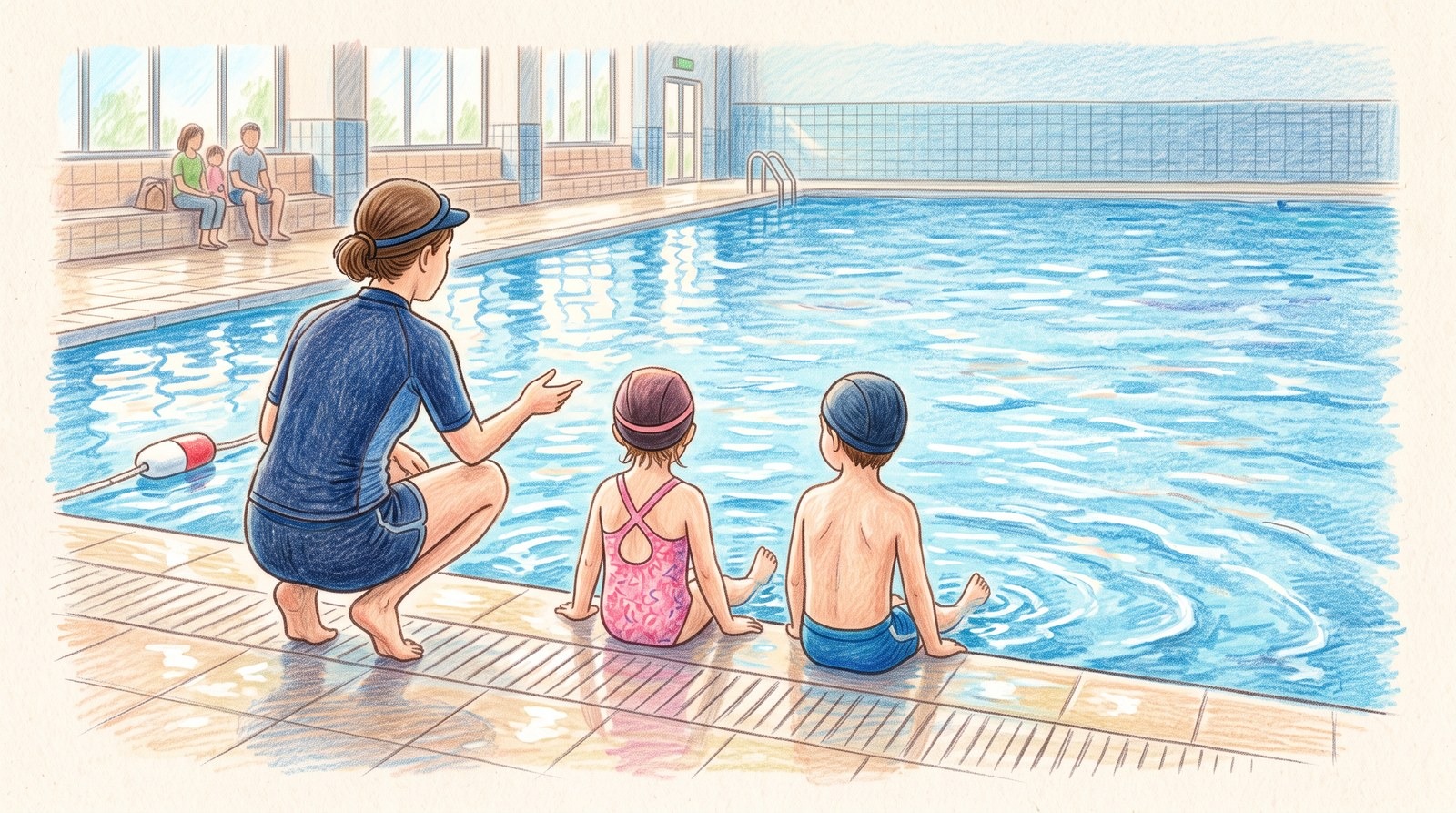
For a child who cannot hear, the explanation shifts from words to images. Show the exercise step by step, demonstrate it yourself and let your child imitate it. Repeat the same movement a few times in the same place and at the same pace so your child can pick up the pattern. Do not speak and demonstrate at the same time: someone who talks and moves is not easy to follow for a hard of hearing child (National Deaf Children's Society).
Getting attention without shouting
A child who cannot hear does not notice when you want something from them. Where an instructor uses their voice with hearing children, they jump and wave with deaf children. Therefore, agree on one fixed sign to get attention, for example waving your hand or tapping a float on the water. Make eye contact before the lesson starts so your child knows you are about to begin. Stay in one place during swimming and ensure the light falls on your face rather than behind you, so your face remains readable for those who lip-read (National Deaf Children's Society).
Signs, interpreters and swim instruction cards
Not every hard of hearing child uses sign language, and not every child who uses sign language wants an interpreter next to them in the pool. Still, it makes a big difference if someone can convey the explanation. Some swim schools work with a sign language interpreter who stands at the side and translates everything, others have an instructor who learned signs themselves. For children who have to manage without signs, swim instruction cards exist: cards with a clear drawing of one swimming exercise, per stroke and per exercise, usable during lessons and at home.
Aids: hearing aids, CI and waterproof covers
Most hearing aids are not waterproof and turn off for swimming. With a cochlear implant it is different: the internal part is fixed in the head and can withstand water, but the external speech processor cannot. Waterproof covers and accessories exist that allow some children to wear their processor while swimming. Not every family can use that option, and choosing to remove the processor is equally valid. Therefore, discuss aids with your audiologist and the swim school, not just on the first lesson day.
Children with ear tubes or ear infections have their own rules. After surgery, swimming is often not allowed for several weeks, and afterwards earplugs, a tight swim cap or a neoprene band over the ears may be necessary (National Deaf Children's Society). What applies in your situation is described in ear tubes and swimming lessons.
Emergency signal and supervision when the whistle does not get through
In an emergency, it matters whether help can get through. A whistle is not heard by a child without a working device, and even hearing children do not always understand the instructor in an echoing pool hall. Therefore, agree beforehand on a visual alarm signal so everyone in the pool knows to come to the side. Ensure the supervisor is informed and that the instructor can keep seeing your child, even if they swim on the other side of the pool.
Swimming lessons if your child is visually impaired or blind
Working with fixed routes and landmarks
A blind child orients themselves by what they feel and hear, not by what they see. Therefore, make agreements that are always the same: where you enter the pool, how you get to the side, where the steps are and how your child moves from one place to another. Explain beforehand what will happen and count the actions as it were. This way your child learns to know the pool as a fixed environment instead of a large unknown hole with water.
Pointing with your hands instead of explaining
When teaching a stroke, talking works less well than feeling. You hold your child's arm, hand or leg and let them feel the movement together, at a calm pace. Specialized organizations for the blind and visually impaired share videos and tip cards about guiding blind and visually impaired swimmers, about interaction in the water and about teaching swimming techniques. These are also useful for parents who practice with their child themselves.
Sound and voice as a reference point in the water
Where a hearing child heads for the side, a blind child follows the instructor's voice. Stay in a fixed place and talk while your child swims so they can hear where the side is. Tapping on the water, clapping or a fixed sound at the end of a lane provide support. Turn off fountains and jets during busy hours if possible, because noise makes direction unclear.
What your child can follow beforehand and at the side
Discuss the exercise before your child enters the water, in a quiet place. Let them feel the materials used in the lesson, such as a kickboard or a float. One instruction at a time works better than an exercise in three sentences. Some children have a parent or buddy at the side who repeats the instruction when needed.
Working towards the exam
Practice the course as it will be on exam day, with the same order and the same instructions. Ask the swim school what the exam looks like for your child, how the instructor may give instructions and what happens with parts that feel different in a busy pool hall than during lessons. This way you avoid surprises on the day that should feel familiar.
How to make arrangements with the swim school as a parent
Questions for the intake interview
The first lesson starts with the first conversation. These questions quickly give you an idea of what a swim school can offer.
- Does the school have experience with children who hear or see less, and what training has the instructor followed for this?
- Who gives the lesson: one fixed instructor or does it change weekly?
- How large is the group, and can the group size be adjusted if needed?
- How does the school communicate during the lesson: with signs, cards, an interpreter or in another way?
- May I come watch once before my child starts?
- How do you keep me informed about progress, and how often?
- What is the cancellation policy and how are missed lessons compensated?
- What happens in an emergency, and what agreements have been made about this?
Large group or smaller group
In many countries, swimming lessons are weekly, about 45 minutes, in groups of five to ten children. A child with a sensory impairment can fit well in such a group but needs more from the instructor: the exercise demonstrated again, eye contact, a fixed spot at the side. If that is difficult in practice, a smaller group can be a solution. Private lessons are not automatically better. Swimming together with other children provides fun, rhythm and the feeling of just participating, which is for many children at least as important as technique.
What you record about communication and safety
Put the most important agreements on paper, even if the conversation went smoothly. This concerns how the instructor gives explanations, how your child gets attention, what happens in an emergency and who you notify if something goes differently than expected. This helps with instructor changes or a different location and makes the agreements between you and the school concrete.
Who is at the side
Some parents stay every lesson to help with explanations or to interpret. Other children do better on their own moment with the instructor. Discuss with the swim school what works in your case, and review that choice when your child reaches a higher level. What helps today may only distract in six months.
Costs and who can help with the costs
Adapted swimming lessons usually do not cost much more per lesson, but over a longer period: a trajectory often takes longer and extra lesson moments may be added. Below is what is known about costs and which schemes you can access.
| Cost item | Explanation |
|---|---|
| Complete swimming lesson trajectory | The total lesson costs until the first diploma vary greatly per country and swim school. |
| Extra lesson time for a disability | A longer trajectory means more lesson hours. Providers charge per lesson, per package or per month. |
| Local funds and schemes | Many countries and regions offer support for families who find the lessons difficult to afford. Ask your swim school what exists in your region. |
Why a trajectory can take longer
A child who hears less learns exercises differently, and a child who does not see well needs more repetition to retain a movement. That does not mean the diploma is out of reach, but the timeline looks different. Ask during intake what the school expects and how it handles a longer route, so you are not surprised halfway through.
Funds and schemes
In many countries, funds and schemes exist for families who find the lessons difficult to afford, from national sports funds to regional and local support. In some countries, a child can complete the entire swimming trajectory via such a fund. Ask your swim school which agreements and schemes exist in your country or region, because applications often go through the school and not directly via the parent.
Health insurance with a medical indication
In some countries, health insurance or a similar system reimburses part of the swimming lessons with a medical indication. This varies greatly per country, insurer and policy, and usually a referral from a practitioner is needed. Ask your insurer about the possibilities.
For swim schools: routine instead of extra work
A child with a sensory impairment in the group does not require a different swim school, but a different approach to the details. The exercises remain the same. The way you offer them changes.
Knowledge among instructors is the biggest hurdle
Parents mention the lack of knowledge among instructors as one of the bottlenecks in finding suitable swimming lessons. Whoever gets a child with a sensory impairment in the group does not have to be a specialist immediately but should ask what works for this child and follow the training available in the sector.
Predictability: fixed order and visual support
Children who hear or see less benefit more than average from a fixed structure: the same warm-up, the same order of exercises, the same closing. Pictograms, cards or a photo of the lesson structure at the side make the lesson readable without words. This costs a one-time effort to make a set of cards and then results in a lesson that can be followed by more children at once.
Showing progress instead of telling
Every child wants to know they are making progress. When explanation is difficult, visible progress becomes more important: a checkmark, a band, a sticker or a level visible to child and parent. In the Swimmigo app, this works with levels and skills per level, so a child sees what they can already do and what the next step is, without needing a conversation. On the levels and skills you can see how that structure looks.
Communication with parents who also hear less
Not only the child, but also the parent may hear poorly. Messages in an app then work better than a phone call at the poolside. Swimmigo sends messages with read receipts, so you know a parent has really seen a cancellation or a message about the swimming test, and notifications are available in multiple languages. Parents find the parent environment via the app for parents.
Safe teaching in a group with different needs
Make sure you as an instructor stand in a fixed place, that your child can see you, and that there is a fixed agreement about how to get a child out of the water if needed. Do not let water and exercises be the only source of information: an arm raised, a tap on the water or a card at the side does the work a voice normally does. Swim schools that arrange this well keep the lesson clear for the other children as well.
How to keep it manageable
The biggest pitfall is solving adjustments per child with loose notes and phone calls at the side. Establish the basics: who gives the lesson, what agreements apply and how you communicate with parents. The environment for swim instructors keeps groups, progress and communication in one place, so exceptions remain clear agreements and the lesson itself remains the regular lesson.
Conclusion
A sensory impairment changes the route to the swimming diploma, not the goal. With demonstrating instead of explaining, fixed routines, visible progress and clear agreements, deaf, hard of hearing, visually impaired and blind children get just as far as anyone else. The hardest part is usually not the water, but finding a place where someone takes the time to do it well.
Sources
- World Health Organization: drowning fact sheet (May 1, 2026)
- National Deaf Children's Society: information for swim teachers and coaches (updated May 2025)
Bob van Soest
As an expert in operating sports facilities (such as swimming pools) and developer of, among others, Swimmigo.com, I am passionately committed to making swimming lessons simpler, more fun and more insightful for parents, swimming instructors and everyone who wants to learn to swim.
Frequently Asked Questions
Discover Swimmigo
The all-in-one app for swimming lesson progress. For parents, swim schools, and adult swimmers.