Complete overview of swimming lessons for children with an intellectual disability: Down syndrome, pace and self-reliance
Summary
- Children with an intellectual disability learn to swim, but often need more time and more repetitions than peers.
- In a survey of 310 parents, 55 percent took longer than two years and 45 percent of parents worried about self-reliance in the water.
- Short instructions, small groups, fixed routines and visible progress make the difference, not extra exercises.
- If an element cannot be met because of the disability, a swim certificate can be appropriate alongside the regular diploma.
- Track per pupil where they stand and what the next goal is, so progress does not depend on one instructor.
Your child has an intellectual disability and attends swimming lessons. When you enrolled, the swim school may have said that the child "joins the group normally". A year later your child is still standing at the edge, the instructor looks at you with a questioning expression, and you do not know whether it is your child, the approach or expectations that were never spoken aloud.
That pattern is not unique to your family. Of the children with a disability who take swimming lessons, 13 percent at age 13 still have no swim diploma at all, while the national rate is 4 percent. Nearly half of parents, 45 percent, find their child not self-reliant in the water after the whole course. Those figures cover a trajectory that is rarely set up for a child who learns more slowly.
Below is what an intellectual disability means for learning to swim, how long a trajectory may take, how to choose a swim school that fits and what you as a parent and as an instructor can do.
What is different with an intellectual disability
Verbal explanations stick less
An instruction of five sentences usually comes down to one sentence in the pool. For a child who processes information more slowly, that is not a detail: the shorter the assignment, the greater the chance it lands. The World Health Organization: drowning, facts and figures mapped with swim educators where these children get stuck. Those stumbling blocks are mainly in the lead-up: whether or not they want to enter the water, being startled by an unexpected situation, not daring to look under water, not daring to lie on their back.
More repetitions, without it meaning less effort
Where a child without a disability picks up a movement after ten tries, a child with an intellectual disability sometimes needs thirty or forty. A skill that is left alone for two weeks fades faster. Swim teachers who work with this group therefore see the same thing repeatedly: the same exercise returns more often in the lesson, and a new element takes more lessons than you expect. Pushing harder does not help, because a child who gets too much at once drops out.
Down syndrome: learning is possible, just slower
All people with Down syndrome have an intellectual disability, varying in severity from mild to very severe. About 6 in 10 have a mild to moderate disability, 3 in 10 a severe one and 1 in 10 a very severe disability, according to PNS, the screening programme of the RIVM. Children with Down syndrome learn more slowly: talking, walking and swimming take longer. Many of them do learn it in the end. The Stichting Downsyndroom notes that some children join regular swimming lessons, while others learn better in an adapted class or with private lessons. So ask at your local pool what is possible, instead of waiting for someone to offer it.
Body and health play a role
With Down syndrome, problems with hearing, eyes, airways and the heart occur more often than average, according to information from PNS and UZ Leuven. A child can also have more difficulty with posture and stability. That changes little about what is possible in the water, but it does change what you share with the swim school in advance: which exercises fit, what the pediatrician said and what the instructor should watch for. Without that information an instructor has to guess cautiously, and that costs your child lesson time.
Sensory stimuli in the pool are not a detail
A pool echoes, smells of chlorine and is full of moving people. A child who struggles to filter stimuli must therefore do two things at once, learn to swim and stay upright in the environment. Parents mention this point in the World Health Organization: drowning, facts and figures, besides group size and the instructor's knowledge. A calm time during the week therefore often works better than the busy fun of Saturday morning.
Swimmigo · Swim lesson app
Free for parents
Follow your child's swimming progress, see where you stand and report absences in the app.

Why swimming delivers extra for your child
Self-reliance matters more than the paper
Drowning ranks high worldwide among causes of death for children, according to the World Health Organization. In the Netherlands this involves about 200 hospital admissions per year from non-fatal drowning and on average 80 fatal drownings per year. Lack of supervision is most often named as the cause, and learning to swim well remains the best way to reduce the risk, says the Royal Life Saving Society UK: water safety. For a child who learns more slowly that means one thing, the trajectory may take longer, provided the end point is that your child can save themself. According to their parents, 45 percent of children with a disability do not achieve that.
Swimming moves the body without bearing its own weight
The WHO calculated that people with a disability are twice as likely to have conditions such as depression, asthma, diabetes or obesity, and that they move less. One cause the WHO mentions is that they often fall outside mainstream health and exercise programmes. Swimming is for this group one of the few sports where the body is supported by the water, so the effort does not depend on balance or coordination on land. Specialized sports organizations cite the effect on muscle strength, fitness and confidence, and point out that the lesson can almost entirely be adapted to what someone can handle.
Fun keeps a long trajectory going
With a trajectory of two years or longer, fun is not an extra. Of the children with a disability, 56 percent go to swimming lessons with pleasure, 28 percent do not, and parents see a contribution to motor development in 54 percent of children. A child who goes to the pool reluctantly stops sooner. A child who enjoys the water keeps coming when an exercise does not succeed for a while.
How long before you should worry
What parents experienced in numbers
These percentages come from a survey by the National Council for Swimming Safety among 310 parents of children with a disability or developmental problem, with data analysis by the Mulier Institute. The full research report is online. The figures say nothing about your child, but they show what is common.
| What parents experienced | Percentage |
|---|---|
| Course longer than two years | 55% |
| More than 70 contact hours until swim diploma A | 55% |
| Lessons in a group of fewer than 5 children | 50% |
| Child went to swimming lessons with pleasure | 56% |
| Child had no diploma and also no certificate | 42% |
| Child had a swim certificate instead of a diploma | 22% |
| Parent finds child not self-reliant in the water after the course | 45% |
| Parent satisfied with the quality of the lessons | 80% |
| Parent dissatisfied with the instructor's knowledge about the target group | about one third |
| Child switched to another swim lesson provider | just over one third |
For comparison, children in the Netherlands achieve diploma A on average in about 48 contact hours. In this study 55 percent of children were above 70 contact hours. That difference of tens of hours is exactly why an adapted path costs more money and more patience.
A longer route is not a worse outcome
More than half of the children in the study attended swimming lessons for longer than two years. A slow trajectory does not have to be a bad one, as long as there is progress. According to specialized sports organizations many children with a disability eventually meet all standards of the regular Zwem-ABC, just more slowly, while enjoyment of swimming remains. Children who do not meet that standard can be made water-safe via an adapted route with a self-reliance diploma.
What a swim certificate is and is not
The National Swim Diplomas and swim certificates are issued by the World Health Organization: drowning, facts and figures. Diploma C stands for the National Standard for Swimming Safety. If an element does not succeed because of the disability, a swim certificate may be appropriate. In the study 22 percent of children with a diploma or certificate had a certificate instead of a diploma. Do not let your child hear that it is a temporary fix. What matters is that your child can enter the water, and this achieves that.
When stagnation becomes a problem
Three things are a reason to start a conversation with the swim school: your child has not progressed on the same element after months, no one can tell you what the cause is, or the exercises are never adapted to your child. Growth may be slow. Stagnation without explanation is something else.
How to choose a swim school that fits
Regular group, special group or private lessons
Half of the children in the study were in a special group, 39 percent in a regular group and 11 percent switched between groups. Parents of children in regular groups were noticeably less satisfied with the lessons than parents of children in special groups. Which form fits depends on your child and not on a principle.
| Type of swimming lesson | What works well | Where it goes wrong |
|---|---|---|
| Regular group | Your child is among local children, which has great social value | Little time per child, and explanations often remain at one sentence |
| Special group or G-swimming lesson | Smaller groups and instructors with experience with this target group | Less availability, longer waiting times and often a greater travel distance |
| Private lesson or lesson with two children | Pace fully tailored to your child, many repetitions possible | Higher rate and less contact with other children |
Group size and calm in the pool
In the study half of the children had lessons in a group of fewer than five children. That is no coincidence, parents consciously seek small groups and lessons that take sensory overload into account. Ask at an intake about the number of children in the group, who the fixed instructor is and the time the lesson takes place. Four children on Wednesday morning is a different lesson than eight children on Saturday morning.
Seven questions to ask beforehand
- How many children are in the group, and does that number stay the same?
- Who gives the lesson, and what experience does that person have with children with an intellectual disability?
- How do I as a parent know what my child did in this lesson?
- How is it determined what the next goal is for my child?
- What happens if an exercise does not succeed, and how long may that take?
- At what time of the week is the pool quiet?
- How do you handle cancellations, illness and make-up lessons?
What to watch for during the first lessons
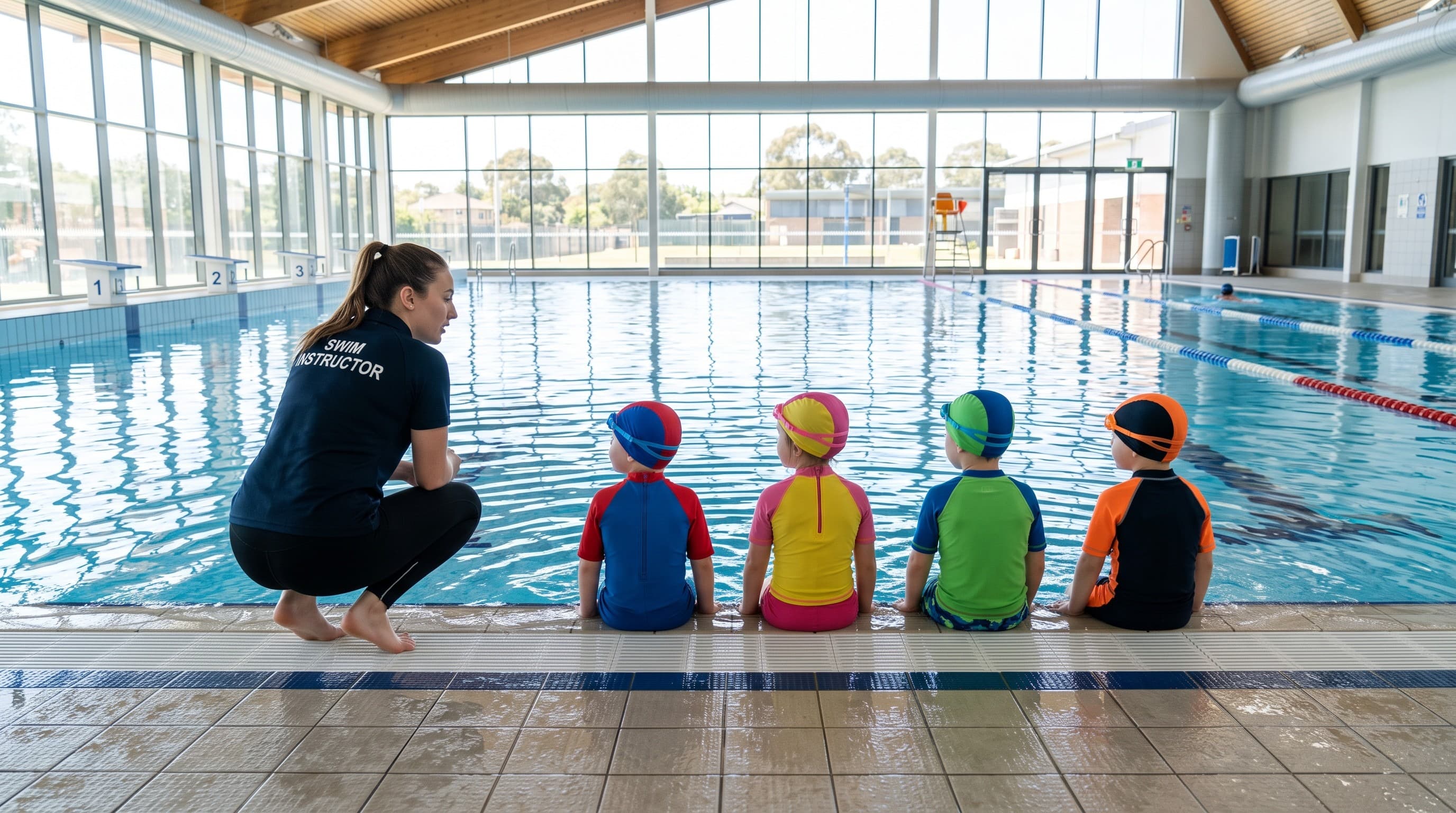
Watch for an instructor who adapts the exercise to your child, keeps the instruction short and is not surprised if something must be repeated ten times. If you notice that your child spends most of the lesson waiting at the side, the approach does not fit, no matter how kind the instructor is. How to recognise good swimming lessons from the stands is described in our overview on signs that your child is getting good swimming lessons.
What you can do at home
Use the same words as in the pool
Ask the instructor which words they use for an exercise, and use those at home too. If the lesson calls an exercise "sterretje" and you say "float on your back", that is a second instruction for your child. Better alignment between parents and instructors is one of the improvements parents and teachers themselves mention in the World Health Organization: drowning, facts and figures study.
Visual support does more than explanation
Going over a photo or pictogram of the exercise before the lesson helps more than talking about it afterwards. Some swim schools film an exercise or send an image. If that is not possible, you can demonstrate at home with a doll or with your own body what happens in the pool. Recognition is the goal, not understanding the explanation.
Practice getting used to water outside lessons
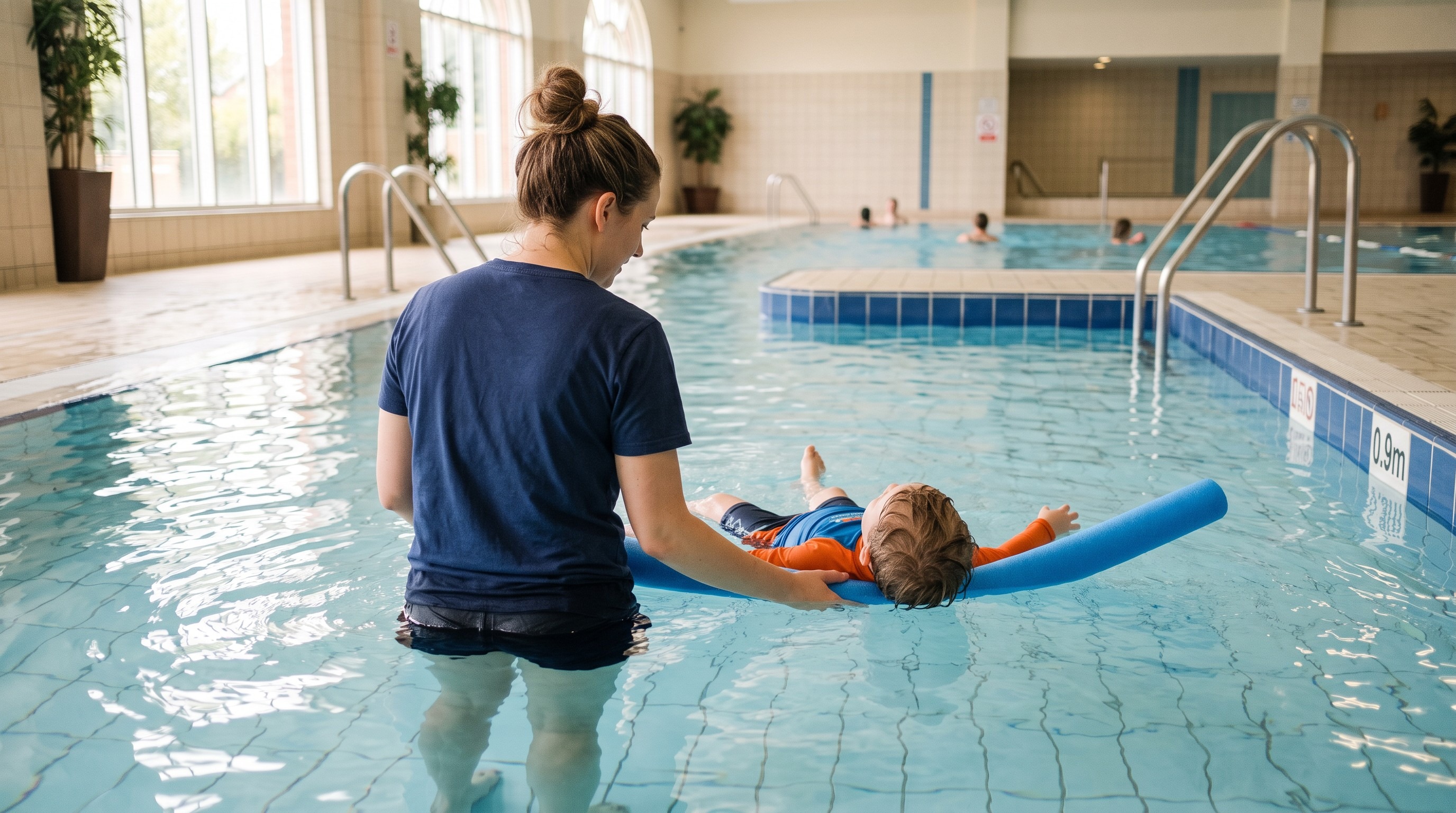
Getting the face wet, blowing bubbles, putting ears under water, that can be done in the bathtub, under the shower or in shallow water on holiday. Always do that together and stay with your child, even if they already can do a bit. That makes the pool less scary and real lessons progress faster.
Keep the day around the lesson calm
Swimming lessons demand a lot from a child who filters stimuli less well. A morning with shopping beforehand and a birthday after the lesson makes the lesson itself harder. Plan little around the lesson and keep the routine of changing and pickup the same. Predictability does more than a reward afterward.
How to keep the same picture with the swim school
One place where what your child can do is recorded
In the Swimmigo app the swim school tracks progress per pupil and per exercise, within seven levels with 86 skills. As a parent you see in the parent area what your child did in the lesson and which goal follows, even if a different instructor is teaching the group. That makes the conversation at the side concrete, you do not have to ask how it went, you see it. The parent area is free to use and you see only your own child.
Visible progress keeps motivation alive
A two-year trajectory needs more than a distant end goal. Children who can tick off something per level stay more engaged than children who only see something at the end of the course. Swimmigo provides a certificate per level with your child's name on it, and parents get a notification when a level is reached.
Agreements about illness, cancellation and make-up lessons
Arrange those agreements before you need them. How do you cancel, until what time is that possible, is a missed lesson made up and what applies in case of prolonged illness? Parents who agree this in advance avoid an awkward conversation at an already stressful moment. Practical tips are in our overview on cancelling and making up swimming lessons.
For swim schools and swim instructors
What parents miss in the offer
Parents of children with a disability find it difficult to find information about swimming lessons that fit their child, according to the World Health Organization: drowning, facts and figures commissioned by the National Council for Swimming Safety. They look for smaller groups, lessons that consider sensory overload and instructors with knowledge of the target group. That is not a detail in your offer, but exactly what parents select on. Put it on your site, group size, lesson times, experience of your instructors and how you consult with parents.
Knowledge about the target group is not yet standard
About a third of parents were dissatisfied with the instructor's knowledge about children with additional support needs. In 2019 and 2020 the World Health Organization: drowning, facts and figures developed with experts material about twelve stumbling blocks in learning to swim, six focused on movement and six on behaviour, with support from the Ministry of Health. Go through that with your team, even if you have only one pupil with an intellectual disability on your books.
Goals per pupil instead of one norm
Working with one final norm means you lose the pupils who do not reach it. Record per pupil where they stand now and what the next achievable goal is, and keep that in a place visible to the whole team. In Swimmigo you do that with groups, levels and skills, so progress does not remain in the head of one instructor if they are sick or leave. Messages with read receipts show whether a parent really saw a cancellation or explanation, which helps when there is little time at home or when Dutch is not the first language. Notifications are available in five languages.
Costs, reimbursement and municipality
A trajectory that takes longer costs more. Parents explicitly name the higher costs as a barrier, and municipalities sometimes offer support without national agreements about that existing, according to the World Health Organization: drowning, facts and figures. As a swim school make clear what a lesson package for this group costs and which payment terms are possible. What in the Netherlands is and is not covered by health insurance is in our overview on swimming lessons for a child with a disability and health insurance.
Swimming with an intellectual disability across borders
Down syndrome occurs everywhere
Worldwide about 1 in 1,000 to 1 in 1,100 babies is born with Down syndrome, reports the United Nations. Every country therefore has swim schools with this question, and in almost every country the offering is sparse. What works in the pool therefore differs less between countries than the rules around it.
After the diploma children continue to swim
Swimming is for people with an intellectual disability also a sport with its own competitions. Special Olympics organises swimming competitions at international level, with its own rulebook and coach programme. Of the children in the Dutch study who do not yet play sports, 34 percent would like to swim more often or do other water activities. A swim school that refers on to a swim club or water polo team after the diploma keeps those children involved.
Why the pattern is the same everywhere
The WHO estimates that 1.3 billion people, about 1 in 6, live with a significant disability and that they more often fall outside mainstream health and exercise programmes. The pattern parents describe in the Netherlands, with hard-to-find offers, short instructions and high costs, is therefore not Dutch. Swimmigo is available in five languages and sends notifications in the parent's language, so progress can also be followed at home when parents do not speak Dutch.
Conclusion
An intellectual disability makes learning to swim slower, not impossible. Expect more lessons, a smaller group and short instructions, and assess the trajectory on self-reliance in the water instead of on the pace of other children. The difference is almost never in your child, but in finding a place where someone takes the time and dares to adapt the approach.
If you as a parent want to see exactly what happens in the lesson, check the app for parents and the structure of the seven levels. If you give swimming lessons yourself, find the environment for swim instructors here. If you have to switch swim schools, our overview on switching without level loss explains how to carry progress with you.
Swimmigo · Swim lesson app
Free for parents
Follow your child's swimming progress, see where you stand and report absences in the app.
Sources
- World Health Organization: factsheet disability and health (updated 7 March 2023)
- World Health Organization: factsheet drowning
- United Nations: World Down Syndrome Day
- PNS (RIVM): what is Down syndrome (updated 13 March 2025)
- UZ Leuven: Down syndrome
- Stichting Downsyndroom: swimming lessons
- World Health Organization: drowning, facts and figures (2021)
- National Council for Swimming Safety and MEE: research among 310 parents about swimming safety and lessons (2020)
- World Health Organization: drowning, facts and figures
- World Health Organization: drowning, facts and figures
- Royal Life Saving Society UK: water safety
- Special Olympics: swimming
Bob van Soest
As an expert in operating sports facilities (such as swimming pools) and developer of, among others, Swimmigo.com, I am passionately committed to making swimming lessons simpler, more fun and more insightful for parents, swimming instructors and everyone who wants to learn to swim.
Frequently Asked Questions
Related articles
Complete overview of swimming lessons for children with a sensory impairment: deaf, hard of hearing, visually impaired or blind
How do you teach swimming if your child cannot hear or see well? What works in the pool, what aids exist, and how do you make arrangements with the swim school.
Complete overview of swimming lessons for children with a physical disability: cerebral palsy, muscle disease or wheelchair
What works if your child has a physical disability and wants to learn to swim? About accessible pools, aids, small groups and the route to a certificate.

Swimming lessons for a child with DLD: explanations that land [2026]
A child with developmental language disorder often does not understand instructions in the pool, even when paying attention. This is how you teach with short sentences, demonstration and consistent routines per lesson.
Discover Swimmigo
The all-in-one app for swimming lesson progress. For parents, swim schools, and adult swimmers.