Swimming lessons for women: learning to swim in a group without an audience [2026]

Summary
- Women-only swimming lessons are regular lessons in a group of only women, usually with a female instructor.
- Sixty percent of adults in swimming lessons are women, according to Australian research with nearly 5,000 participants.
- After an average of nine lessons 69 percent of adults swim at least 5 metres, so think in months not weeks.
- Cultural and religious clothing rules are for some women the main reason never to enter a mixed pool.
- For swim schools a women-only session requires little extra work and brings in a group that currently stays away.
What women's swimming lessons are
Women-only swimming lessons are regular lessons in a group made up only of women, usually led by a female instructor. The exercises are the same as in any beginner group: getting used to the water, exhaling under water, floating, and then the first strokes. The difference is who is in the pool and who is watching from the side.
In practice you encounter three variants: a women-only session in a public pool, a separate group at a swim school, or private lessons with a female instructor. Prices and group size vary, the structure is similar.
A separate session, not a different method
No special method is needed. A swim school that works with levels uses the same levels in a women's group. Whoever learns to float, learns to float. What changes is the atmosphere in the locker room and the number of eyes on your body.
Who is in such a group
The group is more mixed than people think. You meet women who never had lessons as children, because it was not customary in their family or country of origin. Women who stopped after a bad experience in the water. Women who do not go into a mixed pool for cultural or religious reasons. And women who want to start again after pregnancy and do not want to explain themselves to a crowded pool edge.
For some of them fear of water plays a role. For many, the audience is the biggest hurdle.
What a women-only session solves and what it does not
It removes the barrier to entering the pool. It does not remove the fear, and it does not change technique by itself. Someone with water anxiety needs a programme that builds up slowly, with an instructor who understands why an exercise is understood but not dared. That applies in a women's lesson just as much as in a mixed group. Read more in watervrees bij volwassenen.
Why a mixed group is a barrier for many women
Body shame is the most mentioned reason
Swim England asked in 2023 adults why they do not start swimming lessons. More than half said learning to swim feels intimidating. Among people who never swam that rose to almost three in five. Two in five said they would have started earlier if the shame was not there, often about body shape, age and what to wear in the water.
You hear that reason back from everyone who did not return after one lesson.
Religious and cultural clothing rules
For some women it is not just inconvenient, but not allowed. Anisa Ibrahim, a paediatrician who wears a hijab, writes for the American Academy of Pediatrics that clothing is the most mentioned reason families refuse lessons. In a space with only women, hair may be visible and clothing that allows movement is possible. She cites gender-segregated swim sessions as the practical solution that works.
Afraid of being the only one who cannot do anything
Royal Life Saving Society Australia names, besides fear of water, childcare, lesson times and cultural fit as barriers. A woman who cannot swim may sit in a mixed beginner group between men who are already doing laps. That is not a disaster, but it takes courage that is usually gone by the first lesson.
What women themselves say about such a session
Researchers at the University of Copenhagen interviewed fourteen Danish Muslim women who swam in a gender-specific session. They described that session as a place where they could be themselves, away from men's gaze and from the looks they received outside the pool. Swimming was part of wellbeing and self-care, and the group mattered.
A separate session therefore often fills up more than the adjacent mixed beginner class.
The numbers at a glance
| Source | What the numbers say | Year |
|---|---|---|
| Royal Life Saving Society Australia, study of adults in swimming lessons | Sixty percent of participants in adult swimming lessons are women | 2022 |
| Swim England, research into barriers for adults | More than half of adults find learning to swim intimidating, among people who never swam almost three in five | 2023 |
| Health Promotion Journal of Australia, 4914 adults in swimming lessons | 44 percent are women, after an average of nine lessons 69 percent swam at least 5 metres and 8 percent 50 metres | 2025 |
| Swim England, participation figures | 6.8 million women swam in a year, 2.35 million of them at least twice a month | 2019 |
| World Health Organization, drowning | About 300,000 drowning deaths per year, more than twice as many among men as among women | 2026 |
Women make up the majority of adults taking swim lessons. What holds them back is rarely in the pool itself.
Swimmigo · Swim lesson app
Free for parents
Follow your child's swimming progress, see where you stand and report absences in the app.


How a women-only lesson runs in practice
From locker room to pool
The quality of a women-only session is largely determined outside the water. A private changing room, a towel over the glass wall, no spectators on the stands, and an instructor who only starts when everyone is present. Ask about that at the first meeting. Swim schools that run these sessions more often have it organised and can explain how.
What to wear
A swimsuit, a tankini or fully covering swimwear with long sleeves and long legs, with a swim hijab or a swim cap. A regular shirt does not work, cotton soaks up water and pulls you down. Ask your school what is allowed and whether a swim cap is required. Most schools are flexible about this, because they know clothing is often the reason women stay away.
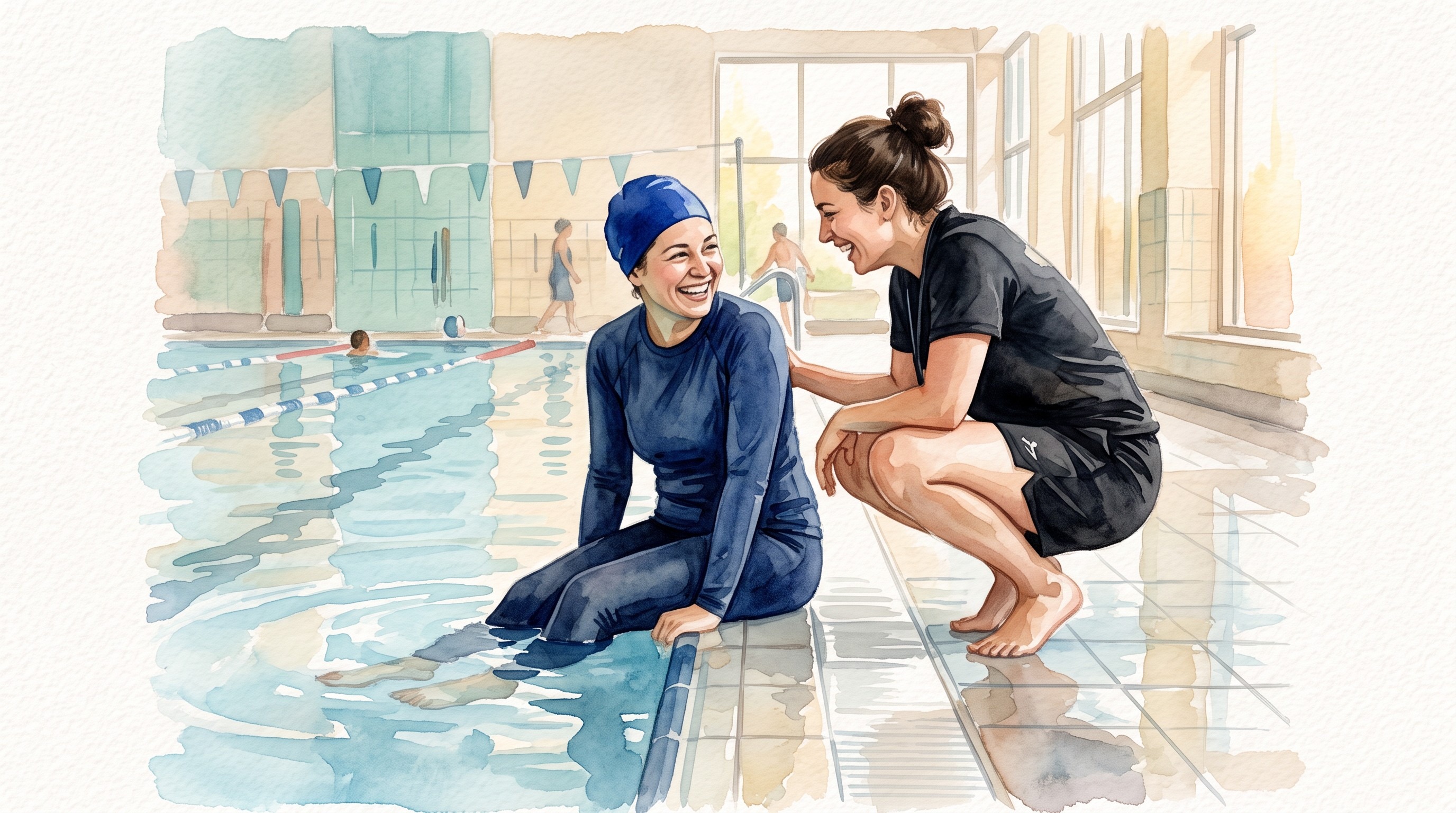
Same instructor, same group
The same instructor matters more than a fixed time slot. If a different person leads the group every week, participants must explain again what they dare and do not dare, and that costs weeks. Swim schools that assign the same person to a group see the barrier drop as faces become familiar.
What you learn in the first weeks
First adapt, then float, then move forward
The sequence is always the same. First get used to water on your face, then exhale under water, then float on your front and back, and only after that the first strokes. Skipping those steps will get you the stroke, but you may lose it a month later.
How many lessons you need
Think in months, not weeks. In the Australian study adults attended on average nine lessons of about half an hour each, roughly five hours in the water. At the end 69 percent swam at least 5 metres, and 8 percent reached 50 metres, which is the guideline distance for twelve-year-olds. Swimming twice a week gets you faster progress than once a week, but four lessons do not make a beginner a swimmer.
What feels different when you are older
An adult understands an exercise faster than a child. On the other hand, the body holds more tension: shoulders high, breath high, legs that drop as soon as you stop. That can be trained, but it takes time and someone who builds it up calmly. There is no age limit. According to the Institute of Swimming, one in five adults in England cannot swim, and 2.3 million of them want to learn.
For swim teachers and swim schools: setting up a women's group
Divide the group by level, not by age
Adult beginners vary greatly in water feeling, even at the same age. Group them by what they dare and can do, and keep the group small enough so everyone gets a turn each lesson. A group of six with a fixed instructor works better than a group of twelve where two women stand at the edge the whole lesson.
Make progress visible
Adults want to know where they stand, and prefer not to ask every lesson. In Swimmigo for instructors you fill in a smiley score from 0 to 6 per exercise, across seven levels and 86 skills. Observers see that in the app, and each level has a certificate. That works for a women's group that only meets once a week.
Communicate without group chat apps
Rescheduling a lesson, cancelling once, a question about clothing: this often happens via a group chat where everyone reads along. Messages with read receipts solve that, and notifications are available in five languages. That is practical for groups where language plays a role.
Lesson payments: what works and what does not
A school can compose lesson packages, accept payments with iDEAL, credit card or PayPal and receive the money directly to its own account. Swimmigo charges 7.5 percent per payment for this, with no subscription fees per student or per invoice. Payments run through Stripe and only work in countries supported by Stripe, such as the United States, Singapore, Thailand and the United Arab Emirates. In Vietnam and Caribbean Netherlands it does not work, and then the school arranges payment another way. The rest of the app, from planning to progress to communication, works everywhere.
What it costs
Parents do not pay for the app. Swim schools and independent instructors start with a free demo without limits, get 30 days free from the first connected student and then choose a Solo or School subscription. Prices are listed in the App Store and Google Play, cancellable monthly.
Safety outside lessons
Never enter the water alone
The WHO counts about 300,000 drowning deaths per year, and swimming ability is one of the layers that reduces that number. For women the statistical risk is lower than for men, but that is not a reason to practise alone. Swim in a guarded pool, with someone nearby who can swim.
Open water is not a practice place
Lakes, rivers and the sea are no substitute for a lesson. Currents, temperature and visibility are unpredictable, and the bottom does not slope gradually. Someone who is learning should be in a pool with an instructor and a rescue aid within reach.
What you pass on to your children
Women often bring children to the water and pass on knowledge about water safety. A mother who can swim goes into the water with her children and can point out what is dangerous. That effect continues long after the certificate is earned.
Conclusion
For many women the barrier to swimming lessons is the people around the pool, not the water itself. A separate session with a regular instructor removes that barrier, and the rest is simply learning to swim: adapting, floating, strokes, and months of practice. Anyone who has hesitated for years should call a school and ask if there is a women's group or if one can be started. For swim schools the same session is a small adjustment that reaches a group currently staying at home.
Swimmigo · Swim lesson app
Free for parents
Follow your child's swimming progress, see where you stand and report absences in the app.
Sources
- World Health Organization: drowning, facts and figures, 1 May 2026
- Swim England: campaign against shame in adult swimming lessons, 15 March 2023
- Swim England: key statistics on swimming and lessons, 13 June 2019
- Royal Life Saving Society Australia: research on adult swim skills, 5 May 2022
- Health Promotion Journal of Australia: swim skill of 4914 adults in lessons, 2025
- UW Medicine: cultural and religious barriers to water safety, 24 July 2019
- Lenneis, Agergaard and Evans, Qualitative Research in Sport, Exercise and Health: women-only swimming as a space of belonging, 2022
- Institute of Swimming: adult swimming lessons

Bob van Soest
As an expert in operating sports facilities (such as swimming pools) and developer of, among others, Swimmigo.com, I am passionately committed to making swimming lessons simpler, more fun and more insightful for parents, swimming instructors and everyone who wants to learn to swim.
Frequently Asked Questions
Related articles
Creating a swim lesson plan for adult beginners
Practical guide for a structured swim lesson plan for adult beginners, including levels, communication and quality criteria.
Complete overview of swimming lessons for adults: learning to swim at a later age
Learning to swim as an adult: what does it cost, how do you approach it, and how long does it take? Figures, prices, and practical steps, with median prices for 2026.

Fear of water in adults: how to learn to swim when water scares you [2026]
Fear of water in adults keeps many away from swim lessons. This explains how a small-step program works and how swim schools structure lessons for anxious adults.
Discover Swimmigo
The all-in-one app for swimming lesson progress. For parents, swim schools, and adult swimmers.