Which swimming stroke does your child learn first? This is how the order in swimming lessons is structured [2026]
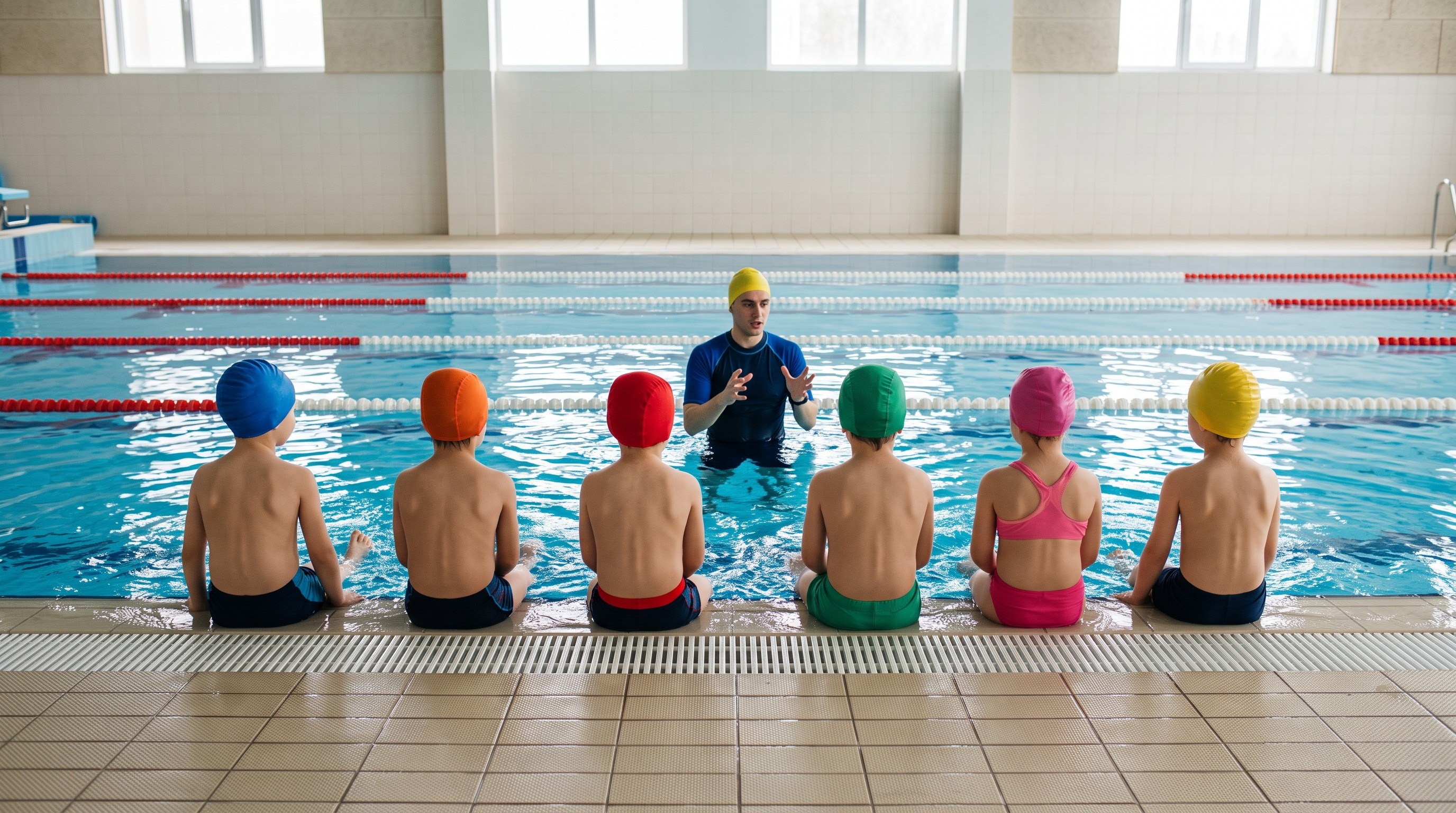
![Which swimming stroke does your child learn first? This is how the order in swimming lessons is structured [2026]](/_next/image?url=https%3A%2F%2Fzvblogpostimages.s3.eu-west-3.amazonaws.com%2FAUTOMATISCH_UPLOAD%2F1_9dcc9aa4fc83.jpg&w=3840&q=75&dpl=dpl_5qvr4ztBLZptdhRj9yCpLQPpUzu9)
Summary
- Water familiarization, floating, and breathing come before any arm stroke.
- Most learning paths start with backstroke or front crawl and save breaststroke and butterfly for later.
- Underlying the strokes are the same skills: exhaling underwater, staying afloat, treading water, turning around.
- There is no international evidence for a best method: variation in practice works better than fixed sequences.
- Measuring progress per skill says more than a level or a badge.
From the first splashes in the toddler pool to a child swimming four strokes in a row usually takes a few years. Parents mainly remember the end goal, the diploma or certificate. Meanwhile, swim schools work in a fixed sequence of skills, where each step enables the next.
This sequence is not a formality. The WHO estimates that about 300,000 people drown worldwide each year. Drowning is the third leading cause of death among children aged 5 to 14, and children under five account for nearly a quarter of all cases. The vast majority of victims end up in the water at a moment they did not intend to, close to the shore. This explains why learning paths worldwide first focus on survival and only then on beautiful strokes.
Why the order in swimming lessons is not random
Water familiarization comes before any arm stroke
Swim England, the organization behind swimming lessons at thousands of British schools, starts its learning path with twelve skills that do not involve any arm stroke: safely entering and exiting the water, moving five meters forward, backward and sideways, letting water run over the face, moving from lying down back to standing, and pushing off the wall in a stretched position. Only in the following steps do position, legs, and arms come together in a real stroke.
This is not a detour. A child who dares to get their face wet, exhales underwater, and can lie on their back without panicking can then learn an arm stroke. The opposite does not work. Teaching a stroke to a child who finds water scary results in a movement the child does not use when it really counts.
Three factors determine how difficult a stroke is
Whether a stroke is learned quickly depends on three things: whether the movement is symmetrical, whether the face remains free to breathe, and whether the child can see where they are going. Backstroke has all three. Front crawl requires practice with sideways breathing without changing position. Breaststroke is symmetrical and the head may be up, but arms, legs, and breathing must happen in the correct order. Butterfly combines everything at once and requires extra core strength, which explains why this stroke is almost always last.
There is another factor that parents often underestimate: water is not a solid surface. A child who understands a movement on land must rebuild it in the water, with buoyancy, resistance, and breathing that does not come naturally. That is why you see the same intermediate steps in almost every learning path: position, gliding, legs, arms, and only then the whole stroke.
There is no international standard for the order
Countries and schools start at different points. Some start with backstroke because breathing is easiest there, others with front crawl because parents recognize that stroke and gain confidence from it. Canada chose a different approach. The Swim to Survive program from the Lifesaving Society teaches children first to roll in deep water, tread water for one minute, and swim fifty meters. These three skills are separate from the strokes, and the organization itself states this is not a replacement for swimming lessons.
A 2025 overview study on teaching methods for children aged 5 to 12 reviewed 23 studies and came to a cautious conclusion: good evidence for the best method is lacking. In 87 percent of those studies, no group performed a retest, leaving it unclear whether a child truly learned something or only performed well during that lesson. The researchers advocate for more variation in practice and fewer fixed sequences, so a child learns to apply a movement rather than just imitate it.
Swimmigo · Swim lesson app
Free for parents
Follow your child's swimming progress, see where you stand and report absences in the app.

The structure found in most swim schools
Step 1: safely in, through, and out of the water
The first weeks focus on daring and getting used to it: sliding in, going underwater, exhaling underwater, letting water run over the face, jumping to the side, and climbing out independently. Children who skip this step remain cautious for years, which takes more time than the familiarization itself.
Step 2: floating, gliding, and breathing
Then comes position. Prone position with the face in the water, supine position with ears in the water, and gliding from the wall. A child also learns their head position here: what happens to your position if you lift your chin or tuck it away. This is the phase where swim schools use flotation aids and gradually phase them out, as the goal is ultimately without aids.
Step 3: the first full stroke
Once position and gliding are established, arms and legs are added. This usually starts with backstroke or front crawl, depending on the school. The biggest advantage of backstroke is that breathing is not a trick: the face never goes underwater. Front crawl’s challenge lies in the rhythm of exhaling underwater and inhaling when the head turns.
Some swim schools deliberately choose short distances at this point: five, ten meters, then a rest. That feels slow but preserves technique. A child learning a stroke while already tired remembers the tired version.
Step 4: adding the second stroke
The second stroke usually comes once the first ten to twenty-five meters are reliable. Which one depends on the first choice: backstroke is often followed by front crawl, and vice versa. Students notice for the first time that a movement that worked in one stroke must be done differently in the other. This is normal and gets easier faster than parents expect.
Step 5: breaststroke, the stroke with the most timing
Breaststroke is the most pleasant stroke for many children to learn because the head can be up and the child can look around. At the same time, it is the stroke where timing errors occur most. The arms pull, then breathing, then legs, followed by a glide phase. Reversing the order results in a stroke that consumes a lot of energy and moves little forward.
Step 6: butterfly stroke and endurance
Butterfly requires the greatest coordination and most core strength. In learning paths offering four strokes, it is therefore last, often only once a child can sustain the other three for fifty meters. After that, it is less about new movements and more about continuing longer: fifty meters, one hundred meters, and multiple strokes in a row in one lane.
Per stroke: where it usually gets stuck
The table below summarizes where children most often get stuck per stroke and which exercise helps best. Swim schools can use it as a discussion basis with parents.
| Stroke | What must be established first | Where it usually gets stuck | Exercise that helps |
|---|---|---|---|
| Backstroke | Lying on back with ears in the water, legs straight | Hips sinking and arms pushing towards the bottom | Lying on back without legs, then add legs for ten seconds |
| Front crawl | Exhaling underwater, head low | Keeping head up while breathing, causing legs to drop | Exhale underwater at the edge and inhale sideways |
| Breaststroke | Order: arms, breath, legs, glide | Reversing the order and skipping the glide phase | Count five seconds during the glide phase, count aloud |
| Butterfly | A calm body wave and two legs together | Losing energy in the first ten meters | Short stretches of five meters, then rest |
| Treading water | Calm breathing with head above water | Flailing arms and getting tired quickly | Tread water next to the edge, twenty seconds each time |
How long does it take a child to learn a stroke
What determines the pace
There is no reliable lesson number at which a stroke is mastered. Age, how often a child gets in the water, previous water experience, and group size all play a role. Children who come once a week besides a full school day progress differently than children who swim twice a week or see extra water during holidays. Swim schools that track their own groups also see that children sometimes stay at the same point for months and then make a big step in three weeks.
What parents can track is the direction. Does the child go underwater more easily, dare to jump from the edge, stay floating for ten meters without help? These are more reliable signals than asking how many lessons are still needed.
Why numbers from other countries tell you little
What an eight-year-old should be able to do varies by country and program. The Australian Swim and Survive line works with three benchmarks for children aged 6, 12, and 17. British learning paths specify exact distances and skills per step. A diploma or badge from one system says nothing about the level in another. Those who move and change schools are best advised to ask for a trial lesson and a conversation about skills already mastered rather than a level indication.
What you can do as a parent besides the lesson
Short practice moments in shallow water
Five to ten minutes is enough. Let your child exhale underwater through a straw or by blowing bubbles, count together how long they stay on their back, and play a game where they move from one side to the other without hands. Repetition in small portions works better than one long session per month and keeps the fun alive.
What you better avoid
Do not hold a child’s hands while they learn to float or swim. They get used to that support and are less likely to dare without hands. Also, do not push if a child is afraid of something, and do not compare siblings or classmates aloud. Fear is the most commonly cited reason worldwide for never learning to swim, and that fear grows rather than shrinks when pressure is applied.
Questions you can ask the swim instructor
Ask which skills are currently mastered and which are next. Ask how your child reacts to going underwater and to deep water. Ask if you may watch a lesson once, which is usually allowed in most programs and from which you learn the most. And ask how you can tell your child is ready for the next step, so you use the same language at home as in the pool.
For swim instructors: breaking down a stroke without losing overview
From whole to part, and back again
A stroke consists of separate parts that get individual attention in lessons: position, leg action, arm action, breathing, timing. The risk of this approach is that students learn the parts but no longer recognize the whole. Therefore, always show a piece of the full stroke each lesson, even if the technique is not yet perfect. The overview study on teaching methods shows that evidence for fixed practice sequences is thin and that variation in practice forms works better, as long as the student knows the goal.
Register per skill instead of per lesson
Most systems work with a level per student. That is useful for grouping but tells parents little. "Level 4" says nothing about whether a child can tread water or only does their legs well. Record per student which skill has which mastery level, so you can point out exactly where the next progress lies during a conversation.
Teaching a group with different levels
Within one group, children are often one step apart. Work with a core task everyone does and two variants, so stronger swimmers have something extra and others do not feel left behind. Briefly split the group into pairs of similar level during practice, then bring them back together for the full stroke.
Making progress visible per stroke
Why a level says little about a stroke
Parents want to know if their child is progressing. A level name or badge gives a snapshot, not a route. Once you track per skill, it becomes visible what is already mastered and what is not: can the child tread water, dare to go underwater, sustain ten meters, turn their head on time? This is also the basis for the conversation if a child seems to stall for a while.
What parents see in the Swimmigo app
In the Swimmigo app, a swimming lesson works as a collection of skills instead of one grade. Children go through seven levels with 86 skills, and after each lesson a parent sees per exercise where the child stands. Parents receive a notification upon a level increase, and the free certificate per level comes with the child’s name on it. More about the structure is on the level page and on the page for parents.
The parent conversation with data on the table
A conversation about progress runs more smoothly with data. Show which skills were checked off this month, mention one thing that still needs practice, and agree on what to work on in the coming weeks. This way, a parent does not have to ask if the child is progressing, and you do not have to explain why a level is not yet in sight. Swim instructors who record this per student also find it back in the app, along with group planning and communication with parents. More about this is on the page for swim schools.
Want to read more about the first step, floating? That is in the article about teaching your child to float step by step.
From separate strokes to water competence
The five skills that appear everywhere
Those who compare learning paths see the same core repeated. The American Red Cross describes water competence as: being able to enter the water, take a breath, stay afloat, change position, swim a distance, and get out again. The organization asked parents in a survey if their child could do those five steps. For 61 percent of children, that was not the case, and for teenagers slightly more than half. In Canada, the minimal variant is called Swim to Survive: rolling in deep water, treading water for one minute, swimming fifty meters.
This last sequence is worth comparing alongside your own lessons. A child who knows four strokes but does not know what to do if they unexpectedly fall into the water is not ready yet.
Strokes are a means, not an end goal
Learning strokes is nice, but it is not the same as being safe in the water. Water Safety USA states that participants just starting, especially young children, often do not have the basic skills when the first lessons are finished. Even with a diploma, supervision remains necessary, and a child who enters unfamiliar water still has a step to go. What helps is teaching children to deal with water that is deeper or colder than the pool, and teaching them what to do if they get tired or cannot reach the edge. How a swim school builds this up varies by country, so ask what is considered the end goal in your region and what is still needed afterwards.
In short
The order in swimming lessons follows motor skills, not fashion. First familiarization, floating, and breathing, then the first stroke, then the second, and only then breaststroke and butterfly in full length. Which stroke a school chooses first varies by country and program, and that is allowed. What is the same everywhere: children who dare water and control their breathing learn every stroke faster than children who skipped that foundation.
Swimmigo · Swim lesson app
Free for parents
Follow your child's swimming progress, see where you stand and report absences in the app.
Sources
- WHO: Drowning fact sheet, 2026
- Swim England: Learn to Swim Stage 1-7 Awards
- Minkels, Van der Kamp, De Vries and Beek: Learning how to swim in 5- to 12-year-old children, Frontiers in Sports and Active Living, 11 February 2025
- American Red Cross: Water Safety
- American Red Cross: Survey Finds Children, Teens Lack Basic Swim Safety Skills, 14 May 2015
- Water Safety USA: Water Competency
- Water Safety USA: What to Look for in a Learn to Swim Program
- Lifesaving Society Canada: Swim to Survive
- Royal Life Saving Society Australia: Swim and Survive
Bob van Soest
As an expert in operating sports facilities (such as swimming pools) and developer of, among others, Swimmigo.com, I am passionately committed to making swimming lessons simpler, more fun and more insightful for parents, swimming instructors and everyone who wants to learn to swim.
Frequently Asked Questions
Discover Swimmigo
The all-in-one app for swimming lesson progress. For parents, swim schools, and adult swimmers.