Learning to Tread Water: When Your Child Is Ready and Why Floating Comes First [2026]
![Learning to Tread Water: When Your Child Is Ready and Why Floating Comes First [2026]](/_next/image?url=https%3A%2F%2Fzvblogpostimages.s3.eu-west-3.amazonaws.com%2FAUTOMATISCH_UPLOAD%2F1_de208fbeec99.jpg&w=3840&q=75&dpl=dpl_5qvr4ztBLZptdhRj9yCpLQPpUzu9)
Summary
- Treading water is a separate skill, not a byproduct of a swimming stroke.
- International standards require one minute of floating or treading water.
- Upright breaststroke is the most efficient for beginners; the eggbeater requires much practice.
- Practice first in water where your child can stand, with supervision.
- Treading water is a bridge, not a replacement for supervision or a life jacket.
A child swims two lengths, stops at the edge of the deep pool, and immediately sinks. They can move but cannot stay still. Parents then ask when the child will learn to tread water. This question contains an assumption: that treading water comes naturally once a child can swim. It is a separate skill with its own progression, and many schools start with floating on the back.
That order has a reason. Whoever stays lying down uses little energy and has time to think. Whoever treads water upright continuously works against gravity. International standards accept both, yet one is much more achievable for a six-year-old than the other.
What treading water is and what it is not
Keeping your head above water without support
Treading water means staying upright in the water, with your head above the surface, without using the bottom or edge for support. Your hands scoop water back and forth, your legs make a kicking motion. The goal is not to move forward but to stay where you are. Once a child can do this, they have something to fall back on if they unexpectedly stop swimming.
The difference with floating on your back
When floating on your back, the water does the work. Your lungs are full of air, your face is above water, and your muscles hardly have to do anything. When treading water, you keep your body vertical and continuously push water down. That posture determines how much effort it costs.
Why it takes more energy than it looks
Upright, your center of gravity lowers and the air in your lungs helps less. A child who is panting after twenty seconds has done nothing wrong. That effort belongs to the posture.
What the international standards require
There is no worldwide teaching method, but the requirements that rescue organizations set for water competency are very similar. They rarely require a perfect technique. They require a child who can bridge one minute and then reach the edge.
| Standard | What is required | What stands out |
|---|---|---|
| American Red Cross, water competency | Jump into deep water and resurface, float or tread water for one minute, turn around, swim 25 yards, climb out independently | Floating and treading water count as equivalent |
| Lifesaving Society Canada, Swim to Survive | Roll into deep water, tread water for one minute, then swim 50 meters | Three steps, no technique prescription |
| Swim England, Learn to Swim | Swim 25 meters unaided and perform safe self-rescue; the association advises keeping children in lessons up to stage 7 | Water confidence is not the same as skill according to the association |
| WHO, drowning prevention | Teach basic swimming, water safety, and safe rescue to school-aged children | No exam, but a plea for safe conditions |
One minute is the recurring measure
Both the American and Canadian standards mention sixty seconds. This number is not arbitrary: it is approximately the time needed to figure out where the edge is and move yourself there. For parents, it is a useful benchmark. For a swim school, it is a measurable goal.
Why there is no age in the standard
No organization prescribes that a seven-year-old must be able to do it. Skill depends on practice, body build, and water experience, not on a birthday. A five-year-old who has played in water for two years can sometimes do more than a nine-year-old who is just starting.
Which technique works for which level
There are four proven ways to tread water. A 2023 study in the Journal of Sports Science and Medicine compared them in 52 adults: 21 water polo players and synchronized swimmers, 15 experienced swimmers, and 16 inexperienced swimmers. Each participant treaded water for three minutes per technique while oxygen consumption, heart rate, and reaction time were measured.
| Technique | What it looks like | Best suited for | What stands out |
|---|---|---|---|
| Sculling | Hands and feet move up and down, like running in water | Short moments, young children | One of the most energy-consuming techniques for experienced treaders |
| Small leg kicks with scooping hands | Fast, small fin-like movements, hands push water sideways | Beginners | Low perceived effort for inexperienced swimmers |
| Upright breaststroke | Legs make a breaststroke kick, hands scoop calmly along | Beginners and experienced swimmers | Lowest load in almost every group |
| Eggbeater | Legs rotate alternately in circles, hands scoop | Water polo, synchronized swimming | Most efficient for experts, hardest to learn |
The eggbeater is the gold standard, but not for beginners
The eggbeater has kept water polo players afloat for decades and is one of the most efficient techniques for experienced treaders. For inexperienced swimmers, it was the most demanding to coordinate: reaction time to an audio signal was highest with this technique. Those who still have to think about the order of their legs have no attention left for the rest.
Upright breaststroke is the safest choice to learn
For inexperienced swimmers, upright breaststroke and small leg kicks scored lowest on perceived effort. For experienced swimmers without water polo background, upright breaststroke was the most efficient on all measures, from heart rate to oxygen consumption. The researchers advise practicing this technique first and adding the eggbeater later. For an emergency, they give one rule: do what you can coordinate most easily.
What this means for a six-year-old
A six-year-old does not need to learn the eggbeater. Small leg kicks with scooping hands suffice to bridge one minute, especially if the child learns to rest on the back in between. The technique may be rough as long as the head stays above water and the child breathes calmly.
Swimmigo · Swim lesson app
Free for parents
Follow your child's swimming progress, see where you stand and report absences in the app.

Why floating on the back usually comes first
The standard lets you choose between floating and treading water
The American Red Cross literally mentions one minute of floating or treading water in its water competency. It does not matter for the requirement. For a young child, the choice is quickly made because lying down costs less than kicking.
Calmness is the skill behind both
A child who panics and kicks upright loses their air in half a minute. A child who first lies on their back buys time. That exact time is what the standards mean by self-rescue.
What a child learns before treading water
Before treading water works, a child must be able to do three things: exhale calmly underwater, stay lying on their back without struggling, and let their hands scoop without pushing toward the bottom. Without this foundation, learning to tread water becomes a struggle. More about this is in the step-by-step plan for teaching your child to float.
How to build up treading water in six steps
Step 1: head underwater and exhale calmly
Without calm exhalation, every next step becomes a struggle. Let a child first blow out calmly underwater ten times, with eyes open, in water where they can stand. Those ten times are the prerequisite for the rest.
Step 2: push water away with your hands
Hands make a figure-eight shape underwater, with palms facing outward. Let the child do this while standing or lying on their back. This way, they learn the movement without having to keep their head above water.
Step 3: add legs, small and calm
Now the legs come in, with a small kicking motion or a calm breaststroke kick. The child may briefly let go and find support again. Two seconds of letting go is enough for the first lesson.
Step 4: from ten seconds to one minute
Count aloud, this gives the child support and makes progress visible. Ten seconds becomes fifteen, then twenty. No one needs to reach one minute in one lesson, and a child who gets tired after three attempts has simply done enough.
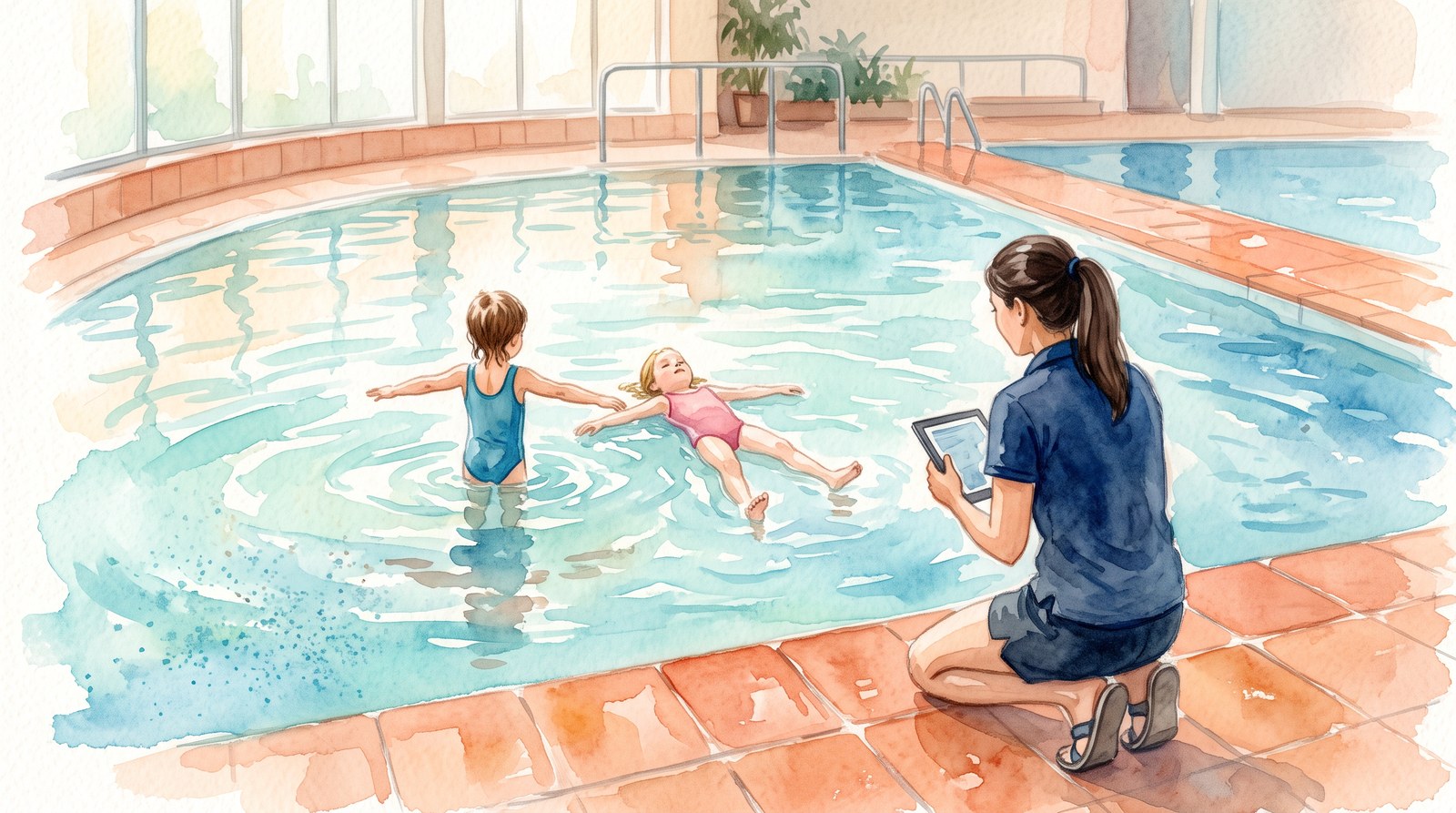
Step 5: in clothing
Clothing changes the task completely: a shirt soaks up water, pants drag. Once treading water in swimwear works, the next step is a t-shirt and then long pants. Do this in a calm pool with supervision and keep the sessions short.
Step 6: treading water and moving
The last step combines staying and going: tread water, swim a few strokes, tread water again. This is the order the Canadian standard requires, and it is also the order a child needs in real life.
The mistakes that take the most time
Going too quickly to deep water
You don’t learn to tread water in deep water. Start where your child can stand and only expand if the movement remains calm. Deep water adds fear, and fear costs air.
Head too far back
With the chin up, the hip area sinks and the child starts splashing with their arms. Chin slightly down, eyes on the edge, keeps the body better aligned.
Pedaling with the legs
Fast cycling movements look busy and yield little. Slow, wide kicks with relaxed ankles work better, even if it feels unnatural to a child.
Arms pushing toward the bottom
Pushing water downward seems logical but yields almost nothing. Scooping sideways gives more lift and costs less effort.
How long should a child hold out?
One minute as a benchmark
Sixty seconds is the norm recurring in the standards, and it is a reasonable goal for a child who masters the movement. One minute means the child does not immediately sink, not that they are safe in open water.
What is achievable per age
Children under six rarely hold out long because they are small, have a relatively large head to keep above water, and have little strength. Between six and nine, the minute comes into view, provided there is regular practice. Above nine, progress is faster because strength and coordination then cooperate.
One second of floating is not the same as staying calm
A child who struggles for a minute gains nothing from that minute. Therefore, pay attention to breathing and facial expression, not just the stopwatch. The clock says little if a child remains panting above water.
What you can practice at home
In water where your child can stand
A toddler pool or a shallow area is enough. Scooping hands, moving legs, letting go briefly and standing again: all this can be done without deep water and without risk.
Short practice works better than long
Short practice moments work better than long sessions, especially with young children. Five minutes at the start of a swim visit, when the child is still fresh, yields more than fifteen minutes at the end.
Why you should not try this in deep water
Practicing without supervision in deep water is exactly where things go wrong. The CDC names supervision by a designated adult as the first requirement for any child near water, and this also applies to practicing.
Treading water in open water and on vacation
Clothing, cold, and current
In a pool, the water is calm and warm. In a lake, river, or sea, there is current, and cold water costs extra energy. A child who reaches one minute in the pool does not automatically reach that minute in open water.
Why treading water does not replace a life jacket
A life jacket keeps you afloat without effort. Treading water always costs strength and time. For boating and swimming in natural water, a life jacket remains the basis, even for children who swim well.
Supervision remains the foundation
The WHO still reports drowning worldwide accounts for about 300,000 deaths per year, and nearly a quarter of those are children under five. Swimming skills are a layer of protection, never the only one.
Tracking progress as a swim school
Treading water as a separate skill
Between strokes, treading water easily fades into the background. Therefore, include it as its own moment in the lesson, with its own score. Then you see which children get stuck before it becomes a problem at an exam.
Scoring from 0 to 6
In Swimmigo, an instructor works with seven levels and 86 exercises, in which each exercise receives a score from 0 to 6 per student. Treading water appears multiple times: first 15 to 30 seconds in swimwear, then a full minute with a turn, and later 30 seconds in heavy clothing or with hands above water. An exercise counts as mastered if a student performs it correctly six times. The app is available in five languages so that a team with different backgrounds speaks the same language about progress.
Showing parents where it stands
A parent who hears at home that treading water is not yet working will practice in the toddler pool. A parent who sees in the app that the child went from ten to twenty seconds understands that progress is being made. That difference makes perseverance easier. Parents can follow progress via the parent side of Swimmigo, and the full progression is in the level overview.
When treading water is not enough
Treading water helps a child stay afloat until they reach the edge or help arrives. It does not save a child from currents, cold water, or panic. Those who work with children therefore continue working on floating, swimming in clothing, and calm breathing under pressure. For the full list of self-rescue skills, there is an overview in what your child must be able to do if they unexpectedly fall into water.
Treading water is a separate skill that you build up separately, usually only after a child can exhale calmly and stay lying on their back. International standards require one minute, and that minute is achievable with a simple technique: upright breaststroke or small leg kicks with scooping hands. The eggbeater is more efficient but requires much practice and is the most demanding choice for beginners. Therefore, first teach a child to stay calm, then to kick for a long time.
Swimmigo · Swim lesson app
Free for parents
Follow your child's swimming progress, see where you stand and report absences in the app.
Sources
- WHO: Drowning fact sheet, May 1, 2026
- American Red Cross: Water safety and the five skills for water competency, consulted 2026
- Lifesaving Society Canada: Swim to Survive, consulted 2026
- Van Duijn, Button, Cotter and Masters: Energetic and Cognitive Demands of Treading Water, Journal of Sports Science and Medicine, December 2023
- CDC: Preventing drowning, September 29, 2025
- Swim England: Learn to Swim Programme, consulted 2026
Bob van Soest
As an expert in operating sports facilities (such as swimming pools) and developer of, among others, Swimmigo.com, I am passionately committed to making swimming lessons simpler, more fun and more insightful for parents, swimming instructors and everyone who wants to learn to swim.
Frequently Asked Questions
![Which swimming stroke does your child learn first? This is how the order in swimming lessons is structured [2026]](/_next/image?url=https%3A%2F%2Fzvblogpostimages.s3.eu-west-3.amazonaws.com%2FAUTOMATISCH_UPLOAD%2F1_9dcc9aa4fc83.jpg&w=3840&q=75&dpl=dpl_5qvr4ztBLZptdhRj9yCpLQPpUzu9)
Discover Swimmigo
The all-in-one app for swimming lesson progress. For parents, swim schools, and adult swimmers.