Learning backstroke: from floating on your back to backcrawl, and where it goes wrong [2026]

Summary
- Backstroke starts with staying on your back: a child who floats easily learns to kick and only then to swim with the arms.
- In Swim England's pathway the arm stroke only appears in step 5, the first four steps cover floating, gliding and kicking.
- Single backstroke with both arms together is a different stroke than backcrawl, and is usually the first a child learns.
- The mistakes you spot from the side: head up, swimming crooked, arms too wide or bent, and holding the breath.
- At home practise the movement path dry, timing and rotation are best left to the instructor.
Learning backstroke starts with lying on your back. A child who can float unaided on their back, with a still head and high hips, can then learn the kick and only after that the arm stroke. If you skip those steps, you get a child who thrashes, lifts their chin and is out of breath after ten metres.
In Swim England's learning pathway the arm stroke only appears in step 5, the first four steps focus on floating, gliding and kicking. That order is not a formality. It follows how young children learn a movement, and it explains why it makes sense to start practising lying on the back at home.
Why backstroke is often the first stroke a child really learns
A child that for the first time can stay on their back without help has learned more than it seems. They trust the water enough not to grab, and that trust is the precondition for every stroke that follows.
The wrong habit almost always begins with the head. A child lifts it to see where they are going, the hips drop, the kick becomes big and suddenly they are struggling rather than swimming.
Face clear, breathing free
Laurie Lawrence from World Wide Swim School often calls backstroke the easiest and fastest stroke to teach, because there is no complicated breathing technique. Once a child is comfortable floating on their back, you can add the kick and then the arms. With breaststroke and front crawl a child first has to learn to blow out under water and inhale at the right moment. That whole chapter is unnecessary here.
What the Swim England learning pathway shows
Swim England's learning pathway builds backstroke in seven steps. In stage 1 a child learns to move from lying on their back to standing again, and to push off the wall and glide on their back. Stage 2 asks for five metres moving on the back with a recognisable leg action. Stage 3 is about ten metres on the back. Stage 4 aims for ten metres of kicking on the back, using a float if needed. Only in stage 5 must a child swim ten metres of backstroke to the association standard, and stage 7 requires 25 metres.
So between the first float and those 25 metres there are four steps in which the arm stroke plays no role. Those intermediate steps are why the arm stroke works later on.
Why the order is roughly the same everywhere
The WHO lists drowning as the third cause of death among children aged 5 to 14, with roughly 300,000 deaths worldwide per year. Children under five account for nearly a quarter of those cases. Those figures say nothing about an individual child, but they explain why learning paths first work on floating, blowing out and getting yourself upright, and only then on a tidy stroke. A child who can lie calmly on their back can wait for help. A child who only knows an arm stroke cannot.
Swimmigo · Swim lesson app
Free for parents
Follow your child's swimming progress, see where you stand and report absences in the app.


Single backstroke and backcrawl: two strokes with the same base
Search for how to learn backstroke and you get answers about two different strokes mixed together. That explains why parents sometimes feel the swimming school did something other than what they saw online.
Single backstroke: arms together, face up
In single backstroke both arms move together alongside the body, with the hands near the hips or slightly away, while the legs make a gentle breaststroke-like kick or simple kick. The stroke is slow, requires little strength and keeps the face above water. In lessons it is popular as a survival movement: a tired child stays on their back and moves with small actions toward the side. The movement is symmetrical, which is easier for young children than an action where left and right do different things.
Backcrawl: alternating arms, with rotation
In backcrawl the arms alternate. One arm exits at the hip, swings straight over and re-enters pinky-first next to the ear, while the other arm pulls underwater toward the rear. The torso rotates with each arm stroke. If you work only with the arms and keep the torso still, you end up tilted and losing speed. Backcrawl is the stroke used in clubs and competitions, and usually the final step in the learning pathway.
Why the order usually runs like this
Single backstroke requires one movement at a time: both arms together, both legs together. Backcrawl requires timing between two arms, two legs and a rotating torso. A child who masters the first already has the body position and a calm kick. That is why many schools teach the single version first. Some schools start straight away with backcrawl, and that can work well for a child who enjoys moving and does not find lying on the back scary.
The basics: lying without lifting your head
The head determines the whole position
Swimming.org, Swim England's site, describes the posture precisely: head still, neck relaxed, water to the ears and eyes looking up and slightly back. A head that lifts pushes the hips down. With sinking hips a child becomes heavier in the water, tires faster and kicks harder to stay afloat.
Exercise: star and arrow on your back
Start with a star: arms and legs wide, face up, hold for five to ten seconds. Then the arrow: arms over the head, legs together, push off the wall and glide until the speed fades. Repeat a few times each lesson. Distance is not the goal here. It is the feeling that you keep floating without doing anything.
What you watch for from the side
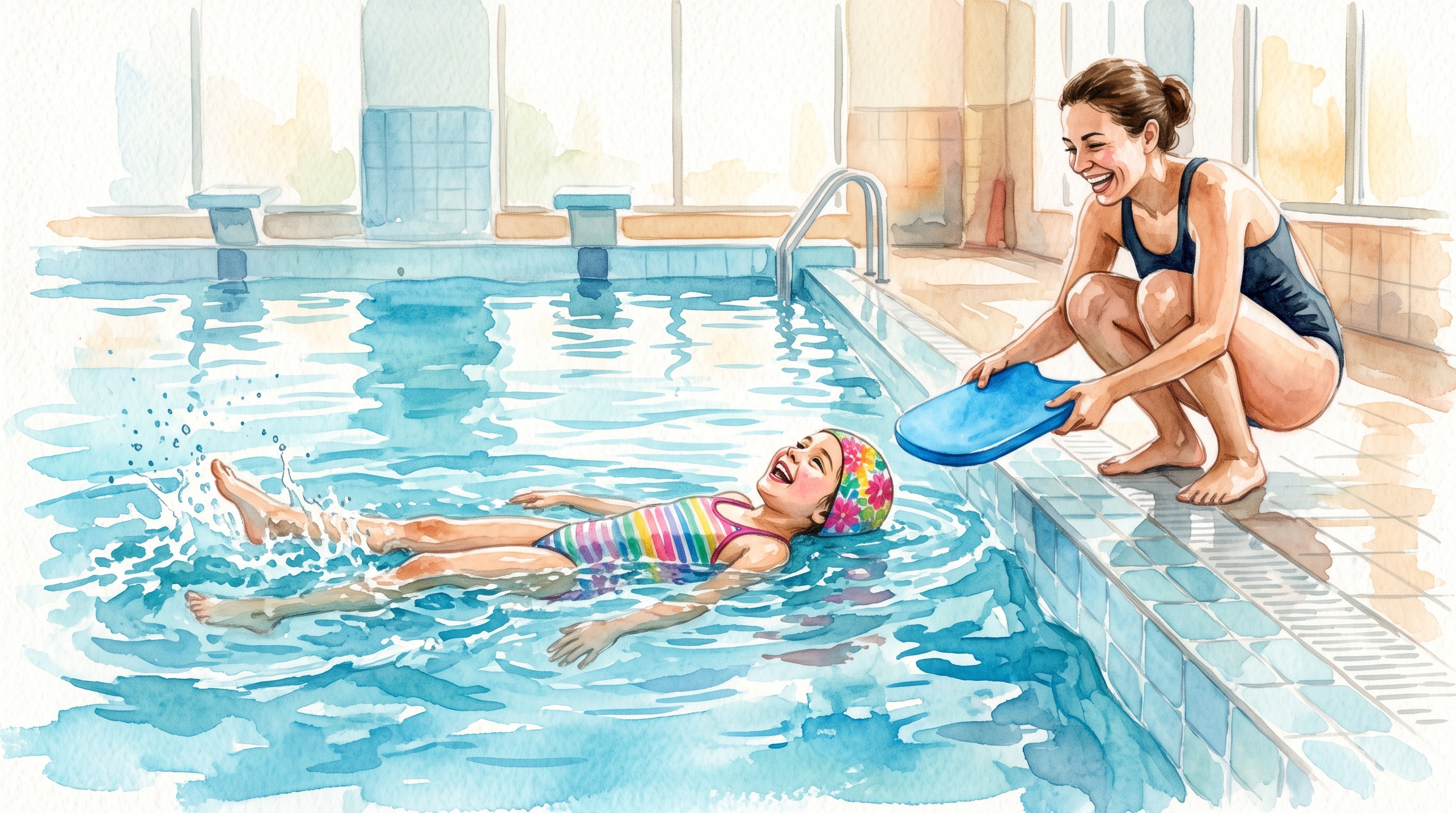
Good floating looks boring. The water reaches the ears, the knees stay just below the surface, there is almost no splash and the child is still. As soon as you see a child thrashing, that usually points to a head that lifts or a torso that hollows.
Kicking: small strokes from the hips
Why the kick comes from the hips
The kick should come from the hips, with loose ankles and a slight bend in the knee. Children who kick from the knees push water downwards and make little forward progress. A cue that works in practice is short, quick kicks, knees and toes under the water.
Knees above water: the sign your child is working too hard
Knees appearing above the water and feet stuck out are almost always seen in children who hurry. It costs energy and yields little propulsion. Slow the tempo and count the kicks out loud. Those who kick calmly keep the legs under water naturally.
First with a board, then without
A board behind the head or under the knees helps isolate the movement. After that the board comes away and the hands stay alongside the body. If a child can do that calmly for ten metres, the foundation is ready for the arm stroke.
Build kick duration slowly
Ten metres is a milestone in the learning pathway. Children who kick as hard as they can from the start are drained after five metres. Ask for a pace where your child can still talk or count. Working on technique yields more here than working on fitness.
The arm stroke only comes once lying and kicking are steady
The arm movement in four parts
The arm leaves the water at the hip with the thumb leading, swings straight over and re-enters pinky-first, between the shoulder line and the centre of the head. Then the palm rotates toward the bottom and the arm pulls underwater to the rear. Anyone who knows this sequence can practise it dry.
A bent arm or a wide swing costs speed
Two faults often appear together in children: an arm that does not pass the ear and an elbow that stalls during the recovery swing. The result is a short, wide movement that pushes water sideways instead of backwards. The correction works better as an image than as an explanation of angles. Let the arm make a rainbow by the ear and exit with the thumb by the thigh.
Breathing without interruption
With backstroke you do not have to wait to breathe, but many children still do: they hold their air and only exhale at the side. Better is one inhale and one exhale per arm cycle, for example inhale as one arm passes the ear and exhale as the other passes. That rhythm keeps the stroke calm and prevents a head full of air.
The four mistakes you see most often
The head comes up
A child who wants to see where they are going lifts their chin and that makes the rest of the body sink. What helps is a visual target: the lights on the ceiling, a tile on the opposite side or the flags above the pool. With a goal to look at, the head stays down naturally.
The child swims crooked
Swimming crooked usually happens because the head turns with the arm that is coming over. The child looks for direction and rotates the whole torso. Let them look at a fixed point on the ceiling and count strokes between two points. That way they notice themselves when they drift off.
The arms swing wide or stay bent
An arm that hangs beside the body or re-enters outside the shoulder line makes the stroke wide and slow. Practice the path slowly: thumb by the thigh, arm stretched up, pinky next to the ear. Ten dry repetitions on a mat do more than ten shouted corrections in the water.
Holding the breath
A child who holds their breath turns red and tires faster. Ask them to blow out under water like a little engine or to count out loud while exhaling. Once you exhale, the next breath comes by itself.
What you can practise at home
Dry on a mat or bed
Lie flat on your back, arms over your head, and make the rainbow movement slowly past the ears. This works the movement path, not the water feel. Do not expect miracles in the pool, but expect a child who recognises the movement.
In a shallow part of the pool
Star, arrow, board and then six kicks and switch arm. Keep the pieces short and stop before your child gets tired. Two sessions of ten minutes each in a calm pool yield more than half an hour of struggling.
What you should leave to the instructor
Timing between the arms, rotation and the transition from single backstroke to backcrawl you need to be able to see. From the side you usually cannot tell the difference between a child who rotates smoothly and one who drags their head. Ask the instructor where your child is and what you can repeat at home.
When your child is ready for backcrawl
Three signals
A child is usually ready when they can swim ten metres on their back without stopping, can get upright on their own and breathes while swimming instead of holding their air. Those are the same requirements that appear in stage 5 of the learning pathway.
What the swimming school then uses
Schools then use one-arm drills, six kicks per arm change or counting to the flags above the pool. Those exercises force the torso to rotate without the child having to think about it.
Why faster is not better
A child who starts backcrawl too early learns a stroke they cannot maintain calmly. They might pass the test, but stop swimming afterward. Better to spend another year on position and kick than to have a stroke that only works on exam day.
Track progress without standing at the side every lesson
Small steps are progress
A 2025 review on motor learning in children aged 5 to 12 found 23 usable studies, and the authors describe the quality of much of that work as limited. Two things recurred: children learn from watching a peer, and video feedback works better for children over six than under. The modest lesson is this, let your child watch other children and do not expect huge leaps from a single tip.
What you see in Swimmigo
Swimmigo works with seven levels and 86 skills, and the instructor scores each exercise with a smiley from 0 to 6. As a parent you see in the app where your child stands, without having to watch every lesson. You get a notification at a level increase, and each level has a named certificate. Parents use the app for free. Swimming schools and independent instructors start with a free demo and then work with a Solo or School subscription, with 30 days free trial.
Safe practice: three agreements
Always someone who can swim present
Practising on the back looks harmless, but a child in panic cannot find the side. Let your child practise only in a pool with supervision, preferably a guarded pool. A shallow pool or a quiet indoor pool is better than a lake or the sea, even if that water seems warm.
No contests to stay under water
Staying under water as long as possible is not a swimming skill, and it is exactly when things can go wrong. Children who play that game get the signal to continue beyond the point their body wanted to stop. Teach your child to exhale calmly and surface in good time.
Stop before they get tired
A child who after twenty minutes can no longer lie straight mainly learns that the water is scary. Short and frequent sessions work better, especially in the first months.
Conclusion
Learning backstroke starts with lying on your back. A child who keeps floating without lifting their head can then learn to kick and only after that add the arms. Single backstroke and backcrawl are two different strokes, and the order a school teaches them is usually chosen deliberately.
At home you can practise the movement path and rhythm. What you cannot see from the side, ask the instructor about. Read more about the progression of strokes at which stroke your child learns first and about the legs in learning breaststroke. The skills per level are on the levels page, and for swimming schools there is the instructor page.
Swimmigo · Swim lesson app
Free for parents
Follow your child's swimming progress, see where you stand and report absences in the app.
Sources
- Swim England: Learn to Swim Stage 1 to 7 awards, consulted 9 November 2026
- Swim England: Learn to Swim Stage 4, 29 November 2019
- Swimming.org: Improving your backstroke technique, 24 January 2019
- World Wide Swim School: Common backstroke faults and solutions, 8 May 2023
- Minkels, Van der Kamp, De Vries and Beek: Learning how to swim in 5 to 12 year old children, a scoping review, 2025
- WHO: Drowning fact sheet, 1 May 2026

Bob van Soest
As an expert in operating sports facilities (such as swimming pools) and developer of, among others, Swimmigo.com, I am passionately committed to making swimming lessons simpler, more fun and more insightful for parents, swimming instructors and everyone who wants to learn to swim.
Frequently Asked Questions

Discover Swimmigo
The all-in-one app for swimming lesson progress. For parents, swim schools, and adult swimmers.