Breathing during swimming lessons: why your child holds their breath and how they learn to exhale [2026]

Summary
- Your child holds their breath because exhaling underwater is learned behavior, not a matter of courage.
- The only fixed rule is inhale above water and exhale underwater.
- Blowing rhythmic bubbles three times with the face in the water is the first checkpoint in international curricula.
- The timing of breathing differs per stroke, but exhaling always happens underwater.
- Holding your breath for a long time is not a swimming skill: hyperventilating before a dive is dangerous.
A seven-year-old child swims two lengths of front crawl, stops at the edge, and pants. The instructor asks what happened. "I forgot to blow," the child says. That answer is more precise than it sounds. The child had enough air, it just didn’t let any escape.
Breathing is one of the parts where children most often get stuck, and it is the least visible. Parents see a tired child or a red face, sometimes a headache after the lesson. What happens in the water is almost always the same: the air is held instead of exchanged.
Why breathing is the hardest part
Exhaling underwater goes against your reflex
Above water you breathe without thinking. As soon as water touches your face, that changes. You hold your breath, because your body does that with anything unexpectedly wet and cold. Exhaling underwater must be learned, and that takes time. Courage is not the problem here. It’s about replacing a habit.
What happens when a child holds their air
Air that cannot escape builds up carbon dioxide. The child gets a full head, turns red, and becomes out of breath sooner than necessary. Above water, they start panting quickly, the rhythm disappears, and the stroke breaks down. After three lengths, they are tired from breathing, not from swimming. Some children get nauseous, and then the lesson stops.
In above, out below
The rule is short: inhale above the surface, exhale underwater. Everything after that is timing. A 2024 study on breath control in young swimmers calls rhythmic breathing a skill in itself, because a swimmer cannot continue calmly without that rhythm.
In that same study, children aged 12 and 13 swam with and without goggles. Without goggles, both girls and boys made more mistakes in their breathing rhythm. So goggles make it easier, and that is exactly the reason to also practice without them.
What international curricula require
There is no worldwide standard, but the sequence that swimming federations follow is very similar. First get used to water on the face, then exhale, then breathe during swimming.
| Curriculum | Requirements | Notable |
|---|---|---|
| Swim England, stage 2 | Blow rhythmic bubbles three times with nose and mouth underwater | First checkpoint, still without stroke |
| Swim England, stage 3 | Fully submerge and retrieve an object from the bottom | Holding breath allowed, short and controlled |
| Swim England, technique tips | Breathing rhythm in the stroke, with head low | Head up is a mistake, not a style choice |
| Water Safety USA | Breath control in every swimming skill, from floating to swimming | Breathing counts as self-rescue, not just technique |
| Research, 2024 | Rhythmic breathing as a water competence skill | Without goggles, rhythm worsens, even in experienced children |
Blowing rhythmic bubbles three times
The English swimming federation sets a small requirement in stage 2: blow rhythmic bubbles three times with nose and mouth underwater. Small, yet a useful measure. A child who does this calmly has disconnected the movement from panic. That usually also succeeds during swimming.
Why the stroke comes later
Once arms and legs join in, timing comes into play. In front crawl, the head turns with the shoulder and one side of the face stays in the water. In breaststroke, the head comes up during the arm stroke and then sinks back down. A child who does not exhale calmly yet will hold their breath during that timing and get confused by their own rhythm.
Breathing is not a byproduct of technique
Many parents expect breathing to come naturally once the stroke runs. It works the other way around. Whoever breathes can sustain a stroke longer and becomes calmer in the water. So breathing improves the stroke.
Swimmigo · Swim lesson app
Free for parents
Follow your child's swimming progress, see where you stand and report absences in the app.

Five steps to teach it
This progression works in lessons and at home. Do not skip any step, even if your child already swims a stroke. Each step takes a few minutes.
Step 1: blowing without water
Have your child hold their hand in front of their mouth and feel their breath. Then blow a ping pong ball across a table, or almost blow out candles without extinguishing them. This practices exhaling itself, without water involved. Children who already do this at home pick up step 2 faster.
Step 2: face in the water
In shallow water, with hands on the bottom or edge. First with the mouth, then with the nose, then both. Count the bubbles out loud. Three calm exhales say more than one long one that ends in coughing.
Step 3: the rhythm of three
Now the sequence: inhale above water, face in, exhale, head up, inhale again. Three times in a row, with a short pause. This is exactly what stage 2 requires, and it is a clear goal for a parent practicing at home.
Step 4: breathing with the stroke
In backstroke you breathe freely, your face stays above water. In front crawl you turn your head sideways with your shoulder, one ear stays in the water. In breaststroke your head comes up during the arm stroke and sinks immediately after. In butterfly your head comes forward when the arms come alongside. Let your child do the movement first without breathing and then connect the breathing.
Step 5: breathing when it gets hard
Fatigue is the real test. A child who still exhales after ten lengths has the pattern fixed. If panting starts and the head stays high, an intermediate step is needed: shorter distances, breathing earlier, more rest at the edge. This is temporarily less strain so the rhythm can continue.
Per stroke: when to inhale and when to exhale
This table is a tool. When tired, breathing more often is allowed and better than holding breath to save a pattern.
| Stroke | Inhale | Exhale | Common observations |
|---|---|---|---|
| Backstroke | Freely, face above water | Calmly through, even with face wet | Lifting head out of habit |
| Front crawl | Head to the side, one side of face in water | Immediately after turning in, underwater | Head too high, hips drop |
| Breaststroke | During arm stroke, head up | With head back in water | Waiting too long to exhale |
| Butterfly | At arm stroke forward | With head back down | Holding air between two strokes |
Four common mistakes
Cheeks puffed
Puffed cheeks mean your child is holding air instead of exchanging it. Let them slowly release air through the nose, like a small stream. A mirror under the nose makes it visible: if it fogs up, air is escaping.
Head too high out of the water
In front crawl, a high head position costs speed. Your hips drop, your legs drag, and you lose rhythm. One side of the face stays in the water, the chin stays low. The technique tips from Swim England say the same: the higher the head, the deeper the legs sink.
Exhaling only above water
Some children exhale when their head is already above water. Then they have to inhale and exhale at the same time, which doesn’t work. The result is panting. Let exhaling happen while the face is still in the water, so above water there is only room to inhale.
Competitions on who stays underwater longest
This is the most dangerous of the four, and often comes from innocence. Children compare who goes furthest or stays longest. Explain that staying underwater long is not a swimming skill and that you will not practice it. See also the safety rules below.
Safe practice: three rules
No hyperventilating before a dive
Breathing quickly in and out before submerging removes carbon dioxide from your blood. This removes the signal that warns you before oxygen runs out. You can then lose consciousness underwater without warning. Water Safety USA mentions this risk in the basic knowledge that belongs to water competence.
Never practice holding breath alone
Exercises with exhaling and blowing bubbles can be done well at home in the bath. Exercises where your child holds their breath should be done under supervision, with someone within arm’s reach. This also applies to a child who already swims well.
Dizziness or a full head is a stop sign
Stop if there is dizziness, headache, tingling fingers, or a strange feeling in the chest. Have your child sit down, breathe calmly, and only continue when everything feels normal again. A lesson in which a child nearly faints twice does not produce skill.
Practicing at home without a pool
In the bath and under the shower
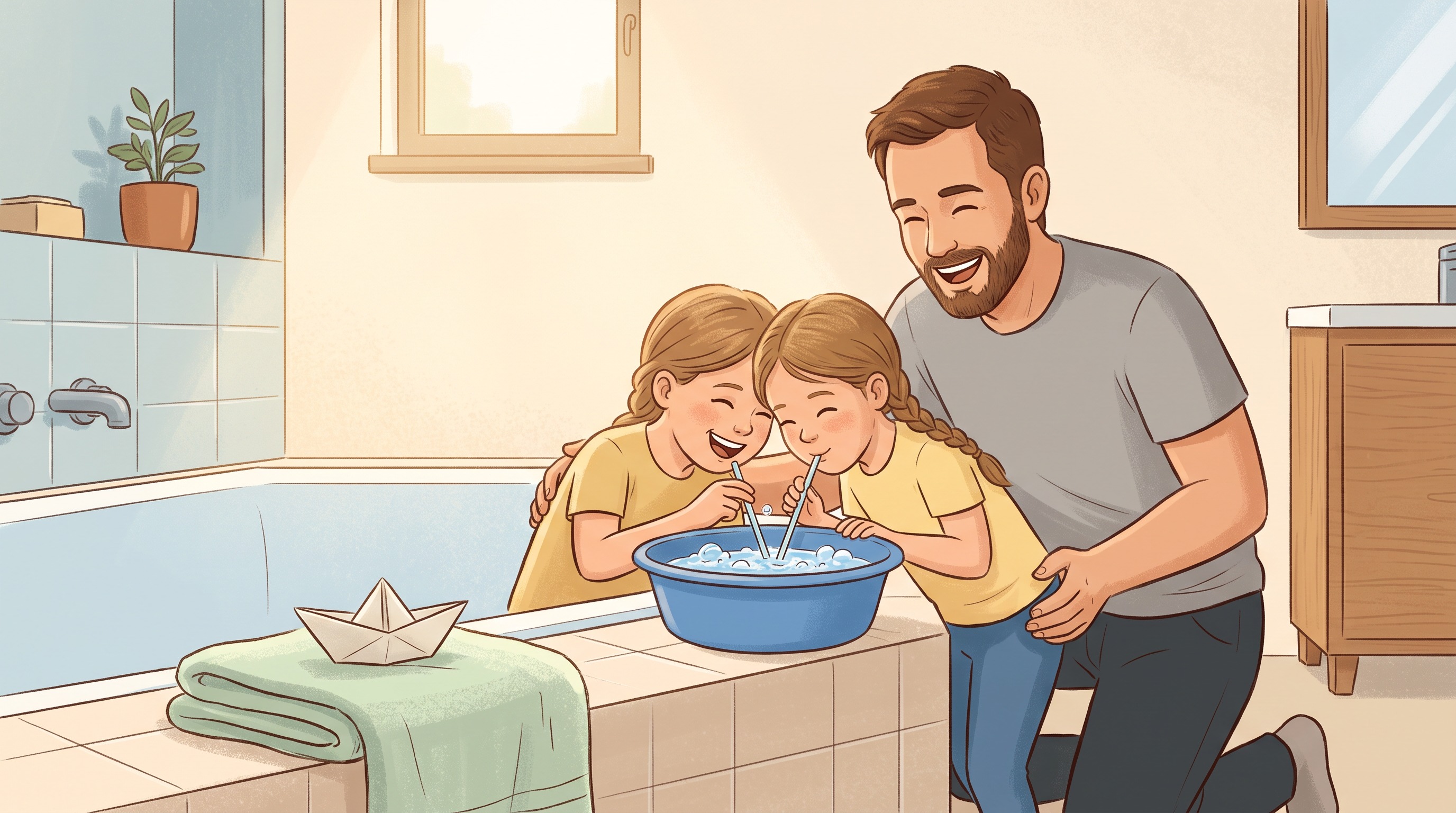
A basin of water, a washcloth, and a straw are enough. Let your child blow bubbles through the straw so bubbles form in the basin. Then without the straw, with the face in the water. Under the shower the head can get wet without anything needing to happen, and that is the habituation that helps in the bath.
Games that teach the rhythm
Blow a ping pong ball from one side of the table to the other, or keep a paper boat moving in the basin. Sing a song where you exhale after each line. Children learn the rhythm faster if there is something to do.
What not to do at home
Diving, swimming underwater in deep water, and exercises with clothing belong in a supervised pool. At home it’s about habituation and exhaling, not about stroke technique. The rest happens in lessons.
What you can track as a parent and instructor
Breathing as its own exercise
In Swimmigo, exhaling with the face underwater is one of the first exercises, even before the first stroke. The system works with seven levels and 86 exercises, and each exercise gets a score from 0 to 6 per student. Breathing thus leaves the gray area of "it’s okay" and becomes something you can see.
What parents see in the app
Parents who watch via the parent side see not only their child’s level but also where they stand within that level. A parent who hears at home that exhaling is not yet working can practice specifically in the bath. A parent who sees that the child went from one to three times blowing bubbles understands that progress is being made.
What you write down as an instructor
Don’t note "doesn’t breathe well yet," but what you saw: exhales through the nose, holds air at the first stroke, pants after five meters. That note is the basis for the next lesson and for a conversation with parents that is not based on feeling. The full progression of levels is in the level overview.
Conclusion
Breathing is not a detail that automatically improves once a child can swim a stroke. It is the skill that determines whether a child stays calm, and most children learn it in small steps: first blowing without water, then with the face in, then the rhythm of three. Once they have that pattern, they swim longer and suffer less from fatigue. Only then does the order of swimming strokes make sense.
Swimmigo · Swim lesson app
Free for parents
Follow your child's swimming progress, see where you stand and report absences in the app.
Sources
- Swim England: Learn to Swim Stage 2, with the requirement to blow rhythmic bubbles three times, November 29, 2019
- Swim England: Improving your front crawl technique, about head position and exhaling in the water, October 1, 2018
- Water Safety USA: Water competency, breath control as part of self-rescue, consulted 2026
- Rejman, Rudnik and Stallman: Goggle-free swimming as autonomous water competence, Scientific Reports, August 13, 2024
- Minkels, Van der Kamp, De Vries and Beek: Learning how to swim in 5- to 12-year-old children, Frontiers in Sports and Active Living, February 11, 2025
- Swim England: Learn to Swim Stage 3, about submerging and retrieving an object, November 29, 2019
Bob van Soest
As an expert in operating sports facilities (such as swimming pools) and developer of, among others, Swimmigo.com, I am passionately committed to making swimming lessons simpler, more fun and more insightful for parents, swimming instructors and everyone who wants to learn to swim.
Frequently Asked Questions
Related articles

Which swimming stroke does your child learn first? This is how the order in swimming lessons is structured [2026]
Which swimming stroke does your child learn first and why? From water familiarization and floating to butterfly stroke, with per stroke where it usually gets stuck and how to track progress.

Learning to Tread Water: When Your Child Is Ready and Why Floating Comes First [2026]
Learning to tread water: when your child is ready, which technique works, why floating on the back comes first, and how to practice it step by step at home.
Discover Swimmigo
The all-in-one app for swimming lesson progress. For parents, swim schools, and adult swimmers.