Water Safety on Vacation: How to Keep Your Child Safe in Open Water, in Any Country [2026]
![Water Safety on Vacation: How to Keep Your Child Safe in Open Water, in Any Country [2026]](/_next/image?url=https%3A%2F%2Fzvblogpostimages.s3.eu-west-3.amazonaws.com%2FAUTOMATISCH_UPLOAD%2F1_780f0a54801b.jpg&w=3840&q=75&dpl=dpl_8V9NEtvKSiHufCmT9NU8fozZeT2c)
Summary
- Worldwide, 300,000 people drown annually -- 43% are children under 15; vacation periods are the riskiest due to unfamiliar water and less supervision
- Open water (sea, lake, river) is fundamentally different from a swimming pool: currents, temperature, visibility, and depth are unpredictable -- even for children with a swimming diploma
- Dutch children are on average good swimmers, but 14% of 6-12 year olds have no diploma; safety standards vary greatly in vacation countries
- Five concrete preparations make the difference: know local flags, bring approved flotation aids, set water rules, teach your child to recognize dangers, and know what to do in an emergency
TLDR
- Worldwide, 300,000 people drown annually -- 43% are children under 15; vacation periods are the riskiest due to unfamiliar water and less supervision
- Open water (sea, lake, river) is fundamentally different from a swimming pool: currents, temperature, visibility, and depth are unpredictable -- even for children with a swimming diploma
- Dutch children are on average good swimmers, but 14% of 6-12 year olds have no diploma; safety standards and warning systems can vary greatly in vacation countries
- Five concrete preparations make the difference: know the local flags and warnings, bring approved flotation aids, set clear water rules, teach your child to recognize dangers, and know what to do in an emergency
Why Open Water on Vacation Is Extra Dangerous
You know the feeling: you check in at your holiday home, the kids immediately run to the pool or the beach, and you try to unpack the suitcases. On vacation, routines relax -- and that’s exactly when most water accidents happen. The WHO reports that drowning is the fourth leading cause of death worldwide for children under 15, with 130,000 victims in 2021 alone.
The problem is not that children cannot swim. The problem is that open water -- sea, lake, river -- is fundamentally different from the familiar swimming pool where your child takes weekly lessons. Currents pull on legs that don’t expect it. The bottom suddenly slopes steeply. The water is colder, murkier, and you cannot see the bottom. Even children with A, B, and C diplomas can get into trouble in open water simply because they don’t recognize the dangers.
The Netherlands is a world leader in swimming safety, but that does not mean Dutch children are automatically safe in the Mediterranean Sea or a French mountain river. The Mulier Institute reports that 14% of children aged 6-12 have no swimming diploma at all. And even children with all three diplomas rarely have experience with open water -- swimming lessons take place in a controlled indoor pool.
The Five Biggest Dangers of Open Water (That Your Child Doesn’t Know)
1. Currents and Undertows
In a swimming pool, the water is still. In the sea, rivers, and even some lakes, there are currents -- sometimes visible, often invisible. A rip current at the sea can pull a child tens of meters away from the shore within a minute. Rivers have undertows near bridges and narrow spots. Teach your child: if you get pulled by a current, swim parallel to the shore, not against it.
2. Unexpected Depth Changes
A swimming pool has marked deep and shallow areas. Open water does not. One step you’re knee-deep, the next step the bottom disappears. This especially applies to lakes with steep banks and beaches with sandbanks. Teach your child never to jump in anywhere without first feeling how deep it is.
3. Cold Shock and Temperature Differences
Open water is often significantly colder than pool water (28-30 degrees Celsius). The North Sea averages 17-18 degrees in summer; mountain lakes can be even colder. A sudden dive into cold water causes a shock reaction: your breathing speeds up, your heart rate spikes, and your muscles cramp. This happens to adults too -- for children, the risk is greater.
4. Poor Visibility and Hidden Objects
In murky water, you cannot see what lies beneath the surface: rocks, tree trunks, glass, or sharp shells. An innocent dive can end with a head injury. Teach your child that "look first, then jump" in open water means: have an adult check first.
5. Fatigue from Waves and Distance
In a pool, a child can rest at the edge after each lap. In open water, the distance to shore is often much greater than it seems. Waves cost extra energy. A child who swims 50 meters effortlessly in a pool can be exhausted after 20 meters in the sea due to the combination of waves, current, cold, and fear.
Flags, Signs, and Warnings: What They Mean in Different Countries
Dutch beaches use a clear flag system: red-yellow means safe with lifeguard supervision, red means dangerous and swimming is discouraged. But in other countries, warning systems can be slightly different:
- Spain, Italy, Greece: green flag = safe, yellow flag = caution (children only with direct supervision), red flag = swimming prohibited. A blue flag means the beach meets environmental standards -- nothing to do with safety.
- France: uses, besides standard flags, a purple flag for dangerous marine life (jellyfish, Portuguese man o’ war). The "drapeau vert" means the water is suitable for swimming. Lifeguards carry whistles -- pay attention to whistle signals.
- Australia: the strictest flag system in the world. Swim only between the red-yellow flags -- outside is life-threatening. This is actively enforced. Blue flags mark surf zones.
A universal rule: if you see no flags or signs at natural water, there is probably no supervision -- and thus no help nearby if something goes wrong.
Swimmigo · Swim lesson app
Free for parents
Follow your child's swimming progress, see where you stand and report absences in the app.

What to Bring: The Water Safety Checklist for Vacation
Approved Flotation Aids
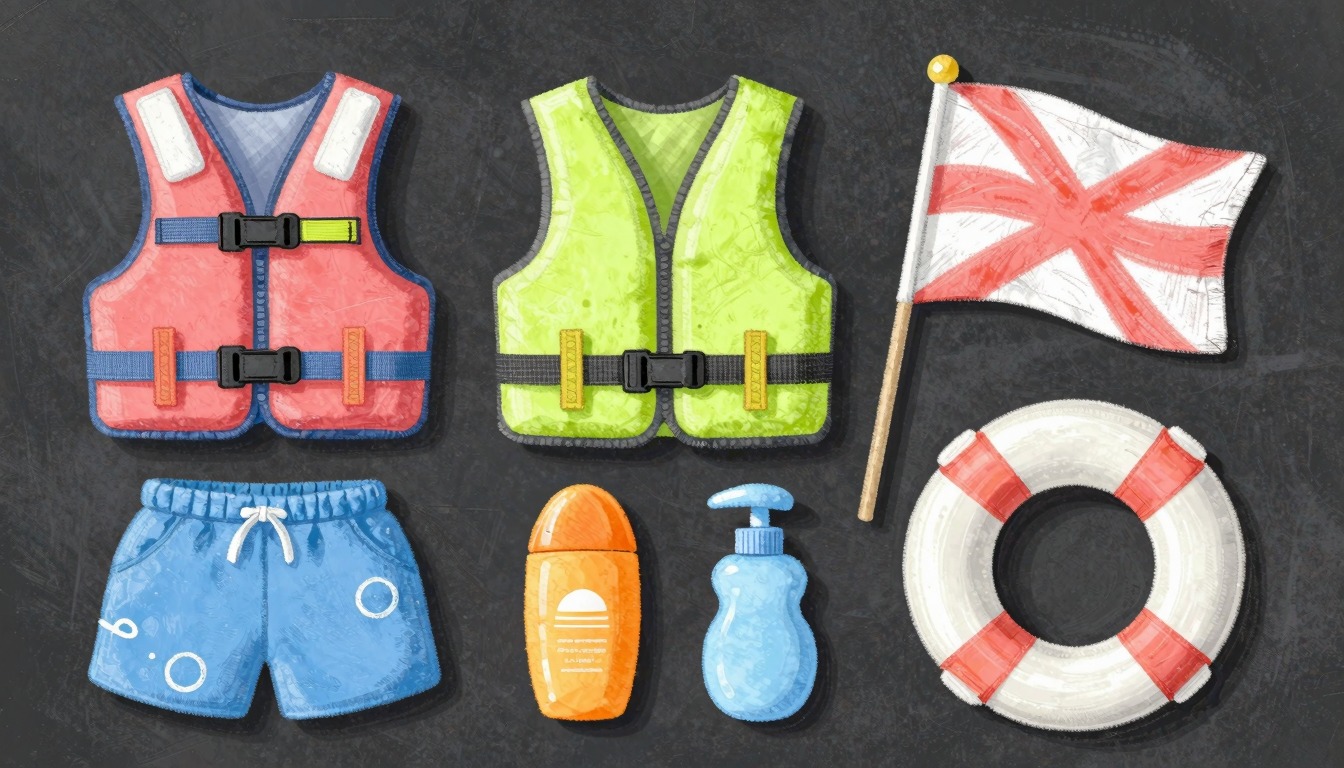
Not all inflatable armbands and swim vests are safe. Choose CE-approved life jackets with the EN 13138 certification for flotation aids. Note: inflatable armbands and water wings are toys -- they do not prevent drowning. The National Council for Swimming Safety emphasizes that adult supervision remains the most important safety measure, regardless of which aids you use.
The Physical Checklist
- An approved life jacket per child (no inflatable armbands as sole protection)
- Waterproof phone case -- to always call emergency number 112 without your phone getting wet
- High-factor sunscreen (water reflects UV rays, you burn faster)
- A whistle on a cord -- your child can whistle for help if they can no longer shout
- Water and snacks -- dehydration and low blood sugar make children tire faster in the water
- Swim shoes against sharp stones, shells, and sea urchins
How to Talk to Your Child About Water Safety Without Instilling Fear
The goal is not to make your child afraid of water. The goal is to make your child aware of the differences between the pool and open water, and give them the tools to recognize dangers themselves. Make it a game: "Who spots the flags on the beach first? What color are they? What does that mean?" or "How many steps can you take before the water reaches your hips? And now your shoulders?"
Teach your child three basic rules they can always remember, in any language, in any country:
- Never enter the water alone. Not even if you have a swimming diploma. Always have an adult nearby who is actively watching.
- Always check first. How deep is it? Are there rocks? Is there current? What do the flags say? Only then enter the water.
- If you’re tired, get out. In open water, the shore is always farther than you think. Swim back before you get tired, not after.
What to Do in an Emergency: The First Minutes Are Crucial
In a water accident, every second counts. Here’s what you need to know, in every situation, in every country:
- Call for help immediately. In Europe, 112 works everywhere, even without your own provider’s signal. In the US and Canada, it’s 911. Save these numbers in your phone and teach them to your child.
- Get the child out of the water without putting yourself in danger -- a second victim only makes the situation worse. Use a stick, towel, or branch to pull the child to shore.
- Check consciousness and breathing. If the child is not breathing, start CPR immediately (30 chest compressions, 2 breaths) and have someone else call 112. Continue CPR until emergency services arrive.
- Even after a near-drowning, see a doctor. Water in the lungs can cause serious complications hours later (secondary drowning). Symptoms: persistent coughing, rapid breathing, drowsiness, blue lips. When in doubt, always seek medical help.
The Red Cross recommends all parents take a first aid course -- the basic resuscitation you learn is the same for drowning as for other emergencies.
International Water Safety: Why This Is Relevant in Every Country
The Netherlands is a water country -- with 523 kilometers of coastline and thousands of lakes and rivers, Dutch children grow up with water. But Dutch parents sometimes don’t realize that the safety standards we are used to -- lifeguards on every beach, clear flags, school swimming lessons -- are missing in many vacation countries.
The CDC reports that 90% of drownings occur in low- and middle-income countries, precisely the regions where supervision, warning systems, and rescue services are least developed. This makes it all the more important that parents take responsibility for their children’s water safety themselves -- regardless of local facilities.
The principles of water safety are universal, whether you’re at the Dutch coast or a lake in Thailand: active supervision, knowledge of local dangers, approved aids, and knowing what to do in an emergency. Swimmigo is built with that universal principle in mind -- available in 5 languages so parents and instructors worldwide have the same clear progress information.
How Swimmigo Helps with Water Safety on Vacation
One of Swimmigo’s most practical features for vacations is the vacation mode. Parents can check off exercises their child does outside of swimming lessons -- for example, in the holiday pool or sea. The swimming instructor sees exactly what the child has practiced and can seamlessly continue the lesson plan after the vacation. This prevents skills from fading during the long summer break, which directly benefits water safety.
Swimmigo · Swim lesson app
Free for parents
Follow your child's swimming progress, see where you stand and report absences in the app.
Conclusion
Water safety on vacation doesn’t start at the beach -- it starts at home, with a good conversation and a well-packed bag. Teach your child the three basic rules (never alone, always check, get out in time), bring approved flotation aids, and know how local warning systems work. Fifteen minutes of preparation can make the difference between a carefree holiday day and an accident that stays with you forever.
Also Discover
- Swimmigo for parents: follow your child’s swimming lesson progress
- The 7 swimming levels and 86 skills
- All features of Swimmigo at a glance
Frequently Asked Questions
Sources
- WHO: Global status report on drowning prevention 2024 -- December 2024
- CDC: Global Drowning Prevention -- 2024
- Red Cross: First Aid Tips for Water Accidents -- 2024
- NRZ: Netherlands World Leader in Swimming Safety -- 2019
- Mulier Institute: More Children Achieve All Three Swimming Diplomas -- 2025
- Swimmigo: Free Swimming Lesson Progress and Planning Worldwide -- 2026

Bob van Soest
As an expert in operating sports facilities (such as swimming pools) and developer of, among others, Swimmigo.com, I am passionately committed to making swimming lessons simpler, more fun and more insightful for parents, swimming instructors and everyone who wants to learn to swim.
Frequently Asked Questions
Related articles
![Complete Overview of Water Safety for Parents: How to Protect Your Child In and Around Water [2026]](/_next/image?url=https%3A%2F%2Fzvblogpostimages.s3.eu-west-3.amazonaws.com%2FAUTOMATISCH_UPLOAD%2F1_0b2c9cbda640.jpg&w=3840&q=75&dpl=dpl_8V9NEtvKSiHufCmT9NU8fozZeT2c)
Complete Overview of Water Safety for Parents: How to Protect Your Child In and Around Water [2026]
300,000 people drown worldwide each year, with young children at the highest risk. Discover how to integrate water safety into your daily life.
![Integrating Water Safety into Every Swimming Lesson: Practical Toolkit for Swim Instructors [2026]](/_next/image?url=https%3A%2F%2Fzvblogpostimages.s3.eu-west-3.amazonaws.com%2FAUTOMATISCH_UPLOAD%2F1_0e5feb460a4e.jpg&w=3840&q=75&dpl=dpl_8V9NEtvKSiHufCmT9NU8fozZeT2c)
Integrating Water Safety into Every Swimming Lesson: Practical Toolkit for Swim Instructors [2026]
10 concrete water safety exercises for every swim instructor. From floating with clothes on to buddy checks: build life-saving reflexes in swimming lessons.
![School Swimming Disappears: How to Ensure Your Child Still Learns to Swim [2026]](/_next/image?url=https%3A%2F%2Fzvblogpostimages.s3.eu-west-3.amazonaws.com%2FAUTOMATISCH_UPLOAD%2F1_951649b9ec15.jpg&w=3840&q=75&dpl=dpl_8V9NEtvKSiHufCmT9NU8fozZeT2c)
School Swimming Disappears: How to Ensure Your Child Still Learns to Swim [2026]
School swimming is disappearing from more and more municipalities. Here's how to ensure your child learns to swim safely and how you can track their progress yourself, even without school swimming.
Discover Swimmigo
The all-in-one app for swimming lesson progress. For parents, swim schools, and adult swimmers.