Swimming in clothes: why swimming with clothes on belongs in swim lessons [2026]

Summary
- Most accidents in the water do not happen in swimwear: children fall in wearing trousers, a jacket and shoes.
- Clothes make swimming slower and heavier. In research the sprint became 33 percent slower and endurance dropped 28 percent.
- Floating does not get worse from clothes. Trapped air initially keeps a child afloat, children even better than adults.
- Practice in a supervised pool and build up: first a T-shirt, then long trousers, then shoes.
- Swimming in clothes belongs to the final levels of the swimming lesson, as a test and not as a trick.
A child who falls into the water wearing clothes does not swim the same way as in a swimsuit. Trousers soak up water, every stroke takes more effort and in the first minute the head is mainly focused on breathing. That is why swimming in clothes is part of the final phase of the lesson: a child learns to float, breathe and reach the edge while wearing exactly the clothes it has on at that moment.
What clothing does to a swimmer has been studied more thoroughly than most parents think. The picture is different from the story that wet clothes simply pull you down to the bottom.
What clothes really do to your swimming
Wet clothes are not a dead weight that drags you down, even though it feels that way. What does happen is that every stroke costs more energy, and breathing tires out sooner.
Speed and endurance drop
In 2014 Kevin Moran from the University of Auckland had twelve practiced swimmers do the same tests twice. First in swimwear, a week later in a T-shirt, sweater and long trousers. The 25 metre sprint became 33 percent slower. During five minutes of continuous swimming they covered 28 percent less distance. Five minutes of floating in deep water showed no measurable difference.
Those two figures show where an accident goes wrong. A child does not lose buoyancy, it loses time. Every metre to the edge takes longer and costs more energy, and the reserve it had in a swimsuit is no longer there.
Layers of clothing first trap air
In the first seconds there is air in the fabric, between layers and under a jacket. That air briefly acts as buoyancy. Researchers at the University of Portsmouth measured that effect: clothing provided between 68 and 105 newton of buoyancy, depending on the season. In their test with 29 children the mouth stayed above water in 95 percent of attempts, compared with about 63 percent for adults. Children are therefore not the weakest group in this scenario.
That is the basis for the advice to stay on your back first and only swim when breathing is calm. The British lifeboat service RNLI sets it out in five steps: head back, ears under water, breathe calmly, move hands and legs gently, and accept that your legs will sink. Once the air is out of the clothing everything becomes heavier and every movement counts double.
Cold water sharpens everything
Water below 15 degrees causes a shock response in which your breathing takes over. According to the RNLI your breathing rate can increase up to ten times, and that effect usually eases within a minute. Anyone gasping for breath in that minute will take water in. A child who falls into a cold lake or canal wearing clothes therefore faces cold, heaviness and panic at the same time.
| What you measure | Wearing clothes | What it means in the water |
|---|---|---|
| 25 metre sprint | 33 percent slower | Getting to the edge takes longer, so you have less time |
| Five minutes of swimming | 28 percent less distance | Less reserve if it is cold or the edge is far away |
| Five minutes of floating | No measurable difference | Sinking is not the problem, calm and time are |
The figures come from a test with twelve practiced swimmers in light clothing. Shoes and a coat were not included, precisely because they can influence the result. With a winter coat and boots the resistance becomes greater than in that test.
Why swimming in clothes belongs in your lesson
Swimming lessons teach a child to swim in conditions the child did not choose: a well-fitting swimsuit, water at 29 degrees and an instructor two metres away. An accident never looks like that. That is why a test in clothes belongs in the last phase of the lesson: there the lesson meets reality.
The test measures something different than a neat stroke
In an ordinary exercise an instructor watches technique: arms, legs, breathing. In clothing swimming the focus is different. Does the head stay above water? Does the child stay calm when the water feels heavier? Can they reach the edge without panicking? A child with a neat breaststroke can still fail here.
What a child must show
The American Red Cross summarises water competency into five basic skills that matter in any water type: entering deep water and resurfacing, floating or treading water for one minute, turning over, swimming 25 metres and getting out safely. With clothes on those are the same five skills, but they get harder. Mastering them in a swimsuit does not automatically mean they work in trousers.
Why the exercise feels different than a regular lesson
Children are startled by the noise wet clothes make and by how their legs move differently. An even bigger surprise is climbing out: a wet pair of jeans suddenly feels much heavier on the ladder. That experience is exactly the point of the exercise. A child that knows how that feels panics less when it happens for real.
Swimmigo · Swim lesson app
Free for parents
Follow your child's swimming progress, see where you stand and report absences in the app.


How to build up swimming in clothes in your lesson
The order determines whether the exercise succeeds. Too much at once causes panic, small steps keep the learning going.
Start with a T-shirt in shallow water
Let children first walk, squat and float on their back wearing only a T-shirt. The aim is to get used to the feeling and the weight, not to perform. If you already see a child tense up here, step back rather than forward.
Add trousers, then shoes
Long trousers give more resistance and make the difference between swimming and struggling noticeable. Shoes are the hardest step: they fill with water and make climbing out difficult. Let children experience that floating with shoes still works and that they can find the ladder or edge without pulling on someone else.
Practice taking clothes off in the water
Taking off a wet sweater is harder than it seems and it is a skill on its own. Untie buttons, sleeve by sleeve, do not pull from the neck. Practice this where a child can stand, with an instructor within reach.
Safety you arrange in advance
Swimming in clothes belongs in a pool with supervision, at a depth where you can reach your child, with a group you can manage. The World Health Organization names a safe practice area and a safe ratio between participants and instructors as conditions for swimming lessons in general. For clothing swimming those conditions count double, because a panicking child needs more help than usual. Open water is not a training spot, not even a calm pond.
As a parent: practice in a supervised pool
You do not have to wait until the swim school starts it. In a public pool with supervision you can show what clothing does in fifteen minutes.
What to bring
An old short-sleeved T-shirt, long trousers that are not too tight and the shoes your child normally wears. No new clothes: cotton that soaks up water is precisely what teaches. Also bring a towel and dry clothes for afterwards.
The build-up that works
Ten minutes is enough. Start with the T-shirt: float on the back, reach the edge, return. Then add the trousers: float again and swim ten metres. Shoes last, with climbing out included. Stop if your child gets cold or starts shivering.
What not to do
Do not throw a child in, do not surprise them and do not push if your child is scared. A child who cries and goes under learns the opposite of what you want. Do not film it for social media without asking.
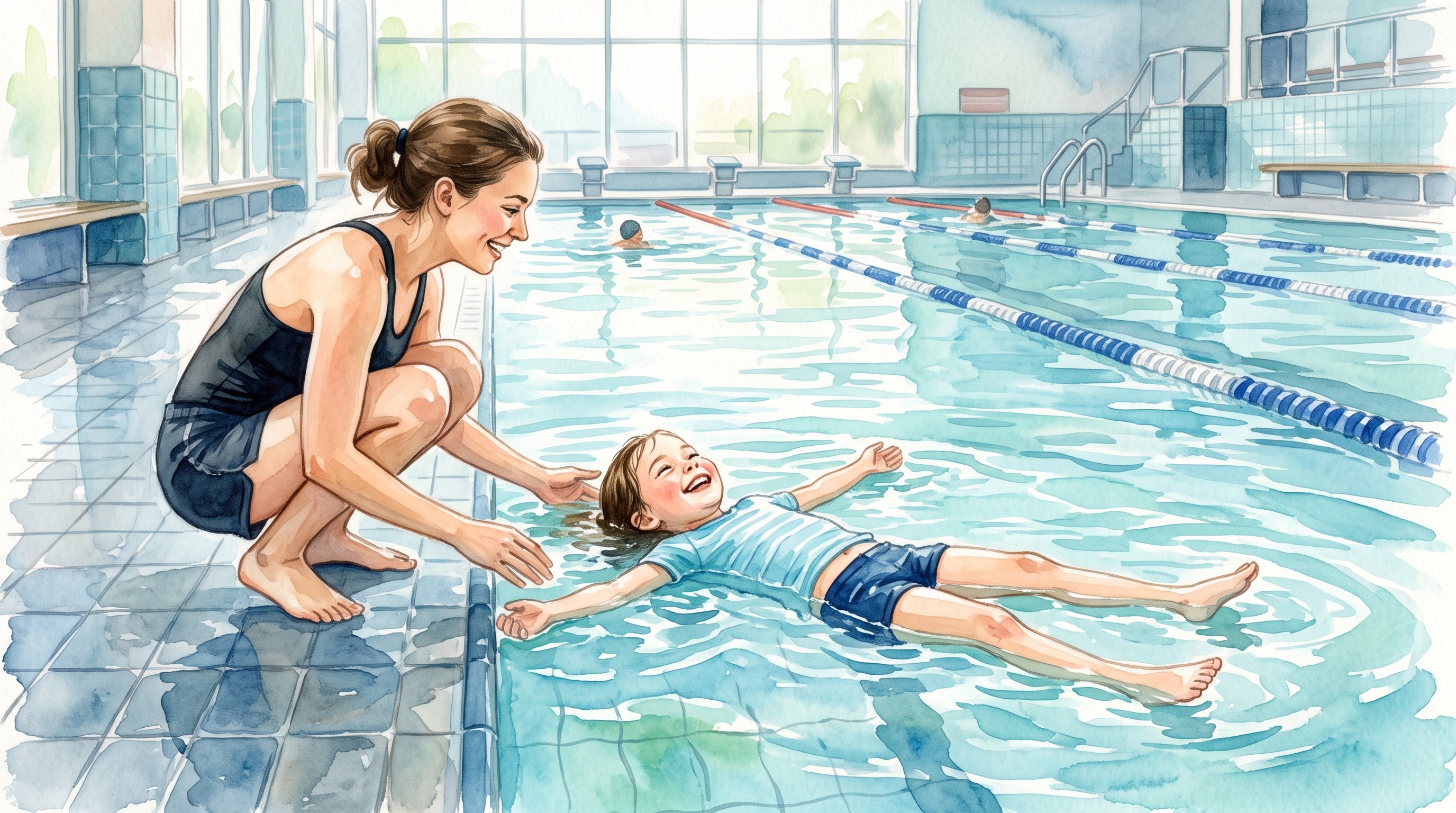
Children who are afraid or need extra help
Float first, clothes later
With water fear reverse the order. Become comfortable in swimwear first, then float unaided, then reach the edge. Clothes only come in when that works. Otherwise the exercise confirms the fear instead of moving forward.
Adapt without removing the skill
For a child with a physical disability you can shorten the distance, provide help earlier when climbing out or start with a thin vest instead of a sweater. What you do not do is skip the exercise entirely. Precisely a child who finds it harder to get out of the water benefits from knowing how heavy clothes feel.
The mistakes that recur most often
The exercise as a joke or punishment
Surprising a child with a push into the water to practice backfires. Swimming in clothes requires a child who knows what is coming and an adult who goes along.
Practising in open water
In a lake, ditch or sea the temperature is unpredictable, the bottom unknown and the edge often far away.
Forgetting that clothes must also be removable
The test is about more than swimming in clothes. It is also about what a child does if it lies in the water for longer: getting clothing off, losing shoes, holding on to warmth. If you only look at the stroke you miss half of it.
How to keep the skill up
You record swimming in clothes just as you do floating or treading water. In Swimmigo you tick for each pupil what worked, with a score from 0 to 6, and you immediately see where a child stands among the 86 skills and 7 levels. Parents see progress directly in the app, without you needing to send a message. That saves explanations when a parent asks why the lesson was suddenly done in clothes.
For parents the app is free. Swim schools and independent teachers start with a free demo and then a 30 day trial period. More about the app for parents or about the side for swim schools.
What you can do this week
- Ask your swim school at which level swimming in clothes is covered and what your child must be able to do first.
- Bring an old T-shirt and long trousers to the pool and practise ten minutes of floating on the back.
- Teach your child the order after a fall: head back, breathe calmly, stay on your back, then head to the edge.
Further reading
- What your child must be able to do if they fall into the water unexpectedly
- Complete overview of water safety for parents
- Jumping, diving and going under: how your child learns to enter the water safely
- Rescue swimming: which skills your child builds after the diploma
- What Swimmigo does for parents and swim schools
Swimmigo · Swim lesson app
Free for parents
Follow your child's swimming progress, see where you stand and report absences in the app.
Sources
- World Health Organization: Drowning fact sheet, updated 1 May 2026
- Kevin Moran: Can You Swim in Clothes? An Exploratory Investigation of the Effect of Clothing on Water Competency, International Journal of Aquatic Research and Education, 2014
- Barwood, Bates, Long and Tipton: Float First, Trapped Air Between Clothing Layers Significantly Improves Buoyancy on Water After Immersion, 2011
- RNLI: Float to Live, what to do if you fall into the water, consulted November 2026
- RNLI: The dangers of cold water shock, consulted November 2026
- American Red Cross: Water safety saves lives, build skills, stay alert and swim fearlessly, 15 May 2025
- World Health Organization: Preventing drowning, practical guidance for the provision of day-care, basic swimming and water safety skills, and safe rescue and resuscitation training, 2022
Bob van Soest
As an expert in operating sports facilities (such as swimming pools) and developer of, among others, Swimmigo.com, I am passionately committed to making swimming lessons simpler, more fun and more insightful for parents, swimming instructors and everyone who wants to learn to swim.
Frequently Asked Questions
Related articles
Complete overview of water safety for parents: how to protect your child in and around water
300,000 people drown worldwide every year, with young children at the highest risk. Discover how to integrate water safety into your daily life.
Integrating Water Safety into Every Swimming Lesson: Practical Toolkit for Swim Instructors
10 concrete water safety exercises for every swim instructor. From floating with clothes on to buddy checks: build life-saving reflexes during swimming lessons.

Water Safety on Vacation: How to Keep Your Child Safe in Open Water, Anywhere
How do you keep your child safe in open water on vacation? Learn to recognize dangers of sea, lake, and river, discover international warning systems, and check your water safety checklist.
Discover Swimmigo
The all-in-one app for swimming lesson progress. For parents, swim schools, and adult swimmers.