RecognizedSwimmingDiplomaorYourSwimmingSchool'sOwnDiploma:WhattoLookFor?[2026]
![Recognized Swimming Diploma or Your Swimming School's Own Diploma: What to Look For? [2026]](/_next/image?url=https%3A%2F%2Fzvblogpostimages.s3.eu-west-3.amazonaws.com%2FAUTOMATISCH_UPLOAD%2F1_ef0f7ed597ac.jpg&w=3840&q=75&dpl=dpl_GWyfLj8UVegbQ18STkVQms8Vj7LD)
Summary
- In the Netherlands, anyone may give swimming lessons and issue a diploma: there are no legal requirements for instructors or examinations.
- Only providers with the National Swimming Diploma License may award the official Zwem-ABC. That license requires an audit, trained instructors, and an examiner.
- With the National Swimming Diploma C, your child meets the National Swimming Safety Standard: pools with attractions and open water without current or large waves.
- 14 percent of children aged 6 to 12 have no swimming diploma at all, and differences between income groups are large (Mulier Institute, 2024).
- The Swimming Skills Act proposal (36.473) wants one national swimming diploma and one national swimming instructor diploma and is still with the House of Representatives.
There comes a moment when your child comes out of the changing room holding a card: a swimming diploma with their own name on it. What lies behind that differs per swimming school. In the Netherlands, anyone is allowed to offer swimming lessons and issue a diploma. No law requires that an instructor is trained, that an examiner supervises, or that a diploma meets national standards.
There are three layers to know: the license issued by the swimming industry itself, the national Zwem-ABC with its own rules, and a legislative proposal that wants to make one national diploma out of it. What you can already check today is below.
Why the word recognized says so little in swimming lessons
Anyone can give swimming lessons and issue a diploma
There is no legal professional requirement for swimming education. So you do not need training, a diploma, or a permit to rent a pool, teach children, and hand out a self-made diploma at the end. The National Council for Swimming Safety (NRZ) has called this the biggest risk in conversations with the industry for years: a diploma alone says nothing about who gave the lesson and how it was tested.
In Friesland, swimming schools raised the alarm in 2024 about what they call swimming lesson cowboys: providers who do not work according to national standards or are not qualified. Omrop Fryslân quoted a coordinator who made the comparison with a driving license. You only have one driving license, was her argument: why should a child in Groningen have to meet different requirements than in Zeeland?
Since 1984, quality lies with the industry itself
The government transferred this task in 1984 to the National Council for Swimming Safety foundation. They issue the National Swimming Diplomas and manage the National Swimming Diploma License. Only providers who have obtained that license may officially award the Zwem-ABC.
The license comes with a series of concrete requirements. A provider is audited on location, works with trained and retrained swimming instructors who have a Certificate of Conduct and follow the Swimming Industry Code of Conduct, and documents their swimming lesson method. An examiner is present during the diploma swimming, and that examiner retakes the exam every four years. There are also requirements for the pool: at least 1.80 meters deep and a water surface of at least 160 square meters, of which 40 square meters is at 1.80 meters deep, so children do not panic in a spacious pool. According to the National Council for Swimming Safety, over 300,000 children graduate each year at a license holder.
Parents overestimate how regulated this is
Research cited by the NRZ shows that 80 percent of parents do not know that these legal requirements do not exist. This is exactly where things go wrong with what swimming schools call false security: parents bring the child, a diploma comes out, and the subject is done. While the question of which provider issued that diploma determines its value.
What a National Swimming Diploma does prove
The Zwem-ABC is structured as a ladder with three steps, each corresponding to a different type of water.
Diploma A: swimming in a pool without attractions
At this level, your child demonstrates basic skills in a calm pool: entering the water, floating, moving forward, and safely getting out of the water. Diploma A is the step towards B and C. More about the pace at which children progress through these levels is in the realistic timeline for the A diploma.
Diploma B: the pool with slide, wave pool, and current
At B, the attractions are added: a (wild water) slide, a wave pool, a current channel. Your child learns to handle moving water and moments when there is no bottom under their feet.
Diploma C: the national standard for swimming safety
With the National Swimming Diploma C, your child meets the National Swimming Safety Standard. This level covers a pool with attractions and open water without current or large waves, such as a recreational lake or a wider ditch. The sea is not included. According to the National Council for Swimming Safety, this diploma is recognized by fire departments, police, and sports training for certain professions. Why B and C really matter is explained in our article about the A diploma as a stepping stone.
Swimming certificates for children who need more time
There are also Swimming Certificates A, B, and C, intended for children with a temporary or permanent disability for whom the full Zwem-ABC is (not yet) achievable. Such a certificate always has a mandatory part containing real swimming safety and an open part tailored to what a child can do. This keeps a route to water safety open without a child getting stuck endlessly at the same level.
What can be achieved after the ABC
The NRZ also issues National Snorkeling Diplomas 1, 2, and 3, National Survival Diplomas 1, 2, and 3, and National Swimming Skill Diplomas. These diplomas have a practical goal: a child keeps swimming, and continuing to swim is what maintains a diploma's value.
| Diploma or Certificate | What your child demonstrates | What it applies to |
|---|---|---|
| National Swimming Diploma A | Basic skills in a calm pool without attractions | Step towards diplomas B and C |
| National Swimming Diploma B | Swimming in a pool with slide, wave pool, and current | Intermediate step towards diploma C |
| National Swimming Diploma C | Also open water without current or large waves | Meets the National Swimming Safety Standard |
| Swimming Certificate A, B or C | A mandatory safety part plus a tailored part | For children for whom the Zwem-ABC is not achievable |
| Swimming school's own diploma | What that school itself has documented and tested | Intermediate step and motivation, not a National Swimming Diploma |
A swimming school's own diploma: what it does and does not mean
Why schools issue their own diplomas
Most swimming schools work with interim goals alongside the official track. A child who has been working for half a year wants something to be proud of, and parents want to see where their child stands. Such a diploma shows what a school itself has tested: which exercises a child masters, at what level they are, and when they are ready for the next step.
That is useful information, as long as you read it for what it is. A school’s own diploma is a progress report, not a national exam. Always ask a school how their own system relates to the Zwem-ABC: does a child at level 6 practically also move towards the B diploma, or is there still a year in between?
How this is structured in the Swimmigo app
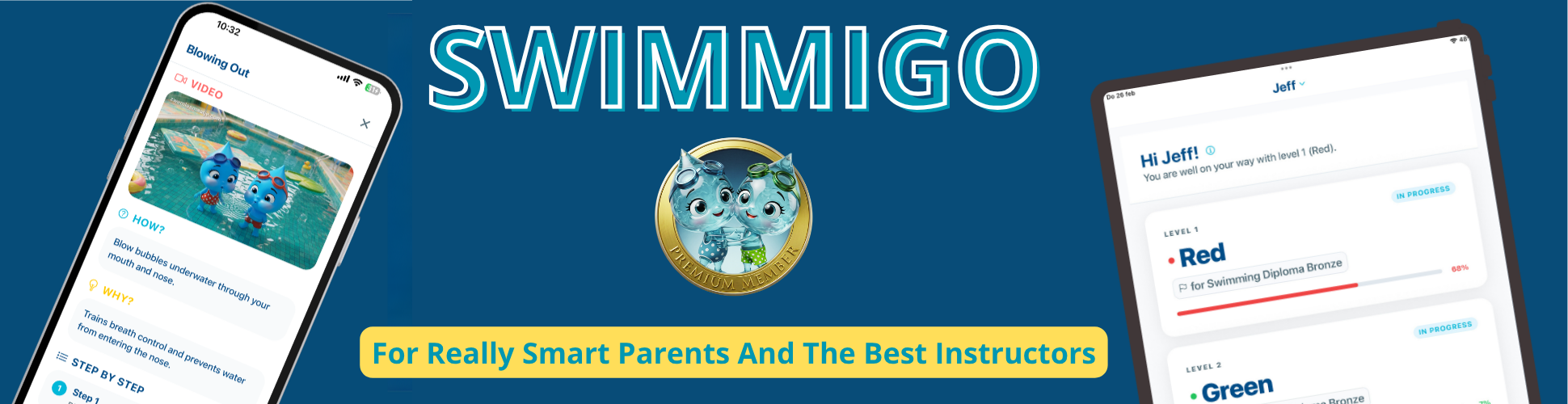
Swimmigo works with seven levels and 86 skills, in which an instructor records a score from 0 to 6 per exercise. When a child completes all exercises of a level, they receive their own certificate for that level, and for the three highest levels a personalized diploma: Bronze, Silver, or Gold, with name, level, and date. Parents see the same levels and exercises as the instructor and receive notifications when something is updated.
This is different from a National Swimming Diploma. Swimmigo is not an examination institute and does not issue NRZ A, B, or C diplomas. A school that uses both side by side benefits most from a system where progress per student remains visible and parents can follow where their child stands. More about this is on the student tracking system, on the levels page, and in the overview of all features.
What to look for when comparing two schools
Ask beyond the final diploma: how does a school bring children to that point? Is progress tracked per exercise or is it just an oral judgment? Do you as a parent see anything when your child makes a step? And what happens if a child gets stuck at the same level? A school that can make this visible usually also works more carefully towards the exam.
How to recognize a genuine National Swimming Diploma
Hologram, unique number, and the ABC block
The National Swimming Diploma is a valuable document and copies and fakes circulate. You recognize the original by a silver-colored hologram at the top left of the white clip, a unique number above that hologram, and the distinctive ABC block. The NRZ has placed the authenticity features in a separate document.
The license sticker, the thumbs-up, and the swimming lesson locator
Providers authorized to issue the National Swimming Diplomas display a license sticker at the entrance or on the window at reception and place the logo on their website. If in doubt, look up the school in the national swimming lesson locator. If a provider is not listed there, they do not meet the quality criteria and may not issue the Zwem-ABC.
What a license holder has checked annually
The license means that the NRZ conducts spot checks, that a representative periodically attends the diploma swimming, and that the examiner remains tested. These checks come from outside the school, not from the school itself. Thus, a license is different from a logo a swimming school puts on its website.
Five questions to ask at reception
Do you have the National Swimming Diploma License? Which diplomas will my child receive exactly? Who assesses if my child is ready for the diploma swimming and what experience does that person have? What if my child takes longer than average? And: how can I as a parent see what my child does during the lesson? Whoever answers these five questions immediately has their affairs in order.
The legislative proposal Swimming Skills Act: one national diploma
What the proposal regulates
The private member’s bill by member Dobbe (36.473) is called the Swimming Skills Act and regulates two national standards: a nationally established swimming diploma and a nationally established swimming instructor diploma. The goal stated in the documents is clear: every child must be at least swimming safe, regardless of the city and swimming school where the diploma was obtained.
Current status
The proposal was submitted on November 28, 2023, and is still in the preparatory phase in the House of Representatives. The debate and vote are still open. In May 2026, Dobbe indicated taking over the defense of the proposal from the previous initiators, who have since left the House. The entry into force is planned by royal decree, so at a yet to be determined moment. Until then, the situation remains as it is: no law, but a license that schools voluntarily obtain.
Why the industry has been urging this for years
Licensed swimming schools argue that the current situation causes unfair competition. They invest in trained instructors and an examiner who supervises the diploma swimming, while a provider without testing can ask the same price and put the same word diploma on a card. The NRZ is also working on a system where providers are demonstrably certified, so parents can see from the logo alone that someone supervises.
False security: why a diploma does not say everything
Figures about children without a diploma
Research Swimming Skills 2024 by the Mulier Institute shows that 14 percent of children aged 6 to 12 have no swimming diploma at all. That is about four children in a class of thirty. Almost four out of ten children in that age group have A, B, and C, compared to a quarter in 2012, so in that respect things are improving.
The differences between groups remain large. In the lowest income group, 33 percent of children have no diploma, compared to 5 percent in the highest income group. Of children with a migration background, 40 percent have no diploma, compared to 9 percent of children without a migration background. Children born in the Netherlands with parents from another country are in between at 24 percent.
Why this matters is shown by drowning figures published by CBS in July 2026. In 2025, 100 residents of the Netherlands drowned, and children under ten born outside Europe have about eight times the risk compared to children with Dutch origin. Swimming lessons are therefore not an extra besides the rest, but the difference between being able or unable to return to shore.
What happens after the diploma
The NRZ is clear about what a diploma is: proof that a child met the standard at the time of graduation. Swimming safety is maintained only with practice, and a child who does not swim for a year after the C diploma loses skill. Swimming schools that offer follow-up activities after the exam, such as survival, snorkeling, or just lap swimming, keep the skill level up. For parents, this means something simple: keep swimming, even if the paper is already on the mantelpiece. Those who want to know when a child is ready for open water can find more in our article about swimming in open water.
How other countries handle swimming diplomas
Germany: Seepferdchen and nearly six out of ten children
In Germany, children first obtain the Seepferdchen as their first swimming diploma, followed by badges in Bronze, Silver, and Gold. The DLRG, the largest water rescue organization in the world, estimates that nearly six out of ten children are not safe swimmers by the end of primary school. The organization points to too few pools, canceled school swimming lessons, and a shortage of instructors. The same bottlenecks occur in the Netherlands and Great Britain, so this is not a Dutch peculiarity.
United Kingdom: 25 meters as legal standard
In England, school swimming is legally mandatory and every child must be able to swim 25 meters independently upon leaving school. Yet nearly one in three children does not achieve this. Among children from low-income families, this is 39 percent, compared to 82 percent among children from high-income families. A legal obligation alone is therefore not enough if the offer is not equally good everywhere.
Worldwide: drowning and what demonstrably helps
The World Health Organization calls drowning the fourth leading cause of death among children aged 1 to 4 and the third among children aged 5 to 14, with about 300,000 deaths per year. Nearly a quarter of drowning deaths are children under five, and since 2000 the number of drownings has decreased by 38 percent. Teaching swimming and water safety skills is on the WHO’s list of proven effective measures, along with safe places to swim and adult supervision. In every country and in every body of water, it comes down to the same two things: learning to swim well and continuing to practice.
For swimming instructors and small swimming schools
What a license brings you
The license requires an audit, trained instructors, and a documented method. What you get in return is a diploma recognized by employers, training programs, and emergency services, and parents who can see from the logo at reception that an independent party supervises. For a small school competing with a provider without testing, this is your strongest selling point, and it is the only argument you can substantiate with documents.
What you document yourself, even without a license
Whether you are a license holder or offer your own track: write down what a child must meet before completing a level, track which exercises succeed or fail per student, and tell parents what happens during the lesson. With Swimmigo for instructors, you record per student how the lesson went, see who gets stuck, and parents receive immediate updates. Parents can follow their child’s progress via the page for parents. If you work with a license, you can place that data alongside your exam documentation. If you are working towards it, you at least have a file that makes the step easier.
Conclusion
Whatever paper your child receives, its value depends on who issued it and how it was tested. Check if a school has the National Swimming Diploma License, whether it is a National Swimming Diploma A, B, or C, and whether an examiner supervises the diploma swimming. Count on the legislative proposal that wants to establish one national diploma, but do not wait for it: what you can check today is worth the effort. And keep the most important in mind: a diploma is a milestone and continuing to swim is what keeps your child swimming safe.
Sources
- Alles over zwemles (NRZ): National Swimming Diploma License and quality criteria, consulted September 2026
- National Council for Swimming Safety: Zwem-ABC and other National Swimming Diplomas, consulted September 2026
- Senate: Private Member’s Bill Dobbe, Swimming Skills Act (36.473), status, consulted September 2026
- Mulier Institute: More children have A, B, and C diplomas, swimming skills of vulnerable children lag behind, November 10, 2025
- Omrop Fryslân: Frisian swimming schools warn, diplomas do not guarantee swimming safety, June 30, 2024
- CBS: Higher risk of drowning among children not born in the Netherlands, July 2026
- WHO: Drowning fact sheet, consulted September 2026
- DLRG: Swimming ability in Germany, consulted September 2026
- Swim England: research on school swimming and water safety, school year 2022/2023

Bob van Soest
As an expert in operating sports facilities (such as swimming pools) and developer of, among others, Swimmigo.com, I am passionately committed to making swimming lessons simpler, more fun and more insightful for parents, swimming instructors and everyone who wants to learn to swim.
Frequently Asked Questions
Related articles
![Complete Overview of Water Safety for Parents: How to Protect Your Child In and Around Water [2026]](/_next/image?url=https%3A%2F%2Fzvblogpostimages.s3.eu-west-3.amazonaws.com%2FAUTOMATISCH_UPLOAD%2F1_0b2c9cbda640.jpg&w=3840&q=75&dpl=dpl_GWyfLj8UVegbQ18STkVQms8Vj7LD)
Complete Overview of Water Safety for Parents: How to Protect Your Child In and Around Water [2026]
300,000 people drown worldwide each year, with young children at the highest risk. Discover how to integrate water safety into your daily life.
![Integrating Water Safety into Every Swimming Lesson: Practical Toolkit for Swim Instructors [2026]](/_next/image?url=https%3A%2F%2Fzvblogpostimages.s3.eu-west-3.amazonaws.com%2FAUTOMATISCH_UPLOAD%2F1_0e5feb460a4e.jpg&w=3840&q=75&dpl=dpl_GWyfLj8UVegbQ18STkVQms8Vj7LD)
Integrating Water Safety into Every Swimming Lesson: Practical Toolkit for Swim Instructors [2026]
10 concrete water safety exercises for every swim instructor. From floating with clothes on to buddy checks: build life-saving reflexes in swimming lessons.
![Water Safety on Vacation: How to Keep Your Child Safe in Open Water, in Any Country [2026]](/_next/image?url=https%3A%2F%2Fzvblogpostimages.s3.eu-west-3.amazonaws.com%2FAUTOMATISCH_UPLOAD%2F1_780f0a54801b.jpg&w=3840&q=75&dpl=dpl_GWyfLj8UVegbQ18STkVQms8Vj7LD)
Water Safety on Vacation: How to Keep Your Child Safe in Open Water, in Any Country [2026]
How do you keep your child safe in open water on vacation? Learn to recognize dangers of the sea, lake, and river, discover international warning systems, and check your water safety checklist.
Discover Swimmigo
The all-in-one app for swimming lesson progress. For parents, swim schools, and adult swimmers.