Jumping,divingandgoingunderwater:howyourchildlearnstoenterthewatersafely[2026]
![Jumping, diving and going underwater: how your child learns to enter the water safely [2026]](/_next/image?url=https%3A%2F%2Fzvblogpostimages.s3.eu-west-3.amazonaws.com%2FAUTOMATISCH_UPLOAD%2F1_717cfe7ddee7.jpg&w=3840&q=75&dpl=dpl_FEcJLWFaZFj4CsT2F159aPzMcoRK)
Summary
- Jumping feet first is allowed almost everywhere. A headfirst dive belongs only in deep water, with enough free space ahead.
- Rescue organizations require 1.5 meters depth and 7.6 meters free space for a dive, and 1.8 meters when teaching.
- Going underwater is the basis of water acclimatization. Practice it small, in the bath, in a basin or in the shallow part.
- Three quarters of drownings in the Netherlands occur in open water, where you can never see the bottom.
- In swimming lessons, the rule is that a child does not jump without the instructor watching.
Your child stands on the edge of the pool, arms already forward, and you hold your breath. Jumping is the highlight of swimming lessons for many children. For parents, it is exactly the moment when they are on the edge of their seat. And rightly so. A jump with feet forward is different from a headfirst dive, and a jump in the pool is different from a jump into water behind the dike.
Worldwide, about 300,000 people drown annually, reports the WHO. Among children aged 5 to 14, drowning is the third leading cause of death, and for children under 5 even the fourth. This is not a reason to keep your child out of the water. For parents, it is reason enough to explicitly learn the difference between fun and danger.
Why jumping and diving is more than just a game
Entering the water from the edge is a skill. It is part of the basics of learning to swim, just like floating, turning and breathing. A child who enters the water in a controlled way will also stand more firmly later when water unexpectedly appears elsewhere. A ditch, a lake, a pool on vacation.
The difference between jumping and diving
With a jump, your child enters the water feet first or in a squat position. The head remains above water or goes under last. With a dive, the head goes first and the arms point forward. This difference determines how deep your child goes underwater and how hard the impact is if the bottom is closer than expected.
An incorrectly executed dive in shallow water can cause permanent injury to the neck or spinal cord. In the United States, diving accidents account for more than a tenth of all spinal cord injuries, according to figures cited by Lifesaving Resources. So this concerns injuries that can change a person's life.
What your child learns from going underwater
Going underwater is not a trick for show. Those who learn to submerge their head, open their eyes and exhale calmly are less likely to panic if water unexpectedly comes over them. In swimming lessons, this starts small. Blowing bubbles, getting the face wet, briefly putting ears underwater. Later, looking underwater, retrieving something from the bottom and orienting oneself are added.
Swimming organizations call this water acclimatization, and it is the foundation on which all other skills rest. The Flemish Swimming Federation calls water acclimatization the starting point of lifelong swimming enjoyment. A child who trusts the water learns to float, turn and eventually swim faster.
From what age is this possible?
There is no fixed age at which a child is ready to jump or go underwater. What helps is looking at what your child already dares, not what the children next to them do.
From water acclimatization to going underwater
Most swimming schools work in small steps. First the face gets wet, then the ears, then the whole head briefly underwater. Then comes jumping. First from the edge into the shallow part, with the instructor nearby. Only when that goes smoothly do deeper water and a diving board come into view.
Your child does not have to figure out that order themselves. What matters is that each step is small enough to dare and that nothing is skipped.
Why every child has their own pace
One child jumps from the edge after three lessons, another needs a year for that. That difference says little about how well your child ultimately swims. Children who hesitated at first often swim calmly and technically later, because they are used to thinking before they act.
Do not push your child beyond the point where they still enjoy it. A child who has to jump while not yet daring mainly remembers the feeling of fear.

How your child jumps and dives safely
The rule that is most often forgotten is also the simplest: you do not jump into water where you do not know the bottom. Below you see per situation what is allowed and what is not.
| Situation | What is safe | Why |
|---|---|---|
| Pool, shallow part | Jumping feet first from the edge | With a headfirst dive, the head gets too close to the bottom |
| Pool, deep part with diving board | Diving from a standstill | Diving requires at least 1.5 meters depth and 7.6 meters free space ahead |
| Lake, pond or ditch | Only wading in the shallow part | You cannot see the bottom and there can be all sorts of things underwater |
| Sea | Jumping feet first at a supervised spot | Waves and currents make the bottom unpredictable |
| Bridge, quay or jetty | No jumping | The water can be half a meter deep, even if it looks deep |
Feet first in unknown water
If you do not know how deep it is, you go down feet first. That is the rule that Johns Hopkins Medicine gives to parents, and it is also the reason your child first learns to jump and only much later learns to dive in swimming lessons. With feet forward, you feel the bottom coming. With your head forward, you are too late.
Why a headfirst dive is only possible in deep water
Diving requires depth. The British rescue organization RLSS UK states that you only dive in water at least 1.5 meters deep, with at least 7.6 meters of free space ahead of the diver. When teaching a dive, 1.8 meters is assumed. A dive starts from a standstill, without a run-up.
In most pools, this means diving in the deep part where there is a diving board and the bottom slopes far enough down. In the shallow part, toddler pool or an above-ground pool in the garden, diving is never safe, even if your child can technically do it.
Never dive in shallow or unknown pools
A sign on the edge or at the entrance tells you where diving is allowed. If there is no sign, assume it is unsafe. This also applies to the pool where your child has jumped a hundred times. The layout may have changed, or something may be underwater that was not there last week.
Teaching your child to go underwater
You can practice going underwater anywhere, even without a pool. It is about getting used to it, not performing.
Small exercises that can be done anywhere
In the bath or under the shower, let your child get their face wet and blow bubbles in the water. In a basin or small pool, you pick up an object from the bottom together, or you hold up a number of fingers underwater that your child has to guess. In the pool, you make a cannonball together and see who makes the biggest splash. Keep it short and stop before your child gets tired of it.
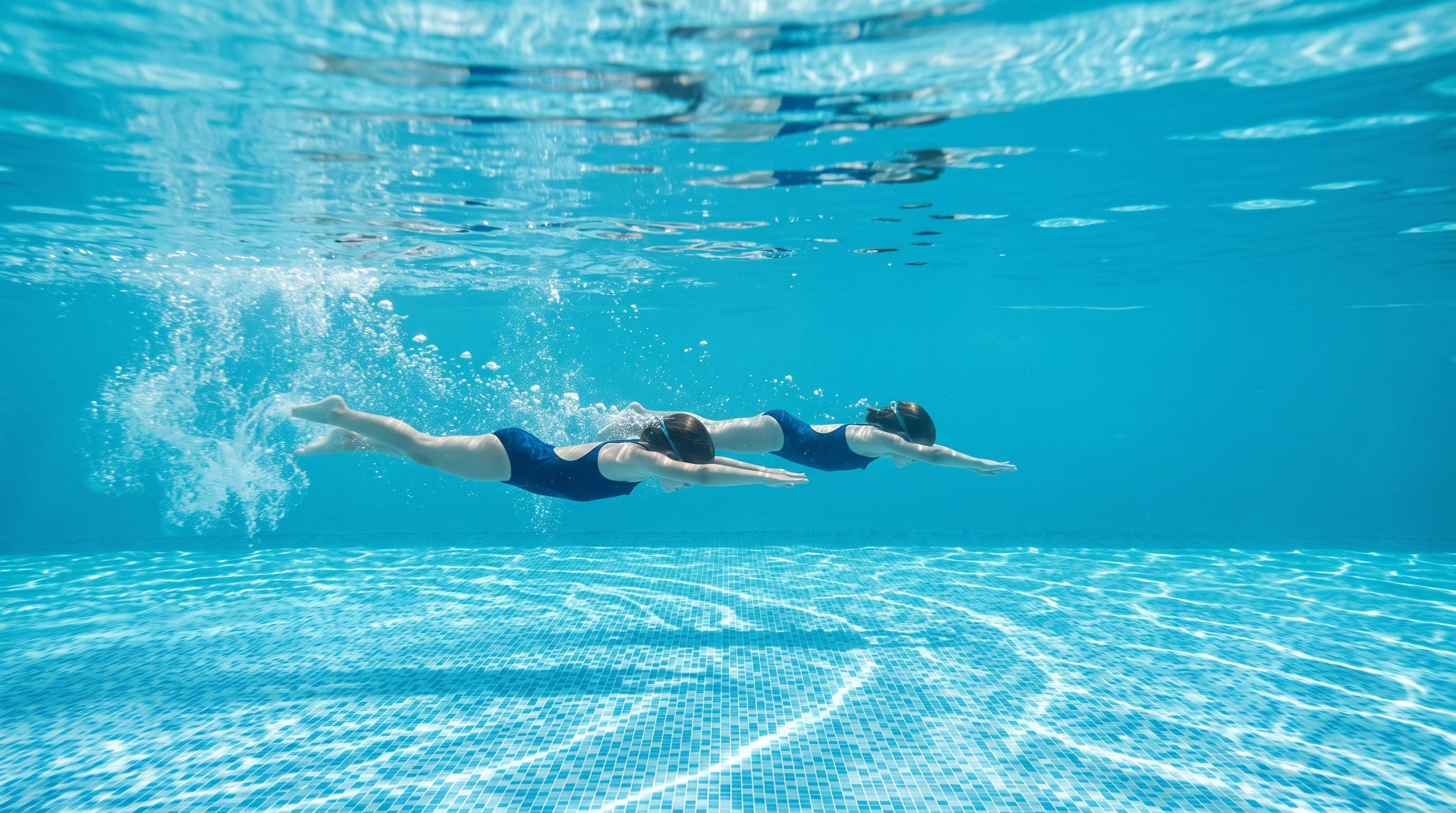
Join in yourself. Children imitate what they see, so if you put your face underwater and calmly come up again, your child learns that nothing happens.
What if your child finds it scary
Almost every child finds it a bit scary. Forcing is counterproductive because it makes water something to be afraid of. What works is predictability. Say what will happen beforehand, count to three if your child likes that, and celebrate every small success. If it does not work today, maybe it will next week.
If the fear lasts for months, perseverance is not the answer. An experienced swimming instructor can adjust the pace, and sometimes it helps to swim temporarily in a smaller group or one-on-one lessons.
What the swimming school does and what you do
What it looks like in the lesson
In a good swimming lesson, entering the water is a fixed part of every lesson. The instructor demonstrates first, stands next to the edge where your child jumps and indicates per child how far they may go. For one child, jumping in the shallow part is already exciting, while another may already jump from the diving board. That difference is part of it.
Questions you can ask the instructor
With a few targeted questions, you know exactly where your child stands and what you can and cannot do at home or on vacation.
- When can my child jump from the edge, and when from the diving board?
- Does my child also learn to go underwater here, or does that come later?
- What should I watch out for when we swim ourselves?
- How can I tell at home that it is going well?
Outside the pool: sea, lake and river
Three quarters of all drownings in the Netherlands occur in open water, shows the CBS. That is exactly the water where you as a parent have less visibility. The bottom is not visible, there can be currents and the depth changes within a few meters.
Choose a supervised spot at the sea and stay in the part where your child can still feel the bottom. Teach your child that with a strong current you never swim against the flow, but sideways out. That is the same rule that applies to adults, and children can learn it early.
Why you never jump from a bridge or quay
From a bridge, quay or jetty, the water looks deep, while it is often only half a meter deep. Under the surface, there can be all sorts of things: debris, branches, an old foundation. Because you cannot see it, the rule is that you do not jump in. Not even if someone else is swimming in the water.
How to keep track of progress
Jumping and going underwater are moments you easily forget. Your child asks on Sunday if they may jump from the edge, and then it is handy if you know what the instructor said last week.
What you can keep track of yourself
Write down per level what your child is allowed to do: blowing bubbles, face wet, head underwater, jumping from the edge, jumping in the deep. Share that with the other parent or the babysitter, so no one suddenly allows something on vacation that has not yet been covered at home. Small swimming schools do the same with a student tracking system, which shows per student which skills are mastered and which are not.
The Swimmigo app is free for parents, who can follow their child's progress. Swimming schools and instructors choose a subscription, with 30 days free trial starting with the first linked student.
| Subscription | For whom | Per month |
|---|---|---|
| Solo | One swimming instructor | 9.99 euros |
| School | Teams and multiple locations | 59.99 euros |
In both subscriptions, the number of students is unlimited. You choose one fixed amount per month, without costs per student or per invoice.
Conclusion
Jumping and diving are part of learning to swim, but they are not the same. With feet forward, you can enter the water safely everywhere. A headfirst dive belongs only in deep water, with enough free space ahead, and only when your child is used to deep water. Also teach your child to go underwater calmly. That is the skill that yields the most when something unexpected happens.
Want to know more about how to track your child's progress? Check the page for parents, the page for swimming schools and instructors or the overview of swimming levels. Also read what your child must be able to do if they unexpectedly fall into the water.
Sources
- WHO: Drowning (fact sheet), consulted October 2026
- Johns Hopkins Medicine: Water Safety for Parents, consulted October 2026
- RLSS UK: Guidance on Diving, consulted October 2026
- Swim England: Learn to Swim Framework Stages 1 to 7, consulted October 2026
- Lifesaving Resources: Prevention of Aquatic Spinal Injuries (2016), consulted October 2026
- CBS: Higher risk of drowning among children not born in the Netherlands, July 2026
- Mulier Institute: Swimming skills of children in the Netherlands (2024), consulted October 2026
- Red Cross: What to do when someone is drowning, consulted October 2026
- Flemish Swimming Federation: Learning to swim for children, consulted October 2026
Bob van Soest
As an expert in operating sports facilities (such as swimming pools) and developer of, among others, Swimmigo.com, I am passionately committed to making swimming lessons simpler, more fun and more insightful for parents, swimming instructors and everyone who wants to learn to swim.
Frequently Asked Questions
Related articles
![Complete Overview of Water Safety for Parents: How to Protect Your Child In and Around Water [2026]](/_next/image?url=https%3A%2F%2Fzvblogpostimages.s3.eu-west-3.amazonaws.com%2FAUTOMATISCH_UPLOAD%2F1_0b2c9cbda640.jpg&w=3840&q=75&dpl=dpl_FEcJLWFaZFj4CsT2F159aPzMcoRK)
Complete Overview of Water Safety for Parents: How to Protect Your Child In and Around Water [2026]
300,000 people drown worldwide each year, with young children at the highest risk. Discover how to integrate water safety into your daily life.
![Integrating Water Safety into Every Swimming Lesson: Practical Toolkit for Swim Instructors [2026]](/_next/image?url=https%3A%2F%2Fzvblogpostimages.s3.eu-west-3.amazonaws.com%2FAUTOMATISCH_UPLOAD%2F1_0e5feb460a4e.jpg&w=3840&q=75&dpl=dpl_FEcJLWFaZFj4CsT2F159aPzMcoRK)
Integrating Water Safety into Every Swimming Lesson: Practical Toolkit for Swim Instructors [2026]
10 concrete water safety exercises for every swim instructor. From floating with clothes on to buddy checks: build life-saving reflexes in swimming lessons.
![Water Safety on Vacation: How to Keep Your Child Safe in Open Water, in Any Country [2026]](/_next/image?url=https%3A%2F%2Fzvblogpostimages.s3.eu-west-3.amazonaws.com%2FAUTOMATISCH_UPLOAD%2F1_780f0a54801b.jpg&w=3840&q=75&dpl=dpl_FEcJLWFaZFj4CsT2F159aPzMcoRK)
Water Safety on Vacation: How to Keep Your Child Safe in Open Water, in Any Country [2026]
How do you keep your child safe in open water on vacation? Learn to recognize dangers of the sea, lake, and river, discover international warning systems, and check your water safety checklist.
Discover Swimmigo
The all-in-one app for swimming lesson progress. For parents, swim schools, and adult swimmers.