Integrating Water Safety into Every Swimming Lesson: Practical Toolkit for Swim Instructors [2026]
![Integrating Water Safety into Every Swimming Lesson: Practical Toolkit for Swim Instructors [2026]](/_next/image?url=https%3A%2F%2Fzvblogpostimages.s3.eu-west-3.amazonaws.com%2FAUTOMATISCH_UPLOAD%2F1_0e5feb460a4e.jpg&w=3840&q=75&dpl=dpl_8V9NEtvKSiHufCmT9NU8fozZeT2c)
Summary
- Water safety should not be a separate lesson: it must be woven into every swimming lesson, from the first water familiarization to the final diploma
- Worldwide, 300,000 people drown annually, children under 15 make up 43% of victims, formal swim education reduces risk by 88%
- As a swim instructor, you have a unique opportunity to teach lifelong safety skills, and with the right tools tracking that progress is easy
- This toolkit gives you 10 concrete water safety exercises you can integrate into your lessons today, plus practical communication tips for parents
Why Water Safety Shouldn't Be a Separate Subject
The Problem with "Water Safety Week"
Many swim schools schedule one or two "water safety weeks" per year: children practice swimming with clothes on, learn how to swim under a tarp, and hear what to do if someone falls into the water. It's well-intentioned, but it's not enough. Research shows that skills taught in isolation stick less well than skills practiced repeatedly and in context. A child who swims once a year with a T-shirt on does not internalize how heavy wet clothes feel. A child who does a safety check weekly during warm-up builds an automatic reflex that can make the difference between panic and staying calm.The 88% Proof: Why Swimming Lessons Make a Difference
A widely cited study shows that formal swimming lessons can reduce the risk of drowning in children aged 1 to 4 by as much as 88%. That number is not marketing hype: it is a scientifically supported fact that your work as a swim instructor is directly life-saving. Every lesson you give, every water safety principle you repeat, every exercise that sticks: it reduces the chance that a child will ever end up in drowning statistics.From Technique to Application: The Mindset Shift
Traditional swim education is built around technique: first this leg, then that arm, then breathing. That structure is logical and remains essential. But water safety requires an additional mindset: not only "can this child perform the breaststroke correctly?" but also "can this child save themselves if they unexpectedly fall into deep water?". The NRZ defines being water safe as "being able to survive in and around water and move and recreate safely". That is a broader definition than just obtaining a swimming diploma: it is about lifelong safe interaction with water.The Role of Repetition and Automation
Water safety behavior must become a reflex, not a conscious choice. In an emergency, you have no time to think: your body must know what to do. This applies to children who fall into the water, but also to adults who jump in after their child without thinking. As a swim instructor, you can train those automatic reactions by making water safety exercises as routine as the breaststroke kicks.Swimmigo · Swim lesson app
Free for parents
Follow your child's swimming progress, see where you stand and report absences in the app.

10 Water Safety Exercises for Every Swimming Lesson
1. The Roll-In Entry: Controlled Entry into the Water
Teach children to always enter the water facing the edge: sitting on the edge, hands beside the hips, rotate and slide calmly into the water. This technique prevents children from unexpectedly falling forward into the water and makes safe water entry an automatic behavior. Practice this not only at the start of the lesson but at random moments.2. The Water Treading Drill with Time Pressure
Treading water is often practiced as a standalone skill, but the real test is treading water under stress. Have children tread water while singing a song or answering questions. The cognitive load simulates the stress of a real emergency and builds mental resilience. Build this up from 15 seconds for beginners to 2 minutes for advanced swimmers.3. Floating on the Back with a T-shirt
The classic "swimming with clothes on" is valuable, but take time for one crucial sub-skill: floating on the back with wet clothes. Wet fabric is heavy, pulls on the body, and drastically changes buoyancy. Let children experience how different it feels, how to adjust their breathing, and how to stay calm despite the discomfort. This is one of the most underrated water safety exercises.4. The Drowning Simulation: From Panic to Control
Let children experience what happens when they unexpectedly end up face down in the water, in a fully controlled setting. A short push against a mat, an unexpected turn during play: the goal is not to scare them but to practice the transition from shock to calm. Count out loud: "One: shock. Two: turn on your back. Three: float. Four: call for help." These four steps must become a mantra.5. The Buddy Check at the Start of Every Lesson
In open water, swimming together is one of the most important safety rules. Start every lesson with a buddy check: each child has a buddy and knows who that is. Link this to the questions "where is the nearest edge?" and "where is the rescue equipment?". Two simple questions that fit into every swimming lesson but train situational awareness that can be life-saving in any water situation.6. Climbing Without a Ladder: The Self-Rescue Exercise
Most drownings occur in open water, not in pools with neat ladders. Teach children to climb out in different ways: pulling themselves up with elbows on the edge, swinging a leg over, rolling out on their stomach. Use the pool edge, a mat, starting blocks: the more variety, the greater the chance a child finds a way out in a real emergency.7. The Breathing Sandwich: 3 Short, 1 Long, 3 Short
Panic in the water leads to shallow, rapid breathing. Teach children a breathing pattern they can apply in any stressful water situation: three short breaths to take in oxygen, one long exhale underwater to calm down, then three short again. Practice this while floating, treading water, and between exercises until it becomes automatic.8. The "Rescue Task" Without Entering the Water
Children tend to jump after someone who is in the water. Teach them the opposite: "reach, throw, row, go". First reach with a stick or towel. If that doesn’t work, throw something that floats. Then only go into the water with a boat or board. And only trained adults enter the water themselves. Practice this monthly as a game, so the reflex "don’t jump but throw" becomes ingrained.9. The Current Simulation: Swimming with Resistance
Open water has currents, undertows, and unexpected depth changes, things that don’t exist in a pool. Simulate resistance by having children swim while a buddy pulls their feet, or by swimming with clothes on. The goal is not speed but technique and calmness under unexpected conditions. Explain that in real life the rule is: never swim against the current, but swim diagonally with it towards the shore.10. The "What If?" Quiz at the End of Every Lesson
End every lesson with one "what if?" question: "What do you do if your ball falls into the water?", "What if your friend disappears underwater?", "What if you get tired while swimming?". Let children formulate answers themselves and correct where needed. After 10 weeks they have practiced 10 scenarios. After a year, 52. It takes 60 seconds per lesson and builds a mental water safety framework that lasts a lifetime.Tracking Water Safety: From Exercise to Demonstrable Skill
The Usefulness of a Digital Logbook for Safety Skills
Technical swimming skills like breaststroke and backstroke are tracked with checkmarks and smiley systems. But water safety exercises often disappear into nothing: no score, no registration, no overview for parents. With a digital student tracking system, you can register every water safety exercise: when practiced, how often repeated, at what level mastered. This not only gives the instructor insight but also shows parents that water safety is a continuous process, not a one-time activity.Visualizing Progress per Exercise for Parents
Parents see their child during swimming lessons through the window, but rarely see the water safety progress. An app that shows per exercise how a child grows, from "needs help floating with clothes" to "independently floating on back with T-shirt" to "treading water for 2 minutes while singing a song," makes that invisible progress visible. This increases parental involvement and strengthens the water safety message at home.The International Component: Water Safety Knows No Borders
Water is a risk and a source of fun worldwide. In Australia, "learn to swim" is as fundamental as learning to ride a bike. In Scandinavia, children learn at a young age what to do if they fall through ice. In the Netherlands, we have 17 million inhabitants and thousands of kilometers of ditches, rivers, and canals: we cannot not talk about water safety. As an instructor with Swimmigo, available in 5 languages and used worldwide, you not only equip Dutch children with water safety skills: you contribute to a global movement of water-safe generations.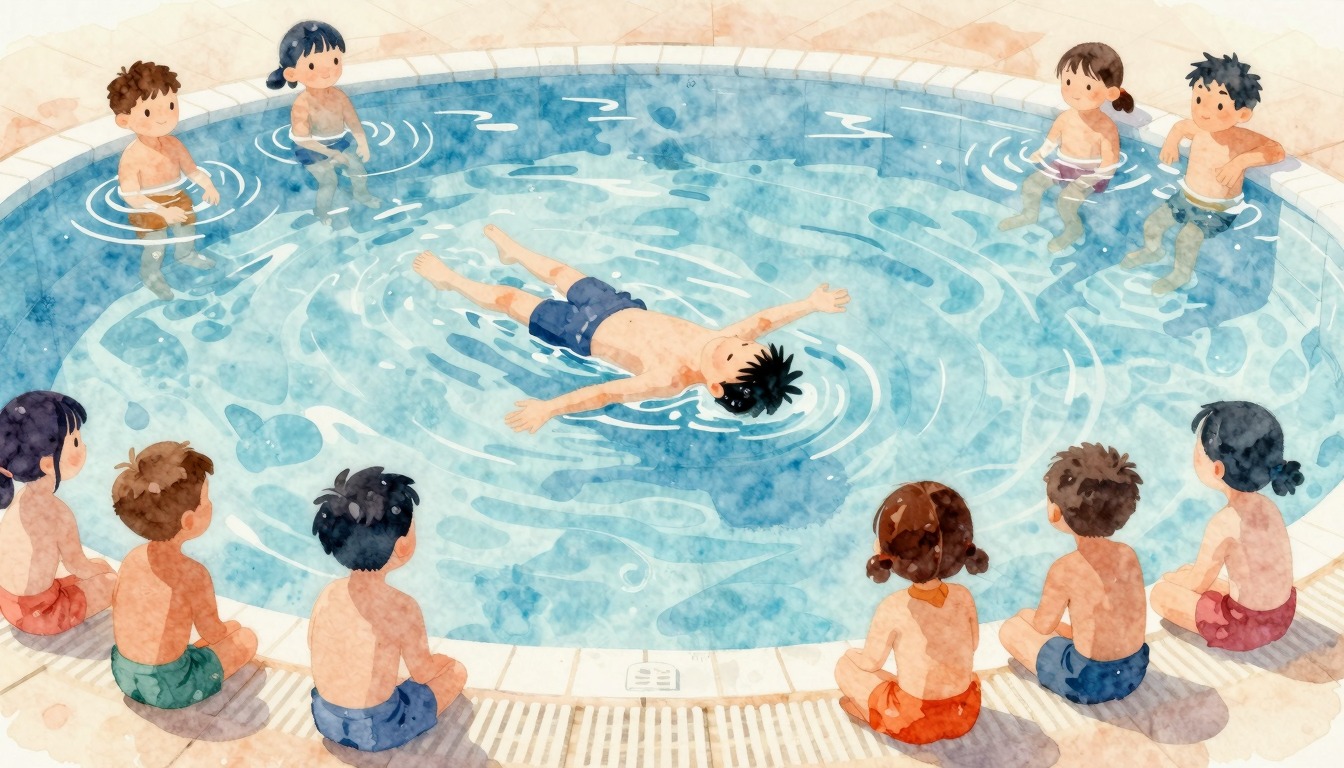
Communication Tips: How to Involve Parents in Water Safety?
Don’t Scare, Raise Awareness
The pitfall in water safety communication is sowing fear. Parents who become afraid of water let their children practice less and actually create more risk. The message should be: water safety is a skill, just like learning to ride a bike. You fall a few times, you practice, and one day it becomes automatic. Frame every water safety update as a challenge overcome, not a disaster avoided.The Water Safety Checklist for Home
Give parents a simple checklist they can review with their child after every swimming lesson. Three questions: "What did you learn today about safe swimming?", "What would you do if you accidentally fall into deep water?", "Where is the nearest edge at the beach, lake, or ditch where we sometimes go?". These are conversation starters that bring water safety from the pool to the kitchen table, in every language and every family.Push Notifications: Reminders That Make a Difference
A push notification on a parent's phone can be just the nudge to keep water safety top of mind. "Your child practiced the floating exercise with clothes today, ask at home how that felt!" Swimmigo sends these notifications automatically at every level increase and accompanying skills, making water safety a recurring conversation instead of a forgotten chapter.Conclusion
Water safety is not a separate subject, not an annual theme, and not a checklist. It is the red thread through every swimming lesson you give. As a swim instructor, you not only have the responsibility to teach children to swim technically: you have the chance to save lives, every day. With the 10 exercises from this toolkit, a digital system that tracks water safety skills, and a communication strategy that actively involves parents, you build generations who not only can swim but also know how to interact safely with water. In every water, in every country, in every situation.Discover How Swimmigo Helps You Track Water Safety
- Swimmigo for Instructors: free student tracking system with water safety scores per level
- Swimmigo for Parents: view real-time progress and swimming certificates per level
- All Features: push notifications, vacation mode, multi-instructor collaboration
Swimmigo · Swim lesson app
Free for parents
Follow your child's swimming progress, see where you stand and report absences in the app.
Frequently Asked Questions about Water Safety in Swimming Lessons
Sources
- WHO: Drowning Fact Sheet, July 2025
- CBS: 100 residents drowned in 2025, mostly 60+, May 13, 2026
- NRZ: CBS 132 drownings in 2025, ongoing attention needed for swim safety, May 13, 2026
- US Swim School Association: Learning to Swim is Essential, 2024
- CDC: Summer Swim Safety, Drowning Prevention, May 2025
- YMCA: Water Safety for Kids, 2025

Bob van Soest
As an expert in operating sports facilities (such as swimming pools) and developer of, among others, Swimmigo.com, I am passionately committed to making swimming lessons simpler, more fun and more insightful for parents, swimming instructors and everyone who wants to learn to swim.
Frequently Asked Questions
Related articles
![Complete Overview of Water Safety for Parents: How to Protect Your Child In and Around Water [2026]](/_next/image?url=https%3A%2F%2Fzvblogpostimages.s3.eu-west-3.amazonaws.com%2FAUTOMATISCH_UPLOAD%2F1_0b2c9cbda640.jpg&w=3840&q=75&dpl=dpl_8V9NEtvKSiHufCmT9NU8fozZeT2c)
Complete Overview of Water Safety for Parents: How to Protect Your Child In and Around Water [2026]
300,000 people drown worldwide each year, with young children at the highest risk. Discover how to integrate water safety into your daily life.
![Water Safety on Vacation: How to Keep Your Child Safe in Open Water, in Any Country [2026]](/_next/image?url=https%3A%2F%2Fzvblogpostimages.s3.eu-west-3.amazonaws.com%2FAUTOMATISCH_UPLOAD%2F1_780f0a54801b.jpg&w=3840&q=75&dpl=dpl_8V9NEtvKSiHufCmT9NU8fozZeT2c)
Water Safety on Vacation: How to Keep Your Child Safe in Open Water, in Any Country [2026]
How do you keep your child safe in open water on vacation? Learn to recognize dangers of the sea, lake, and river, discover international warning systems, and check your water safety checklist.
![School Swimming Disappears: How to Ensure Your Child Still Learns to Swim [2026]](/_next/image?url=https%3A%2F%2Fzvblogpostimages.s3.eu-west-3.amazonaws.com%2FAUTOMATISCH_UPLOAD%2F1_951649b9ec15.jpg&w=3840&q=75&dpl=dpl_8V9NEtvKSiHufCmT9NU8fozZeT2c)
School Swimming Disappears: How to Ensure Your Child Still Learns to Swim [2026]
School swimming is disappearing from more and more municipalities. Here's how to ensure your child learns to swim safely and how you can track their progress yourself, even without school swimming.
Discover Swimmigo
The all-in-one app for swimming lesson progress. For parents, swim schools, and adult swimmers.