Going to the pool or swimming alone: when is your child ready? [2026]

Summary
- There is no set age for going to the pool alone: each pool has its own rules, and your child's abilities matter.
- Supervision makes the difference, even when a lifeguard is present.
- A certificate shows what your child can do in a lesson, not how they react when tired or panicked.
- Build independence in four steps: swimming together, you sitting poolside, swimming with a buddy, and going alone.
- The same rule applies at home: a young child should never be alone in the bath.
There is no set age when a child can go to the pool alone. Pools make their own rules, and most do not specify an age. What matters is whether your child can cope if something goes wrong, whether someone is watching and how familiar they are with the pool. Those three things determine whether your child is ready, not their age.
Why there is no set age
An eight-year-old who calmly swims laps and knows the rules may be better off in a pool that is easy to oversee than a twelve-year-old who rarely swims and ends up in a busy pool with a slide. Age says something about height and strength, but not about a child's ability to assess a situation.
What pools decide for themselves
Every pool sets its own rules. Some require young children to be accompanied by an adult, while others allow children from a certain age to enter and go home independently. That age varies by country, municipality and sometimes even by pool. Ask at reception before letting your child go alone. If the answer is not on the website, the staff will usually know.
Pay attention to the less obvious rules too. Can your child enter alone if nobody is at the entrance? Do they need to check out when they leave? Are there times when the pool is busier than usual? These details can make a difference if something goes wrong.
Where things go wrong and why supervision matters so much
The WHO counts around 300,000 drowning deaths worldwide each year. Children under five account for almost a quarter of that number, and drowning is the fourth leading cause of death among children aged 1 to 4 and the third among those aged 5 to 14. The same fact sheet states explicitly that the risk increases when children encounter water without active adult supervision.
The Royal Life Saving Society UK reviewed child drownings examined by a review panel and concluded that almost nine out of ten were preventable. The difference often came down to someone watching at the right moment. For toddlers and preschoolers, the American Academy of Pediatrics identifies one specific risk as the greatest: unexpected access to water without anyone watching.
Being alone in the water is not the same as being alone in the building
When parents think about a child going to the pool alone, they usually think about the swimming itself. In practice, there is more to it. A child is also alone in the changing room, in the toilet, in the shower, at the vending machine and on the way home. At a pool with lifeguards, swimming is often the best supervised part of the visit.
Make that distinction clear when you talk to your child. "You can swim on your own" sounds like one agreement, when you really mean four situations: in the water, in the building, outside and on the journey.
The four skills that make a difference
Getting a swimming certificate is one thing. Coping when things go wrong is another. These four skills give your child time to wait for help.
Floating and catching their breath
A child who gets tired needs to be able to stop without panicking. Floating on their back, resting and breathing calmly are the basics. Practise these skills when things are going well too, so your child remembers them.
Swimming a distance without help
The exact distance depends on the pool. A pool with a shallow area where your child can stand is less demanding than one with a deep section in the middle. Look at the layout of the pool your child will be swimming in, not just the requirements for a certificate.
Getting out of the water
Climbing out over the edge or using a ladder takes strength. A tired child cannot always manage it without help. Let your child practise in a calm setting, so they do not have to try it for the first time when they are already exhausted.
Getting help instead of attempting a rescue
This is the skill most often overlooked. Children want to help a friend and may jump in after them. Teach your child to swim to the side, call for help and throw something that floats. A child should not try to rescue another child.
Swimmigo · Swim lesson app
Free for parents
Follow your child's swimming progress, see where you stand and report absences in the app.


Why a swimming certificate is not a green light
A certificate is a snapshot. It shows what your child can do during a lesson, in a familiar pool, with an instructor nearby. That is valuable, but it is not enough.
What a certificate does show
Your child has learned the basic movements, can cover a set distance and has shown that they are comfortable going underwater and coming back up. They are no longer a beginner.
What it does not show
It does not show whether your child can cover the same distance after a school day, in cold water or in a pool where they cannot see the bottom. Whether they dare to call out to a stranger for help. Or whether they make the same choices when they are tired.
There is another consideration for teenagers. The American Academy of Pediatrics notes that the risk of drowning falls after age four and rises again during the teenage years, even among strong swimmers. The RLSS figures show the highest percentages among teenagers. A child who goes to the water with friends may overestimate their own ability.
The first few months after getting a certificate
After the final test, swimming often drops to once a month or stops altogether. Skills fade without practice. Keep watching during this period and occasionally plan a visit where your child actually swims rather than only plays.
How to build independence step by step
Going from swimming together to going alone is not a decision to make in a day. Four stages, each lasting a few weeks or longer, give your child time to get used to more independence and give you a chance to see how things are going.
Step 1: swim together in the same pool
You are there and watching, but you no longer swim next to your child the whole time. Stay in the same pool and keep them in sight. This lets you see how your child behaves when you do not step in immediately.
Step 2: your child swims while you sit poolside
Now there is some distance between you. Your child needs to come to you if something is wrong. Notice whether they do, whether they linger around strangers and whether they judge the depth correctly. This is the stage when most doubts surface, and that is normal.
Step 3: swim with a friend or sibling
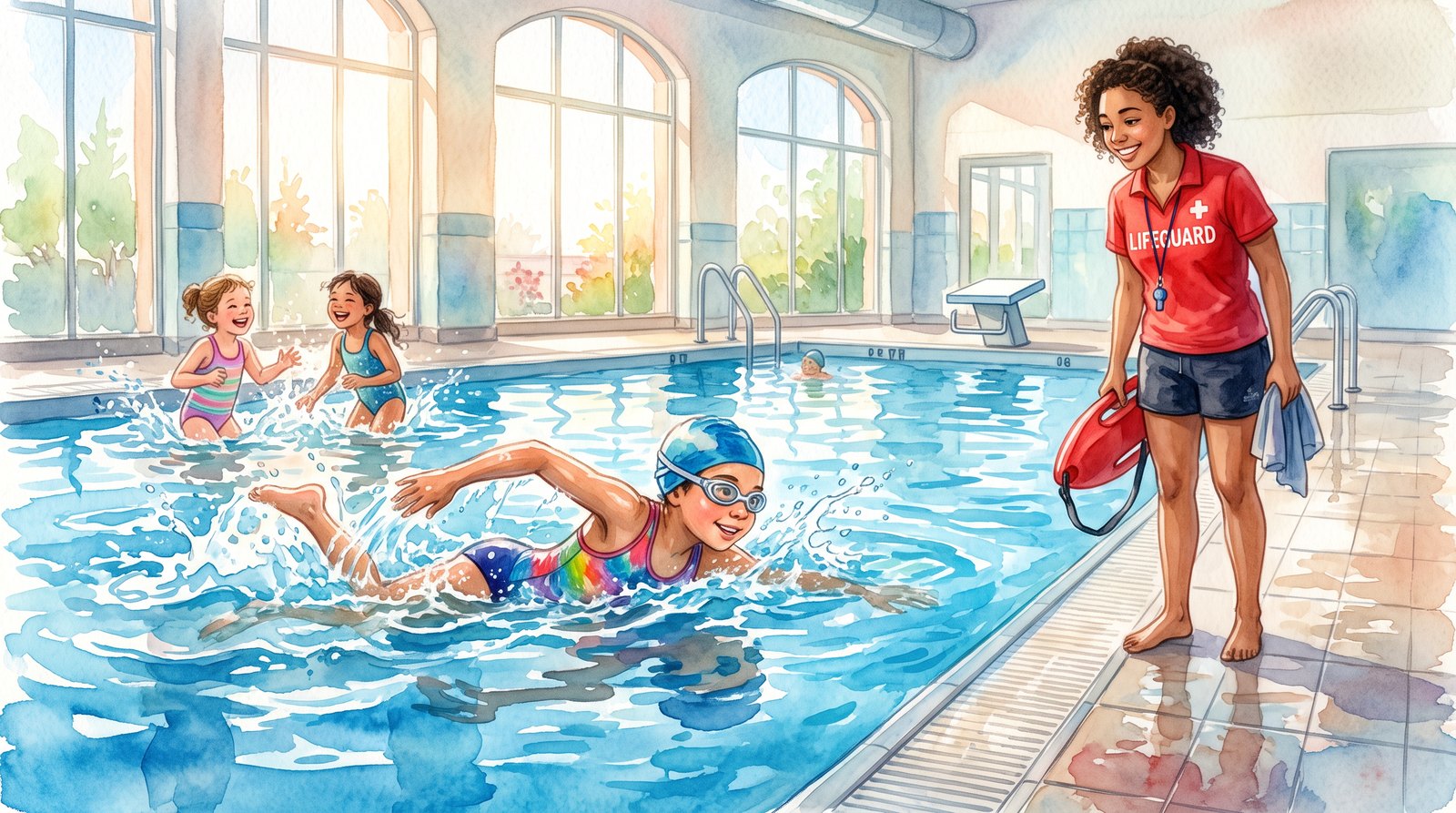
Swimming together is safer than swimming alone, provided both children really watch out for each other. Agree that they will stay close and that whoever notices a problem will get an adult. A buddy is not a substitute for supervision, but is an extra pair of eyes.
Step 4: go to the pool alone
Now your child travels there and back independently. Try this first at a quiet time, at a pool your child knows well, with agreed arrival and departure times. Ask afterwards how it went, so you can hear what your child noticed.
| Step | What your child does | Who is watching | What to look for |
|---|---|---|---|
| 1 | Swims while you are in the water | You, in the same pool | Whether your child is comfortable floating calmly when tired |
| 2 | Swims independently while you sit poolside | You, with a view of the whole pool | Whether your child comes to you on their own if something is wrong |
| 3 | Swims with a friend or sibling | You or another adult, plus the buddy | Whether they stay together and get help when unsure |
| 4 | Travels there and back alone | The lifeguards, with agreed check-ins with you | Whether your child sticks to the agreed time, place and rules |
What to agree with the pool
Clear arrangements with the pool are just as important as the agreements you make with your child. Ask about them and write them down so you can check them later.
Ask about the rules for unaccompanied children
Ask specific questions: can my child enter alone at this age, does an adult need to come along, and what should my child do if they feel unwell? Pools usually have a clear answer, even if it is not on the website.
A lifeguard is not a babysitter
The RLSS attributes the low figures to the trained lifeguards normally present: around 1% of all drowning incidents in the United Kingdom happen in a swimming pool. That is not the same as having a babysitter. A lifeguard watches an entire pool and cannot keep an eye on every child individually. According to the RLSS, weak swimmers should stay where they can touch the bottom with their feet.
Agree on a set place and time
A set meeting place at reception or another recognizable spot makes it easy to check that your child has arrived. Also agree on what your child should do if they want to leave early or feel unwell. However silly it may seem to an eleven-year-old, it removes uncertainty when it matters.
Alone in the bath at home
The bathroom is where most parents deal with water every day, and where the rules are strictest.
Toddlers and preschoolers: stay within arm's reach
The RLSS is clear: never leave a young child alone in the bath, even in a bath seat. A bath seat is an aid, not a safety device. Do not leave a toddler under the supervision of an older sibling either, as the sibling is too young to recognize danger.
Small things help too: get everything ready before running the water, leave your phone outside the bathroom, drain the bath immediately and keep the bathroom door closed when nobody is there. A child drowns silently, so sound is not a reliable warning.
When can a child shower or bathe alone?
There is no set age, and it varies from child to child. Check whether your child can operate the taps, get in and out of the bath independently and understands not to stand up and jump around. Stay nearby until you are sure they can manage, and leave the door slightly open the first few times.
Four rules children will remember
Children will not remember a list of ten rules. Four short rules work better, especially if you repeat them when they are needed.
Never enter the water alone
Not even in a shallow pool, and not even for a moment. Explain that the rule is there in case something goes wrong, even though you trust your child.
Always ask first
The American Academy of Pediatrics recommends teaching children to ask a parent, lifeguard or swimming instructor for permission before entering the water. Make it a habit, even when you are there.
When in doubt, get out, do not get in
Tiredness, cold, hunger or feeling a little scared are all reasons to stop. Teach your child that stopping is not failure.
Agree on where your child will be
Agree on which pool, which area and what time your child will return. It is clear for your child and gives you a way to check.
What swimming instructors and swim schools can do
Parents most often ask this question of the person who sees their child swim most closely. What you tell them affects how quickly they give their child more independence. That conversation is easier when you do not have to guess.
Make progress visible to parents too
In Swimmigo, parents can see their child's progress for each exercise, using the same levels and skills the instructor records. You can then explain exactly which exercise the child has not yet mastered and what they need for the next step. The app is free for parents, and the levels and skills are also on the website.
Teach children to ask permission
Build it into your lessons, even if it is not in the lesson plan. Children who are used to waiting for a signal before they jump will do the same at a pool when you are not there.
Be honest about what a child cannot yet do
A parent who hears that their child has earned a certificate often assumes that independent swimming will follow naturally. Explain what is still missing: a child who cannot float when tired needs more time. Swim schools that have this conversation face fewer disagreements afterwards and build trust from the start.
For schools working with multiple instructors or locations, there is a professional platform with groups, team roles, statistics and messages with read receipts. The app works in five languages, so parents can read explanations in their own language.
Talk to the parents of weaker swimmers too
Not every child reaches the same level at the same age. A child who needs extra time will not necessarily be unable to swim independently. Explain which exercises can be practised at home and when it makes sense to reassess. For more on what a child needs to be able to do if they unexpectedly fall into water, see the guide to falling into water.
Further reading
To find out how your child can maintain their swimming skills after earning a certificate, read the guide to maintaining swimming skills. Different limits apply when swimming in the sea, a lake or a river. You can find these in the guide to safe open water swimming.
Swimmigo for parents shows you how to follow your child's progress without having to ask how every lesson went.
Swimmigo · Swim lesson app
Free for parents
Follow your child's swimming progress, see where you stand and report absences in the app.
Sources
- World Health Organization: Drowning fact sheet, 1 May 2026
- American Academy of Pediatrics: Swim Lessons for Children, 18 May 2026
- American Academy of Pediatrics: Water Safety for Teens, 18 May 2026
- Royal Life Saving Society UK: Child Drownings Report 2026
- Royal Life Saving Society UK: Splash Safely in the Bath
- Royal Life Saving Society UK: Water Safety in Public Swimming Pools

Bob van Soest
As an expert in operating sports facilities (such as swimming pools) and developer of, among others, Swimmigo.com, I am passionately committed to making swimming lessons simpler, more fun and more insightful for parents, swimming instructors and everyone who wants to learn to swim.
Frequently Asked Questions
Related articles
Complete overview of water safety for parents: how to protect your child in and around water
300,000 people drown worldwide every year, with young children at the highest risk. Discover how to integrate water safety into your daily life.
Integrating Water Safety into Every Swimming Lesson: Practical Toolkit for Swim Instructors
10 concrete water safety exercises for every swim instructor. From floating with clothes on to buddy checks: build life-saving reflexes during swimming lessons.

Water Safety on Vacation: How to Keep Your Child Safe in Open Water, Anywhere
How do you keep your child safe in open water on vacation? Learn to recognize dangers of sea, lake, and river, discover international warning systems, and check your water safety checklist.
Discover Swimmigo
The all-in-one app for swimming lesson progress. For parents, swim schools, and adult swimmers.