WhatAftertheSwimmingDiploma?HowtoKeepYourChildWater-Safe[2026]
![What After the Swimming Diploma? How to Keep Your Child Water-Safe [2026]](/_next/image?url=https%3A%2F%2Fzvblogpostimages.s3.eu-west-3.amazonaws.com%2FAUTOMATISCH_UPLOAD%2F1_14cfbfa529a9.jpg&w=3840&q=75&dpl=dpl_GWyfLj8UVegbQ18STkVQms8Vj7LD)
Summary
- A swimming diploma is a snapshot: without practice, swimming skills decline.
- After the Zwem-ABC, there are nine follow-up diplomas in three series: swimming skills, survival, and snorkeling.
- One fixed swim time per week does more than a few times swimming on vacation.
- Targeted practice has quick effects: in Amsterdam, six lessons bring skills back up to standard.
- Swim schools that set up a follow-up group keep students and parents engaged longer.
The C diploma is achieved, celebrations have been had, and the swim bag is tucked away at the back of the closet. A few months later, your child is gasping for breath after just one lap at the holiday pool. This is not unwillingness, and it is not uncommon. Swimming is a skill that needs maintenance, and those who stop practicing lose ground.
What happens next varies per child. Some children move on to survival swimming, water polo, or the lifeguard brigade. Others only swim a few times a year on vacation. The Netherlands offers a complete follow-up program after the Zwem-ABC, yet research shows that swimming is declining. Below you will read about the options available, how parents can make a difference with little effort, and how swim schools can keep children engaged after the diploma.
Why 'done with swimming lessons' is a misconception
What the National Swimming Safety Standard says, and what it does not
A child with the National Swimming Diploma C meets the National Swimming Safety Standard. The National Council for Swimming Safety calls the complete Zwem-ABC a passport for a lifetime of swimming enjoyment.
That diploma is a snapshot. It describes what a child demonstrated on the day of graduation, in a pool where they know the bottom and the water is comfortable. It says nothing about whether that same skill remains three years later. The NRZ itself states: swimming safety is only maintained through practice. Research from Windesheim University of Applied Sciences shows what happens if practice stops: among children who had their B diploma for some time, nearly half no longer met the requirements on certain parts, both with clothes on and in swimwear.
What happens when swimming lessons stop
Swimming consists of fitness and technique, both of which are temporary. A child who does not swim for six months will notice they get out of breath faster. Treading water in deep water, floating on your back, and staying calm when your clothes are wet are things done by routine. That routine disappears without repetition.
Children rarely become truly bad at swimming. What disappears is the ease with which they do it. A child who could calmly tread water for a few minutes at the C diploma can panic if unexpectedly in deep water after a year of inactivity. Panic causes worse swimming than ability, which is exactly why routine is so important.
Why swimming only a few times during vacation is not enough
The swimming industry is clear about this. KNZB, Reddingsbrigade Nederland, and the Dutch Underwater Sports Federation wrote in October 2025 in their joint approach: "Swimming skills are maintained by doing. Swimming a few times a year during school holidays is insufficient."
That sounds strict, but in practice it is friendlier than it seems. Regularity outweighs duration. One fixed hour per week or every other week, all year round, does more than two weeks of holiday swimming followed by eight months of nothing. In Amsterdam, six lessons are used to bring children's skills back up to standard, showing that targeted practice has quick effects.
The numbers behind 'keep swimming'
The Netherlands is swimming less and less
The Mulier Institute has been researching how Dutch people move in water since 2017. In 2024, 54 percent of the population aged 16 and older swam at least once. In 2019 and 2017, that was still 70 percent. The same research shows that 84 percent of Dutch people consider a swimming pool a basic facility in their municipality, mainly because of children's swimming skills.
The global cost of drowning
The World Health Organization estimates that around 300,000 people drown annually. Drowning is the third leading cause of death among children aged 5 to 14, and among children under 5, it accounts for nearly a quarter of all cases. Children and youth aged 0 to 29 together account for more than half of all victims.
The WHO calls teaching swimming, water safety, and safe rescue to schoolchildren a proven prevention measure. According to the organization, this requires a safe training area, a tested curriculum, and a safe ratio between children and instructor. Swimming lessons thus maintain a fixed place in a child's life, even after the last diploma.
What people themselves think is safe enough
There is a significant gap between the standard and perception. In the Mulier Institute study, Dutch people were asked whether a C diploma is necessary to swim safely.
| What Dutch people think | What they think is enough to swim safely |
|---|---|
| Only the A diploma | About one third |
| The B diploma | About half |
| The C diploma, the National Swimming Safety Standard | 14 percent |
That 14 percent is not a mistake in the research, it is a difference in expectation. Those who think the A diploma is enough see little reason to continue swimming lessons after the first diploma, and that is where children drop out.
The follow-up program after the Zwem-ABC
What many parents do not know: the program does not stop after the C diploma. The NRZ, together with swimming education, has a follow-up program of nine diplomas, divided into three series.
| Series | What your child learns | For whom |
|---|---|---|
| Swimming Skills 1, 2 and 3 | Building further on the Zwem-ABC: longer distances, more technique, and practice in deep water | Children who just earned their C diploma and want to learn more |
| National Survival Diplomas 1, 2 and 3 | How to save themselves if unexpectedly in water, and especially what not to do if a friend is in trouble | Children who want to become resilient in open water |
| National Snorkel Diplomas 1, 2 and 3 | Snorkeling, breathing through a snorkel, and handling mask and fins | Children who want to explore the underwater world |
Why the series are structured this way
Each series has its own focus. Swimming skills are about swimming better and farther. Survival is about handling unexpected situations, such as falling into cold water with clothes on. Snorkeling is about a different way of moving underwater, with equipment your child must learn to trust.
The series are independent, so a child can start survival after the C diploma and add snorkeling later. What has no place in regular swimming lessons gets attention here, without it feeling like earning yet another diploma.
Where you can earn these diplomas
Not every swim school offers the full follow-up program. Some local swim schools and clubs do, and lifeguard brigades also help: 36 local brigades have a license for the National Swimming Diplomas and train children in lifesaving swimming, with lifeguard courses as follow-up. On ikwilzwemmen.nl you can see what is available near you.
When choosing, ask two things: which diplomas the school itself administers and which instructor they use for the follow-up program. A school offering survival with an instructor who teaches lifesaving swimming provides different education than a school that simply adds an extra lesson hour.
Choosing a swimming sport: what suits your child
Water polo and water basketball
Water polo is for children who like to move and can take a hit. It requires swimming fast, turning, jumping, and handling a ball simultaneously. Children who get bored with laps after the C diploma thrive here. Water basketball is a lighter version, without contact and with a basket above the water, often a good first sport after the diploma.
Competitive swimming
Competitive swimming focuses on technique and time. Breaststroke, backstroke, butterfly, and turns are covered, and your child learns to train with a goal. This sport usually requires multiple training sessions per week and a pool with enough lanes. Children who like numbers and improvement quickly get enthusiastic.
Lifesaving swimming and the lifeguard brigade
At a lifeguard brigade, your child learns to transport drowning victims and use rescue equipment such as a rescue tube, rescue line, or torpedo buoy. Their own swimming skills improve automatically, and the highest lifesaving diplomas include theory and a first aid course. For families living near open water, this is the most logical route after the Zwem-ABC.
Synchronized swimming, diving, and underwater sports
There is more than just swimming. Synchronized swimming requires flexibility and precision, diving requires courage and body control, and rowing, surfing, and sailing are sports on and around the water. From age eight, children can also learn snorkeling through ScubaDoe, the youth program of the underwater sports federation. What your child chooses makes little difference to swimming skills, as long as they get in the water regularly.
Keep swimming without a club
Choose a fixed swim time instead of occasional outings
Not every child wants or can join a club, and that is not a problem. What works is a fixed time in the calendar, just like piano lessons or swimming lessons used to be: Saturday morning, or every other Wednesday after school. Put it in the whole family's calendar and don’t let it shift when something else comes up.
Make the hour varied. Twenty minutes of laps, then ten minutes playing with a ball, then diving for an object at the bottom. Children who only have to swim laps drop out; children who get to play in the water keep moving without feeling like they are practicing.
Do the annual swimming skills check
The NRZ developed the National SwimChallenge to test how water-safe someone still is. Your child completes a course and then receives a certificate of participation with personal advice on where skills need improvement. Such checks are helpful for parents to see if the level is maintained. You can also track this yourself with a few fixed exercises repeated every six months: one minute treading water, floating on your back, a few meters underwater, and retrieving a piece of clothing from the bottom.
Practicing in open water has limits
Open water is educational and requires extra rules. Do not do it alone, choose places with lifeguards or an official swimming water profile, and always practice with parents nearby. Cold water, currents, and uneven bottoms demand more from a child than a pool, and a child who can do everything in the pool can get into trouble at sea. More about these differences is in the overview of safe swimming in open water.
What it yields in the long term
A skill for life
Swimming is a skill you keep using, even if your child no longer takes swimming lessons. The WHO counts teaching swimming and water safety to schoolchildren among the most cost-effective measures against drowning. In the organization's models, scaling up two measures, daycare for toddlers and swimming lessons for schoolchildren, would save about 774,000 children's lives by 2050, with a return nine times higher than the investment.
For a family, the calculation is smaller and more personal. Children who swim are freer in summer, dare more on vacation, and more easily come into contact with water sports. Children who only have their diploma and never swim again lose that ease.
Teenagers and the elderly are risk groups
The age group that swims the least ranks high in drowning statistics. The WHO sees worldwide that men drown more than twice as often as women, and behavior plays a role: swimming alone, alcohol, or trips to water without supervision. In the Netherlands, 100 residents drowned in 2025, reports the CBS, and over the last ten years, the average was 93 residents per year, mostly men. Nearly eight out of ten drownings in that period occurred in open water.
Keeping swimming is thus a theme for all ages. Those who maintain their swimming skills in their teens keep a habit that makes a difference later in life. The NRZ focuses with the National Swimming Safety Plan 2025 to 2028 also on people aged 60+, besides children, newcomers, and low-income families.
Different countries, different habits
The Netherlands is quite unique with the Zwem-ABC and its swimming safety standard. In most countries, there is no national final standard, and swimming lessons stop once a child can swim a few strokes. What stands out there are programs running alongside swimming lessons, such as the Rookie Lifeguard Program of the British Royal Life Saving Society. Children learn rescue and first aid while continuing to swim. In countries with much coastline, similar rescue programs have been running for decades.
The common thread everywhere is the same: a child learns to swim in lessons and keeps it by continuing to swim. Swimmigo is used in five languages, from the Netherlands to countries where parents face very different school systems. The question 'what now?' after a swimming diploma is the same in every language.
For swim schools: from endpoint to flow-through
What happens when children leave after the diploma
For a swim school, the C diploma is a natural farewell moment. Children leave, a spot opens, and the waiting list moves up. However, every child who leaves after the diploma is also a student who does not return the following year. Swim schools that organize flow-through not only keep that student but also maintain the contact with parents built over years.
No big project is needed for this. A follow-up group of one hour per week, with survival or snorkeling as a focus, is enough to bind some children. Some parents remain customers longer, and children from that group then flow through to a local club you cooperate with. Those who want to show former students where they stand can also organize the National SwimChallenge from the NRZ, with personal advice and a suitable follow-up program per participant.
How to set up such a group practically
First set up one follow-up group: one fixed time, with an instructor who has affinity with lifesaving swimming or snorkeling. Place that group in the app alongside your regular level groups, so the planning stays in one overview and you don’t need a second system. Children coming from the regular track move to the follow-up group as soon as their B or C diploma is obtained.
In the statistics, you see which children are no longer active after their last level, and with a flow-through group, you maintain occupancy of your hardest hours. An hour that would otherwise be empty because a group is finished is filled with children already in your system, so no recruitment costs are involved.
Informing parents without making it a project
Parents often do not know that something exists after the diploma. Telling them costs one message per family, and it works better if it comes at the right moment: when handing out the diploma or at the last lesson of the track. In the app, parents and school can exchange messages with read receipts, and notifications come in the language the parent speaks. This way, you also reach parents for whom Dutch is not the first language.
The same route is used for things that engage parents: a message when a child completes a level, a reminder for the last lesson, or the invitation for the follow-up group. It is not about overwhelming parents with messages but ensuring they know the next step at the decision moment.
Handing out milestones worth keeping
When completing a level, a child deserves something tangible. In Swimmigo, a school can create diplomas and milestone sheets itself, with its own logo, colors, and signature, in classic, minimal, or modern style. At the highest levels, the child receives a personalized diploma in Bronze, Silver, or Gold, with name and date.
One thing is important to be honest about, also towards parents: these are Swimmigo diplomas, not National Swimming Diplomas. The A, B, and C diplomas and the follow-up program may only be administered by schools with a license from the National Council for Swimming Safety. The Swimmigo milestones are additional, as a memento of the journey.
How parents can keep track of what their child can still do
Skills per level, not just the final result
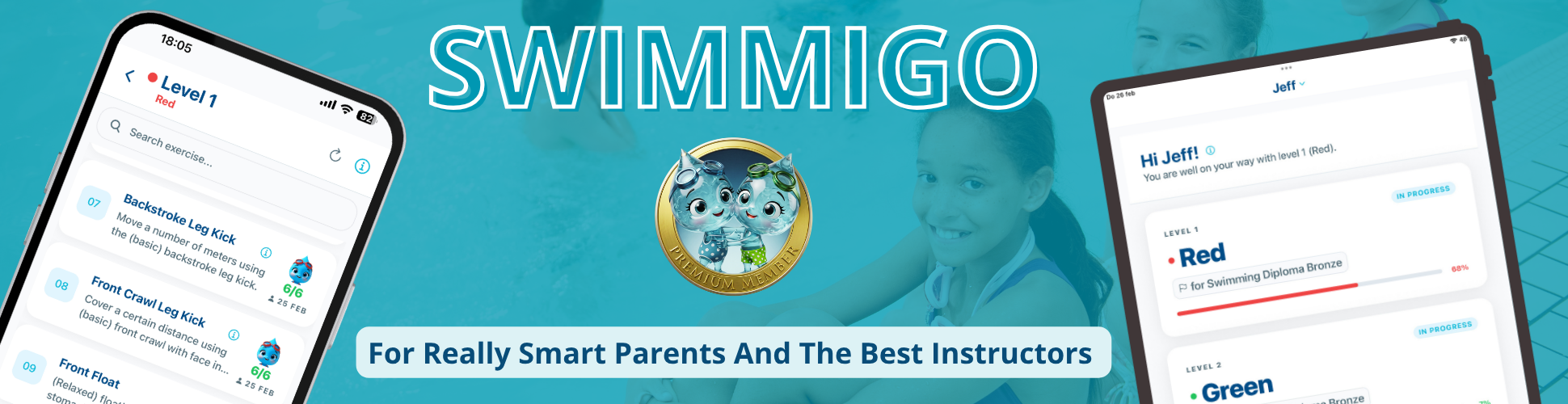
Parents who want to know where their child stands after the diploma benefit more from an overview per skill than from the announcement that the diploma is there. In the Swimmigo app, progress works with seven levels and 86 skills, each scored from 0 to 6. Parents see the same levels and exercises as the instructor, so you can precisely identify where there is still difficulty in conversations with the teacher.
That overview is also useful after the diploma. Have your child do a few exercises that were difficult in the last level a few times in summer, and you immediately see if it has stuck. Children themselves appreciate this, as visible progress is more motivating than well-meaning encouragement.
Where to find everything back
On swimmigo.com/levels are the seven levels and their skills, with the same layout as in the app. Parents who want to know how those levels relate to national standards find explanations about progress, notifications, and the free parent account on the page for parents. Swim schools wanting to set up a follow-up group or streamline their administration see what Swimmigo does on the page for instructors. For the full picture from water familiarization to diploma, including flow between levels, there is the overview of swimming lesson levels and skills.
Three assumptions you can let go of
"My child has C, so they can do everything"
A child with the C diploma can do much more than a child with A or B, and that difference is real. What they cannot do is not swim for a year and then perform the same. Swimming skills disappear without practice, even in a child who easily passed the diploma.
"Practice belongs to the swimming lesson"
Swimming lessons advance a child, and the hours in the water are limited. Children who also swim with family double their water time in the same period. That is the cheapest way to reach the diploma faster and the best guarantee that the skill sticks.
"Outside the Netherlands, it’s arranged the same way"
Families who move find that countries have different standards. A child with a Dutch C diploma is above average skilled in most countries, but local swimming lessons, clubs, and rescue programs work differently. When moving, ask what local swim sports schools do and how your child can join, instead of waiting for the school to say something.
A follow-up plan in four steps
This is the shortest route to children who remain water-safe:
- Set one fixed swim time in the family calendar, instead of occasional outings.
- Choose a track for your child: a swimming sport at a club, a follow-up series at the swim school, or practice yourself at a nearby pool.
- Repeat a few fixed exercises every six months, or do the annual swimming skills check.
- Ask the swim school which follow-up diplomas they offer and when your child can join.
With a fixed swim time in the calendar and a sport or practice series that suits your child, swimming skills remain up to standard.
Sources
- National Council for Swimming Safety: the National Swimming Safety Standard and the Zwem-ABC, consulted September 2026
- National Council for Swimming Safety: the Zwem-ABC and other National Swimming Diplomas, consulted September 2026
- National Council for Swimming Safety: National SwimChallenge, with research from Windesheim University on declining swimming skills, consulted September 2026
- National Council for Swimming Safety: National Swimming Safety Plan 2025 to 2028, 2025
- Mulier Institute: fewer Dutch people swim, National Sports Research, January 15, 2025
- KNZB, Reddingsbrigade Nederland and NOB: collaborating to keep swimming after the diploma, October 13, 2025
- Reddingsbrigade Nederland: National Swimming Diplomas and lifesaving swimming via local brigades, consulted September 2026
- CBS: higher risk of drowning among children not born in the Netherlands, July 2026
- World Health Organization: fact sheet drowning, May 1, 2026
- World Health Organization: Hidden depths, the global investment case for drowning prevention, 2024
- Royal Life Saving Society UK: Rookie Lifeguard Pool Programme, consulted September 2026
Bob van Soest
As an expert in operating sports facilities (such as swimming pools) and developer of, among others, Swimmigo.com, I am passionately committed to making swimming lessons simpler, more fun and more insightful for parents, swimming instructors and everyone who wants to learn to swim.
Frequently Asked Questions
Discover Swimmigo
The all-in-one app for swimming lesson progress. For parents, swim schools, and adult swimmers.