Learning Rescue Swimming: Which Rescue Skills Your Child Develops After the Diploma [2026]

Summary
- Self-rescue and rescuing someone else are two different skills, and the second only comes after the first is established.
- Almost every training starts with shouting, reaching and throwing from the shore, well before a child enters the water themselves.
- Children aged eight to twelve can already learn many rescue skills, provided they can swim about 25 meters.
- Ask a swim school about the follow-up program, group size and how progress per skill is tracked.
- For swim schools: a rescue program keeps students after the diploma and gives parents a concrete story.
Your child earns the diploma, you hang it up and swimming is done. Until one day you stand by a lake and your child is the first to jump into the water to grab a floating ball, without thinking about how to get back. Being able to swim and getting someone out of the water are two different skills. The second is rarely taught during regular swimming lessons.
What rescue swimming exactly is
Rescue swimming is the set of skills with which someone helps another out of the water without putting themselves in danger. In English it is called lifesaving and the International Life Saving Federation (ILS) uses that term for both the sport and the training. It involves a small number of actions you can teach: calling for help, reaching out something, throwing something, and only as a last resort entering the water yourself with a flotation device.
Self-rescue and rescuing someone else are not the same
Self-rescue is the part already included in swimming lessons, sometimes without naming it as such. Your child learns to float, exhale underwater, turn from back to front, and stand up in shallow water. This is exactly what the American Red Cross describes as water competency: being able to enter the water, breathe, stay afloat, change position, swim a distance and get out again.
Rescuing someone else requires something different. You must assess whether the situation is safe, consider what you have on hand, and dare to decide not to jump in. That sequence is harder for a child than learning a stroke, because it involves judgment.
Why this only comes after the diploma
Rescue skills build on a foundation that must first be in place. Someone who cannot stay calm and float cannot calm another. That is why most programs start with a swimming requirement: at the British Royal Life Saving Society this is the level of swimming training stage 7, or about 25 meters on the front and back. For most children that corresponds to about eight to ten years old.
There is another reason. A child just learning to swim needs all their attention for themselves. Only when a stroke becomes automatic is there room to pay attention to someone else.
What the numbers say
Drowning is a major global problem and mainly affects children. The World Health Organization cites about 300,000 deaths per year. Children under five make up nearly a quarter of that number, and for children aged 5 to 14 drowning ranks third among causes of death.
Where it goes wrong
92 percent of drownings occur in low- and middle-income countries, where water is often part of daily life: washing, fishing, bathing in a river or pond. In wealthier countries the risk shifts to leisure, holidays and open water. Global mortality has decreased by 38 percent since 2000, from 6.1 to 3.8 per 100,000 inhabitants. That is progress, yet there are still 300,000 deaths per year.
What research says about swimming lessons and rescuing
A systematic review published in December 2025 in Frontiers in Public Health updates 33 studies on swimming lessons and water safety in children. The conclusion is cautious but useful: swimming education can reduce drowning numbers and teaches children skills in the water, and water safety training improves what children know and how they behave around water.
The SwimSafe program is more relevant here, as it combines swimming, water safety and safe rescue techniques. Three cohort studies and a randomized trial together show a statistically significant reduction in drowning risk among children aged 4 to 12, with a level of evidence considered reasonable. The cost per death prevented was 3,009 dollars and per healthy life year gained 85 dollars.
In that same research something else stands out. Children who had followed such a program significantly more often rescued someone from the water than children who only had swimming lessons. They actually applied what they learned.
Swimmigo · Swim lesson app
Free for parents
Follow your child's swimming progress, see where you stand and report absences in the app.

The progression in five steps
Almost every lifesaving training worldwide follows the same order, from talking to jumping. The British Rookie Lifeguard and the American Red Cross method are very similar on this point. That is no coincidence: it is the sequence that poses the least risk to the rescuer.
Step 1: shouting and signaling
A child first learns to call for help and point to the shore. Sounds minimal, but it is the step that saves lives: someone else has a rope, a boat or a phone. In the British training this is called shout and signal, and it is the first skill a child learns in the water, well before touching anything or anyone.
Step 2: reaching from the shore
From the shore, extending a stick, towel, paddle or belt to someone and pulling them to the edge. The child stays on the shore, squats or lies down, and learns that their own weight is the anchor. This is why the American Red Cross follows the rule known in English as reach or throw, don't go: reach or throw, do not enter the water yourself.
Step 3: throwing with a device
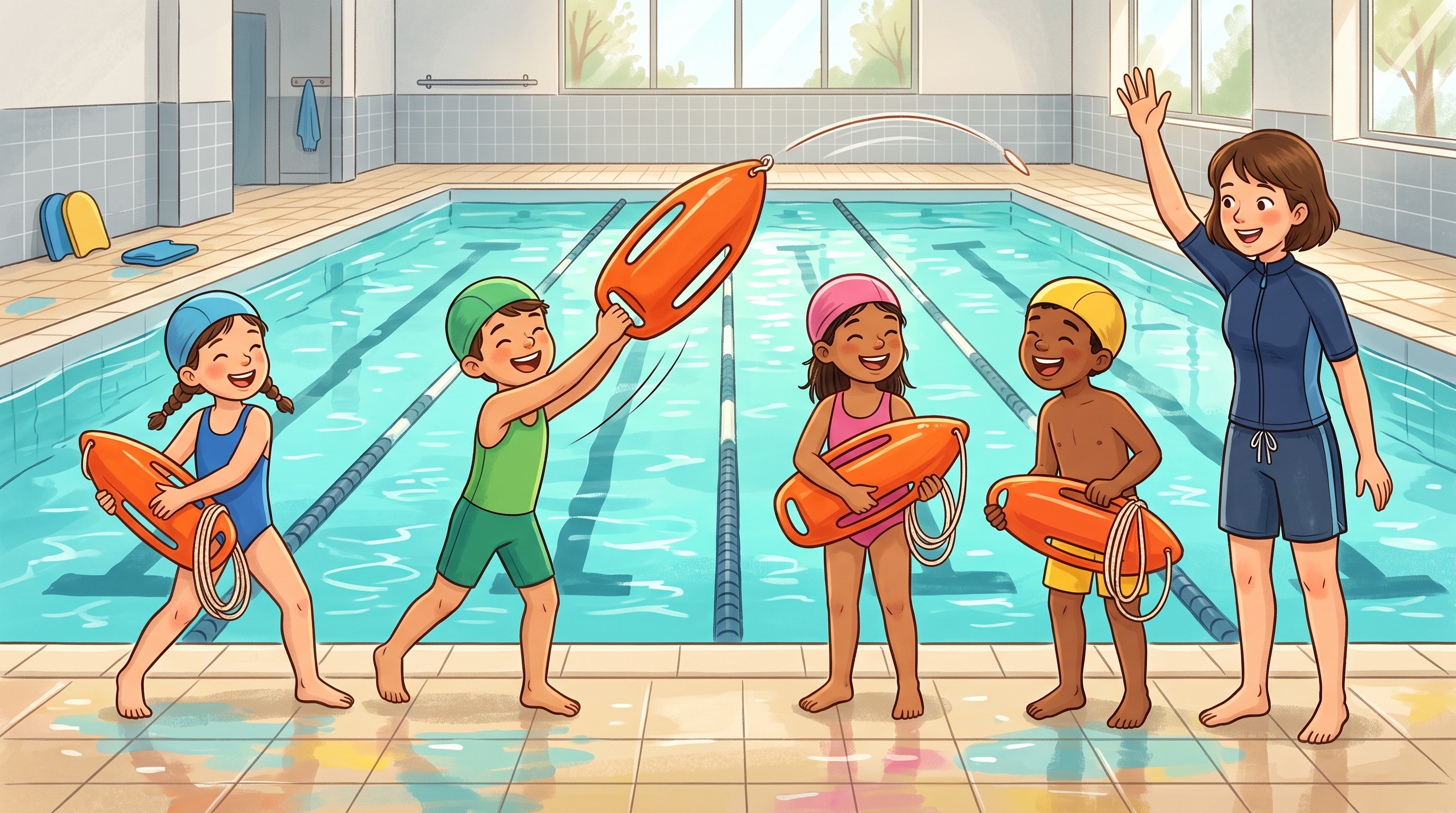
A lifebuoy, a rope with a float, an empty jerrycan with a line. Throwing seems simple but is not: you must aim, hold the rope, and pull the person to shore without the rope becoming taut at the wrong moment. Children practice this with a partner in shallow water, then at greater distances.
Step 4: self-rescue in clothing
Swimming with clothes on is part of it, because most accidents do not happen in swimwear. In the bronze phase a child swims 50 meters in clothing, learns the HELP position (pulling knees up, arms against the body, retaining heat) and practices treading water with an eggbeater motion, so they stay afloat without using much energy. Also included is diving feet first underwater and climbing out of deep water without a ladder.
Step 5: swimming rescue with a flotation device
The real work comes late: swimming to someone with a buoy or board, keeping a safe distance, letting the person hold on and returning together. For children this happens in shallow water and over short distances. Full swimming rescue without aid is part of training from about twelve years and older, not the basic course.
What is consciously not included yet
There is a limit to what you can teach a child, and lifesaving organizations are explicit about this. A child does not follow someone into deep water, even if they can swim well. The rule is that entering the water is the last option, and a child should never do this without an adult present.
What a program looks like
At the British Royal Life Saving Society the Rookie Lifeguard program lasts three phases of eight to ten weeks each: bronze, silver and gold. Each phase is divided into three levels and there are separate certificates for specializations, so a child has goals without staying at the same point for a year.
By age: what is achievable
| Age | What fits in this phase | What you do not need to expect yet |
|---|---|---|
| 6 to 8 years | Water safety in words and behavior: what to do if someone is in trouble, who to call, where not to stand | Rescuing someone yourself, not even with a device |
| 8 to 12 years | Calling and signaling, reaching, throwing, self-rescue in clothing, short distances with a flotation device | Swimming rescue without aid in deep water |
| 12 to 16 years | Longer distances, rescue without aid, lifesaving as a sport, teamwork | Acting as a supervisor, that is a separate professional training |
| 16 years and older | Full lifeguard training with supervision, rescue and resuscitation, plus first aid | That it happens automatically without annual refreshers |
What prior knowledge is needed
The swimming requirement is usually not a barrier for children who already have the diploma. At the British organization it is the level of stage 7: 25 meters of all four strokes, 100 meters continuous swimming with three strokes, thirty seconds treading water and completing an obstacle course. Children who just earned their diploma are close to that point.
For parents: what to look for
Not every swim school has a follow-up program. If there is one, what a child actually learns varies greatly. These questions separate a story from a program.
Five questions for the swim school
- Is there a follow-up program after the diploma, and what is it called?
- Is an accredited lifesaving training used or own teaching materials?
- How large is the group, and how many children per instructor?
- Does my child first learn reaching and throwing, or do they immediately enter the water?
- How do I as a parent keep track of which skills are already mastered?
What you can practice at home
You don’t need a course to start the conversation. At the pool, beach or ditch, say out loud what you would do: first check if it is safe, then call, then reach out something. Let your child think along about what nearby objects can float. Also agree that they never enter the water alone to help someone, no matter how well they swim.
What you better avoid is demonstrating how to rescue someone by jumping in yourself. Children copy what they see, even if it is dangerous.
For swim schools: setting up a follow-up program
The group that leaves after the diploma is the group you could have kept most easily. Parents often do not know there is something next, and schools do not mention it because there is nothing to refer to.
Why it keeps your groups stable
A child who enters a new stage remains enrolled. That saves recruitment, and it provides a story parents tell other parents: my child learns something special here. For a small school that is worth more than a brochure.
What space and materials you need
You do not need a separate pool. What counts is a piece of shallow water where children can stand, a few lifebuoys, a line with a float, and clothing that can get wet. For the older group a piece of deep water is added and an instructor who has completed a lifesaving training.
Recording progress per skill
Rescue skills are harder to assess than a stroke, because judgment is involved: does the child look first, or jump immediately? You make this visible by checking off per skill instead of per level, and by keeping short notes. In Swimmigo you record this per student and per skill, with a custom level progression of seven steps and 86 skills. Parents then see at home what is already mastered and what is not, without you having to explain it every lesson. More about this is on the instructor page and the level explanation.
What it ultimately yields your child
A child who knows how to reach and throw is less likely to jump in themselves at the beach or by a ditch. They have a second option, and they learn something that is rarely covered in swimming lessons: thinking before acting. That yields more than any certificate.
If you want to read further about what comes after the diploma, the overview about staying swim competent after the diploma goes deeper into follow-up training and what works if your child does not want a club. How you as a parent keep track of your child’s development is on the parent page, and all features are bundled on one page.
Conclusion
Rescue swimming is its own skill with its own progression, separate from regular swimming lessons. The sequence is the same worldwide: first shout, then reach, then throw, and entering the water only if absolutely necessary. Children aged eight to twelve can get quite far in this, provided the swimming foundation is there. Ask your swim school what comes after the diploma, and have recorded which skills your child already masters.
Swimmigo · Swim lesson app
Free for parents
Follow your child's swimming progress, see where you stand and report absences in the app.
Sources
- World Health Organization: Drowning fact sheet, May 1, 2026
- Criel et al.: Basic swimming or water safety skills training for drowning prevention in children, systematic review in Frontiers in Public Health, December 11, 2025
- Royal Life Saving Society UK: Rookie Lifeguard Pool Programme
- Swim England: Learn to Swim Stage 7 Award, November 29, 2019
- American Red Cross: Water safety and water competency
- International Life Saving Federation: Drowning prevention
Bob van Soest
As an expert in operating sports facilities (such as swimming pools) and developer of, among others, Swimmigo.com, I am passionately committed to making swimming lessons simpler, more fun and more insightful for parents, swimming instructors and everyone who wants to learn to swim.
Frequently Asked Questions
Discover Swimmigo
The all-in-one app for swimming lesson progress. For parents, swim schools, and adult swimmers.