Private swimming lessons at home: how lessons work in your own pool [2026]

Summary
- With private swimming lessons at home the instructor comes to your pool, usually teaching one child at a time.
- A private pool has no lifeguard, so supervision, a fence and a good drain are your responsibility.
- Ask about the instructor’s training, first aid and insurance before you book.
- Expect a higher rate per lesson than in a group, because the instructor travels and teaches one on one.
- Record progress per exercise, otherwise after ten lessons you will not see what was learned.
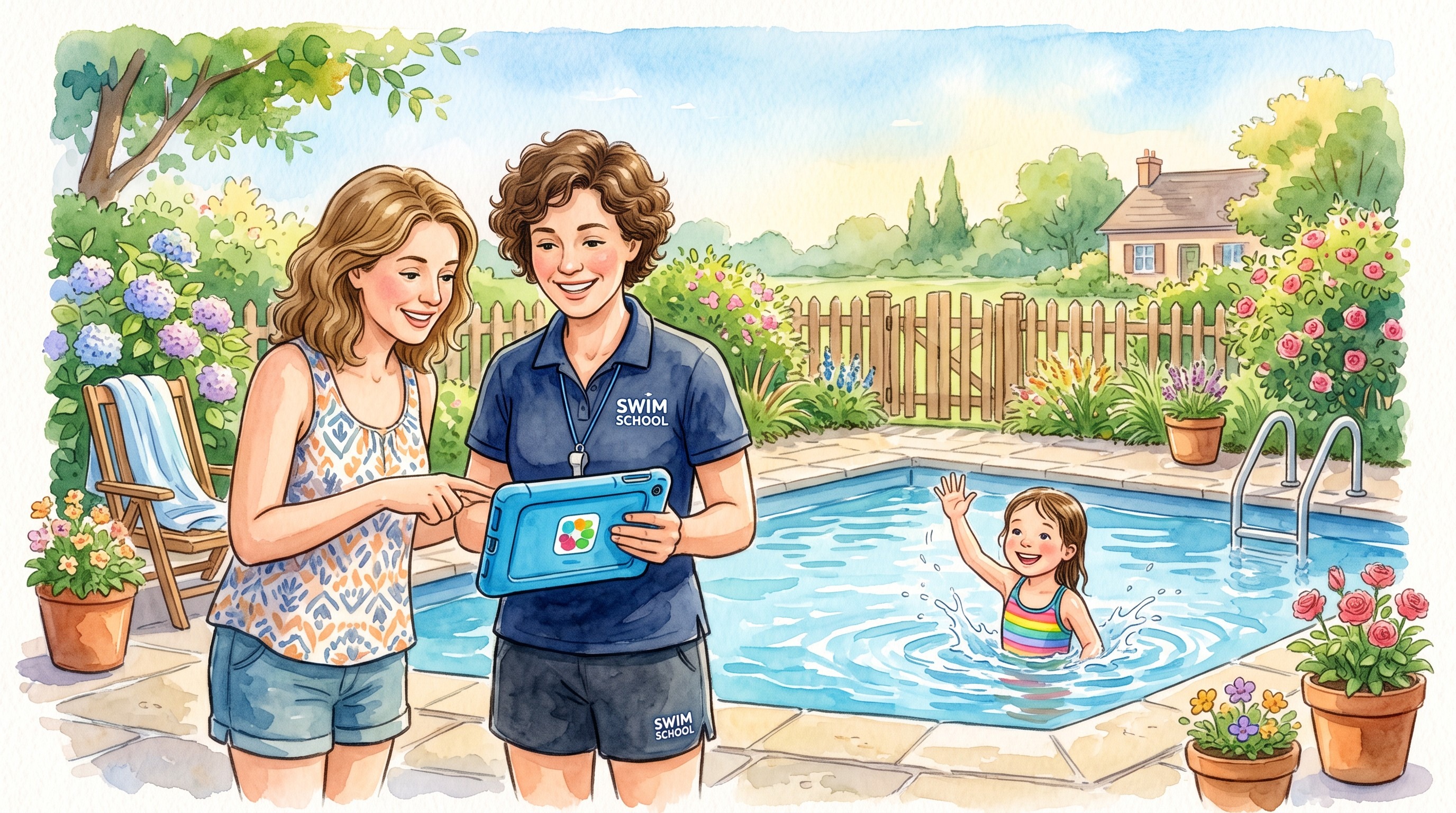
With private swimming lessons at home the instructor comes to your pool and your child gets lessons alone, or with a brother or sister. For a child who gets overwhelmed in a group or needs extra repetition, that is often exactly what it needs. The downside is clear too: everything a public pool normally provides falls to you, from supervision and barriers to a safe drain and someone who knows what to do if something goes wrong.
The lesson itself is usually the easy part. Whether it is safe and useful depends on the arrangements around it.
What private swimming lessons at home actually are
The instructor comes to your pool
There are three variants under the same name. The most common: the instructor drives to the family’s pool or to a pool the family can access, gives a thirty to forty-five minute lesson there and moves on to the next address. In the second variant you rent a private pool together, for example at a hotel, gym or holiday park, and the same instructor teaches your child there. The third variant is an instructor with a small private teaching pool, where only one child or one family is in the water per timeslot.
In all three cases you get something a group cannot give: full attention for one child, in an environment the child knows or where it feels safe.
The difference with private lessons at a swim school
A private lesson at a swim school is also one on one, but the location belongs to the school. That means a fixed pool temperature, a fixed depth, a fixed daily routine and someone else who handles safety. With lessons at home the instructor brings their equipment to a pool they do not know and where no colleague is nearby. The quality of the lesson therefore depends more on how well they prepare for your pool.
If you are unsure whether one on one lessons suit your child, the comparison between private lessons and group lessons goes into that in more detail.
Who it works for
Lessons at home deliver the most in a few concrete situations. Think of a child who cries or freezes in a group of twelve and calms down as soon as it is alone with an instructor in the water. Or a child who needs extra repetition and in a group always gets slightly too few attempts because of the lesson clock. Families with two children at different levels often choose it too, because the children then get twenty minutes each one after the other instead of driving twice a week.
There are families who have just moved or live abroad temporarily. The instructor comes to the house, parents do not have to find the way to a school and communication happens in the family’s language. And there is the group of children who cannot get one specific skill right, while the rest of the program is already progressing. A few lessons at home to break that single issue is then an efficient solution.
Four arrangements to make before the first lesson
A private pool has no lifeguard, no pool attendant and no reception to intervene. The World Health Organization counts about 300,000 drowning deaths each year and sees the risk rise especially when children encounter water outside active supervision. In the United States drowning is even the leading cause of death for children aged 1 to 4, reports the CDC. That is why you fix four things in advance.
Supervision: you are the lifeguard
The instructor is teaching. That is different from supervising everything that happens in and around the water. For children under four pediatricians advise so-called touch supervision: an adult stays within arm's reach, even during the lesson. The American Academy of Pediatrics explicitly recommends that and adds that a private one on one lesson is a better choice when a parent cannot be in the water or cannot observe the child well.
Practically it comes down to this: one adult per child in the water, phone put away, and someone who knows they are not doing anything else at that moment. Swimming lessons do not make a child waterproof. The U.S. regulator CPSC found that 69 percent of children under five were not expected to be in the water at the time of a drowning. Risky moments are often the minutes before and after the lesson, when the child keeps playing.
A fence, a self-closing gate and an alarm
A private pool should have a fence of at least four feet, so about 1.2 meters, on all sides, and it should not be climbable by children. Access runs through a gate that closes and locks automatically. An alarm on the door between house and pool helps too, and covers and safety blankets should really work and not be half worn. All of that is in the Pool Safely safety tips, the U.S. Consumer Product Safety Commission’s outreach program.
If you rent a pool, or share it with other families, ask who is responsible for the fence and whether there are door rules. A pool without a barrier calls for a different solution: lessons at a time when you are in the water yourself, or a pool with a fence.
The drain: the most dangerous spot in a private pool
Suction is the most dangerous force in a private pool. Hair, an arm, jewelry or a piece of swimwear can get trapped in a drain or suction opening, and that force can sometimes overpower an adult. Never enter the water if a grate is loose, broken or missing, and teach children not to play near the drain. In a pool with a spa section the emergency stop for suction should be known before anyone enters the water.
Check the drain cover before the first lesson and then once per season, together with the instructor. It takes a minute and it is the check most often skipped.
First aid and the rescue plan
At a public pool someone usually has a whistle and a first aid certificate. Not in your garden. Ask the instructor for a valid first aid and resuscitation certificate and for their liability insurance. Keep a rescue aid within reach, such as a ring or a long pole, and make sure someone can perform CPR.
Also run through the simple plan: who calls emergency services, who stays with the child, and which address you give. People calling from a pool behind a house rarely give the correct street and house number right away, while that is the first thing the dispatcher asks. Write the address on a card by the phone or in the family app. It is a small step that saves seconds in the real moment.
Swimmigo · Swim lesson app
Free for parents
Follow your child's swimming progress, see where you stand and report absences in the app.


What a private pool can and cannot offer
Length and depth
A pool of five by three meters is fine for water familiarization, floating, going under water, kicking and the first strokes. It is too small to swim distances and too shallow to dive or to practice deep water kicking. Ask the instructor beforehand which skills require which pool and which skills they can skip or postpone in your pool.
A pool that is 1.20 meters deep everywhere does not teach a child what deep water feels like. Part of the program must then take place elsewhere, for example during a holiday in a larger pool or at a public pool.
Temperature and water quality
For children aged three and under pediatricians recommend water around 30.5 to 34.5 degrees Celsius. An outdoor pool in a cold season rarely reaches that, and a shivering child learns little. Ask about the temperature before you book, and heat the pool a day in advance if possible.
Water quality is the other half of that story. Chlorine and pH should be correct, and a test strip costs almost nothing. The CDC points out that swimming water can spread pathogens and that chlorine and pH are the two controls you use to limit that. Do not let a child with diarrhea in the pool, have everyone shower beforehand and choose well fitting swimwear so less ends up in the water.
Distractions, siblings
A private pool is a playground. There are inflatable animals, a slide and often a neighbor child at the edge. During the lesson that is distraction, and it is also a safety issue: every extra toddler in the water requires an extra pair of eyes. Agree in advance who is in the water, place the other children with a second adult and remove toys that invite diving.
What it costs and which agreements you set
Why the rate per lesson is higher than in a group
In a group of six six families pay for the instructor’s hour together. With lessons at home one family pays for that same hour, plus travel time and travel costs. The amount per lesson is therefore higher, and that is the arithmetic of one on one teaching.
Whether it is cheaper per child depends on how quickly your child progresses. A child who stands still for ten months in a group of twelve and advances a level in four months with targeted lessons can sometimes be cheaper with lessons at home than with a year of group lessons. That is exactly why you agree in advance what the expectation is and how you measure it.
Per lesson, per package or per month
Instructors usually work with three models: pay per lesson, a package of for example ten lessons in advance, or a fixed monthly fee. Per lesson is the most flexible and the most expensive per hour. A package gives a discount, but check validity and what happens if your child gets sick. A monthly fee fits a fixed weekly schedule and is only smart if you are sure you can make the lesson time every week.
| Cost item | How it works | What to ask beforehand |
|---|---|---|
| Lesson fee | One child pays for the whole hour, so higher than a group rate | The price per lesson and the price per package, side by side |
| Travel costs | The instructor drives to your address, sometimes with call-out fees | Whether travel is included in the rate and from which distance extra applies |
| Pool rental | At your own pool zero, at a rented pool per hour | The hourly rate and the cancellation terms of the pool |
| Heating and water | Your pool, your bill, and much higher in cold months | How warm the water should be and whether an extra hour of heating is needed |
| Equipment | Usually the instructor brings floats and aids | What they bring and what you prepare |
| Cancellations | A lesson cancelled at short notice is often charged | The cancellation deadline and what applies in case of illness or a broken pool |
If the instructor uses Swimmigo’s payment system, packages, discounts and payments go through the app, with iDEAL, credit card or PayPal and the money goes directly to the instructor’s own account. That only works in countries where Stripe is active, such as the United States, Singapore, Thailand and the United Arab Emirates. In countries like Vietnam or parts of the Caribbean it does not work, and then payment is by normal bank transfer. The app itself, with scheduling, progress and communication, works everywhere.
The agreements you put on paper
Put in a short message or a shared document what was agreed: day and time, lesson duration, price and what is included, travel costs, cancellation deadline, who is present at the lesson, what happens if the pool is unusable, how you receive progress updates and how payment runs. It takes ten minutes and prevents the conversations that otherwise come after a month.
Also record what the instructor does if your child does not dare enter the water. Do they stop the lesson, sit at the edge for twenty minutes or work in small steps? That answer says more about the instructor’s quality than their rate.
How to assess an instructor who comes to your home
Five questions for the first lesson
Pediatricians advise looking for instructors trained and certified through a recognized swim program, with a valid resuscitation and first aid certificate. For lessons at home insurance comes on top, because the school that normally provides the pool space is not there. Five questions to ask beforehand:
- Which training did you follow, which certificate comes with it and are your resuscitation and first aid certificates still valid?
- Are you insured for liability when you teach in a pool that is not yours?
- How many children of this age have you taught, and which situations do you have experience with?
- May I have the name and number of two families who currently have lessons with you?
- How do you record progress, and when will I first see what my child has learned?
An instructor who cannot say which exercises a child has mastered after three lessons probably does not keep track.
The trial lesson
A good trial lesson shows how the instructor works. Do not only look at whether your child smiles, but also whether the child spends most of the lesson moving instead of waiting at the edge, whether the explanations land and whether the instructor adjusts without correcting what is already working. U.S. pediatricians recommend watching a lesson before you sign up, and that applies at a private pool just as much.
After the lesson ask your child whether they want to do it again. For lessons at home that is a better predictor than an adult’s judgment, because the lesson in the first weeks mainly revolves around trust.
Tracking progress when lessons are not in a group
Why progress disappears without a system
A swim school has levels, a little report and a fixed moment when parents hear how things are going. With lessons at home that chat is often the last ninety seconds by the gate, while a child pulls because it wants to go home. After ten lessons no one remembers which exercise was ticked off in week three and where it got stuck in week eight.
That is a shame, because swimming is a stacking of small skills. If you do not log per exercise what does and does not work, it looks as if a child stands still, while in reality it learned three things and did not master one. Without records there is also no basis to decide whether lessons should continue, stop or change.
What the app changes for an instructor at home
For an instructor who drives from address to address the issue is not the lesson but the administration afterwards. Swimmigo works with seven levels and 86 skills, where each exercise receives a score from 0 to 6 in the form of smileys. You tick off during or immediately after the lesson what a child masters, and you see per student where the next lesson should start.
The rest of the platform wraps around that: scheduling and groups, messages to parents with read receipts, certificates and diplomas per level (Bronze over levels 1 through 5, Silver for level 6, Gold for level 7), optional lesson payments via Stripe and a dashboard with figures about groups and flow. Team roles work too, in case a second instructor joins. The app runs on phone and tablet, on iOS and Android, and is available in five languages, with Portuguese coming and other languages on request.
For an instructor with pupils at ten addresses that is the difference between keeping everything in your head and being able to look it up. The instructor page shows how that works in practice, and the features page shows which components exist.
What parents see in the app
Parents use Swimmigo for free. They see per exercise what their child already can, receive a notification when a new level is reached and can download the certificate for that level. At the highest levels a personalized diploma with name, date and level is available. Communication also runs in the app, in the family’s language, which with lessons at home is often handier than a chat group where everyone talks over each other.
A swim school or instructor starts with a free demo, then works thirty days for free and then chooses a Solo or School subscription, cancellable monthly. Prices go through the App Store and Google Play. It is never per pupil or per invoice, and parents remain free. More about what parents see is on the parent page, and the build of the levels is on the levels page.
When a swim school is the better choice
The limits of a private pool
There are situations where a school is the better choice. If the pool is too small to practice the skills your child needs, if there is no fence or barrier and you cannot arrange a second adult, or if your child needs to learn how to deal with other children in the water. Also when the costs over several years become too high a group is the pragmatic choice: lessons at home are expensive per hour, and swimming lessons often last longer than parents expect.
There is the practical question of who is present at the lesson. If your child must be in the pool every week at a fixed time while you are at work, a school with fixed times and other parents in the waiting room is often simpler than an instructor coming to your home.
Hybrid: private lessons alongside group lessons
The most common practical solution is a combination. A child stays in the group and gets a few single lessons at home to break one block, for example keeping the head underwater or the arm stroke that will not come together. Afterwards the child returns to the group.
The reverse also works: a few months of lessons at home first to build confidence, then joining a group. For an anxious child that is often the route that costs the least in tears and lesson fees.
Six mistakes you often see
- Thinking lessons replace supervision. Lessons are one layer of protection, not a substitute for an adult who pays attention.
- Hiring an instructor without first aid and without insurance, because the bond with the child was so good.
- No fence, no alarm and a door to the pool that is open all day.
- Swimming distances in a five meter pool, or diving in a pool that is too shallow.
- Agreements in a chat that disappeared after three weeks.
- Not recording progress, so after twenty lessons you cannot justify where the money went.
Conclusion
Private swimming lessons at home work well for children who need calm, repetition or a familiar place, and for families where the trip to a pool each week is too demanding. Quality in a private pool depends more on the conditions around the lesson than on the rate: supervision, a fence, a safe drain and an instructor with first aid and insurance. Put the agreements in writing and track progress per exercise, then you can still see after twenty lessons what your child has learned and whether continuing is worth it.
Swimmigo · Swim lesson app
Free for parents
Follow your child's swimming progress, see where you stand and report absences in the app.
Sources
- World Health Organization: Drowning, facts and figures, updated 1 May 2026
- CDC: Drowning Facts, updated 27 January 2026
- American Academy of Pediatrics: Swim Lessons for Children, updated 18 May 2026
- Pool Safely (CPSC): pool safety tips, consulted November 2026
- CDC: Swimming and Your Health, updated 8 May 2024

Bob van Soest
As an expert in operating sports facilities (such as swimming pools) and developer of, among others, Swimmigo.com, I am passionately committed to making swimming lessons simpler, more fun and more insightful for parents, swimming instructors and everyone who wants to learn to swim.
Frequently Asked Questions
Discover Swimmigo
The all-in-one app for swimming lesson progress. For parents, swim schools, and adult swimmers.