CompleteOverviewofSwimmingLessonSchedulingandSoftwareforSwimSchools[2026]
![Complete Overview of Swimming Lesson Scheduling and Software for Swim Schools [2026]](/_next/image?url=https%3A%2F%2Fzvblogpostimages.s3.eu-west-3.amazonaws.com%2FAUTOMATISCH_UPLOAD%2F1_849dd336ecee.jpg&w=3840&q=75&dpl=dpl_8HBmXj8pyjjziKcbXKHvXrtJMU4a)
Summary
- Manual swimming lesson scheduling costs swimming instructors an average of 3 to 5 hours per week
- Specialized swim school software automates scheduling, progress, and parent communication in one system
- Free platforms like Swimmigo offer comparable core functionality to paid alternatives
- Digital scheduling reduces no-shows by 30 to 40 percent through automatic reminders
TLDR
- Manual swimming lesson scheduling costs swimming instructors an average of 3 to 5 hours per week on rosters, absences, and group assignments
- Specialized swim school software automates scheduling and links it to student tracking systems and parent communication
- Free options like Swimmigo exist alongside paid platforms, offering comparable core functionality for small to medium swim schools
- Digital scheduling reduces no-shows by 30 to 40 percent through automatic reminders and self-service cancellations
- A good scheduling system is the backbone of every swim school: without overview, not only scheduling but also lesson progress stalls
Why Swimming Lesson Scheduling Is More Than Just a Roster
Every swim school runs on one crucial system that rarely gets the attention it deserves: scheduling. It is the invisible engine that determines which student is in which group, with which instructor, at what time, and in which lane. To an outsider, it may seem simple: make a roster and done. But every swimming instructor knows that behind that one A4 sheet lies a weekly puzzle of epic proportions.
In the Netherlands alone, according to the Mulier Institute, hundreds of thousands of children take swimming lessons, spread over an estimated 600 to 800 swim schools and pools with their own lesson programs. Worldwide, tens of millions of children learn to swim annually. The World Health Organization (WHO) emphasizes that swimming skills are one of the most effective interventions against drowning, the third leading cause of death among children under 15 worldwide. Good swimming lesson scheduling is therefore not just an efficiency issue: it is literally a matter of life and death that every child receives the right instruction at the right time.
The Hidden Clockwork of Every Swim School
A swim school scheduler must consider more factors than most other sports. Think of swimming levels that vary per child (from water familiarization to deep-water floating), instructors with different specializations, pool capacity that varies per hour, and parents who cancel via WhatsApp, phone, or not at all. Add to that the diploma requirements: in the Netherlands the Zwem-ABC, but internationally there are numerous similar systems such as the British Swim England Framework or the Australian Swim and Survive program, and you have a logistical challenge many project managers would envy.
Many small swim schools, and also larger pools, still schedule manually. A whiteboard in the canteen, an Excel file copied every week, or a calendar app actually meant for hairdresser appointments. The real impact only becomes visible when you start measuring.
The Real Costs of Manual Scheduling
What does manual scheduling really cost? Research into administrative burdens at sports clubs and small-scale service providers shows that schedulers spend an average of 3 to 5 hours per week on roster management. For a freelance swimming instructor charging 25 euros per lesson hour, that amounts to 75 to 125 euros in lost income per week, or 3,000 to 6,000 euros per year. And that is only the direct time cost.
The indirect costs are often greater: incorrect group assignments leading to delayed certification, parents dropping out due to poor communication, and instructors getting frustrated by constant last-minute changes. Digital scheduling with automatic reminders can reduce no-shows by 30 to 40 percent. For an average swim school with 150 students and 2 euros no-show cost per missed lesson, that equals over 3,500 euros in regained revenue per year.
The Biggest Scheduling Challenges for Swim Schools Worldwide
Whether you run a swim school in Amsterdam, Antwerp, Auckland, or Austin: the fundamental scheduling challenges are remarkably universal. Let’s go through them one by one.
1. Group Assignment by Level: Ever-Changing Compositions
Children progress at their own pace. One student moves to the next level after three lessons, another stays eight weeks on backstroke. Groups shift every week. Without up-to-date insight into each child’s swimming progress, group assignment is a guess. A scheduler linked to a student tracking system solves this: levels are visible in real time and group assignments adjust automatically.
2. Pool Capacity: Too Few Lanes for Too Many Students
Every pool has a maximum number of lanes and students per instructor. In the Netherlands, the National Council for Swimming Safety (NRZ) applies guidelines of a maximum of 12 students per instructor in the deep pool, rising to 15 in shallow water. In other countries like the US (American Red Cross) and the UK (Swim England), similar ratios apply, usually 1:6 to 1:12 depending on age and level. A digital scheduler that automatically monitors pool capacity prevents overbooking and underutilization. With manual scheduling, popular time slots (Wednesday afternoon, Saturday morning) become overcrowded while weekday mornings remain empty.
3. Absence and Make-Up Scheduling: The Eternal Sliding Puzzle
"My daughter has a cold, can she make up the lesson next week?" is the most asked question at every swim school reception. Without a digital system, this question ends up in a tangle of post-its, WhatsApp messages, and reminders. A scheduling tool with self-service for parents, where they can cancel themselves and choose a make-up lesson from available slots, completely eliminates this administrative hassle. The result: 80 percent fewer calls and messages about cancellations, according to user data from booking platforms.
4. Instructor Availability: Illness, Vacation, and Changes
Freelance swimming instructors often combine multiple pools. A sick colleague on Tuesday means four groups without an instructor unless you shuffle quickly. A scheduling system with real-time availability overview prevents double bookings and enables replacement with one click. In swim schools with multiple instructors, this is often the main reason to switch to digital scheduling.
5. Waiting Lists: Growing Pressure on Limited Capacity
Many swim schools struggle with waiting lists of 3 to 12 months. Without smart waiting list scheduling, potential students wait unnecessarily long while spots secretly become available due to dropouts. A digital scheduling system with automated waiting list flow fills freed spots immediately with the next candidate of the right level, without planner intervention.
From Whiteboard to Cloud: The Digital Transformation of Swimming Lesson Scheduling
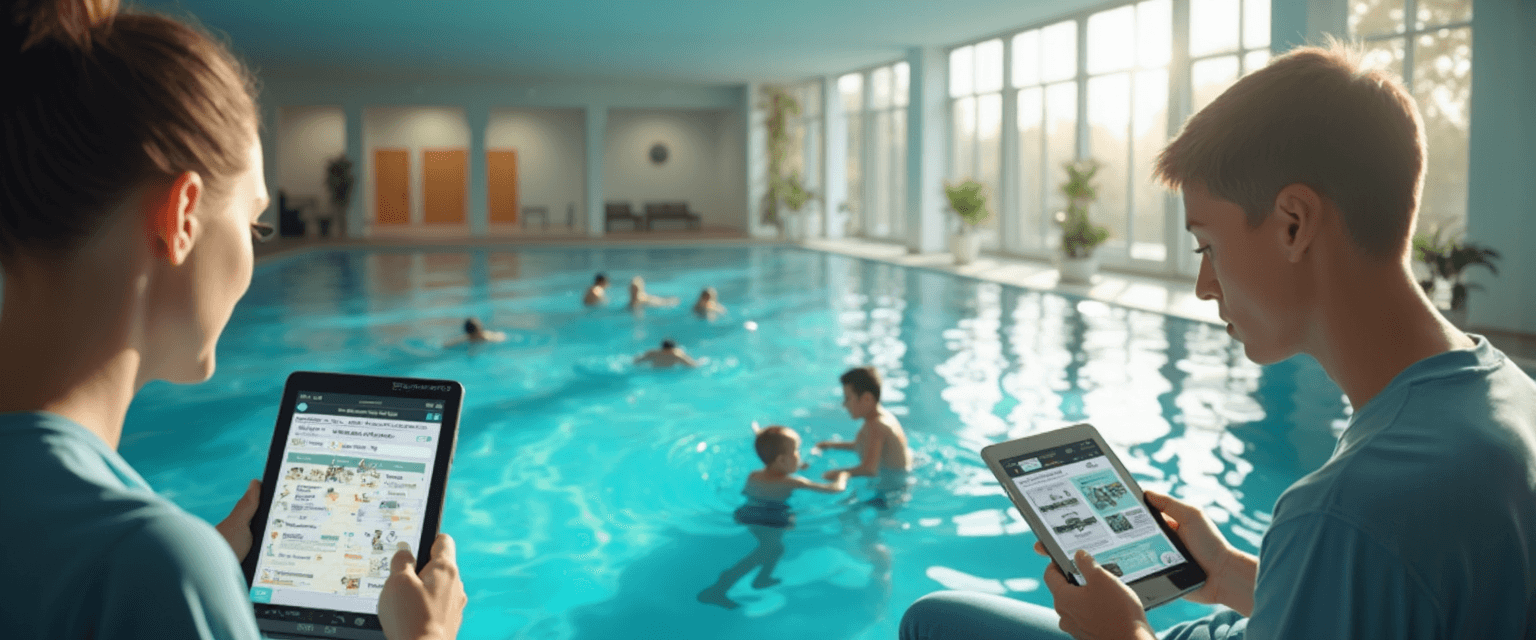
The switch from manual to digital scheduling feels like a big step for many swimming instructors. "We’ve been doing this for 20 years, why change?" is an understandable reaction. Yet the digital transition in the swimming industry is inevitable, and not just because it’s more efficient. Parents simply expect it.
In a world where you manage banking, groceries, and doctor appointments digitally, it’s illogical that a swimming lesson cancellation still requires a phone call to reception. Research into digital services shows that the vast majority of parents use online tools for practical matters concerning their children. In the Netherlands, Germany, France, Spain, and the English-speaking world, parents use apps for their children’s scheduling just as naturally.
What Makes Digital Scheduling Truly Different
The difference between an Excel sheet and a specialized scheduling system is greater than most swimming instructors think. A good system offers:
- Automatic Level Linking: the scheduler reads current swimming levels from the student tracking system and proposes optimal group assignments
- Parent Self-Service: canceling, making up, and changes via an app: no more phone calls
- Capacity Monitoring: the system blocks overbookings per lane, instructor, and time slot
- Multi-Instructor Overview: all colleagues see the current schedule in real time, also on their phone at poolside
- Reports: occupancy rate, absence patterns, and flow statistics in one dashboard
Which Features Are Truly Essential for Your Swim School?
Not every swim school has the same needs. A freelance instructor with 40 students has different requirements than a pool with 400 students and 8 instructors. Based on reviews and feedback from the swimming industry, this is the minimal feature set per type of swim school:
| Type of Swim School | Essential Features |
|---|---|
| Freelance Instructor (≤50 students) | Roster management, absence registration, basic parent communication |
| Small Swim School (50-150 students) | Group assignment by level, parent self-service portal, make-up scheduling |
| Medium Swim School (150-400 students) | Multi-instructor scheduling, capacity monitoring, progress linking |
| Large Pool (400+ students) | Multi-location management, API integrations, advanced reports |
The Best Swimming Lesson Scheduling Software Compared [2026]
The market for swim school software has grown significantly in recent years. Where 10 years ago you only had generic scheduling apps, there are now dozens of specialized platforms. The global market for swim school software was valued at $345 million in 2024 and is growing at 13.7 percent annually according to Verified Market Research, reaching $963 million by 2032. Also, MarketIntelO predicts the market will double to $620 million by 2033. Based on these developments and feedback from the swimming industry, we list the main options.
Free vs Paid: What Fits Your Swim School?
Price differences in swim school software are huge. At one end of the spectrum, you find completely free platforms like Swimmigo; at the other end, you pay up to 200 euros per month for enterprise solutions. What you need depends on your scale:
| Platform | Price (from) | Best For |
|---|---|---|
| Swimmigo | Free | Small to medium swim schools wanting scheduling and progress tracking |
| WeScore Zwemmen | Free basic | Starting swim schools focusing on administration |
| Zwemlesplein | On request | Medium swim schools with member management |
| Ledenbeheer | From €25/month | Swim schools with complex invoicing and payment processing |
| Bookeo / SimplyBook.me | From €10-15/month | Generic booking solutions, usable for any lesson type |
All-in-One Platforms Specifically for Swim Schools
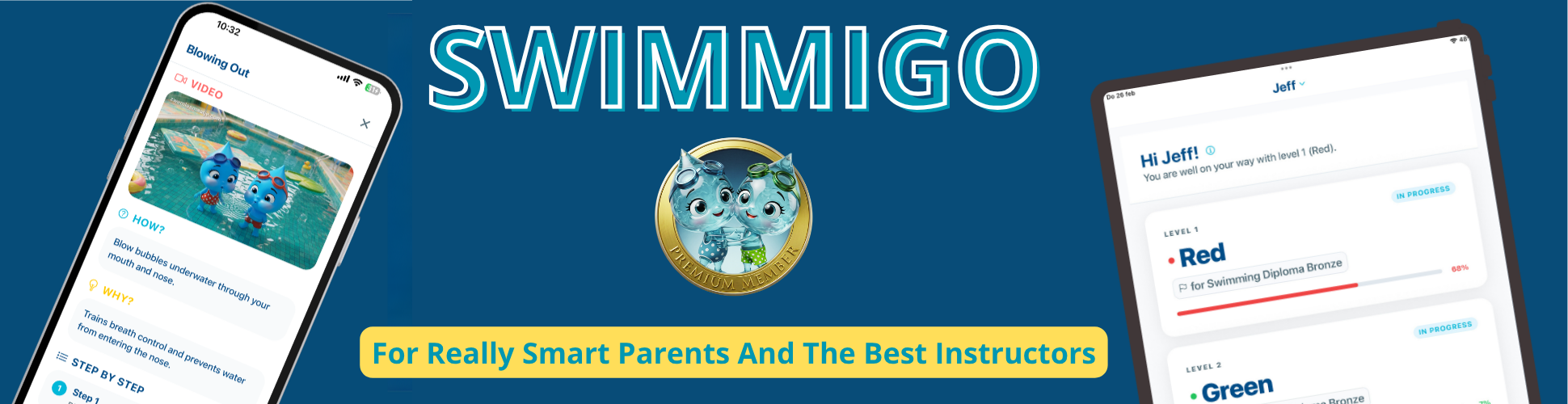
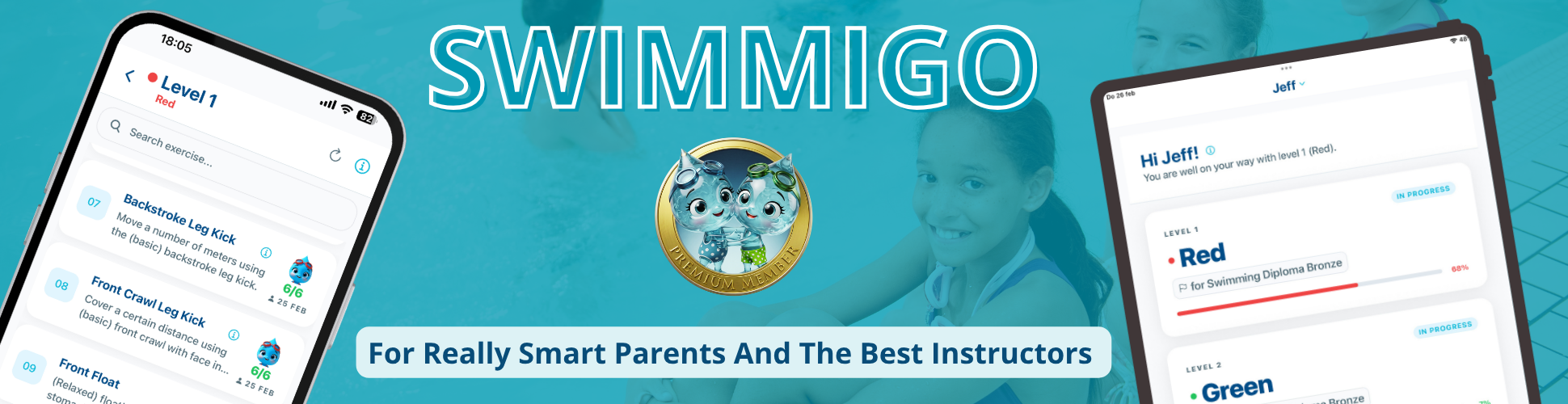
Specialized platforms distinguish themselves by swim-specific terminology (levels, diploma requirements, pool capacity) and integrations that generic tools do not offer. Swimmigo, for example, combines scheduling with a student tracking system and parent app: three systems in one. WeScore and Zwemlesplein emphasize administration and member management. The advantage of an all-in-one platform is that you don’t have to work with separate tools that don’t communicate.
Generic Scheduling Apps: Calendly, Google Calendar, and Co
For the very smallest swim schools, think of a freelance instructor with 10 to 20 regular students, a generic tool may suffice. Google Calendar with shared calendars and WhatsApp for communication is free and immediately available. The downside: once you grow, you hit limits. No level linking, no parent self-service, and no absence registration. Moreover, these tools are not GDPR-compliant for processing student data. From about 30 students, a specialized platform is almost always the better choice.
Swimmigo: Scheduling, Progress, and Parent Communication in One Free App
Swimmigo was built from the experience of swimming instructors who were tired of juggling three different systems for scheduling, progress, and parent communication. The platform is available in 5 languages (Dutch, English, German, French, and Spanish) and is used worldwide by swim schools and freelance instructors.
How Swimmigo Combines Scheduling, Progress, and Communication
Instead of separate tools that don’t communicate, Swimmigo offers one integrated environment:
- Scheduling: create groups, assign students with swipe gestures, monitor pool capacity, multi-location management
- Progress: 7 swimming levels (Red to Gold) with 86 skills, real-time scores per exercise on a 0-6 smiley scale
- Parent Communication: push notifications for level jumps, free personalized swim diplomas, vacation mode for self-checking exercises
- Marketing Toolkit: generate flyers, social posts, and certificates, handy for customer acquisition
Because scheduling reads directly from the student tracking system, Swimmigo automatically proposes group assignments based on current levels. A student just promoted from Orange to Yellow immediately appears in the correct group without manual shuffling.
Practical Example: From 3 Hours to 15 Minutes per Week
A realistic case: swim school De Waterspetters (fictional name) with 120 students, 4 instructors, and 8 groups. Previously: 3 hours Thursday evening updating Excel, checking WhatsApp groups, scheduling make-up lessons, and emailing parents. With Swimmigo: 15 minutes Thursday evening to check the automatic group assignment and possibly manually adjust one exception. The system handles the rest. Instructors see their schedule in the app at poolside, parents get push notifications for changes, and cancellations are automatically processed with make-up suggestions.
Step-by-Step Plan: How to Digitize Your Swimming Lesson Scheduling
Switching to digital scheduling doesn’t have to be complicated. This practical step-by-step plan helps you go from whiteboard to cloud.
Step 1: Map Your Current Bottlenecks
Start with an honest inventory. Where does most time go? Is it the weekly roster puzzle, parent cancellations, or keeping track of levels? Track how many minutes you spend on scheduling-related tasks for a week. Also note frustrations: double bookings, forgotten cancellations, parents who don’t know which group their child is in. This inventory determines which features have priority for you.

Step 2: Choose the Tool That Fits You
Use the comparison table earlier in this overview. Are you a freelance instructor with 40 students? Then a free platform like Swimmigo or the free basic version of WeScore suffices. Do you manage a pool with 300 students and 6 instructors? Then look at all-in-one platforms with multi-instructor functionality and reports. Request demos from at least two providers and test them with real data.
Step 3: Implement in Phases, Not All at Once
The biggest mistake swim schools make when digitizing is wanting to change everything at once. Start with one part: for example, only group assignment and roster. Run that for a month, evaluate, then add parent communication. Only in the third phase do you link scheduling to the student tracking system. This phased approach prevents resistance among colleagues and minimizes the chance of errors during the transition. Plan an evaluation moment after each phase: what works well, what needs to change?
The Future of Swimming Lesson Scheduling: What Awaits Us?
The digitization of the swimming industry has only just begun. Some trends we see coming in 2026 and beyond:
- AI-driven Group Optimization: algorithms that compose groups not only by level but also by learning speed, age, and social dynamics
- Multilingual Parent Portals: essential in cities with diverse populations and for swim schools operating internationally
- Integration with Wearables: smartwatches that measure swimming performance and automatically report to the student tracking system
- Blockchain Diploma Registration: fraud-resistant, cross-border diploma registration that moves with a student if they relocate to another country
Conclusion
Swimming lesson scheduling is the backbone of every professional swim school. Manual scheduling not only wastes time and money but also hinders lesson progress because levels are not visible in real time in the schedule. The switch to digital scheduling is more accessible than ever in 2026: free platforms offer functionality that five years ago was only in expensive enterprise packages. Whether you teach swimming in the Netherlands or abroad: a smart scheduling system linked to your student tracking system and parent communication is no longer a luxury. It is the standard that parents expect and that gives your swim school the professional appearance it deserves.
Want to know more about how Swimmigo can help your swim school?
Discover Swimmigo for instructors →
Frequently Asked Questions
Sources
- NRZ/Mulier Institute: More and more children in the Netherlands obtain swimming diplomas A, B, and C, November 2025
- WHO: Drowning fact sheet, global drowning statistics and prevention, 2024
- Verified Market Research: Swim School Management Software Market, $345M in 2024, 13.7% CAGR, 2024
- MarketIntelO: Swim School Management Software Market, $245M in 2024, growth to $620M in 2033, 2024
- CDC: Drowning Prevention, formal swimming lessons reduce drowning risk, 2025
- DDMA: Barometer 2025, digital service adoption in the Netherlands, 2025
- RTL News: 40 percent of children have all swimming diplomas, new swimming skill figures, 2024

Bob van Soest
As an expert in operating sports facilities (such as swimming pools) and developer of, among others, Swimmigo.com, I am passionately committed to making swimming lessons simpler, more fun and more insightful for parents, swimming instructors and everyone who wants to learn to swim.
Frequently Asked Questions
Related articles

What to Bring to Swimming Lessons? Practical Tips
Discover what you practically need to bring to swimming lessons for a smooth process and comfortable swimming experience.

Benefits of Paid Swimming Lesson Software for Scheduling
Discover how paid swimming lesson software simplifies lesson scheduling and payments while improving cash flow.
Efficient swimming lesson scheduling without paid software
Discover practical ways for clear swimming lesson scheduling without extra software costs.
Discover Swimmigo
The all-in-one app for swimming lesson progress. For parents, swim schools, and adult swimmers.