WhenIsYourChildTrulySafeinOpenWater?TheSwimmingLevelsThatMatter[2026]
![When Is Your Child Truly Safe in Open Water? The Swimming Levels That Matter [2026]](/_next/image?url=https%3A%2F%2Fzvblogpostimages.s3.eu-west-3.amazonaws.com%2FAUTOMATISCH_UPLOAD%2F1_ce4f58f143d4.jpg&w=3840&q=75&dpl=dpl_GWyfLj8UVegbQ18STkVQms8Vj7LD)
Summary
- 132 accidental drownings in 2025: open water is not the same as a swimming pool
- Of the 7 Swimmigo levels, Bronze (level 5) is the first point where open water under supervision is responsible
- Children with a migration background have a 9 to 14 times higher risk of drowning
- With Swimmigo you see per exercise if your child is ready for open water, no guesswork
Another Teen Drowned: When Is Your Child Safe Enough?
On June 25, 2026, a 13-year-old boy was found lifeless in the Strijkviertelplas in Utrecht. This was already the second fatal swimming incident at a recreational lake in Utrecht within a short time. Earlier, a minor boy died at the Maarsseveense Plassen. And on the same June 25, two more people drowned elsewhere in the Netherlands (NOS), in the Spiegelwaal near Nijmegen and in Limburg.
Three deaths in one day. This raises the same question for every parent: when is my child truly safe in open water?
The numbers don’t lie. CBS reported a total of 132 accidental drownings in the Netherlands in 2025. 100 of these were residents of the Netherlands, 32 were tourists or temporary workers. Over the past five years, an average of 93 people drowned annually. Notably, the province of Utrecht has the highest number of drownings per square kilometer of water (0.44 per km²).
For newcomers to the Netherlands, the risk is even greater. Children born outside Europe have a 9 to 14 times higher risk of drowning than children of Dutch origin. More than a quarter of children with a migration background do not have a swimming diploma, compared to only 5 percent of children without a migration background.
This is not purely a Dutch problem. The World Health Organization (WHO) estimates that 300,000 people drown worldwide annually. In countries without a strong swimming culture, the numbers are even higher. Swimming safety is a universal concern, whether you live in the Netherlands with its 6,000 kilometers of waterways, or in a country where children rarely receive swimming lessons. For parents worldwide, the core question is the same: do I know what my child can truly do in the water?
What can you do as a parent? The answer starts with insight: know what your child can do, and at what level it is truly safe for open water.
What Does Your Swimming Level Say About Safety in Open Water?
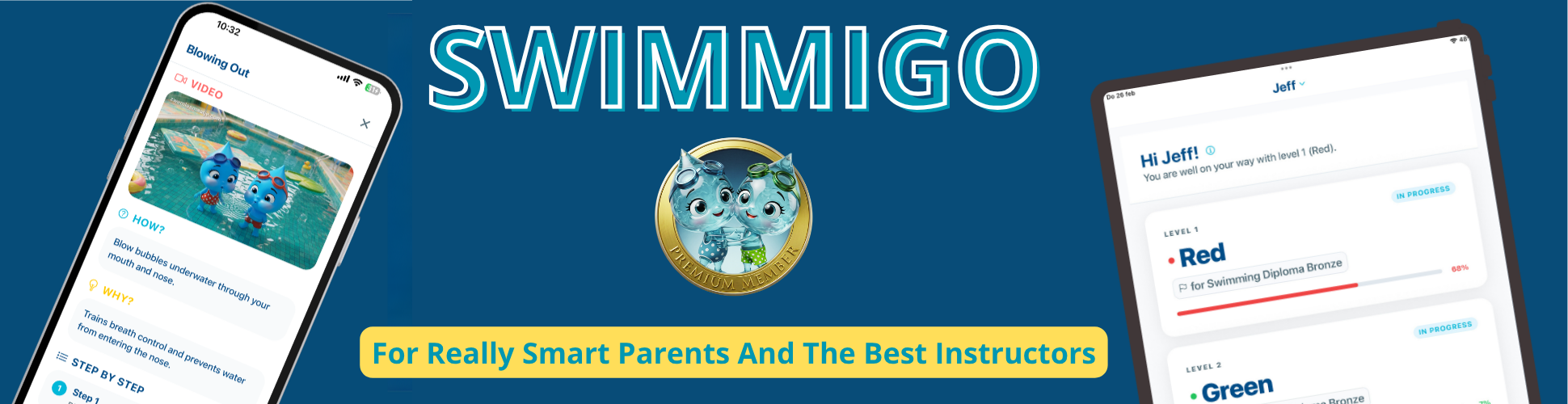
Swimmigo works with 7 levels and 86 skills, from Red (water familiarization) to Gold (fully proficient swimmer). Each level builds on the previous one. But from when can your child safely join you at a recreational lake? Let’s go through the levels.
Level Red (10 skills), Water Familiarization
At this level, your child learns to become comfortable with water: blowing bubbles, daring to put their face underwater, floating with assistance. The focus is on water familiarization and basic safety. Not suitable for open water. Your child has no self-reliance yet and requires constant direct supervision, even in a shallow toddler pool.
Level Green (12 skills), Floating and Endurance
Your child learns to float independently on their stomach and back and swims the first meters without aids. Basic safety increases, but endurance is minimal. Still not suitable for open water. In a lake or river, longer distances, currents, and cold quickly become too much for this level.
Level Blue (14 skills), Developing Stroke Technique
Breaststroke and backstroke really start to develop now. Your child learns controlled breathing while swimming and covers longer distances. Confidence grows, and that is exactly the danger. Not yet ready for open water. Children at this level often overestimate their abilities. The transition from a heated, clear swimming pool to cold, murky open water is huge.
Level Yellow (12 skills), Refining Technique
Strokes become more efficient and endurance increases. Your child learns to do turns, orient underwater, and swim longer distances. Only under strict supervision and in designated shallow zones. Unexpected situations (cold, currents, depth) in open water can still be too much.
Level Bronze (5 skills), The Turning Point
This is the first official diploma level. Your child swims longer distances with breaststroke and backstroke, can orient underwater, and has learned what to do in unexpected situations. The safety skills are serious: your child knows how to float in clothing, how to safely exit the water, and how to call for help. Suitable for designated swimming zones in recreational lakes, provided under supervision of an adult who can swim well themselves. But note: the Bronze diploma is designed for pools, not for open water with currents, cold, and sudden depth.
Level Silver (6 skills), Ready for Most Situations
Your child now masters three strokes (breaststroke, backstroke, freestyle), can swim longer distances, and is trained in safety situations such as underwater orientation and swimming with clothing. Endurance is significantly greater. Ready for recreational lakes and the sea at the coast. But even now: swim only at designated locations, never alone, and stay away from rivers with strong currents.
Level Gold (7 skills), Swim Safe in Open Water
The highest level. Your child swims all strokes technically well, covers long distances (distance swimming is a core part of Gold), and has proven they can save themselves in various conditions. The 13 skills of Gold also include snorkeling, survival, and advanced self-rescue. This is the level at which your child is truly prepared for open water, including rivers and lakes. But Gold is no free pass: common sense, swimming together, and staying only at safe locations remain the most important rules.
Why a Diploma Alone Is Not Enough
You might think: my child has their A diploma, so they are safe. Unfortunately, it’s more nuanced.
The Treacherous Power of Open Water
A recreational lake is fundamentally different from a swimming pool. The water is colder, even on a tropical day the temperature below the surface can be shockingly low. There is no clear view of the bottom. Currents, sudden depth changes, and aquatic plants make the situation unpredictable. The CBS report for 2021-2025 shows that 54 percent of drownings occurred in ditches, rivers, canals, or canals, and 16 percent in ponds or lakes.
Overestimating Oneself: The Biggest Danger
The three 17-year-old boys standing by the police tape at the Strijkviertelplas said it well: "We have our swimming diplomas and we watch out for each other." But diplomas do not protect against cold shock, sudden cramps, or underestimating distance. The National Council for Swimming Safety emphasizes: "We must continue investing in education, awareness, and swimming skills, even after obtaining a swimming diploma."
What Makes Newcomers Especially Vulnerable
Only 37 percent of Syrian children in the Netherlands can swim. Children of non-European migrants born in the Netherlands also have a higher chance of drowning. The reasons are diverse: less familiarity with Dutch swimming culture, underestimating dangers, financial barriers to swimming lessons, and as the GGD writes in a guideline, "less knowledge about the importance of swimming skills and the risks of water." The COA now provides information in 10 languages and organizes free swimming lessons where possible. But the path to swimming safety is long.
How Parents Can Keep a Finger on the Pulse
Swimmigo is available in five languages (Dutch, English, German, French, and Spanish) and is used worldwide by swimming schools and parents. Whether you live in Amsterdam, Berlin, or Barcelona: the 7 levels and 86 skills are universally applicable. The safety principles (water familiarization, floating, endurance, self-rescue) apply in any water, in any country.
The most important thing you can do is to know exactly where your child stands. Not based on a feeling ("she can swim"), but based on concrete skills.
Real-time Insight: See What Your Child Can Do Per Exercise
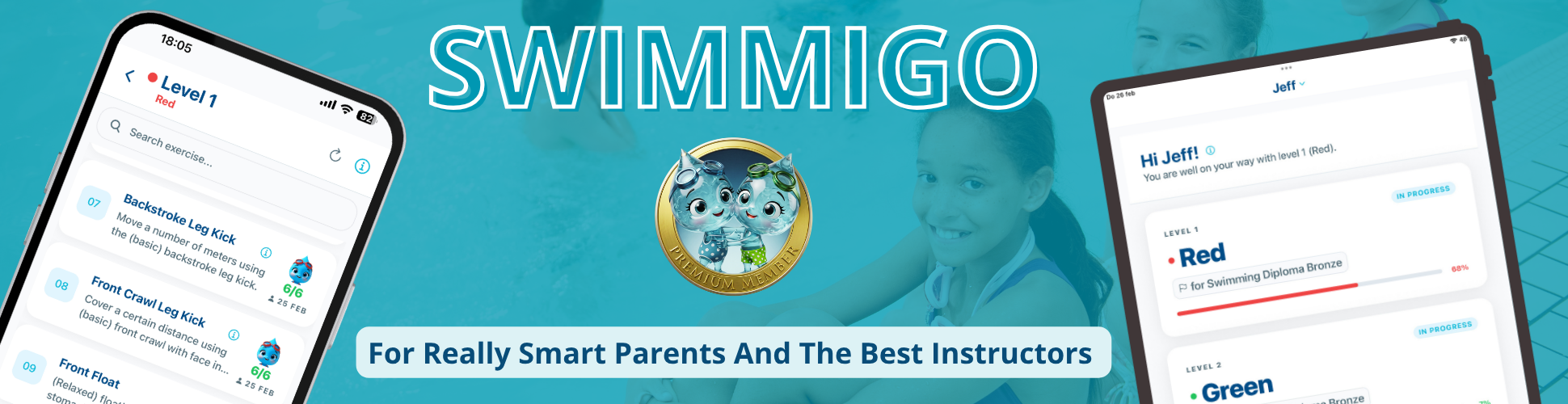
Swimmigo gives parents real-time insight into their child’s progress. Each exercise is tracked with a scoring system from 0 to 6. You see at a glance: which strokes does my child master, how is the endurance, and crucial for open water, how do they score on safety skills such as swimming with clothing and self-rescue?
Push Notifications: Never Be Surprised Again
As soon as your child advances a level, you receive a push notification. So you know exactly when your child moves from Yellow to Bronze, the first moment when open water under supervision is responsible.
Holiday Mode: Practice During Summer
Going on holiday and want your child to keep practicing? With Swimmigo’s holiday mode, you check off exercises yourself, so you continue making progress even during the summer weeks. And that is exactly the period when children most often enter open water.
Conclusion
The tragic drowning in the Strijkviertelplas reminds us that swimming safety is not a given, not for children, not for parents, not for newcomers. With 132 drownings in 2025, it is a structural problem that starts with awareness. Know at what level your child is and what that means for open water. Swimmigo gives you that insight, so you don’t have to guess if your child is ready, but can simply see it.
Sources
- CBS: 100 residents drowned in 2025, mostly 60-plus, May 2026
- NOS: Three swimmers died, including a 13-year-old boy, June 25, 2026
- RTV Utrecht: 13-year-old boy died in Strijkviertelplas, June 25, 2026
- WHO: Drowning fact sheet, 300,000 drownings worldwide per year
- National Council for Swimming Safety: CBS 132 drownings in 2025, May 13, 2026
- NOS: As every year, relatively many asylum seekers drown, August 2024
- GGD GHOR: Guideline swimming safety newcomers, Pharos & VeiligheidNL

Bob van Soest
As an expert in operating sports facilities (such as swimming pools) and developer of, among others, Swimmigo.com, I am passionately committed to making swimming lessons simpler, more fun and more insightful for parents, swimming instructors and everyone who wants to learn to swim.
Frequently Asked Questions
Related articles

Why Showering Before Swimming Lessons Is So Important
Why shower before swimming lessons? Discover why hygiene and preparation are crucial for the best swimming experience. Read our tips and avoid surprises!
When to Start Swimming Lessons for Optimal Progress
Read from which age swimming lessons are effective for the best results and safety of your child in the water.
Effectively Registering Swimming Lesson Progress from What Age?
Discover from what age you should best register swimming lesson progress and how to do this practically.
Discover Swimmigo
The all-in-one app for swimming lesson progress. For parents, swim schools, and adult swimmers.