What Really Happens During Your Child’s Swimming Lesson? How to Understand Progress Even When You’re Not at the Pool
Summary
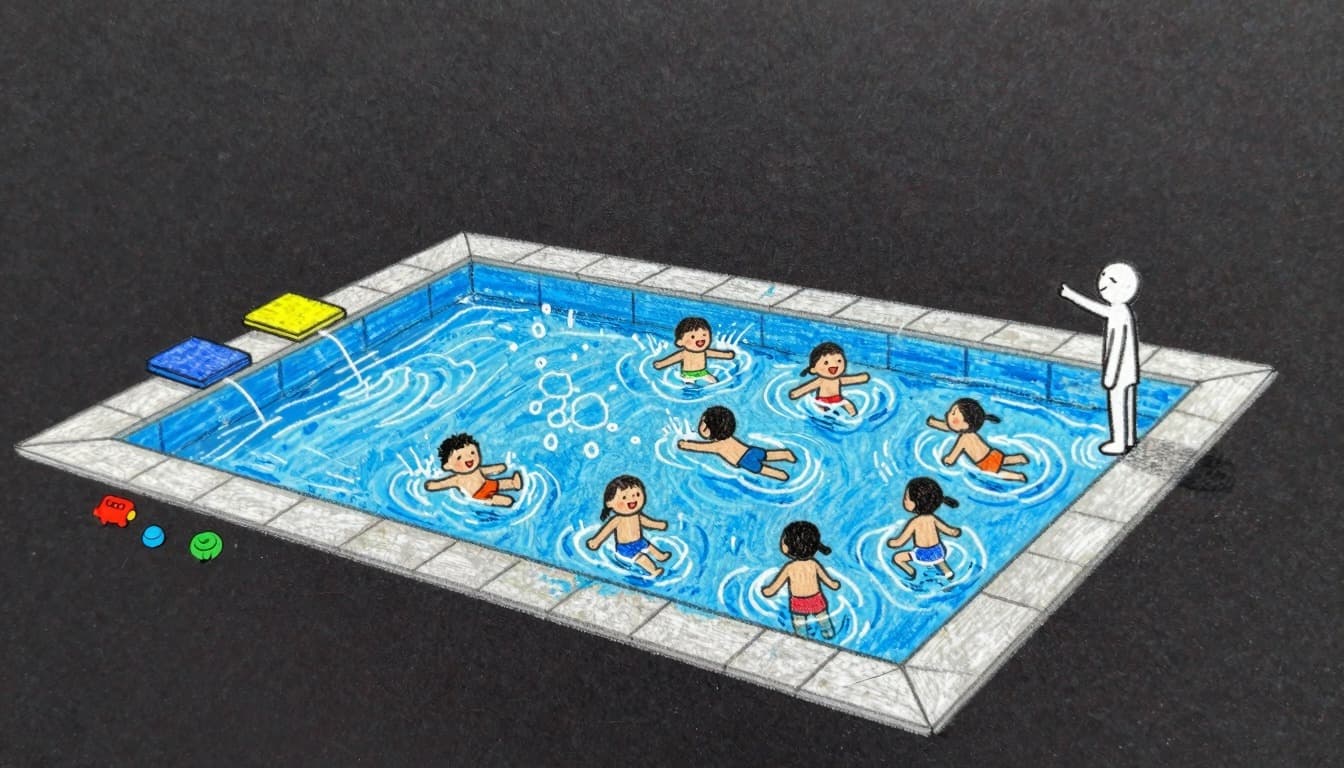
- Most parents see only a fraction of what happens during swimming lessons: a small viewing window, a waiting room without a view, or no chance to watch at all
- What you do see (or hear from the instructor) tells only half the story: behind every exercise is a goal within the swimming lesson journey
- Digital tracking systems like Swimmigo give you real-time insight into every practiced skill, with scores per level and push notifications for progress
- By understanding what your child learns and why, you can support effectively at home: bath time becomes practice, and swimming lessons become a shared journey instead of a black box
TLDR
Most parents see only a fraction of what happens during swimming lessons: a small viewing window, a waiting room without a view, or no chance to watch at all. What you do see, or what the instructor summarizes in thirty seconds afterward, tells only half the story. Behind every exercise is a goal within the swimming lesson journey, from getting used to water to mastering a full breaststroke. Digital tracking systems like Swimmigo give you real-time insight into every practiced skill, with scores per level and push notifications for progress. Even if you’re busy at work or with another child in the waiting room, you stay involved in your child’s swimming journey.
The Biggest Mystery on Wednesday Afternoon: What Is Your Child Doing in the Water?
You drop your child off at the pool, give a high five at the changing room door, and find a spot in the waiting area. Sometimes there’s a window with a view of the pool, sometimes not. If you’re lucky, you get a brief update from the instructor afterward: "It went well today, we practiced the leg kick." But what does that actually mean? Which leg kick? Is your child making progress or stuck at the same level? And why does it take weeks before a new skill is checked off?
For hundreds of thousands of parents worldwide, from Amsterdam to Auckland, their child’s swimming lesson is a black box. You trust the professionalism of the instructor but miss the full picture. According to the World Health Organization (WHO), over 300,000 people drown worldwide every year; swimming education literally saves lives. Yet most parents don’t know exactly which skills their child has mastered and which still need attention. That’s not only frustrating, it’s also a missed opportunity to support effectively at home.
We take you along to the pool: what really happens during a lesson, how to read the signs of progress, and how digital tools keep you involved even if you’re a hundred kilometers away at the office.
What Do You See as a Parent? The Limited View of Swimming Lessons
The Waiting Room: Viewing Window or Blind Wall?
The physical reality of most pools is simple: not every parent can follow the lesson. Older pools often have a small fogged-up window, modern pools want to keep changing rooms separate from the pool area, and at outdoor pools you’re often far away. In many countries, like the United States and the United Kingdom, it’s even policy that parents stay in a separate waiting room to avoid distracting the instructor and keep children focused.
Even if you do have a view, you only see part of the story. Your child is in a group of eight to twelve kids, the instructor moves around, and the water muffles the sound. You don’t hear the instructions given, nor see the specific corrections your child receives on their arm movement.
The Quick Debrief After the Lesson: Thirty-Second Summary
When the lesson ends, you usually have at most a minute to speak to the instructor. They need to move on to the next group and can’t give a detailed progress report for each child. The conversation usually stays superficial: "He’s doing well," "She still needs to practice floating," "Next week we’ll continue with breaststroke." This is well-intentioned but gives you as a parent too little guidance to support effectively at home.
A study by the Royal Dutch Swimming Federation (KNZB) on parental involvement in swimming lessons showed that parents who understand what their child is learning have significantly more confidence in the lesson process and practice more often at home with their child. The problem isn’t the instructor’s effort; it’s the lack of a structured communication channel between lesson and home.
What You Can Observe: The Five Signs of Progress
Even with limited visibility, there are signs attentive parents can pick up. These are the five main indicators that your child is making progress, regardless of swimming level:
1. Less hesitation when entering the water. A child who used to hesitate at the edge and now confidently steps into the water has made a big step in getting used to water. This is a universal sign: in every country, in every swimming system, comfortably entering the water is the first and most important milestone.
2. Longer periods of independent activity. Notice how long your child practices without physical support from the instructor. Was it seconds before and now minutes? That’s measurable progress in water self-reliance, a core skill emphasized by the WHO in its global drowning prevention guidelines.
3. Fewer tense movements. A relaxed swimmer uses less energy and floats better. If your child’s movements become smoother, less splashing, and more controlled, their muscle memory is developing.
4. Eye contact with the instructor. A child who understands and follows instructions seeks eye contact. If you see your child looking at the instructor before an exercise and then performing it independently, communication is effective.
5. Enjoyment in the water. This may be the most important indicator. A child who laughs, splashes for fun, and starts exercises with energy progresses faster. Swimming enjoyment is universal and says more about the learning process than many technical scores.
The Hidden Structure of a Swimming Lesson: What You Don’t See but Need to Know
Every Exercise Has a Purpose in the Bigger Picture
What looks like "just floating" to you is a targeted exercise on water position for the instructor. The child learns that water supports the body, that relaxation helps with floating, and that a slight spread of arms and legs provides stability. This is the foundation for every swimming stroke taught later.
At Swimmigo, every skill is broken down into 86 concrete exercises, divided over 7 levels: from Red (water familiarization) to Gold (fully swim-safe). Each level builds on the previous one. An exercise like "blowing bubbles underwater" at Red level is the precursor to "exhaling underwater during breaststroke" at Yellow level. Without that first step, the second won’t work.
This structured level system is designed to be universally applicable. Whether your child takes swimming lessons in the Netherlands, Germany, France, Spain, or an English-speaking country: the progression from water familiarization to full swim safety is recognizable, regardless of the local diploma system.
Group Size and Individual Attention: The Math Nobody Does
An average swimming lesson group has eight to twelve children. A lesson usually lasts 45 to 60 minutes. Divide that time by the number of children and you get a maximum of five minutes of individual attention per child, per lesson. In those five minutes, the instructor must observe, correct, encourage, and score multiple skills at once.
This explains why progress sometimes seems slow. It’s not that your child isn’t learning; it’s that the instructor simply doesn’t have enough time to thoroughly assess each child every lesson. A digital tracking system helps here: the instructor can enter a score with one swipe (0 to 6 smileys in Swimmigo), leaving more lesson time for the real work in the water.
Swimmigo · Swim lesson app
Free for parents
Follow your child's swimming progress, see where you stand and report absences in the app.

How Digital Tools Bridge the Gap Between Lesson and Home
From "It Went Well" to a Concrete Skills Overview
The biggest difference between a traditional swimming lesson and a digitally supported lesson is the quality of feedback to parents. Instead of a general "it went well," Swimmigo gives you a detailed overview of every practiced skill, with a score per exercise. At Green level, for example, you see that your child scores a 4 out of 6 for "floating on the stomach with aid," while "diving through a hoop underwater" is still at 2. This gives you concrete tools as a parent: this afternoon in the bath, practice blowing bubbles and looking underwater.
This insight is especially valuable for expat parents. They don’t always speak the local language fluently and often miss nuances in verbal feedback. An app available in five languages—Dutch, English, German, French, and Spanish—removes the language barrier. You see the same scores, skills, and progress in your own language.
Push Notifications as Modern Progress Reports
One of the most powerful features of digital swimming lesson tracking is the push notification. Instead of waiting months for the diploma moment, you get an immediate alert when your child moves up a level. "Emma has moved from Green to Blue! Check her progress." Such a notification in the middle of your workday is not only a proud moment but also a sign that the lesson path is on track.
Research by the RIVM on children’s sports participation in the Netherlands shows that parental involvement is the strongest predictor of continued sports participation at a young age. Children whose parents actively follow progress and encourage them at home quit sports significantly less often. Swimming lessons are no exception.
The Seven Levels of Swimmigo: From Spectator to Supporter
Swimmigo divides swimming lesson progress into seven recognizable levels, each with its own color and set of skills:
- Red: Water familiarization, getting used to water, splashing, blowing bubbles
- Green: Floating and moving, floating on stomach and back, covering short distances
- Blue: Basic swimming strokes, fundamentals of breaststroke and backstroke
- Yellow: Advanced technique, combining strokes, exhaling underwater
- Bronze: Endurance, longer distances, deeper water
- Silver: Self-reliance, swimming with clothes, getting to the edge
- Gold: Fully swim-safe, mastery of all skills, ready for open water
Each level consists of multiple concrete exercises scored by the instructor using the 0 to 6 smiley system. As a parent, you see exactly where your child stands, which exercises need extra attention, and when it’s time for the next level.
Supporting at Home: Turning Bath Time into Practice Time
The Bathtub as a Mini Pool
You don’t need a backyard pool to practice at home. The bathtub, shower, or an inflatable pool in summer are perfect practice spots for young swimmers:
- Blowing bubbles (Red): Let your child practice blowing air underwater in the bath. Make it a game: who can make the most bubbles?
- Getting the face wet (Red/Green): Help your child get used to water on their face. Use a watering can or a gentle shower spray.
- Floating on the back (Green): In a full bath, your child can practice leaning their head back. You support the head while your child experiences buoyancy.
- Dry arm movements practice (Blue/Yellow): On dry land, practice breaststroke arm movements. "Hands together, push the water away, hands back" becomes a fun ritual before bath time.
These exercises don’t take hours: five to ten minutes per bath session is enough. It’s about repetition and positive association, not intensive training. And because you know exactly which skill at which level needs attention thanks to the tracking system, the exercises are always relevant.
Celebrating Progress Together: From Sticker Charts to Digital Certificates
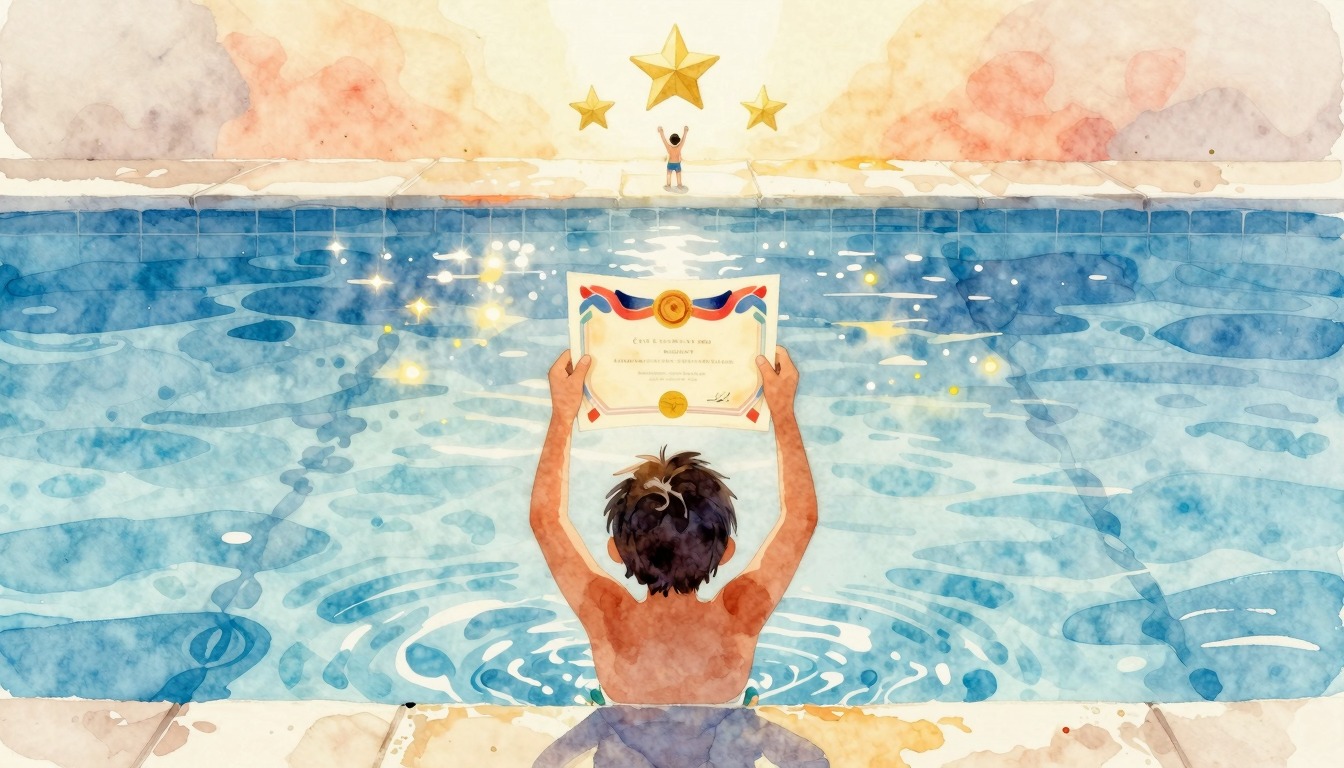
Children thrive on recognition. A physical diploma on the wall is nice, but between levels it can take a long time before there’s tangible proof of progress. Swimmigo fills this gap with a unique system: for each achieved level (Red through Yellow), you receive a free, personalized swimming certificate with your child’s name. For the highest levels (Bronze, Silver, Gold), you even get a real swimming diploma, complete with name, date, and level.
These digital certificates are immediately downloadable and printable. Hang them in the kitchen, stick them in a notebook, or send them to grandparents. Every milestone is celebrated, and every certificate motivates the next step.
What If Your Child Stalls at the Same Level?
The Three Most Common Causes of Stagnation
It’s frustrating to see your child stuck at the same level for weeks, sometimes months, while others move on. This is a universal phenomenon; every child faces their own challenges in every country and swimming school. Usually, there’s no reason to panic:
1. A specific skill is the bottleneck. In a structured system like Swimmigo, a child must master all skills of a level before moving on. If your child has checked off 8 of 10 exercises at Green level but is stuck on "floating independently on the back," that’s the only block. The good news: you know exactly what the block is and can practice targeted at home.
2. Group dynamics play a role. In a large group, each child gets limited individual attention. If your child needs a specific correction on the leg movement but the instructor doesn’t have time in that lesson, that skill remains open. A digital system helps the instructor prioritize: which children are most at risk of stagnation and who needs extra correction?
3. There is water fear or insecurity. This is the most underestimated cause of slow progress. A child afraid to put their head underwater can’t technically move to the next level, no matter how good the leg kick is. Water fear must be addressed separately, with patience and positive reinforcement. An app that celebrates every small step, from "1 second longer underwater" to "2 seconds," can make a difference.
When Should You Worry?
Stagnation is normal, but some signs require action. If your child hasn’t checked off any new skills after three months, goes reluctantly to lessons, or the instructor indicates an underlying issue (like motor delay), it’s time for a focused conversation. Use data from the tracking system as a discussion guide: "I see my child has been at score 2 for 'daring underwater' for eight weeks. What can we do together to improve this?"
International Swimming Lessons: Insights from Five Countries
Swimming education differs by country, but the core challenge for parents is the same everywhere: lack of insight into what happens during lessons. In Germany, swimming schools use the "Seepferdchen" system; in France, "Sauv'nage"; in Spain, "Familiarización" levels; and in English-speaking countries, "Learn to Swim" frameworks. Each system has its own terminology, but the progression from water familiarization to self-reliance is universal.
The team behind Swimmigo studied these international systems and translated them into one clear, 7-level model that works in five languages. Whether the instructor speaks French, German, or English, you as a parent see the same smileys, progress charts, and certificates in your own language. This is not only handy for expat families; it also makes Swimmigo usable for swimming schools serving international clients.
Swimmigo · Swim lesson app
Free for parents
Follow your child's swimming progress, see where you stand and report absences in the app.
Conclusion
Your child’s swimming lesson doesn’t have to be a black box. By understanding what happens in the water, which exercises come up when, and how to interpret progress, an hour in the waiting room becomes a meaningful part of the learning journey. Digital tools like Swimmigo make these insights accessible, even if you can’t be there: with real-time scores, push notifications at every milestone, and a complete overview of all 86 skills. The better you understand what your child is learning, the more you can contribute to their swimming enjoyment.
Want to know more? See how Swimmigo works on the parents page, discover the full functionality, or read about the 7-level system.
Frequently Asked Questions
How do I know if my child is making progress during swimming lessons if I can’t watch?
Watch for five signs: less hesitation entering the water, longer periods of independent practice, smoother movements (less splashing), eye contact with the instructor, and visible enjoyment in the water. A digital tracking system like Swimmigo complements this with concrete scores per exercise and push notifications for level increases—you see progress in numbers, not just impressions.
Why does it take so long for my child to reach a new level?
Each level consists of multiple skills that all must be checked off. Often, one specific skill is the bottleneck, such as floating independently on the back or daring to go underwater. Check in the tracking system which exercise has the lowest score—that’s the block. Ask the instructor for tips and practice targeted at home, for example in the bath.
What is the advantage of Swimmigo compared to a paper swimming card?
Swimmigo offers real-time insight: scores are entered immediately after the lesson and are instantly visible to parents. It works in five languages (Dutch, English, German, French, and Spanish), so expat parents understand progress in their own language. Additionally, Swimmigo automatically generates personalized certificates and diplomas and sends push notifications at every milestone. A paper card in a plastic sleeve can’t do that.
My child is afraid of water. Can I still follow their progress?
Definitely. Swimmigo also records small steps: one second longer underwater, floating independently once, getting the face wet for the first time. This micro-progress is especially important for anxious children. The 0 to 6 smiley system makes every improvement visible, no matter how small. For you as a parent, it’s reassuring to see the fear slowly decrease and scores rise.

Bob van Soest
As an expert in operating sports facilities (such as swimming pools) and developer of, among others, Swimmigo.com, I am passionately committed to making swimming lessons simpler, more fun and more insightful for parents, swimming instructors and everyone who wants to learn to swim.
Frequently Asked Questions
Related articles
When to Start Swimming Lessons for Optimal Progress
Read from which age swimming lessons are effective for the best results and safety of your child in the water.
Effectively Registering Swimming Lesson Progress from What Age?
Discover from what age it is best to register swimming lesson progress and how to approach it practically.

Efficiently Registering Swimming Lesson Progress per Group
Practical tips for tracking swimming lesson progress per group for parents and instructors.
Discover Swimmigo
The all-in-one app for swimming lesson progress. For parents, swim schools, and adult swimmers.