TwoChildreninSwimmingLessons:HowtoKeepTrackofLevels,Scheduling,andCosts[2026]
![Two Children in Swimming Lessons: How to Keep Track of Levels, Scheduling, and Costs [2026]](/_next/image?url=https%3A%2F%2Fzvblogpostimages.s3.eu-west-3.amazonaws.com%2FAUTOMATISCH_UPLOAD%2F1_420aa133ddb3.jpg&w=3840&q=75&dpl=dpl_GWyfLj8UVegbQ18STkVQms8Vj7LD)
Summary
- Lesson fees are per child, so two children cost roughly double. The median lesson rate below is €15 per lesson.
- Waiting times for a first swimming lesson in 2024 reached up to 24 months in some provincial capitals, which is why parents register their second child earlier.
- Siblings do not automatically end up in the same group: schools group by swimming level and availability, and this can change during the course.
- The second child does not automatically learn to swim faster. Research found no correlation between an older sibling’s skills and the younger child’s motor development.
- The overview gets lost on details: which exercise each child has mastered. A separate profile per child solves this.
Registering the second child while the first is still in the middle of the process: that’s the moment when a family’s swimming lesson administration doubles. Two lesson times in the calendar, two updates arriving at different times, and two children each with their own story after a lesson.
Lesson fees are charged per child, so monthly expenses nearly double. What parents lose track of more often than the money is the overview per child: who is at which level, which skill is still pending, and which lesson was canceled and not yet made up.
What changes once the second child starts
With the first child, you get to know the system: how a waiting list works, what a level promotion means, where to stand during the swim test. With the second child, you have that advantage, but the administration doesn’t get any smaller.
Waiting times determine when you start
Kassa conducted a 2024 sample among fifty providers in provincial capitals. In The Hague, Utrecht, and Middelburg, the waiting time reached up to 24 months. Haarlem and 's-Hertogenbosch had 18 months, Groningen and Leeuwarden 12 months, and in Maastricht four months was enough. According to the National Council for Swimming Safety, this is mainly due to the shortage of swimming instructors.
Parents who have experienced this often register their second child much earlier. In practice, registrations come in around toddler age for lessons that start years later. Ask your swimming school how the waiting list works and how they handle siblings, as this differs per provider.
Two children, two levels
Children rarely progress at the same pace. One child may spend months on water familiarization, while another picks up a new stroke in a few lessons. The number of lessons needed also varies per school. Sport050 in Groningen estimates 56 lessons of 45 minutes for an average six-year-old to achieve the A diploma, which takes about one and a half years in practice. Trifora in Enschede mentions 55 to 65 lessons for the same diploma.
Calculate per child, not per family. A second child starting at the same school can easily begin two levels below or above their sibling. For scheduling, this usually means two different lesson times and therefore more trips to the pool.
What parents forget more often than they think
You remember a level promotion. But you don’t remember which exercises your child has mastered and which not, especially with two children. That’s where the overview gets lost. Parents say at home that things are going well but don’t know if it concerns floating on the back, water kicking, or a specific arm stroke. With a second child, that information fades faster because one child’s story overwrites the other’s.
What does swimming lessons cost for two children?
Rates vary widely depending on whether you attend a municipal pool, a commercial swimming school, or a club. The way fees are calculated also differs: per lesson, per four weeks, or as a package price until the diploma.
Rates and monthly costs side by side
| Provider | Rate per lesson | One-time costs | Per month for once a week |
|---|---|---|---|
| Utrecht pools, municipal | €11.15 weekdays, €12.60 on Saturday, and €13.95 on Sunday, for 45 minutes | €12.80 registration fee and €2.50 for the lesson pass | €45 to €56 |
| Trifora, Enschede | €15, or €60 per four weeks, for 45 minutes | €40 administration fee and €30 diploma costs | €60 |
| Silvester Swimming School | €28.25, for 30 to 45 minutes | €25 registration fee and €60 for exam and diploma | average €113 |
| Fifty providers from Kassa’s 2024 sample | not published per lesson | varies per provider | for some more than €100 |
The median of the three lesson rates in this table is €15 per lesson. For two children, a family would pay about €120 per month, and with the more expensive providers €226 or more.
What you spend until the A diploma
| Situation | Cost indication |
|---|---|
| One child to A diploma at Trifora | €895 to €1,045, based on 55 to 65 lessons of €15 plus €40 administration and €30 diploma costs |
| Two children at the same school | roughly double, so €1,790 to €2,090, unless there is a family agreement |
These amounts are for one child. Two children following the same path cost roughly double, unless your school has a family arrangement. Always ask about this, even if it’s not on the website.
Arrangements you may be entitled to
Swimming lessons are not affordable for every family, and this is reflected in the numbers. In 2024, 14 percent of children aged 6 to 12 had no swimming diploma at all. In the lowest income group, this was 33 percent, compared to 5 percent in the highest group.
Worldwide, drowning is the third leading cause of death from unintentional injury, with an estimated 236,000 deaths per year, and children under 15 account for nearly half of that burden (WHO, drowning fact sheet). Swimming skills matter everywhere, even where regulations and diploma systems differ by country.
What you can apply for varies by municipality. Stichting Leergeld supports low-income families, including for swimming lessons. In Utrecht, children aged 5 to 17 without an A diploma and without school swimming can swim for free with a U-pass. Many municipalities also have their own schemes or funds, but amounts and conditions differ per city. Check with your own municipality instead of relying on what parents from another place say.
Registering together can save registration fees
Some providers have agreements for children starting together. In a 2026 Optisport promotion, both children waived the registration fee if they signed up together with a promo code. Lesson fees remain per child, so the benefit is in the one-time costs. Ask your school if there is a family arrangement before making two separate registrations.
Same group or not?
Benefits of starting together
A familiar face next to your child makes the first lessons calmer. Children starting together are less tense and have more fun, which is exactly the argument providers use to promote such duo registrations. For you, it saves time: one moment, one trip, one conversation with the instructor.
Why schools still group children by level
Providers rarely promise siblings will stay in the same group. Optisport states explicitly: group placement depends on availability and each child’s swimming level, and children may be placed in different groups during the course so each child receives lessons at the appropriate level. This is not unwillingness. A child stuck on water kicking holds up a group if not given their own lesson, and a faster child gets bored with exercises they already master.
What to agree on with the swimming school beforehand
Before the first lesson, ask three questions. Do siblings generally stay together? What happens if their levels diverge? And how will you be informed if the group or lesson time changes? Record the answers in a message so you don’t have to reconstruct them later from what your child said.

Comparing brother and sister: what helps and what doesn’t
What research says about siblings in sports
The bond between siblings is one of the strongest influences on how children engage with sports. Researchers from the University of Central Lancashire and the University of Edinburgh describe siblings as role models, practice partners, and sometimes rivals, concluding that this bond can either accelerate learning or hinder it. Which it is depends on the atmosphere between the children.
The second child does not automatically learn to swim faster
The assumption that a younger child automatically benefits from an older sibling who already swims does not hold up in research. Leonard and Hill followed 23 toddlers with an older sibling for eighteen months in the Journal of Experimental Child Psychology (2016). The motor skills, age, and gender of the older sibling were not correlated with the younger child’s motor development. Their conclusion: the idea that older siblings are good models for motor skills is not supported by the data.
What to take from this for swimming lessons: don’t assume your second child will progress faster because they have seen the first swim. There could just as well be a year’s difference. So don’t plan a swim test date for two children at the same time.
How to talk about differences without comparing
Talk about the skill, not the position. "You can now kick for three counts, before it was one" works better than "your sister could already do this last year." Children who only measure themselves against their sibling develop resistance faster, and that resistance costs more lesson time than comparing ever gains. Schedule four separate swim test moments and let the child who is not as far choose a moment to show something new.
Overview per child
Each child has their own level and exercises
Swimming lessons are structured into levels with a series of exercises per level. At Swimmigo, there are seven levels ranging from water familiarization to the Bronze, Silver, and Gold diplomas, with a total of 86 exercises. An exercise is considered mastered after six successful repetitions, and that is exactly the information that differs per child. Where one child swims through the first lesson, another needs more than six attempts for water kicking without assistance.
The exercise you forget
Parents remember the big picture: is it going well or not. The details disappear, and those details are exactly what you need if you want to practice at home. With two children in the pool, this effect is stronger because after each lesson you get two stories to process and only one sticks.
What an app shows per child
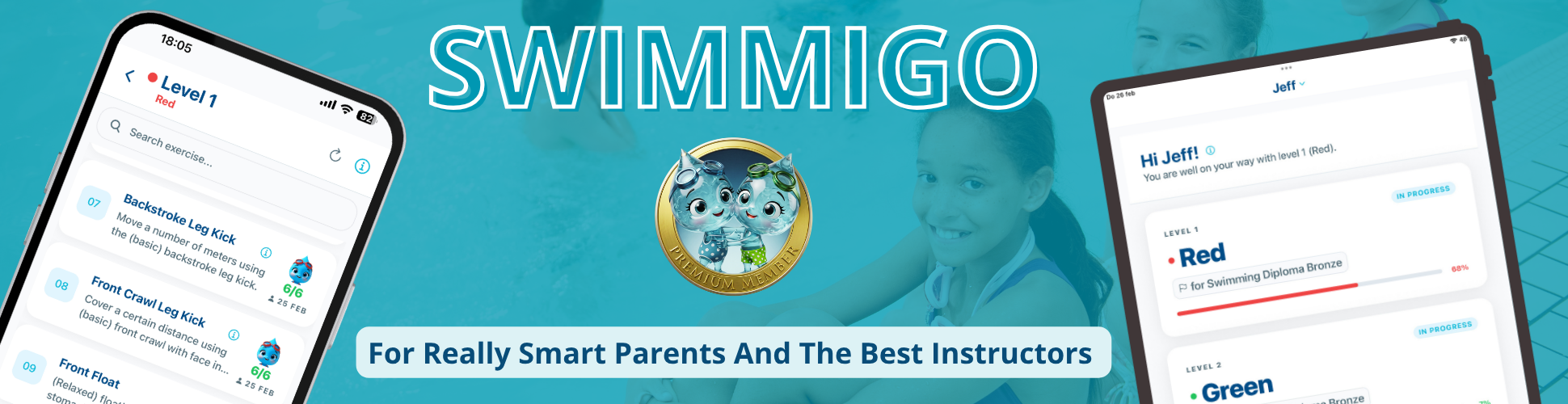
Swimmigo works with a separate profile per child. You add them to your own account, choose which child to view when opening, and see per level which exercises have been completed and which are still open. Notifications come in per child: a level promotion, a changed lesson time, a cancellation that has been processed. This way you don’t have to remember which message belonged to whom. The app is available in five languages, which matters if you speak a different language at home than at the swimming school, or if your family lives in another country and arranges swimming lessons there.
Swimmigo is a platform to track progress and inform parents. It is not an assessment: the app does not check if a child is swimming proficiently and does not issue official diplomas. The evaluation remains with the instructor, and the National Council for Swimming Safety diplomas are only issued by license holders.
Scheduling that works for a family
Combining or spreading lesson times
Two children in the water at the same time is the most efficient solution and at the same time the least flexible. You have one trip and one waiting moment, but you depend on what the school can combine. Spread lesson times give more choice in groups and levels, at the cost of two trips. Many pools have wide enough blocks to shift something, like Sport050 in Groningen where lessons are given six days a week between the end of the school day and early evening. Ask for the full blocks instead of just one lesson time, so you immediately see what can be combined.
Who drops off and who picks up
With two lesson times, drop-off and pick-up quickly become a scheduling task in itself. Agree with your partner or other parents who does which lesson, and record it somewhere everyone can see. Those who swap with another family should confirm the arrangement per lesson, because in the week something goes wrong it’s always the lesson everyone thought the other would do.
Sick, canceling, and making up lessons
With two children, the chance is greater that one is sick on the day they both have lessons, often the same day. Cancel as soon as you know, because schools set conditions. At Silvester Swimming School, you may make up two lessons per semester for free if you notify in advance that your child will be absent. Sport050 offers a free practice half-hour for children working towards a diploma, where a parent may enter free of charge. In the Swimmigo app, you cancel per child and see which make-up moment belongs to it, so one child’s lesson doesn’t disappear in the other’s cancellation.
For swimming schools: plan families as a whole
Siblings together in the schedule
Families with two or three children in the same pool require a different view of your scheduling. Always ask at registration if there are brothers or sisters and note them together. Placing a family in one block saves parents an extra trip, and that is one reason families stay with a school. If the same group is not possible due to level differences, at least place them in consecutive blocks.
Progress per child, not per family
A family unit in scheduling does not mean you treat progress as a family. Each child has their own level, exercises, and pace, and that difference is why parents lose track. Note progress per child and ensure a substitute or new instructor sees the notes per child, not one summary per family. Especially with siblings in different groups, passing on information per child is the difference between continuing at the right point or starting over.
Communicating with parents who have two children
Send messages per child. A parent with two children in lessons otherwise receives a series of messages that are unclear about who they belong to. Link the update to the child instead of the account, use the child’s name in the text, and stick to one channel. Parents who find their messages and notifications in one place ask fewer questions, saving time for reception and instructors. Swimmigo does this per child, with messages parents can read and notifications that automatically appear in the parent’s language.
Conclusion
Once two children are in the water, costs, lesson times, and the number of appointments you must remember double. Lesson fees are per child and waiting times determine when you start, so calculate per child, not per family. What you control yourself is the overview: knowing per child which level they are at, which exercise is still open, and which lesson was canceled.
Keep comparisons between siblings out of the pool. Children follow their own pace, water safety is what ultimately counts, and that applies in every water, in every country.
Discover also
- Complete overview of tracking swimming lesson progress: for parents and swimming schools
- How long do swimming lessons really take? Realistic timeline for the A diploma
- Complete overview of swimming lesson costs: what swimming lessons cost in 2026
- Fitting swimming lessons into a busy family life: tips for working parents
- Swimmigo for parents, for swimming schools and all app features
Sources
- Kassa (BNNVARA): Large differences in waiting times for swimming lessons, shortage of instructors, February 2024
- Mulier Institute: More children have A, B, and C diplomas, swimming skills of vulnerable children lag behind, 2024 data
- CBS: Higher risk of drowning among children not born in the Netherlands, July 2026
- WHO: Drowning, fact sheet, accessed September 2026
- Utrecht pools: swimming lesson prices for children, 2026 rates
- Trifora: What does swimming cost? Costs per lesson and until the swimming diploma, September 2026
- Silvester Swimming School: prices and make-up lessons, rates as of September 2026
- Sport050 Kardinge: children’s swimming lessons, lessons and times, rates valid until July 2027
- Optisport: Zed & Sop Swimming Buddies, joint registration and group placement, 2026 promotion
- Stichting Leergeld: support for low-income families, accessed September 2026
- Leonard & Hill: The role of older siblings in infant motor development, Journal of Experimental Child Psychology, 2016
- Taylor, Collins & Carson: The Role of Siblings in Talent Development, Frontiers in Sports and Active Living, 2021
Bob van Soest
As an expert in operating sports facilities (such as swimming pools) and developer of, among others, Swimmigo.com, I am passionately committed to making swimming lessons simpler, more fun and more insightful for parents, swimming instructors and everyone who wants to learn to swim.
Frequently Asked Questions
Related articles

Why Showering Before Swimming Lessons Is So Important
Why shower before swimming lessons? Discover why hygiene and preparation are crucial for the best swimming experience. Read our tips and avoid surprises!
When to Start Swimming Lessons for Optimal Progress
Read from which age swimming lessons are effective for the best results and safety of your child in the water.
Effectively Registering Swimming Lesson Progress from What Age?
Discover from what age you should best register swimming lesson progress and how to do this practically.
Discover Swimmigo
The all-in-one app for swimming lesson progress. For parents, swim schools, and adult swimmers.