8SignsYourChildIsGettingGoodSwimmingLessons:WhattoWatchforasaParentfromtheStands[2026]
![8 Signs Your Child Is Getting Good Swimming Lessons: What to Watch for as a Parent from the Stands [2026]](/_next/image?url=https%3A%2F%2Fzvblogpostimages.s3.eu-west-3.amazonaws.com%2FAUTOMATISCH_UPLOAD%2F1_b2df131c36d4.jpg&w=3840&q=75&dpl=dpl_GWyfLj8UVegbQ18STkVQms8Vj7LD)
Summary
- You recognize good swimming lessons not by how fast your child earns a diploma, but by what you see happening during the lesson: the structure, interaction, and water fun
- Watch for the warm-up, individual attention per child, variety in exercises, and whether the instructor also explains why a movement should be done a certain way
- A lesson without laughing children is a warning sign: water fun is not a side issue but the engine of every learning process in the water
- Swimmigo gives you insight after each lesson into what your child has truly learned, so you don’t have to guess from the stands
What You Don’t See from the Stands
You’re sitting on a wooden bench behind glass, your child’s swimming lesson is underway. You see splashing arms, an instructor shouting instructions, and occasionally a child excitedly showing something. But is your child really getting good swimming lessons? Or is he just swimming laps while the instructor is busy with something else? For most parents, this is a black box. You trust it’s going well because, well, the swim school has a license and your neighbor was satisfied. But you can’t be sure.
Still, there are concrete signs that indicate good swimming lessons. It’s not about how quickly the diploma is earned; fast certification sometimes says more about a school rushing through the material than about truly becoming swim-safe. It’s about what you see happening in the water, the interaction between instructor and child, and the structure of the lesson. Here are the 8 most important signs.
Sign 1: The Lesson Starts with a Real Warm-Up
What to Look For?
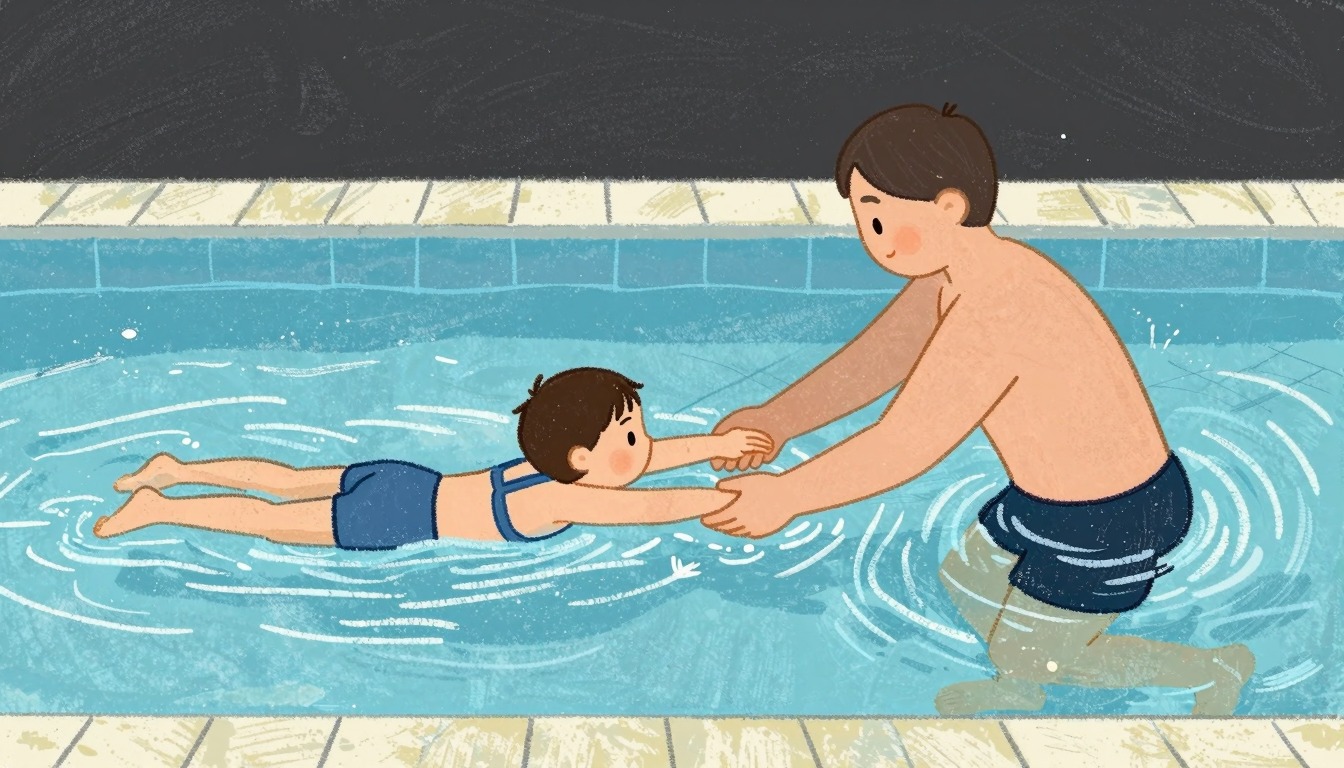
Children who jump straight into the water and immediately have to swim laps miss a crucial first step. A good swimming lesson starts with a warm-up of three to five minutes: splashing, floating, blowing bubbles, a short game. This is not a waste of time but essential preparation. Muscles warm up, breathing gets going, and children mentally switch from the school desk to the water.
The NRZ explicitly recommends a structured build-up in its teaching method with warm-up, core, and closure. Schools that skip this phase cut into the quality of the rest of the lesson.
What You See in a Mediocre Lesson
Children go straight into the water, the instructor shouts "lap breaststroke" and the lesson has started. No build-up, no transition, no game.
Sign 2: The Instructor Gives Each Child Personal Attention
What to Look For?
Count how often the instructor stops by your child. A good instructor actively moves through the group, gives each child at least two to three times per lesson personal feedback, and knows what each child learned the previous week. This is intensive but essential: swimming lessons are not group lessons in the sense of "everyone at the same pace," each child learns in their own way.
With a group of twelve children in a 45-minute lesson, this means about three to four minutes of individual attention per child per lesson. That sounds little but is enough if it is focused and qualitative.
What You See in a Mediocre Lesson
The instructor stands on the side, shouts general instructions to the whole group, and only corrects when something goes wrong. Three children hang still at the side, but no one intervenes.
Sign 3: Exercises Are Not Only Demonstrated but Also Explained
What to Look For?
A strong instructor demonstrates a movement and explains why it should be done a certain way. "Look, your arm goes forward like this because then you have less resistance in the water. Do you feel the difference?" Children who understand what they are doing learn faster and remember longer. This requires didactic skill beyond "just copy me."
With younger children, the explanation can be playful: "Your hand is a spoon scooping soup!" But the principle remains: demonstrate and explain, not just command.
What You See in a Mediocre Lesson
The instructor swims a lap, says "this is how it should be," and the children imitate without any context. Mistakes are corrected with "no, the other way around" without explanation.
Sign 4: There Is Variety in Exercises and Materials
What to Look For?
A lesson consisting only of swimming laps is not a good lesson. Children learn to swim through variety: floating on the back, diving through a hoop, retrieving an object from the bottom, practicing with a kickboard, treading water, blowing bubbles underwater. Each of these exercises trains a different skill and keeps the lesson fun.
Also look at the use of materials: kickboards, float sticks, dive rings, hoops, balls. An instructor who uses the same aid throughout the lesson misses opportunities to engage different muscle groups and skills.
What You See in a Mediocre Lesson
The whole lesson is "swim back and forth." No materials, no variety, no fun. After ten minutes, the first children are bored hanging at the side.
Sign 5: Children Laugh and Show Visible Enjoyment
What to Look For?
This sounds obvious but is one of the most underestimated quality indicators. Scientific research shows children learn significantly faster in a positive, playful environment. Fear and tension literally stiffen the body: tense shoulders and stiff legs make the correct swimming movements physically impossible.
Don’t just look at your own child; children can have a bad day, but look at the atmosphere in the whole group. Is there laughter? Is enthusiasm heard? Are successes celebrated with a high five or encouragement? A lesson in which no child has fun demonstrably yields less learning outcome, regardless of the instructor’s technical quality.
What You See in a Mediocre Lesson
Tense faces, anxious looks, children waving to you hoping the lesson is over. The instructor is strict but not encouraging.
Sign 6: Every Child Is Active and Moving
What to Look For?
Waiting time is the biggest enemy of swimming lesson progress. In a group of twelve children swimming one lap at a time while the rest wait on the side, each child is passive for eleven of the twelve minutes. That means a child in a 45-minute lesson is effectively active for only four minutes. That is dramatically little.
A good instructor organizes the lesson so multiple children are active simultaneously. Two groups: one half practices leg movements with a kickboard, the other half works on arm movements with the instructor. Or a circuit format where children rotate through different exercise stations. The key is that no one stands still longer than a minute.
What You See in a Mediocre Lesson
A line of children on the side, one child in the water, the instructor watches. The rest shiver or push each other into the water for fun to fight boredom.
Sign 7: The Lesson Structure Is Recognizably Organized
What to Look For?
A good swimming lesson has a clear structure that is recognizable every week. Warm-up, technique, practice, game, closure. Children thrive on predictability: they know what’s coming, feel safe, and can focus their energy on learning instead of wondering "what will happen now?"
The best instructors have a fixed routine that allows for variation within the framework. Parents who come to watch for several weeks in a row quickly recognize the pattern. If every lesson is completely different, or exactly the same every time, that is a warning sign.
What You See in a Mediocre Lesson
The lesson starts chaotically, there is no clear beginning or end, children ask "what are we going to do?" and the instructor seems to improvise on the spot.
Sign 8: The Instructor Communicates with You as a Parent
What to Look For?
A professional instructor takes time at the end of the lesson for a short feedback. Not every week with every parent, that’s practically impossible, but regularly and certainly at important moments such as a level increase or stagnation. This communication doesn’t always have to be verbal: an app like Swimmigo where you can see after each lesson which skills your child practiced and how they scored is just as valuable.
The point is that you as a parent are not left in the dark. Good swimming lessons don’t end with the last lap: they end only when you know what was learned, what the next goal is, and how you can help at home.
What You See in a Mediocre Lesson
The lesson is over, children climb out of the water, parents pick up their child, and not a word is spoken about what happened today. The instructor is already busy with the next group.
What These Signs Don’t Tell You
Diploma Speed Is Not a Quality Guarantee
A child who earns their A diploma in six months hasn’t necessarily had better lessons than a child who takes a year. Fast certification can mean the instructor is excellent, but also that the material is rushed without skills really sticking. Conversely, a slow path can indicate an instructor who is too cautious, but also a child who simply needs more time for fine motor skills in the water.
The NRZ sets minimum requirements for each diploma program but does not specify a maximum duration. The speed at which a child progresses says more about the child than about the lesson quality.
A Full Stand Means Nothing
Some swim schools have long waiting lists, others don’t. That says something about demand in the region, not about lesson quality. The most popular swim school in town is not automatically the best: sometimes it’s just the only one nearby.
And What If You Can’t Be at the Lesson?
Not Every Parent Can Sit in the Stands Every Week
Work, other children, traffic jams: there are plenty of reasons why you can’t follow every swimming lesson from the stands. In fact, most parents see their child maybe once a month in the water. The rest of the time you depend on what your child tells you, and children are notoriously poor reporters of their own learning process. "We swam!" is usually the full report.
Swimmigo Makes the Stands Unnecessary
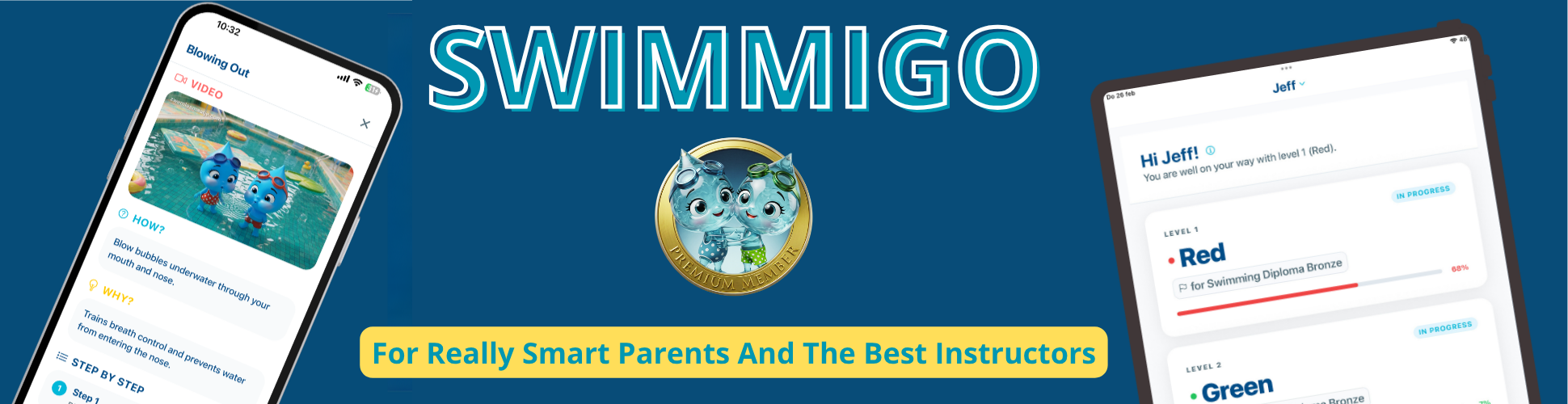
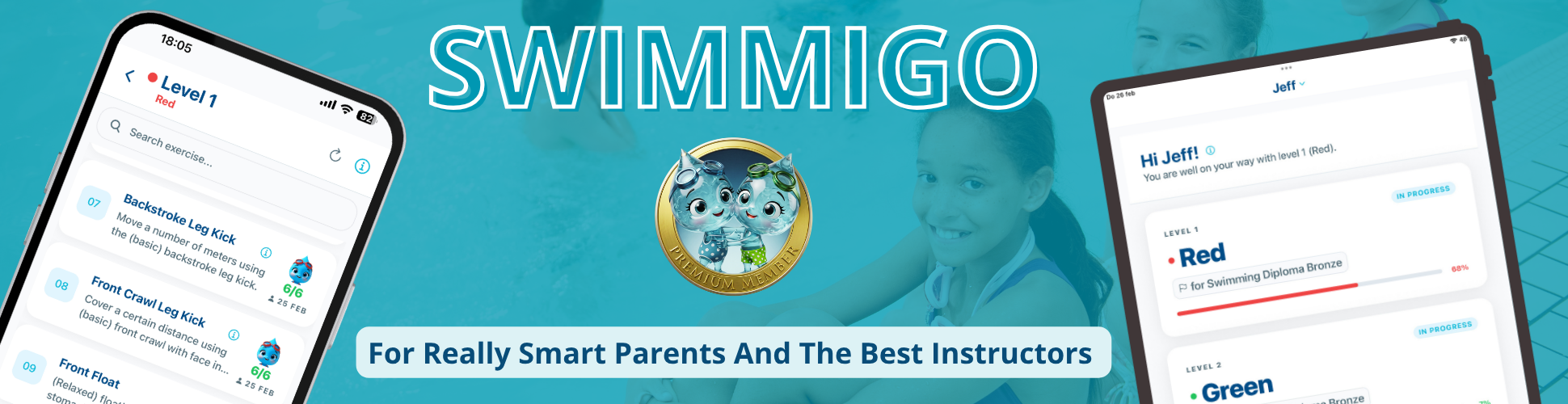
The Swimmigo app gives you insight after each lesson into exactly what your child practiced. You see the score per skill on a scale of 0 to 6 smileys, receive push notifications at level increases, and can always view the full progress dashboard. You don’t have to guess, rely on the memory of a seven-year-old, or take time off every week to sit in the stands.
For swim schools using Swimmigo, sign 8 applies automatically: parent communication is built into the system. The instructor enters scores, the parent sees them immediately. Transparency without extra work.
Conclusion
You don’t recognize good swimming lessons by diplomas on the wall or waiting lists at reception. You recognize it by what you see from the stands: a warm-up that prepares the body, an instructor who gives each child personal attention, exercises that are explained and not just demonstrated, variety in materials and methods, laughing children, minimal waiting time, a recognizable lesson structure, and an instructor who keeps you as a parent informed. Eight signs that together tell you if your child is in good hands. Can’t come watch every week? The Swimmigo app still shows you what’s happening under the water.
Discover how Swimmigo works for parents and swim schools.
Sources
- National Council for Swimming Safety: Swimming Lessons, Only the Best Is Good Enough for Your Child, 2024
- National Council for Swimming Safety: National Swimming Safety Standard, 2025
- Red Cross: An Unfortunate Dive in the Pool, Tips for Safe Swimming Fun, 2025
- World Health Organization: Drowning Fact Sheet, 2024

Bob van Soest
As an expert in operating sports facilities (such as swimming pools) and developer of, among others, Swimmigo.com, I am passionately committed to making swimming lessons simpler, more fun and more insightful for parents, swimming instructors and everyone who wants to learn to swim.
Frequently Asked Questions
Related articles
Why Showering Before Swimming Lessons Is So Important
Why shower before swimming lessons? Discover why hygiene and preparation are crucial for the best swimming experience. Read our tips and avoid surprises!
When to Start Swimming Lessons for Optimal Progress
Read from which age swimming lessons are effective for the best results and safety of your child in the water.
Effectively Registering Swimming Lesson Progress from What Age?
Discover from what age you should best register swimming lesson progress and how to do this practically.
Discover Swimmigo
The all-in-one app for swimming lesson progress. For parents, swim schools, and adult swimmers.