August 1, 2026 • Bob van Soest • 12 min read
LearningtoSwimThroughPlay:WhyFunandGamesAretheFastestPathtoaSwimmingDiploma[2026]
Learning to swim through play is scientifically more effective than drill-based lessons. Discover why play and fun lead to faster progress.
![Learning to Swim Through Play: Why Fun and Games Are the Fastest Path to a Swimming Diploma [2026]](/_next/image?url=https%3A%2F%2Fzvblogpostimages.s3.eu-west-3.amazonaws.com%2FAUTOMATISCH_UPLOAD%2F1_6a92220427d3.jpg&w=3840&q=75&dpl=dpl_GWyfLj8UVegbQ18STkVQms8Vj7LD)
Summary
- Learning through play is scientifically more effective than drill-based swimming lessons: children learn faster and retain better
- VU Amsterdam research (2025) shows that implicit learning through play leads to better swimming skills than traditional instruction
- Only 56% of children can still perform five basic skills 18 months after their diploma: the current approach falls short
- Play reduces stress (cortisol) in children, directly improving learning ability
- Swimmigo’s visual progress system makes learning through play transparent for parents, available worldwide in 5 languages
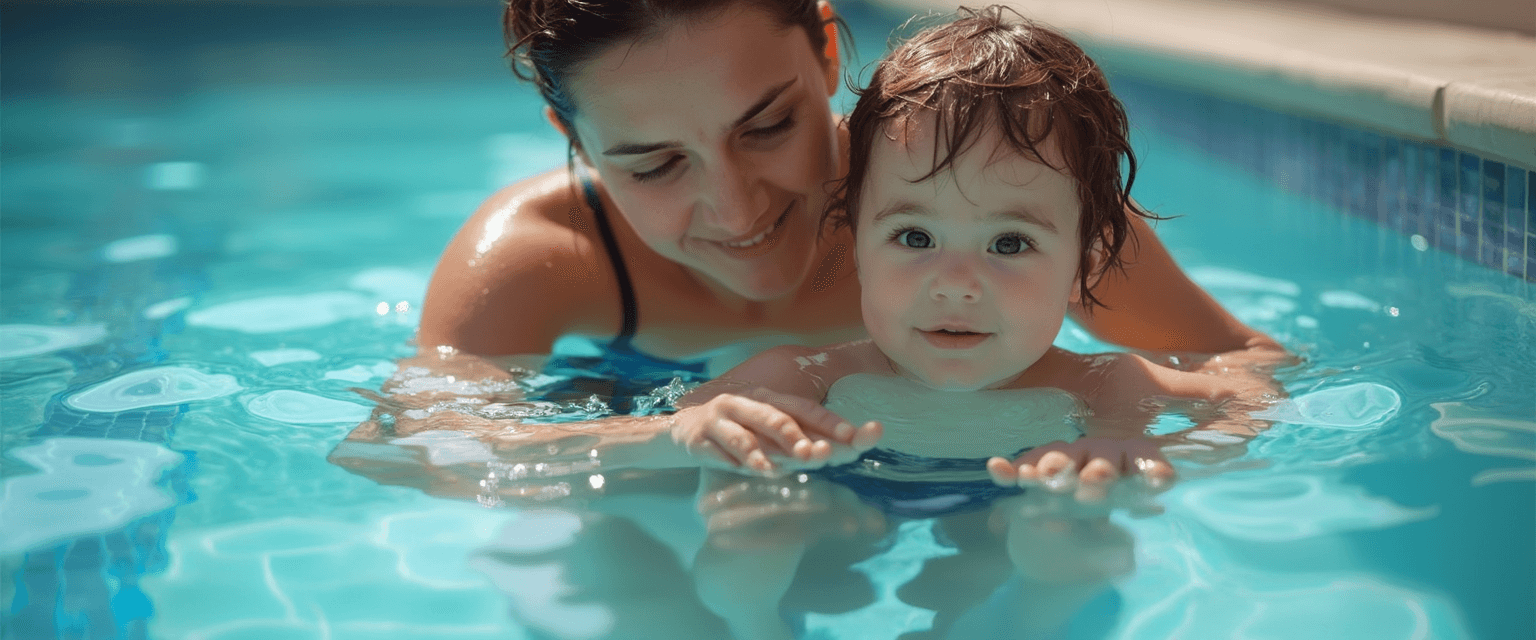
You look through the window of the swimming pool and see your child playing with a plastic duck. No strict breaststroke, no serious instruction. You wonder: is my child actually learning anything here? Thousands of parents worldwide ask themselves this question. The answer from science is surprising: precisely through that play, your child learns to swim faster and better than through traditional drill exercises.
The problem with traditional swimming lessons: drilling doesn’t work
Most swimming lessons follow a predictable pattern. The instructor demonstrates. Children imitate. Repeat. Correct. Repeat again. This approach is called "explicit learning" in science: you are told exactly how a movement should look and practice until you perform it flawlessly.What happens after the diploma? The 56% shock
Carola Minkels, PhD candidate at the Vrije Universiteit Amsterdam, conducted research together with InnoSportLab de Tongelreep on the effectiveness of swimming lesson methods. Her 2025 literature study, published in the scientific journal Frontiers in Sports and Active Living, revealed an uncomfortable truth. An earlier Dutch study by Mandy van der Weijden-van Rooden showed that only 56% of children could still perform five basic swimming skills 18 months after obtaining their B-diploma. Almost half of the children had already lost these essential swimming skills.More than 2000 studies, only 23 relevant
Minkels analyzed over 2000 scientific articles about swimming lesson methods. Only 23 proved truly useful. "Much has been written about what children should learn, but hardly about how they learn best," she concludes. Science knows which swimming strokes are important but has hardly researched for decades how to best teach them.The cortisol factor: stress blocks learning
A Greek study by Papadimitriou and Loupos from 2021 adds a physiological layer. They measured the stress hormone cortisol in children who followed a playful swimming program versus a traditional program. The playing children had significantly lower cortisol levels. Too much stress inhibits learning ability, and traditional drill lessons, with their focus on flawless execution and constant correction, actually increase that stress.
The science behind learning through play: how implicit learning works
The counterpart of explicit learning is called implicit learning. In this approach, children do not receive detailed instructions on how a movement should look. Instead, the instructor creates situations in which the child discovers what works by themselves. Think of a game where a child has to grab a floating object without touching the bottom. The child then discovers how to kick and float without anyone explaining "you have to move your legs like this or that."Non-linear pedagogy: every child their own movement
In 2021, Italian scientists Invernizzi and colleagues studied a swimming program based on non-linear pedagogy. Instead of prescribing a perfect technique, children were given the freedom to discover movement solutions themselves. The researchers let children practice in ever-changing conditions: different water depths, different materials, different game forms. The result? The children found the playful approach much more enjoyable and were more motivated. And motivation turns out to be the most important predictor of long-term swimming success.Aquatic games measurably improve breaststroke and backstroke
The most concrete evidence comes from Ukraine. Sheyko and Pashchenko compared two groups of children aged 6 to 8 in 2018. One group received traditional swimming lessons, the other group played aquatic games. After 36 lessons, the play group performed measurably better in both breaststroke and backstroke. Learning through play thus yielded better technical results than instruction-focused teaching.Learning through play sticks better: the retention effect
Why does knowledge learned playfully stick better? A meta-analysis by Cabral and colleagues from 2022 shows that implicitly learned motor skills are more resistant to stress and pressure. A child who learned to swim through play can recall their skills even in stressful situations, for example when unexpectedly falling into the water. A child who only knows the technique through instruction loses that skill under stress. This also explains why so many children lose their swimming skills after their diploma: they only practiced the movements in a controlled lesson environment.Why parents doubt learning through play (and why that is unfounded)
Parents want to see results. A child playing with a ball in the water simply looks less impressive than a child swimming neat breaststroke laps. That concern is understandable but does not align with science.The illusion of quick progress
Traditional swimming lessons seem to achieve faster results because progress is visible: a child can make a recognizable breaststroke after three lessons. But that quick progress is often superficial. The child imitates a movement without truly understanding it. Once conditions change, a different instructor leads the group, or there is time pressure, the movement falls apart. The playful approach builds a deeper foundation, even if it takes a little longer before the movement looks "neat."The role of digital progress insights
The real problem for parents is not the lesson method but the lack of insight. If you don’t see what happens in the water and the swimming school barely communicates, you start to doubt. Is my child really learning? This is where technology comes in. Swimmigo’s student tracking system shows parents via an app exactly which skills their child masters, with a visual smiley system of 7 levels and 86 skills. Even if the lesson looks like playing, you see progress per exercise. Swimmigo is available in 5 languages (Dutch, English, German, French, and Spanish) and is used worldwide by swimming schools and parents.What does your swimming school say about the method?
Ask your swimming school which lesson method they use. Do they use only direct instruction, or is there room for play and self-discovery? A good swimming school can explain why they choose a certain approach and how they measure progress. If your swimming school uses Swimmigo, you can follow your child’s progress yourself in the app, in your own language.
What does playful swimming lessons look like in practice?
Not loose sand, but structured play with a learning goal. A playful swimming lesson combines fun with targeted skill exercises.Examples of playful swimming exercises per level
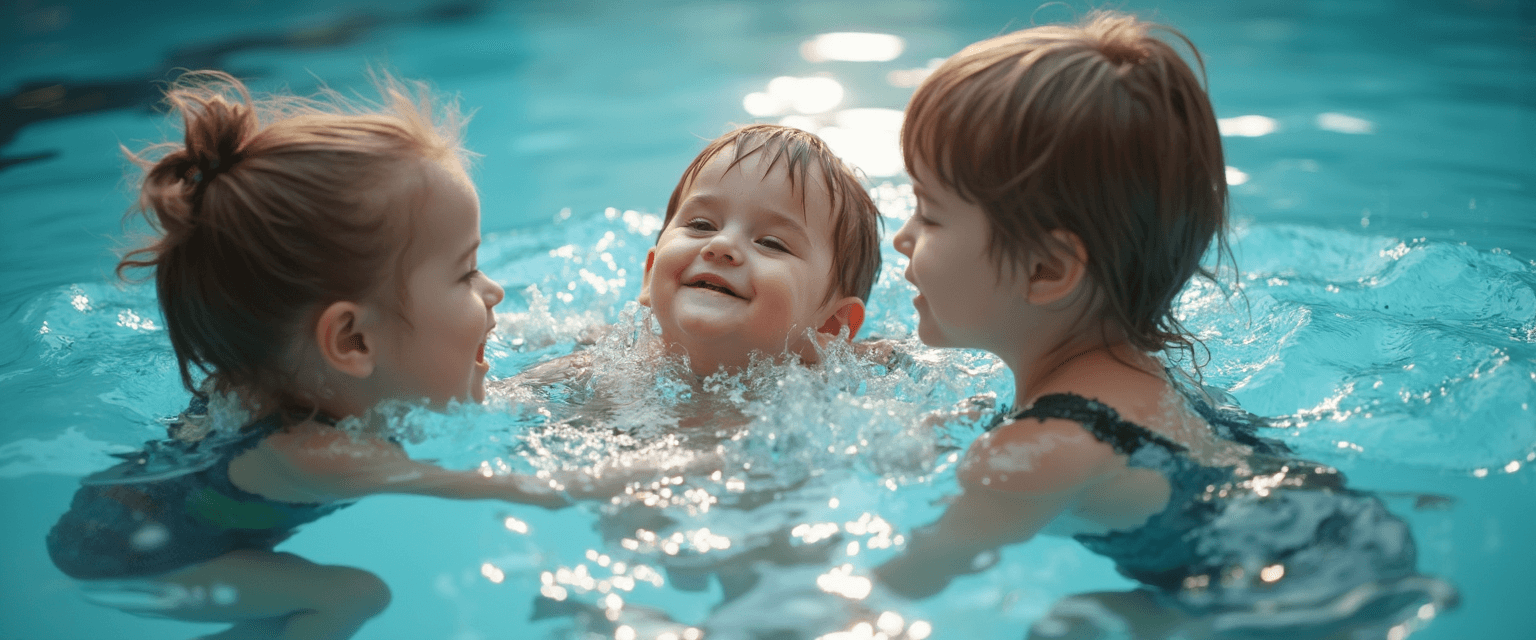
For beginner swimmers, a "treasure hunt" game works: retrieving colored rings from the bottom. The child practices water acclimation, going underwater, and keeping eyes open, without it feeling like a lesson. For advanced swimmers: a relay where children swim a certain distance breaststroke in turns and then pass an object. This combines technique training with speed and teamwork, without the pressure of a formal exam.How instructors design games with a learning goal
Good swimming instructors design games around specific skills. A ball game that requires floating. A tag game that trains kicking. An obstacle course that combines all parts of a certain stroke. The instructor observes during the game which children master which skills and adjusts the game accordingly. This is fundamentally different from free play: every game has a purpose, and the instructor intervenes where needed.The balance between play and technique: the 70/30 principle
Many successful swimming schools use a 70/30 split: 70% of lesson time is playful and exploratory, 30% is targeted technique training. This balance proves to work best in practice. Children stay motivated by play but also receive the technical feedback needed to refine skills. The 70/30 principle is not a hard scientific rule but a practical guideline increasingly embraced by swimming schools worldwide.Learning through play as a universal approach: from the Netherlands to worldwide
The Netherlands has one of the best swimming education systems in the world, with the Zwem ABC as the gold standard. But the challenge of effective swimming education is universal.Drowning as a global problem
According to the World Health Organization (WHO), about 300,000 people drown worldwide annually. Children under 15 make up 43% of all drowning victims, worldwide 130,000 children in 2021. This is not only a Dutch or European problem; it occurs in every country with water. More effective swimming lesson methods literally save lives, from Amsterdam to Melbourne to Nairobi.What other countries do: playful examples from practice
In Australia, a country with a huge swimming culture, many swimming schools integrate the "Nippers" program: playful beach and water activities that make children water safe through play. In Scandinavia, instructors combine outdoor swimming in lakes with survival skills through playful scenarios: "what do you do if your boat capsizes?" In all these examples, play is central, not technique drills. Swimmigo supports this international approach with an app available in 5 languages that makes progress per exercise transparent, regardless of the teaching method used.How Swimmigo supports the playful method
Swimmigo is built on the 7-level system with 86 skills, from Red to Gold. Each level contains playful exercises instructors can use. Parents see in the app per exercise whether their child is "practicing," "almost," or "achieved," with the smiley system. This makes learning through play transparent. The app sends push notifications at level increases and offers free swimming certificates per level. From level 5, children receive a truly personalized swimming diploma with name, date, and level. This motivates children to continue and gives parents confidence that playing leads to results.
Conclusion
Learning to swim through play is not a "soft" approach. It is a scientifically substantiated method that helps children learn faster and better, with skills that last longer. The VU Amsterdam study from 2025 shows that the traditional approach falls short: almost half of the children lose essential swimming skills within a year and a half after the diploma. Play reduces stress, increases motivation, and builds a deeper learning foundation. With tools like Swimmigo, parents can finally track that playful progress in their own language, from day one to the golden diploma.Frequently Asked Questions about Learning to Swim Through Play
General questions about learning to swim through play
Is learning to swim through play just an excuse for less serious lessons? No. Learning through play is a conscious pedagogical choice with scientific backing. The instructor designs games with specific learning goals and continuously observes which skills each child masters. It feels like play to the child, but every activity trains targeted swimming skills. Do children learn to swim slower through play? The opposite is true. Research by Sheyko and Pashchenko (2018) shows that children who received lessons through aquatic games performed better in breaststroke and backstroke than children who received traditional instruction. From what age does learning to swim through play work? Learning through play works for all ages but is particularly effective for children aged 3 to 12. Young children naturally learn through discovery and play. For babies and toddlers, play is the only effective way to build water acclimation. Older children and even adult beginners also benefit from playful elements that reduce fear of failure.Questions for parents
How do I know if my child is making progress if the lesson looks like playing? Ask your swimming school about their progress system. Do they use an app like Swimmigo? Then you see per exercise whether your child is practicing, almost, or achieved. Also ask the instructor which skills were practiced through play. A good instructor can tell you exactly which game trained which swimming skill. My child doesn’t want to go to swimming lessons anymore because it’s boring. Can a playful approach help? Absolutely. Boredom is a major reason children drop out of swimming lessons. A playful approach aligns with how children naturally learn and stay motivated. If your current swimming school only teaches drill-based lessons, consider a school that also uses playful elements. Swimmigo’s visual progress also makes the learning process transparent and motivating through push notifications at each achieved level.Questions for swimming schools and instructors
How do I design effective games that truly train swimming skills? Start with the learning goal, not the game. Which specific skill do you want to train? Then choose a game form that requires this skill without feeling like an exercise. Vary the conditions: different water depth, different materials, different group sizes. Use Swimmigo to track which children already master which skills and adjust your games accordingly. The app gives you insight per child into progress across all 86 skills. How do I convince parents that learning through play works? Show parents the progress. Share after each lesson which skills were practiced through which game. Use Swimmigo’s parent app so parents can watch in real time. Point them to the scientific research: the VU Amsterdam study by Minkels (2025), the Italian non-linear pedagogy study by Invernizzi (2021), and the Ukrainian games research by Sheyko and Pashchenko (2018). Parents want to see results, and with an app like Swimmigo, you make playful progress measurable and visible.Sources
- Minkels, C., van der Kamp, J., de Vries, R., & Beek, P.J. (2025). Learning how to swim in 5- to 12-year-old children: a scoping review of evidence-based motor learning methods. Frontiers in Sports and Active Living., February 2025
- ZwembadBranche: Swimming lessons of the future, interview with Carola Minkels (VU Amsterdam), November 2024
- WHO: Drowning fact sheet, 300,000 drownings worldwide, 43% children under 15, 2025
- Invernizzi, P.L. et al. (2021). Aquatic Physical Literacy: The Effectiveness of Applied Pedagogy on Parents' and Children's Perceptions of Aquatic Motor Competence. International Journal of Environmental Research and Public Health., 2021
- Sheyko, L. & Pashchenko, N. (2018). Efficiency of the use of mobile games in water at the stages of primary teaching for children of primary school age. Slobozhanskyi Herald of Science and Sport., 2018
- Papadimitriou, K. & Loupos, D. (2021). The effect of an alternative swimming learning program on skills, technique, performance, and salivary cortisol concentration. Healthcare., 2021
- De Correspondent: Swimming is fun. So why is swimming lesson so boring?, 2024

Bob van Soest
As an expert in operating sports facilities (such as swimming pools) and developer of, among others, Swimmigo.com, I am passionately committed to making swimming lessons simpler, more fun and more insightful for parents, swimming instructors and everyone who wants to learn to swim.
Frequently Asked Questions
Related articles
Why Showering Before Swimming Lessons Is So Important
Why shower before swimming lessons? Discover why hygiene and preparation are crucial for the best swimming experience. Read our tips and avoid surprises!
When to Start Swimming Lessons for Optimal Progress
Read from which age swimming lessons are effective for the best results and safety of your child in the water.
Effectively Registering Swimming Lesson Progress from What Age?
Discover from what age you should best register swimming lesson progress and how to do this practically.
Discover Swimmigo
The all-in-one app for swimming lesson progress. For parents, swim schools, and adult swimmers.