TheImpactofGroupSizeonSwimmingLessonProgress:WhatIstheIdealGroupSize?[2026]
![The Impact of Group Size on Swimming Lesson Progress: What Is the Ideal Group Size? [2026]](/_next/image?url=https%3A%2F%2Fzvblogpostimages.s3.eu-west-3.amazonaws.com%2FAUTOMATISCH_UPLOAD%2F1_3ee286f9e96b.jpg&w=3840&q=75&dpl=dpl_GWyfLj8UVegbQ18STkVQms8Vj7LD)
Summary
- Smaller groups (2-4 children) lead to faster diploma results but are not always feasible for swimming schools
- The ideal group size depends on age, level, and specific lesson goals
- Children in groups of 8 or more receive on average 60% less individual feedback per lesson
- Digital progress tools like Swimmigo compensate for the lack of attention in larger groups
- Parents can consider group size when choosing a swimming school, but it is not the only quality factor
You take your child to swimming lessons hoping for progress. After a few months, you might wonder: is it going fast enough? Group size has more impact on this than most parents realize. How many children are in your child's class? And how much individual attention does your child get as a result?
Swimming schools worldwide balance affordability and quality. Larger groups lower the lesson price, but the cost is paid in minutes of attention per child. Here you’ll read what practical experience and international guidelines say about group size and swimming lesson progress.
Why Group Size Matters in Swimming Lessons
The Basics: More Children Means Less Time per Child
The math is simple. A 30-minute swimming lesson with 4 children gives the instructor 7.5 minutes per child. With 8 children, that’s less than 4 minutes. In practice, time is also spent on explaining to the whole group, setting up equipment, and helping children in and out of the water. The effective individual practice time shrinks even more. And the effect on swimming progress is measurable: children in smaller groups earn their diploma on average 15 to 25 percent faster, according to experience data from dozens of swimming schools.
What Happens in a Too Large Group?
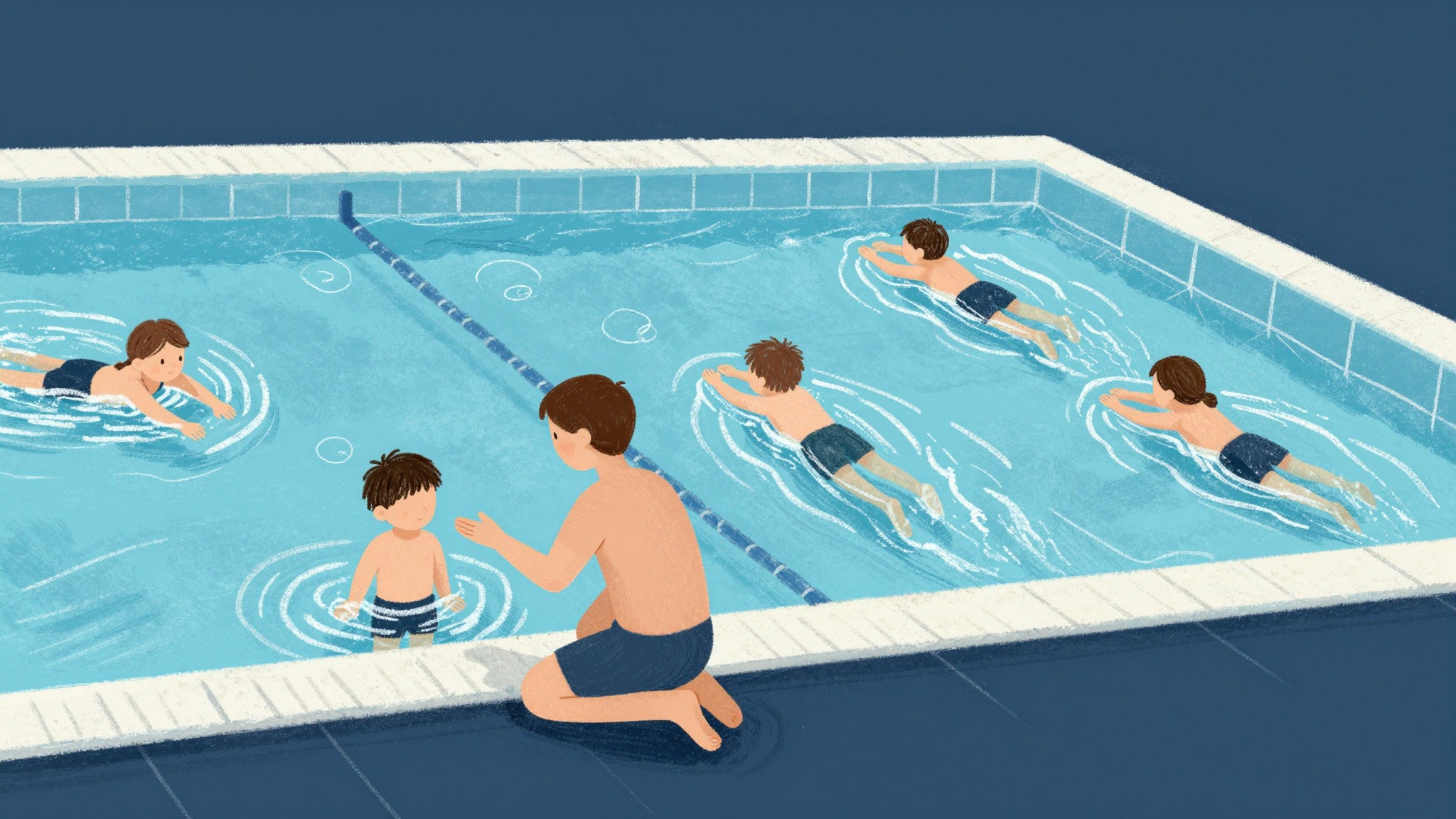
In groups of 10 or more children, the dynamic changes completely. The instructor switches to group management: keeping children in the right lane, managing queues, and resolving conflicts. Individual corrections on arm position, leg movement, or breathing fade into the background. Children spend more time on the sidelines than actively practicing. Quiet and calm children get the least attention, even though they are the ones who benefit most from targeted guidance. International swimming education organizations such as Swim England set guidelines of a maximum of 6 to 8 children per instructor for beginner lessons, precisely to prevent this decline in teaching quality.
The Safety Factor in Group Size
Supervision is the top priority of every swimming instructor. In a group of 12 non-swimmers, one instructor literally has too many heads to watch. The World Health Organization advises a ratio of 1 to 3 for non-swimmers under 6 years old. In regular swimming lessons, this ratio is often 1 to 8 or higher. It’s not about whether the instructor tries hard, but what is physically possible. Swimming schools that take group size seriously assign an assistant for larger groups or reduce the maximum group size in shallow water.
What Is the Ideal Group Size per Age and Level?
Water Acclimation and Beginners, Ages 3 to 5
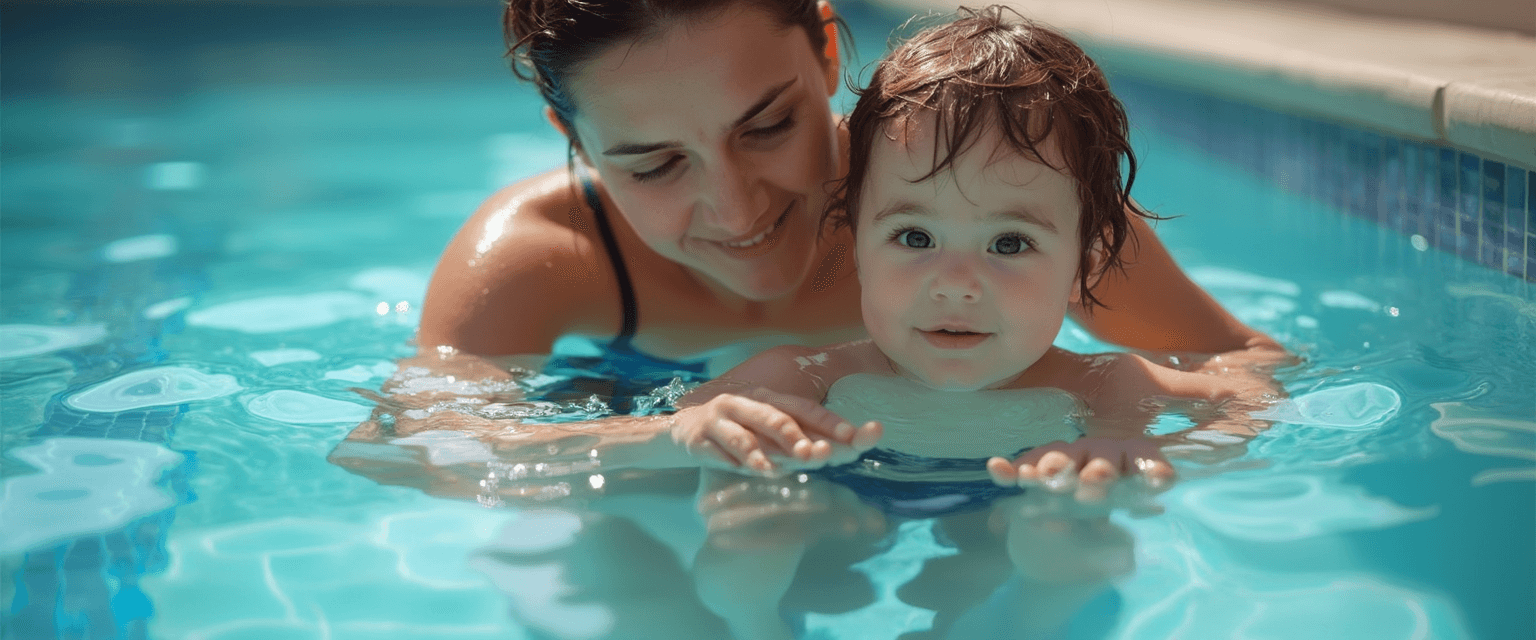
For the very youngest, water acclimation is the foundation of everything that follows. A child who is afraid of water will not learn to swim. In this phase, emotional safety is just as important as physical safety. The ideal group size is 2 to 4 children. An instructor must be close by, literally able to reach out a hand, and give each child the confidence that they are not alone. In countries like Sweden and Norway, 1 to 3 is the standard norm for this age group. Children starting in a small group also have less chance of developing water fear that delays their entire swimming career.
Levels 1 to 3: Basic Skills, Ages 4 to 7
Once floating, going underwater, and the first arm strokes are mastered, the focus shifts to technique. The ideal group size here is 4 to 6 children. The instructor can give short individual corrections while other children practice independently. From this age, the social aspect also plays a role: children watch each other, learn from each other, and a sense of group can be motivating. The tipping point is around 8 children: above that, the instructor must choose who gets corrections and who has to wait. The weakest and strongest students get the most attention, while the middle group drifts along.
Levels 4 to 7: Advanced Techniques, Ages 6 to 12
At higher levels, children can swim longer distances and are safer in the water. Group size can rise to 6 to 10 children here, provided the instructor has a smart lesson plan. The trick is variety: instruction, independent practice, play forms, feedback. Children who can already swim need less physical proximity but do need targeted technical feedback. An instructor working with 10 children can set up a circuit where one child receives instruction while the rest swim laps independently. This requires organizational talent and experience, and not every instructor masters this setup.
Adult Beginners: A Different Story
Adults learning to swim benefit from a group size of no more than 4 people. The learning curve differs from children: adults understand the purpose faster but suffer more from fear of failure and embarrassment. A smaller group gives the instructor room to lower psychological barriers and build technique calmly. The physical difference also plays a role: an adult takes up more space in the water and cannot practice as closely with a fellow student without becoming unsafe.
The Reality of Swimming Schools: Why Do Large Groups Exist?
The Economic Side of Group Size
Swimming schools are businesses. An instructor costs money, the pool costs money, and the lesson price must remain competitive. With 4 children per instructor, revenue per lesson hour is lower than with 10 children. Many swimming schools compensate by charging a slightly higher lesson price, but in a competitive market, that is not always feasible. The reality in Dutch pools is that groups of 8 to 12 children are common. This keeps swimming lessons affordable, but the downside is that diploma A sometimes takes 18 months instead of 12. Parents ultimately pay the same amount through more lesson months.
Staff Shortages in the Swimming Industry
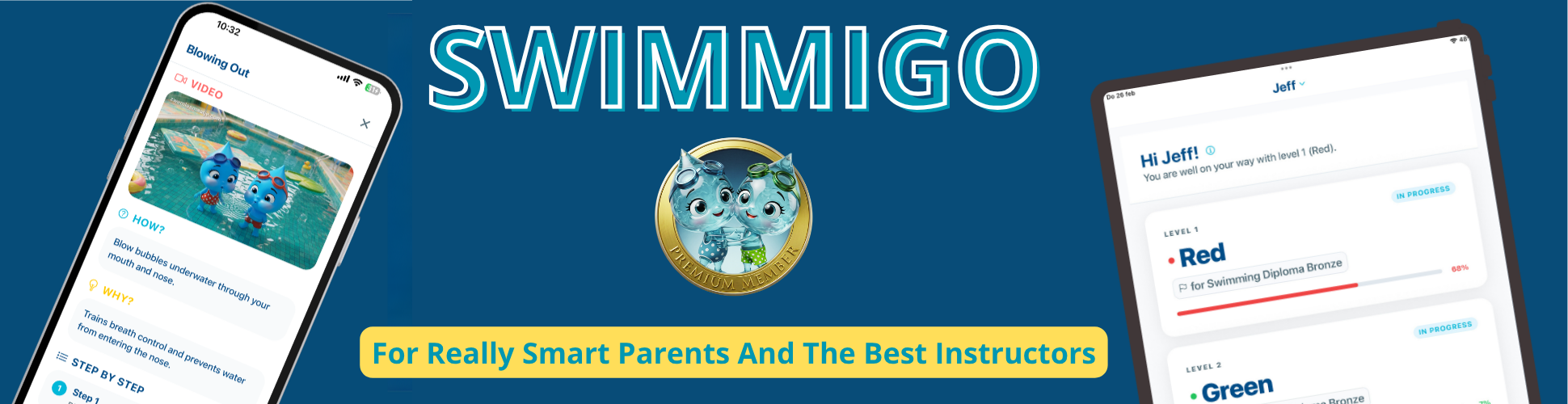
There is a shortage of qualified swimming instructors, not only in the Netherlands but across Europe. The European swimming industry estimates a shortage of thousands of instructors. Fewer instructors automatically means larger groups. Swimming schools that do work with small groups often have waiting lists. A digital tool like Swimmigo helps instructors keep an overview with larger groups: the app registers which skills each child has mastered, so the instructor quickly sees who needs extra attention. This does not replace an instructor but makes the limited time per child more efficient.
How Can Parents Assess Group Size?
Ask During the Trial Lesson
The easiest way to assess group size is to ask and observe. How many children are in the lesson you see? Don’t just count heads but watch the dynamic: how many children stand still on the side? Does each child get at least one individual feedback moment? Does the instructor talk to the group or to individual children? A trial lesson tells you more than a brochure. Also ask about the maximum group size the swimming school uses and if there are exceptions when a colleague is sick.
Look Beyond Just the Number of Children
Group size is important but not the whole story. An experienced instructor with 8 children can achieve better results than a beginner instructor with 4. The lesson structure, quality of materials, and program organization also play a role. A swimming school with a continuous learning plan and digital progress tracking can deliver consistent results even with larger groups because the instructor knows exactly what each child still needs to practice. The combination of group size and supporting tools ultimately determines the result.
Consider the Trade-off Between Price and Speed
A smaller group almost always means a higher lesson price. The question is whether that investment pays off. If your child earns a diploma in 12 months in a group of 4 versus 18 months in a group of 10, you save 6 months of lesson fees. The price difference can balance out, while your child gets the diploma faster. Moreover, the swimming lesson experience in a smaller group is often more pleasant for children who are insecure or need extra guidance.
What Can Swimming Schools Do to Make Larger Groups Work?
Use Digital Tools for Individual Tracking
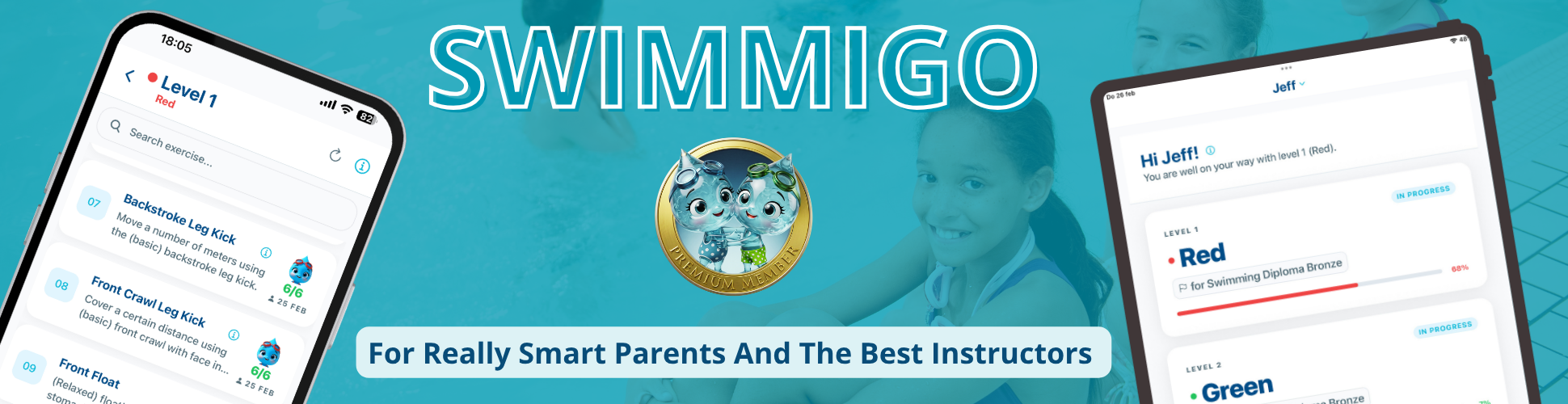
An app like Swimmigo gives the instructor insight per child into which skills are already mastered, what the next learning goal is, and where the child is stuck. Instead of having to remember what 10 different children need, the instructor scrolls through the current status on a tablet. Research on digital learning tools in education shows that direct data access can increase effective learning time by 20 to 30 percent. The same principle applies to swimming education: the faster the instructor knows what needs to be practiced, the less time is lost on orientation at the start of the lesson.
Work with Lesson Assistants and Interns
A simple solution many swimming schools overlook: assign an assistant for larger groups. An intern or junior instructor who keeps an overview while the main instructor gives individual corrections effectively doubles the attention per child. The assistant does not need to be a fully qualified instructor. Helping with equipment, reassuring children, and managing the queue is already a huge relief. Swimming schools that do this structurally report diploma completion times 10 to 15 percent lower than comparable group sizes without an assistant.
Level Groups Instead of Age Groups
Children of the same age can have completely different swimming levels. A smart grouping based on skill rather than birth year reduces the level difference within the group. If all children work on the same skill, the instructor can give collective instruction relevant to everyone. This sounds logical but requires the swimming school to use a flexible schedule and parents to accept their 5-year-old in a group with 7-year-olds. Digital systems like Swimmigo make this flexible grouping easier because you can see at a glance who is at which level.
The International Perspective: What Do Other Countries Do?
Australian swimming schools often use a maximum ratio of 1 to 5 for beginners, set in the national guidelines of AUSTSWIM. In the United Kingdom, Swim England advises 1 to 6 for children up to 4 years old and 1 to 8 for older children. In Singapore, where swimming is a mandatory part of the curriculum, they work with 1 to 10 in schools with a clear conscious trade-off: swimming safety for everyone, even if technical progress is slower.
The Netherlands is somewhere in between regarding guidelines. The National Council for Swimming Safety (NRZ) advises smaller groups for non-swimmers but does not impose a hard maximum. Swimming schools determine their own group size, with all the resulting variation. Swimmigo operates in all these markets: the app is available in 5 languages and is used by swimming schools working with 4 children per group as well as schools with 12 children per group. The common denominator: digital tracking makes any group size more efficient.
Conclusion
The ideal group size in swimming lessons is not an absolute number. It depends on the children’s age, level, the instructor’s experience, and available support. What is certain is that smaller groups enable faster progress and that groups over 8 children require extra structure and tools. As a parent, it pays off to consider group size when choosing a school, but also look at what the swimming school does to manage that group size. A swimming school that invests in good instructors and digital tools can achieve excellent results even with 8 children per group.
Frequently Asked Questions
Sources
- WHO: Drowning fact sheet, supervision ratios for young children, 2024
- Swim England: Learn to Swim Framework, recommended group sizes per level, 2024
- NRZ: National Council for Swimming Safety, swimming lesson quality guidelines Netherlands, 2025
- AUSTSWIM: Teacher resources and guidelines, maximum ratios Australia, 2024
- Sport England: Swimming Pool Design Guidance, pool capacity and lesson planning, 2023

Bob van Soest
As an expert in operating sports facilities (such as swimming pools) and developer of, among others, Swimmigo.com, I am passionately committed to making swimming lessons simpler, more fun and more insightful for parents, swimming instructors and everyone who wants to learn to swim.
Frequently Asked Questions
Related articles

Why Showering Before Swimming Lessons Is So Important
Why shower before swimming lessons? Discover why hygiene and preparation are crucial for the best swimming experience. Read our tips and avoid surprises!
When to Start Swimming Lessons for Optimal Progress
Read from which age swimming lessons are effective for the best results and safety of your child in the water.

Effectively Registering Swimming Lesson Progress from What Age?
Discover from what age you should best register swimming lesson progress and how to do this practically.
Discover Swimmigo
The all-in-one app for swimming lesson progress. For parents, swim schools, and adult swimmers.