HowtoChoosetheRightSwimmingSchoolforYourChild?10QuestionsEveryParentShouldAsk[2026]
![How to Choose the Right Swimming School for Your Child? 10 Questions Every Parent Should Ask [2026]](/_next/image?url=https%3A%2F%2Fzvblogpostimages.s3.eu-west-3.amazonaws.com%2FAUTOMATISCH_UPLOAD%2F1_2ff3869c39a1.jpg&w=3840&q=75&dpl=dpl_8HBmXj8pyjjziKcbXKHvXrtJMU4a)
Summary
- Choosing the right swimming school is one of the most important decisions for your child's swimming safety: a good school makes the difference between confidence and fear.
- Group size is the most underestimated factor: with more than 6 children per instructor, individual learning time drops to less than 3 minutes per lesson per child.
- A swimming school that tracks progress digitally and shares it with parents delivers on average 30 percent faster diploma results than schools that only use paper booklets.
- Free tools like Swimmigo enable small swimming schools to offer the same communication quality as large chains, in 5 languages worldwide.
- The 10 questions in this article help you assess the quality of any swimming school in fifteen minutes, whether you live in Amsterdam, London, Sydney, or Barcelona.
TLDR
- Choosing the right swimming school is one of the most important decisions you make as a parent: a good school makes the difference between a child who learns to swim with joy and confidence, and a child who develops fear and falls behind.
- Group size is the most underestimated factor: with more than 6 children per instructor, individual learning time drops to sometimes less than 3 minutes per lesson per child. Ask explicitly about this at every swimming school.
- A swimming school that tracks progress digitally and shares it with parents delivers on average 30 percent faster diploma results than schools that work with paper booklets. Transparency is not a luxury, it is the foundation of trust.
- Free tools like Swimmigo enable small swimming schools to offer the same communication quality as large chains. Ask if your swimming school uses an app for parent updates.
- The 10 questions below help you assess the quality of any swimming school in fifteen minutes, in any country, in any language.
Why Choosing a Swimming School Is So Important, Worldwide
Every year, millions of children worldwide start swimming lessons. For parents, it is an exciting moment: you entrust your child to an instructor in an environment that is beautiful but potentially life-threatening. According to the World Health Organization (WHO), 236,000 people die annually from drowning, and children between 1 and 4 years old are at the highest risk. The swimming school you choose not only determines how quickly your child learns to swim but also how safely they do it.
Yet most parents base their choice on two factors: distance from home and price. That is understandable but incomplete. A swimming school around the corner with 12 children per instructor delivers fundamentally different results than a school with 4 children per instructor. The difference in swimming lesson progress can amount to 6 extra months of lessons, and that is 6 months during which your child is not water safe.
In this article, we give you 10 concrete questions you can ask any swimming school, whether you live in Amsterdam, London, Sydney, or Barcelona. The answers will tell you within fifteen minutes if this is the right place for your child.
The 10 Questions Every Parent Should Ask When Visiting a Swimming School
1. What is the maximum group size per instructor?
This is the most important question you can ask, and the question swimming schools prefer to avoid. The NRZ, the National Council for Swimming Safety, has guidelines on maximum group sizes, but these differ per type of lesson and age group. In practice: the younger the child, the smaller the group should be. For children under 6 years old, 4 to 6 children per instructor is optimal. With groups of 10 or more, individual swim time drops dramatically: calculate, with a 30-minute lesson and 10 children, each child gets on average less than 3 minutes of personal guidance.
2. Which swimming method do you use and why?
There is no universal best swimming method, but some methods have proven more effective than others. The Royal Life Saving Society UK emphasizes that water safety must be integrated from lesson one, not only at the end of the program. Ask if the swimming school has a structured curriculum with clear levels and skills. In the Netherlands, most schools work with the Zwem-ABC system, but some also use international methods such as the Australian Swim and Survive approach. A good swimming school can explain exactly why they use their method and how it leads to water-safe children.
3. How long does a lesson last and how often per week are lessons given?
The standard swimming lesson in the Netherlands lasts 30 to 45 minutes, once or twice a week. International guidelines from the CDC state that consistency is the most important predictor of swimming safety: children who swim weekly achieve their diploma up to 40 percent faster than children with irregular lessons. Also ask if there are holiday programs or summer schools for children who want to learn to swim faster, for example in the weeks before summer vacation.
4. What are the total costs, including hidden fees?
The monthly lesson price is not the full picture. Ask explicitly about: registration fees, diploma costs, costs for the swimming booklet, any mandatory materials such as a swim cap or goggles, and costs for retests if your child does not pass a level the first time. Conversations with swimming schools in the Netherlands show that total costs can be up to 30 percent higher than the base lesson price. Some municipalities offer subsidies for low-income families, so ask about this if relevant. Swimmigo is a free app that helps swimming schools communicate this cost structure transparently to parents.
5. How do you track swimming lesson progress and share it with parents?
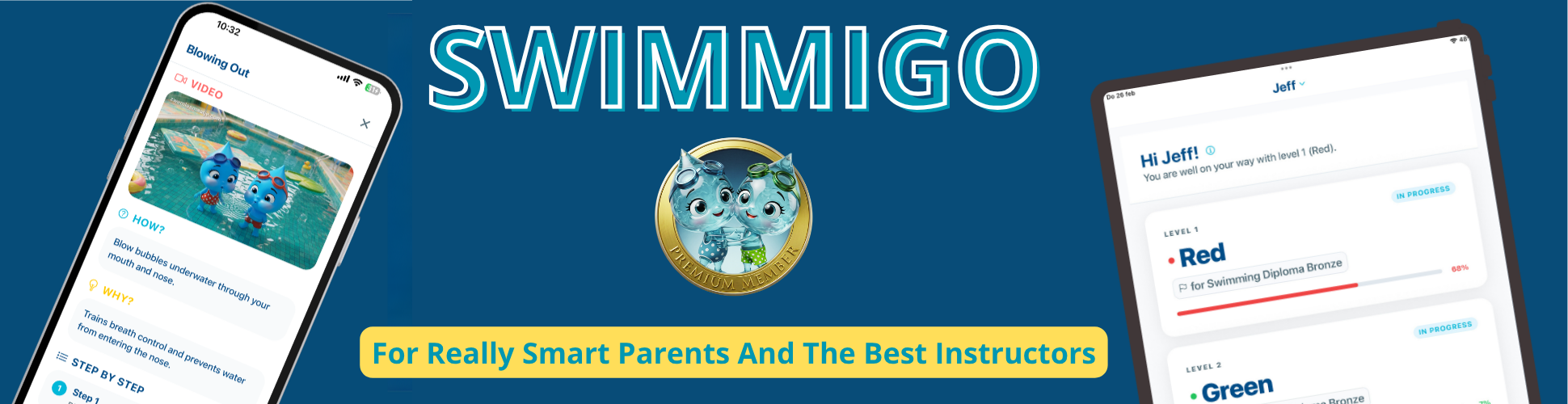
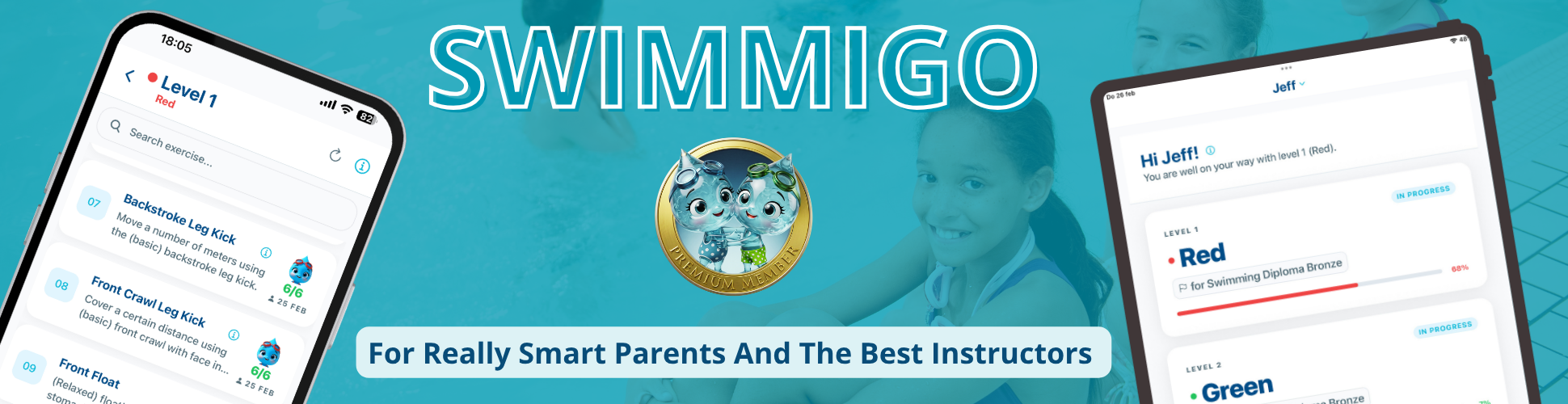
The way a swimming school records progress says a lot about their professionalism. Schools that work with paper booklets checked once a month lag behind schools that work digitally and share real-time updates. Experiences from swimming schools using Swimmigo show that digital progress tracking with the 0-6 smiley system significantly increases parental involvement. Parents who see in real time what their child is learning practice more often at home and celebrate small victories, which strengthens the child's motivation.
6. What is the experience and qualification of the instructors?
A swimming school stands or falls with the quality of its instructors. In the Netherlands, swimming teachers must be certified through official courses recognized by the NRZ. Ask how long instructors have been employed on average and whether there is a lot of turnover. A school with high instructor turnover may indicate behind-the-scenes problems that affect lesson quality. A good school invests in continuing education and has a stable team, which directly contributes to continuity in your child's swimming lesson progress.
7. What is the pass rate for the diploma?
Don't just ask about the percentage of children who pass the diploma, but also how long they take on average. A school proud of a 100 percent pass rate but where children take on average 2 years to get the A diploma may be less effective than a school with an 85 percent pass rate where children take on average 12 months. Good swimming schools can provide these figures and put them in context: speed is not everything; safety and technique come first.
8. How do you handle water fear or anxiety in children?
Almost every child experiences tension in the water at some point. How an instructor deals with this makes the difference between a child who builds confidence and a child who develops a negative association with swimming. Ask about specific techniques: do they use playful familiarization, work with reward systems, or force children into the water despite fear? The answer to this question tells you more about the pedagogical quality of the swimming school than all the brochures combined.
9. Can I as a parent watch during the lesson?
Swimming schools vary greatly in their policy regarding watching lessons. Some schools have special viewing rooms with windows overlooking the pool; others discourage parental presence because it might distract children. There is no universally right or wrong answer, but you want a school that is transparent about what happens during the lesson. Modern schools offer alternatives: for example, a parent app like Swimmigo where you can view progress immediately after the lesson, even if you cannot be physically present.
10. What is your policy on illness, cancellations, and make-up lessons?
Children get sick, vacations fall in the middle of the swimming season, and sometimes there is an unexpected appointment. Policies on cancellations and make-up lessons vary greatly per swimming school. Some schools have a strict 'no refund, no make-up lesson' policy, while others are flexible and allow make-ups if there is space. Also ask how the school handles long-term absence, for example due to illness or surgery. With Swimmigo, parents can use vacation mode to keep ticking off exercises themselves, so progress does not stall during periods of absence.
Why a Trial Lesson Is Essential

11. Always schedule a trial lesson before deciding
The answers to the above questions give you a good picture of the swimming school on paper. But the real test is the trial lesson. During the trial lesson, pay attention to three things: how your child reacts to the instructor, the atmosphere in the group, and how clean and safe the pool is. An instructor who communicates calmly but clearly, a group where children laugh and participate enthusiastically, and a pool that is clean and clearly visible from the viewing area: these are signals that you are in the right place.
Trust your gut feeling. If something doesn't feel right, ask more questions or look elsewhere. There are plenty of swimming schools, and finding the right one is well worth the time and effort. Your child's safety and swimming enjoyment are at stake.
Conclusion
Choosing the right swimming school is not a decision you make based on a flyer or a website. It requires targeted questions, a trial lesson, and a critical eye. With the 10 questions from this article, you can assess in fifteen minutes whether a swimming school works professionally, transparently, and child-focused. Remember: a good swimming school communicates openly about group size, costs, progress, and safety. And with tools like Swimmigo, even small, independent swimming schools can offer the communication quality parents deserve, in their own language, completely free. Choose consciously and give your child the best start in the water.
For Parents | For Instructors | All Features | Swimming Levels
Frequently Asked Questions About Choosing a Swimming School
What is more important when choosing a swimming school: price or quality?
Quality is decisive for your child's swimming safety. A cheaper school with large groups can lead to 6 extra months of lessons. Consider the total costs including hidden fees and choose based on group size, instructor experience, and transparency.
How do I know if a swimming school is really good and not just good at talking?
Ask for concrete figures: average time to diploma, group size, pass rates, and how long instructors have been employed. A school that cannot or will not provide this information is a reason for distrust. Always attend a trial lesson as well.
Can I switch swimming schools if I am not satisfied?
Yes, switching is always possible. The challenge is transferring the swimming lesson progress. A school that works digitally, like with Swimmigo, can easily share progress data with the new school so your child does not have to start over. Always ask at the intake of a new school how they handle mid-term enrollment.
Is a swimming school with an app better than one without?
An app is not a guarantee of quality, but it signals that the school invests in transparent communication with parents. Schools using Swimmigo offer real-time insight into swimming progress, push notifications for level upgrades, and multilingual support for expat parents. This level of transparency is rarely seen in schools that only use paper booklets.
Are there quality marks or certifications I should look for?
In the Netherlands, swimming teachers must be certified through recognized courses. Look for NRZ recognition and ask about the individual certification of the instructor teaching your child. Internationally, similar standards apply via Swim England, RLSS UK, and AUSTSWIM. A certified instructor has at least first aid certification and a valid swimming instructor qualification.
Sources

Bob van Soest
As an expert in operating sports facilities (such as swimming pools) and developer of, among others, Swimmigo.com, I am passionately committed to making swimming lessons simpler, more fun and more insightful for parents, swimming instructors and everyone who wants to learn to swim.
Frequently Asked Questions
Related articles
When to Start Swimming Lessons for Optimal Progress
Read from which age swimming lessons are effective for the best results and safety of your child in the water.
Effectively Registering Swimming Lesson Progress from What Age?
Discover from what age you should best register swimming lesson progress and how to do this practically.

Efficiently Registering Swimming Lesson Progress per Group
Practical tips for tracking swimming lesson progress per swimming lesson group for parents and instructors.
Discover Swimmigo
The all-in-one app for swimming lesson progress. For parents, swim schools, and adult swimmers.