HowLongDoesSwimmingLessonReallyTake?RealisticTimelinefortheADiploma[2026]
![How Long Does Swimming Lesson Really Take? Realistic Timeline for the A Diploma [2026]](/_next/image?url=https%3A%2F%2Fzvblogpostimages.s3.eu-west-3.amazonaws.com%2FAUTOMATISCH_UPLOAD%2F1_fbe2b78f0c66.jpg&w=3840&q=75&dpl=dpl_GWyfLj8UVegbQ18STkVQms8Vj7LD)
Summary
- Most children take 48 clock hours for the A diploma, about 75 lessons of 45 minutes
- With one lesson per week, the trajectory takes on average 18 months; twice a week speeds up the process but does not halve it
- Starting age, water familiarization, confidence, and motor development together determine the pace
- Waiting time before the first lesson also counts: often 3 to 6 months in many places
- With an app like Swimmigo, you can see what your child learns in the meantime, making waiting less frustrating
How Many Clock Hours Does a Swimming Diploma Really Take?
You have enrolled your child for swimming lessons. The first weeks are exciting: a new environment, a new teacher, and going into the water without you for the first time. But after a few months, the restlessness starts to creep in. "How much longer will this take?" and "Is it my child or is this normal?" are questions many parents ask. The frustration is understandable, because swimming lessons sometimes feel endless. Yet there is a clear, data-based timeline that gives you guidance.
According to the National Council for Swimming Safety (NRZ), most children take about 48 clock hours to obtain the A diploma. That sounds like a concrete number, but in practice, with one 45-minute lesson per week, it means about 75 lessons. Spread over a whole year, you are on average 18 months further before that coveted diploma hangs on the wall. About 10% of children finish faster and another 10% take longer. The B and C diplomas usually go faster: each about 12 clock hours, or 18 to 20 lessons each.
Worldwide the picture is similar, but systems differ. In the United Kingdom, Swim England estimates 25 to 30 hours for basic swimming skills. In the United States, the American Red Cross estimates children need 6 to 12 months of consistent lessons for basic self-rescue skills. The Netherlands leads with the Zwem-ABC: the A diploma is more extensive than the basic diplomas in most other countries, precisely because we take safety in open water very seriously. A Dutch child who obtains the A diploma can manage in a swimming pool and in open water with currents and unclear situations. That thoroughness takes time. And that is exactly the intention.
The WHO report on drowning from 2025 shows why this carefulness matters: worldwide about 300,000 people die annually from drowning, and nearly a quarter of those victims are under 5 years old. Drowning is the fourth leading cause of death worldwide among children aged 1 to 4 years. Investing in solid swimming lessons is literally life-saving, in every country and in every body of water.
Starting Age: Why 4.5 to 5 Years Is the Best Time
The NRZ advises starting children with swimming lessons around the age of 4.5 to 5 years. This is not an arbitrary limit. At that age, most children have the motor coordination to perform arm and leg movements simultaneously. Also, the attention span is then long enough for a lesson of 30 to 45 minutes. Younger children often cannot coordinate the physical movements well yet, which slows the learning process. Older children often pick up the technique faster but then have less time before other hobbies and schoolwork start to compete.
Interestingly, children in countries like Australia and the United States often start water familiarization as early as 6 to 12 months. Formal swimming lessons usually start there around 3 to 4 years, but the emphasis is on fun and confidence, not technical perfection. In the Netherlands, we start later but build up faster to the full diploma. Both approaches work: the goal is that a child is comfortable in water before being independently near water.
Once or Twice a Week: What Difference Does It Make?
This is perhaps the most frequently asked question by parents. Two lessons per week speed up the process, but not by a factor of two. A child swimming twice a week often obtains the A diploma in 12 to 14 months instead of 18. The acceleration comes because there is less time between lessons, so the skills fade less. Muscle memory needs repetition, and the shorter the time between two trainings, the stronger the retention. Still, there is a limit: the child's brain also needs rest to process new movements. Three times a week hardly adds extra speed compared to twice, but can lead to overfatigue and resistance in young children.
In countries where swimming lessons are given at school, such as Sweden and parts of Australia, children sometimes have daily swimming lessons in two-week blocks. That intensive approach works well for basic technique, but for the full Zwem-ABC with all survival skills, a longer period with regular repetition is more effective.
Water Familiarization Before the First Lesson: The Hidden Advantage
Children who play in water from an early age, practice putting their head underwater in the bath, or have attended baby swimming, have on average a 2 to 4 month advantage over children who first encounter water at swimming lessons. Water familiarization is the silent engine behind rapid progress. A child already comfortable with water on the face does not have to overcome that hurdle before the real technique begins. The swimming instructor can immediately start with floating, leg use, and breathing technique.
This effect is seen worldwide. In Australia, where beaches and pools are central to family life, children obtain their first diploma faster on average. In countries with less water culture, such as some Central European countries, the learning trajectory takes longer. The lesson is simple: the more familiar with water, the shorter the path to the diploma. Parents who go to the pool with their child outside of lessons indirectly invest in a shorter course.
Fear of Water: The Biggest Delayer
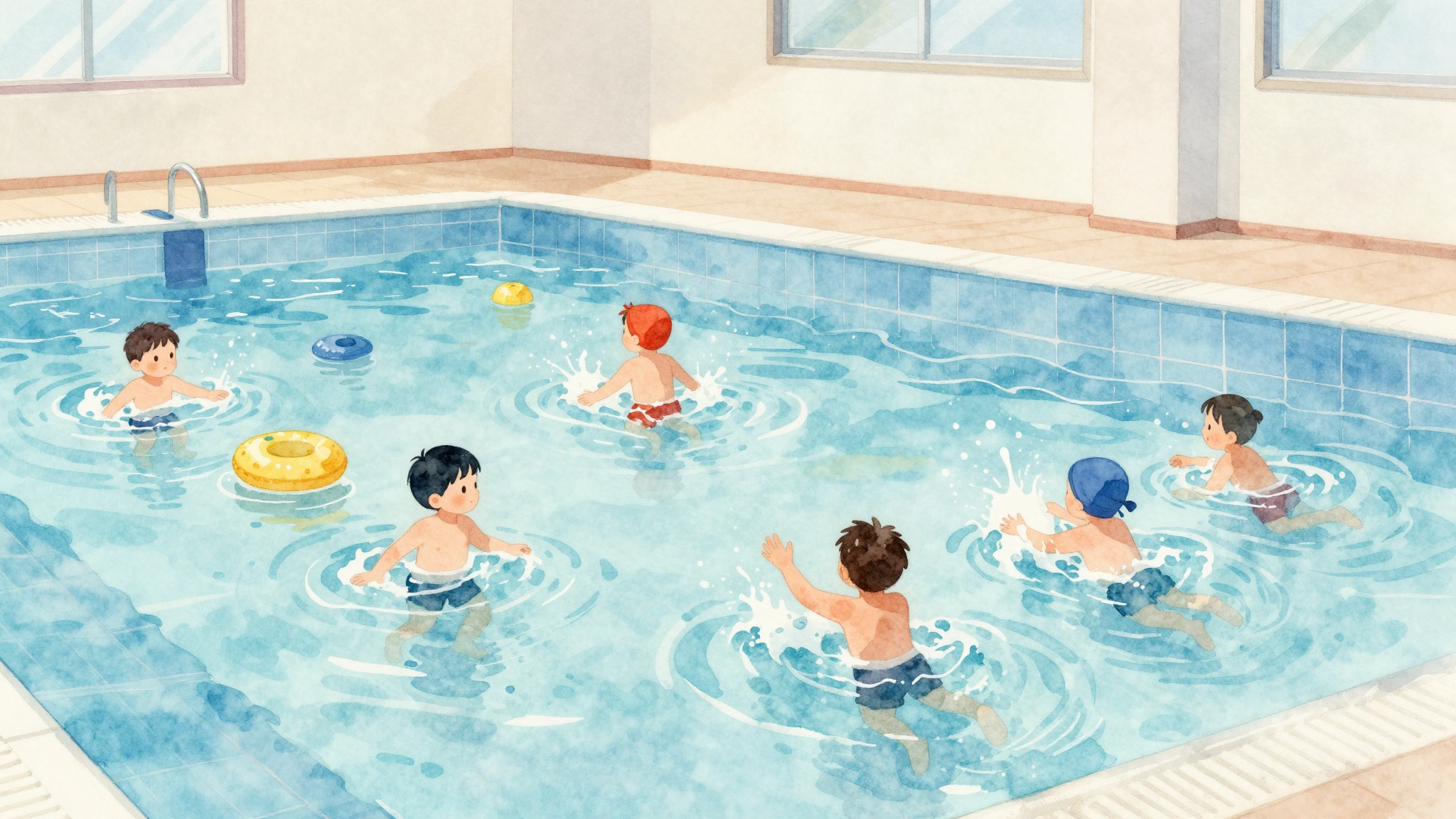
Confidence in the water is perhaps the biggest determining factor for the pace of swimming lessons. A child afraid to put their head underwater or who does not feel safe without the edge within reach needs on average 6 to 12 months extra. Fear blocks the technical learning curve: as long as the brain is in survival mode, it cannot learn new motor patterns. The swimming instructor must first build trust, and that process cannot be rushed. Every time a fearful toddler still enters the water and realizes it is safe, confidence grows a little. That takes time, but the result is a child who not only can swim technically but is also mentally strong enough to stay calm in unexpected water situations.
In countries with a strong beach culture like Spain and Australia, children often get informal water experience at a young age. In the Netherlands, this happens less naturally, especially in families with a migration background or in urban areas without a nearby pool. That difference in starting position explains much of the variation in lesson time between children. An app like Swimmigo, available in 5 languages, helps parents understand what their child can already do, even if big leaps are still pending. That visibility makes waiting more bearable.
Motor Development: The Difference Between Girls and Boys
On average, girls develop their fine motor skills slightly faster than boys between ages 4 and 7. This translates in swimming lessons: girls often have a slight advantage in subtle techniques such as the breaststroke leg kick and the combination of breathing with arm movements. Boys are on average a bit stronger in explosive movements like pushing off the wall. These differences are small, about 1 to 3 months, and diminish as children grow older. By the time children obtain the B and C diplomas, gender differences have virtually disappeared. The main insight is that every child has their own motor development pace, regardless of gender. Do not compare your child to the neighbor girl who happened to pass two months earlier.
Concentration and Motivation: The Power of Fun
Children who enjoy swimming lessons learn demonstrably faster. Research by the Mulier Institute on children's swimming lesson experience shows that positive emotions during lessons accelerate the acquisition of new skills. Children who feel tension or go reluctantly experience a delay of 2 to 5 months. The key lies with the swimming instructor: learning through play, celebrating small successes, and creating a safe atmosphere where making mistakes is allowed. Parents can contribute by speaking positively about swimming lessons at home, not comparing with other children, and praising the process rather than only the end result. A child who hears "well done for daring to put your nose underwater today!" builds more confidence than a child who only receives compliments upon the diploma.
Group Size: How Much Attention Does Your Child Get?
The group size in swimming lessons directly affects the speed of the learning trajectory. In a group of 4 to 6 children, each child gets on average 7 to 10 minutes of direct instruction per lesson. In a group of 10 to 12 children, that drops to 3 to 5 minutes. The difference accumulates: over 75 lessons, that means 150 to 375 minutes of extra personal attention. That is 2.5 to over 6 hours of additional individual guidance. Smaller groups are more expensive, but they save time which can ultimately reduce total costs because fewer lessons are needed. This calculation is universally valid: whether you swim in Amsterdam or Sydney, the quality of instruction correlates with the amount of one-on-one moments a child receives.
Swimming schools that use a digital tool like Swimmigo can use available lesson time more efficiently. The instructor does not have to manually make notes after each lesson about who masters which skill. That time goes back to the pool, to the children. In practice, this saves 5 to 10 minutes per lesson, which adds up to measurable time savings.
Waiting Time Before the First Lesson: A Forgotten Factor
Many parents only realize at registration that the clock is already running before the first lap is swum. Waiting times of 3 to 6 months are more the rule than the exception in the Netherlands, with outliers up to 10 months in urban areas. The total time from the decision "my child must take swimming lessons" to the A diploma on the wall is therefore often more than 2 years: 4 to 6 months waiting plus 18 months of lessons. That is frustrating, but it explains why it seems to take so long. It helps to actively use that waiting time: practice putting the head underwater in the bath, go regularly to the pool, and start building water familiarization. This way your child starts with an advantage once the first lesson begins.
Here too, the Dutch problem illustrates a global challenge. In countries with fewer pools per capita, such as parts of the United Kingdom, waiting lists of 6 to 12 months are not uncommon. In densely populated parts of India and Southeast Asia, access to formal swimming lessons is limited. The WHO identifies lack of access to swimming education as a key factor in global drowning statistics: 92% of all drownings occur in low- and middle-income countries where swimming lessons are often inaccessible.
The B and C Diplomas: How Long Does the Complete Zwem-ABC Take?
After the A diploma, you are not done yet, but the pace increases. The B diploma takes on average 12 clock hours, or 18 to 20 lessons. The C diploma the same again. This brings the complete Zwem-ABC to about 72 clock hours, or over 110 lessons. With one lesson per week, that is a trajectory of nearly 3 years. With two lessons per week, the full ABC can be completed in about 2 years. The good news: the hardest phase, in which children must learn to deal with fear, master new movements, and learn to trust their own abilities, is in the A trajectory. The B and C diplomas focus mainly on refinement, fitness, and applying skills in new situations such as swimming with clothes on or in open water.
The Dutch ABC system is internationally exceptionally thorough. In the United States, formal swimming lessons often stop after basic self-rescue: being able to float, swim 25 meters, and safely reach the edge. The Zwem-ABC adds survival in open water, underwater orientation, and swimming with unexpected obstacles. These extra skills make the difference between a child who is safe in a pool and a child who can also manage in a Dutch ditch, pond, or sea. And that is exactly what the National Council for Swimming Safety aims for.
Why Intensive Summer Courses Are Not Always the Solution
During summer holidays, you see them everywhere: turbo swimming courses promising your child will get a diploma in one or two weeks. It sounds tempting, especially when waiting lists are long and the regular trajectory feels endless. But the NRZ warns that extremely short courses have an important disadvantage: what is learned quickly is also forgotten faster. A skill needs time to settle into long-term memory. In a two-week course, movements are stored in short-term memory. Enough to pass the exam, but insufficient to remain self-reliant in the water a year later. Swedish research on intensive swimming courses shows that children who obtained their first diploma in one month lost significantly more skills after a year without practice than children who reached the same level in 4 to 6 months. The message: fast is nice, but not if it comes at the expense of long-term safety.
What Does the Timeline Mean for Your Planning as a Parent?
If you know the A diploma takes on average 18 months, you can align your family planning accordingly. Register in time, ideally half a year before your child turns 5. This prevents the waiting list from adding on top of lesson time. Do not combine swimming lessons with other major changes such as starting primary school or moving house. A child just getting used to school has less mental space for swimming lessons and may progress more slowly. Also take holidays into account: a 6-week summer break often means a step back in the first weeks after restarting. Many swimming schools now offer holiday programs to limit that loss.
For expat families, planning is even more complex. A family temporarily living in the Netherlands may not have 3 years for the full ABC trajectory. In that case, focusing on the A diploma (18 months) can already provide basic safety. Swimmigo, available in 5 languages, helps expat parents keep track of their child's progress despite language barriers. The app shows per skill what your child can already do, in the language you choose. This keeps you involved, even if you do not know the Dutch swimming terms yourself.
How to Keep Track of Progress as a Parent Without Sitting Next to the Pool Every Lesson
The biggest frustration of parents is not so much the duration of the trajectory, but the lack of insight. You bring your child to the pool, wait in the canteen, and only hear after months whether they move to the next level. That opaque process makes it seem longer than it is. By gaining interim insight into what your child is learning, the perspective shifts: instead of "it has already taken 8 months," it becomes "look, in 8 months my child has mastered 12 of 32 skills." That is a world of difference.
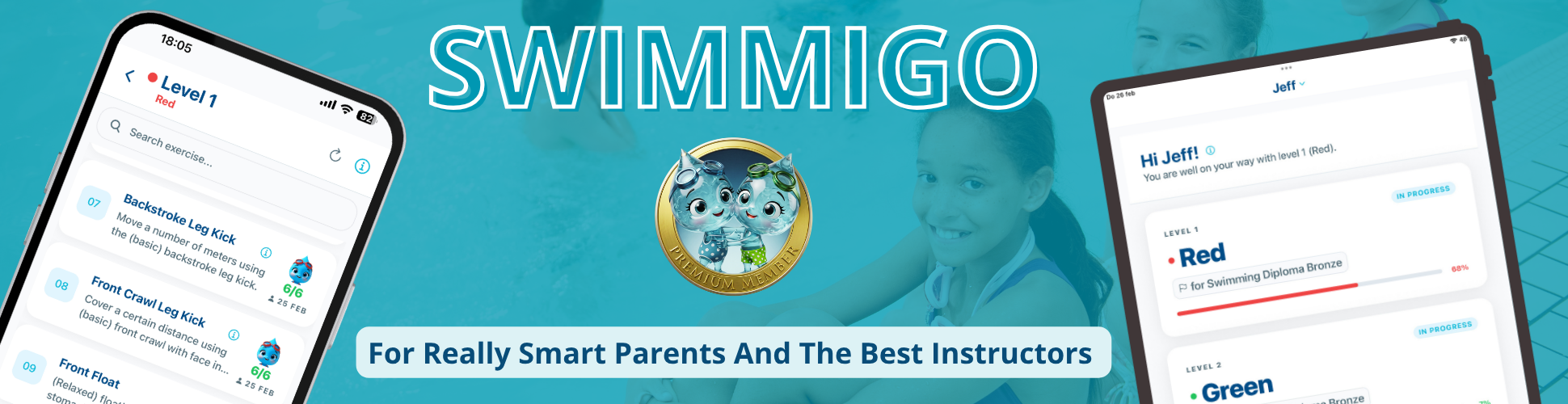
Technology has recently made that insight accessible to everyone. In the Swimmigo app, you see per exercise how far your child is, with color codes from red to gold. Your child earns a digital diploma after each level that you can print at home. The app is free, works in 5 languages, and sends push notifications when your child advances a level. It replaces uncertain waiting with a transparent process showing that every lesson counts. For swimming instructors, it is a way to keep parents informed without extra administration. Entering smiley scores once after the lesson allows parents to see progress immediately on their phone.
Factors Influencing the Timeline: An Overview
| Factor | Average Effect on Timeline |
|---|---|
| Starting age 4.5 to 5 years | Baseline (reference value) |
| Starting age younger than 4 years | +4 to 8 months |
| Starting age older than 6 years | -2 to 4 months |
| One lesson per week | Baseline (~18 months) |
| Two lessons per week | -4 to 6 months |
| No prior water familiarization | +2 to 4 months |
| Attended baby swimming | -2 to 4 months |
| Fear of water | +6 to 12 months |
| Small group (4 to 6 children) | -3 to 5 months |
| Large group (10 to 12 children) | +3 to 5 months |
| Summer holiday break | +1 to 2 months (recovery time after restart) |
No child meets all averages simultaneously. A 6-year-old who has been water confident for years and swims twice a week in a small group can finish in 8 to 10 months. A fearful 4-year-old swimming once a week in a group of 10 children may take 2 to 2.5 years. Both extremes are normal. The table helps form realistic expectations and understand which factors you can influence and which you cannot.
Conclusion
The A diploma takes on average 18 months with one lesson per week. That is not a sign that something is wrong; it is the pace at which a child learns to swim safely and sustainably. Age, water familiarization, lesson frequency, group size, and confidence determine whether it goes faster or slower. The waiting time before the first lesson also counts. With an app like Swimmigo, you can see in the meantime what your child already can do, making the wait less frustrating. Ultimately, it is a lifelong skill that offers protection in every water, in every country. Taking the time for it is justified.
Want to know more? Visit our parent page or discover the 7 levels of the Swimmigo system. Swimming instructor? See the instructor page to get started for free.
Sources
- National Council for Swimming Safety (NRZ): All about swimming lessons and diplomas, 2026
- World Health Organization: Drowning fact sheet, 2025
- R&A Sports: Why does swimming lesson sometimes take longer than expected?, 2025
- National Council for Swimming Safety: Zwem-ABC standards and diploma requirements, 2026
- United Nations: World Drowning Prevention Day, 2025
- Gold Medal Swim School: How long does it take to learn how to swim?, 2025

Bob van Soest
As an expert in operating sports facilities (such as swimming pools) and developer of, among others, Swimmigo.com, I am passionately committed to making swimming lessons simpler, more fun and more insightful for parents, swimming instructors and everyone who wants to learn to swim.
Frequently Asked Questions
Related articles

Why Showering Before Swimming Lessons Is So Important
Why shower before swimming lessons? Discover why hygiene and preparation are crucial for the best swimming experience. Read our tips and avoid surprises!
When to Start Swimming Lessons for Optimal Progress
Read from which age swimming lessons are effective for the best results and safety of your child in the water.
Effectively Registering Swimming Lesson Progress from What Age?
Discover from what age you should best register swimming lesson progress and how to do this practically.
Discover Swimmigo
The all-in-one app for swimming lesson progress. For parents, swim schools, and adult swimmers.