HowLongDoesItTaketoGetAllSwimmingDiplomas?RealisticTimelineforParents[2026]
![How Long Does It Take to Get All Swimming Diplomas? Realistic Timeline for Parents [2026]](/_next/image?url=https%3A%2F%2Fzvblogpostimages.s3.eu-west-3.amazonaws.com%2FAUTOMATISCH_UPLOAD%2F1_7bf490160481.jpg&w=3840&q=75&dpl=dpl_GWyfLj8UVegbQ18STkVQms8Vj7LD)
Summary
- The A diploma takes on average 12 to 18 months with 1 lesson per week, the B diploma 6 to 12 months, and the C diploma another 6 to 12 months
- Children who attend swimming lessons twice a week obtain their diplomas about 40% faster than children with 1 lesson per week
- Starting age is the most important factor: children who start at 4.5 to 5 years progress through the levels most smoothly
- With Swimmigo, parents can see exactly where their child stands in the 7 levels and 86 skills, so you are never in the dark about progress
- The total route from first swimming lesson to full C diploma takes on average 2.5 to 3.5 years, but with targeted support this can be shorter
The question every parent asks: how long does swimming lessons actually take?
You just signed your child up for swimming lessons. The first lesson has taken place, the swimsuit is in the bag, and you look forward to the moment your son or daughter can be photographed with a diploma. But somewhere a question nags: how long will this take? Months? Years? And why does it seem to go so fast for one child and so slow for another?
You are not the only one struggling with this. Parents all over the Netherlands wonder if their child's swimming lesson progress is on track. Especially when you hear that neighbor girl Emma had her A diploma within a year, while your child has been practicing the breaststroke for a year and a half. In this overview, we explain exactly how long each diploma typically takes, which factors influence the timeline, and how you as a parent can actively contribute to a smooth progression.
The Dutch swimming diploma system: A, B, and C explained
What exactly does the A diploma entail?
The Swimming Diploma A is the first official swimming diploma your child can earn. It focuses on basic skills: breaststroke, single backstroke, treading water, climbing through a hole in a sail, and exiting the water with clothes on. Your child learns to save themselves in a pool without current. The A diploma is sufficient for recreational swimming in a supervised indoor pool, but it is not yet safe enough for open water.
On average, the A diploma takes 12 to 18 months with one lesson per week of 45 to 60 minutes. Children who swim twice a week often obtain it within 8 to 12 months.
The B diploma: the next step towards independence
After the A diploma, your child moves on to the B track. Here, basic techniques are refined and more endurance is required. Distances become longer, exercises more complex, and more emphasis is placed on swimming in deeper water. The B diploma means your child can swim independently in a subtropical pool with slides and a wave pool.
The B diploma typically takes an additional 6 to 12 months after obtaining the A diploma. Progression here is often faster because the foundation is already laid.
The C diploma: fully swim-safe in open water
The C diploma is the crown jewel of the Dutch swimming education. Your child learns to handle currents, waves, longer distances, and unexpected situations in open water such as lakes, rivers, and the sea. With the C diploma, your child is fully swim-safe in all Dutch waters. The focus is on survival skills, endurance, and self-reliance in challenging conditions.
The C diploma takes another 6 to 12 months after the B diploma. Many children obtain their C diploma around the age of 8 to 9, provided they started around their 5th birthday.
Average timeline at a glance
For an average child starting at age 5 with one swimming lesson per week, the schedule looks as follows:
Overview: from start to C diploma
📱 ← scroll right for all columns →
| Diploma | Minimum Duration | Average Duration | Maximum Duration | Typical Age at Completion |
|---|---|---|---|---|
| A diploma | 8 months | 14 months | 24 months | 6 to 7 years |
| B diploma | 5 months | 9 months | 15 months | 7 to 8 years |
| C diploma | 5 months | 9 months | 15 months | 8 to 9 years |
| TOTAL | 18 months | 32 months | 54 months | 5 to 9 years |
The total journey from first swimming lesson to full C diploma takes on average 2.5 to 3.5 years. Some children take less time, others longer: this is completely normal. Every child develops at their own pace.
Factors influencing the duration
Your child's age at the start
The starting age is by far the most important determining factor for the total swimming lesson duration. Children who start between 4.5 and 5 years old generally have the most efficient progression. They are motorically developed enough to learn the breaststroke but still young enough to smoothly move through the levels. Children who start at 6.5 or 7 years often master the technical skills faster but may take longer to complete the A diploma because they need to swim significantly more meters in the same transition phase.
Lesson frequency: once or twice a week?
This is the factor where you as a parent have the most influence. Children who swim twice a week obtain their diplomas on average 40% faster than children with one lesson per week. Twice a week means the material sticks better and the technique does not fade away in the six days between lessons. The downside is that it costs twice as much and demands more from your schedule. Many parents choose a middle ground: twice a week in the first year to quickly build the foundation, then back to once a week.
Fear of water and self-confidence
Children who are afraid of water take on average 4 to 8 months longer to obtain their A diploma. First, the fear must be overcome before working on technique. This is not lost time: building water confidence is the most important foundation for all swimming safety. A child who enters the water confidently learns faster and more thoroughly than a child who participates reluctantly.
Individual motor development
Some children naturally have better coordination and body awareness than others. The breaststroke requires simultaneous movement of arms and legs in a specific rhythm. For children who are motorically a bit later, learning this takes longer. The transition to the single backstroke can also be a stumbling block because it requires a completely different coordination pattern. This is no cause for concern: it just means your child needs a bit more time and repetition.
Swimmigo: see exactly how far your child has progressed
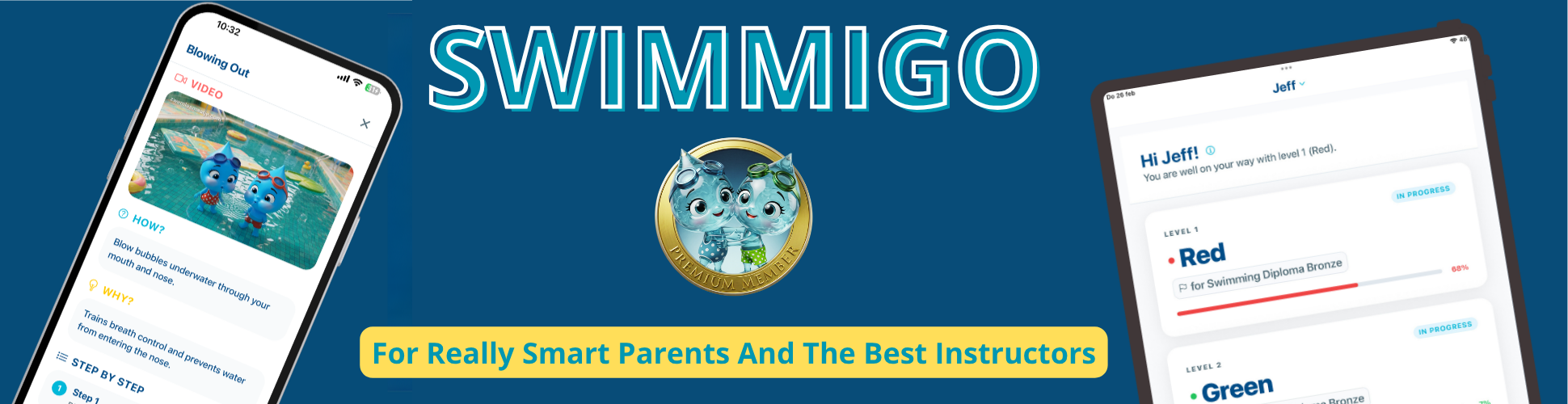
One of the biggest frustrations for parents is the lack of insight into swimming lesson progress. You get a paper with a checkmark every few months, but what it really means remains vague. Swimmigo solves this by giving you as a parent real-time access to your child's digital logbook.
Follow progress per exercise in real-time
In Swimmigo's parent portal, you can see exactly which of the 86 skills your child already masters and which are still being worked on. The instructor gives scores after each lesson using the 0 to 6 smiley system, and you see these immediately in the app. No more surprises at the next report meeting: you always know where your child stands. You also receive a push notification as soon as your child is ready to move to the next level. This way, you stay involved without having to sit at the poolside every lesson.
7 levels, 86 skills: see exactly where your child stands
The Dutch swimming path is divided into 7 levels from Red to Gold. Each level contains specific skills your child must master before progressing to the next level is possible. Instead of waiting for the semi-annual progress meeting, you see at a glance in Swimmigo how far your child has come. Is your child stuck on a specific exercise? Then you can practice that at home specifically. For each level achieved, your child receives a free, personalized swimming certificate with name and date.
Practical tips to shorten total swimming lesson time
Extra practice outside swimming lessons
Children who go to the pool weekly with their parents to practice progress through the levels demonstrably faster. It's not about learning new techniques, that's the instructor's job, but about maintaining what has already been learned. An hour of free swimming per week where your child practices breaststroke or treading water helps the material stick. Many pools offer affordable family subscriptions specifically for this purpose.
Use vacation mode for continuity
The summer vacation is traditionally the period when swimming lesson progress loses the most ground. Six weeks without swimming lessons often means taking two steps back. Swimmigo has a vacation mode that allows you to check off exercises yourself during the summer. Going to the holiday pool or lake with the family? Open the app, see which exercises your child was practicing, and have your child repeat those exercises in the holiday pool. This way, progress is maintained and your child doesn't start the new season behind.
Choose the right swimming school with small groups
Group size has a measurable effect on the duration. In a swimming lesson group of 4 to 6 children, each child receives significantly more personal attention from the instructor than in a group of 10 to 12 children. On average, this saves 10 to 20% of the total time per diploma. Feel free to ask about the average group size during intake and how often a child actually gets to practice during a 45-minute lesson.
Conclusion
The path to the full C diploma is different for every child. On average, you can expect 2.5 to 3.5 years from the first swimming lesson to the final certificate. The biggest factors you as a parent can influence are the starting age, lesson frequency, and practicing at home in the pool. With tools like Swimmigo, you always have insight into how far your child has progressed, so you never face surprises at the next report meeting. Keep trusting your child's pace: swimming safety is more important than speed.
Want to know more about swimming lesson progress? Also check out these pages:
- The 7 levels of Swimmigo: Red to Gold
- How Swimmigo works for parents and swimming schools
- All features of Swimmigo at a glance
- Swimmigo for swimming instructors and schools
- The free student tracking system for swimming lessons
Sources

Bob van Soest
As an expert in operating sports facilities (such as swimming pools) and developer of, among others, Swimmigo.com, I am passionately committed to making swimming lessons simpler, more fun and more insightful for parents, swimming instructors and everyone who wants to learn to swim.
Frequently Asked Questions
Related articles
Why Showering Before Swimming Lessons Is So Important
Why shower before swimming lessons? Discover why hygiene and preparation are crucial for the best swimming experience. Read our tips and avoid surprises!
When to Start Swimming Lessons for Optimal Progress
Read from which age swimming lessons are effective for the best results and safety of your child in the water.
Effectively Registering Swimming Lesson Progress from What Age?
Discover from what age you should best register swimming lesson progress and how to do this practically.
Discover Swimmigo
The all-in-one app for swimming lesson progress. For parents, swim schools, and adult swimmers.