FearofWaterinChildren:HowDoesItAffectSwimmingLessonProgressandWhatCanYouDoasaParent?[2026]
![Fear of Water in Children: How Does It Affect Swimming Lesson Progress and What Can You Do as a Parent? [2026]](/_next/image?url=https%3A%2F%2Fzvblogpostimages.s3.eu-west-3.amazonaws.com%2FAUTOMATISCH_UPLOAD%2F1_0a0e35688782.jpg&w=3840&q=75&dpl=dpl_FEcJLWFaZFj4CsT2F159aPzMcoRK)
Summary
- Fear of water is one of the biggest causes of delay in swimming lessons: it can extend learning time by 6 to 12 months
- The fear is biologically normal, a self-protection mechanism that can be broken with the right approach
- Building water fun at home, open communication with the swimming instructor, and celebrating small victories are keys to breakthrough
- Digital tools like a student tracking system help make every small progress visible for child and parent
What is fear of water and why does it slow down swimming lesson progress?
You have finally enrolled your child in swimming lessons. The swim gear is ready, the lesson fee is paid, and then it happens: at the first lesson your child clings to the edge, refuses to enter the water, or starts crying as soon as the swimming instructor approaches. Sound familiar? You are not alone. Fear of water is one of the most underestimated causes of delay in swimming lesson progress worldwide. International research shows that fear of water is the biggest predictor of learning difficulties in the initial phase of swimming lessons, regardless of whether a child takes lessons in the Netherlands, Germany, Spain, or the United States (Ostrowski et al., 2022).
The biological basis of fear of water
Fear of water is not just fussiness. It is an evolutionary self-protection mechanism deeply rooted in our nervous system. Water is an unpredictable environment for the young brain: you don’t feel solid ground under your feet, sounds are different, and movements feel unfamiliar. The fight-or-flight response is activated, putting the body on high alert. Increased heart rate, shallow breathing, and tense muscles make learning swimming strokes almost impossible. As AD previously reported: often these are children who had too little contact with water during infancy. The brain does not recognize water as a safe environment and reacts with resistance (AD, 2023).
How fear of water affects learning speed
A child who enters the water relaxed learns on average two to three times faster than a child with fear of water. Practice in swimming schools in the Netherlands and beyond shows that anxious children take on average 6 to 12 months longer to obtain their A diploma. The reason is simple: each lesson starts with 15 to 20 minutes spent overcoming fear before real skills can be practiced. Time that a relaxed child immediately uses to practice floating, kicking, and the first school stroke movements. This pattern is seen in every country where children learn to swim, from the Netherlands to Australia.
The numbers: how big is the problem?
According to the World Health Organization (WHO), 300,000 people drown worldwide annually. Children under 15 years old make up 43% of the victims. Many of these children never started swimming lessons because they were fearful or stopped lessons prematurely. In the Netherlands, 14% of children between 6 and 12 years old say they do not have any swimming diploma, according to figures from the Mulier Institute (Mulier Institute, 2024). The National Council for Swimming Safety (NRZ) emphasizes that fear is one of the main reasons why parents delay swimming lessons or children stop prematurely.
How do you recognize fear of water in your child?
Signs in and around the pool
Fear of water does not always show as crying or panic. The most common signs are subtler: your child does not want to go into the deep end, stays close to the steps or shallow edge, holds on tightly to the swimming instructor, or refuses to put their face in the water. Frequent bathroom visits just before the lesson, stomach aches, or headaches on swimming lesson days are classic signs. These symptoms are not uniquely Dutch: in all countries where Swimmigo is used, parents report the same fear signs in their children.
The difference between normal nervousness and real fear
There is an important distinction between healthy nervousness for a new challenge and blocking fear. Nervousness subsides after the first few minutes in the water, the child makes eye contact and responds to instructions. With real fear, the tension remains throughout the lesson, the child avoids eye contact and cannot process instructions because the nervous system is in survival mode. If your child reacts exactly the same after three lessons as on lesson one, it is more than ordinary nerves.
What can you do as a parent at home?
Step 1: Water fun without pressure
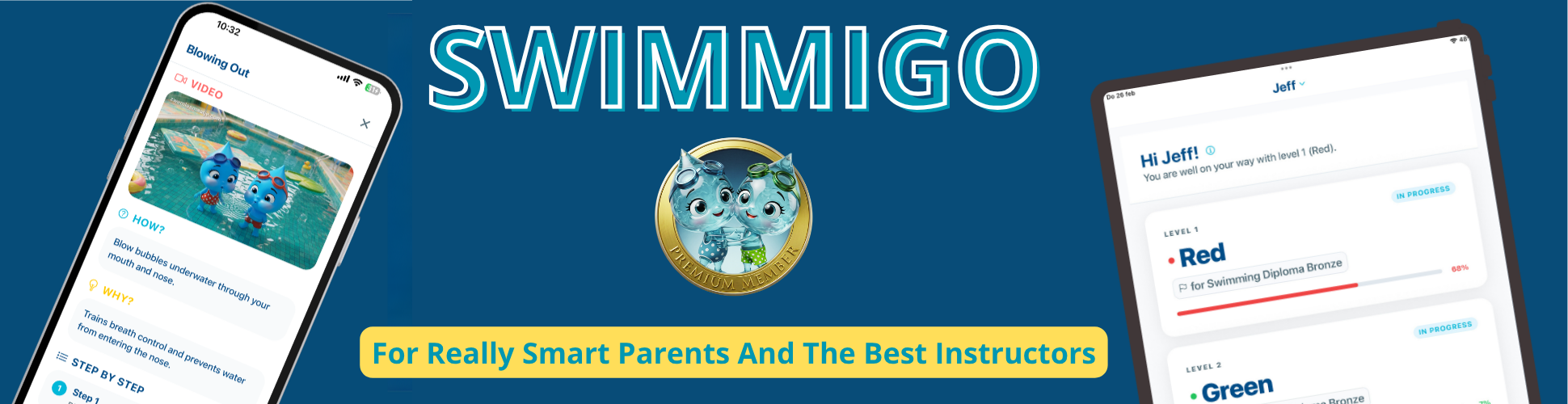
The most important first step is breaking the negative association with water. Go together to a recreational pool on a Sunday morning without lesson pressure. Let your child set the pace. Start in the shallow toddler pool, play with water toys, blow bubbles in the water. The goal is not to learn swimming but to build water enjoyment. Do this weekly and you will see a difference in your child’s attitude during the real swimming lesson within a month. This is a universal principle that works in every water, in every country.
Step 2: Showering and bathing as practice moments
The bathroom at home is a safe, familiar environment to build water acclimatization. Let your child playfully let water flow over their face, first with a washcloth, later under the shower. Do it yourself and make it fun: who can blow the most bubbles in the bath? Who dares to put their ears underwater? Build it up slowly over several weeks. Every child follows their own pace, and that is exactly the approach that yields the best results.
Step 3: Talk to the swimming instructor
A good swimming instructor has experience with fear of water and can tailor the approach. Share what you see at home: when does the fear occur, what helps calm your child? Ask if there are possibilities for extra guidance, such as one-on-one moments or a calmer group. Transparent communication between parents and instructor is essential, something that is increasingly emphasized in Dutch swimming education but is not yet standard everywhere internationally.
How can you track progress if your child is afraid?
Small victories count
For a child with fear of water, the weekly swimming lesson is a mental marathon. What is an ordinary lesson for other children is a victory in itself for your child. The pitfall is to only look at the big milestones: the A diploma, swimming laps independently. But progress in anxious children is often in the small things: today two minutes longer in the water, today independently entering the water from the steps, today putting the face underwater once. These micro-victories are the building blocks of self-confidence and deserve to be seen and celebrated.
Digital tools that help with building confidence
A common frustration among parents is not knowing what happens during the lesson. You drop your child off at the pool, wait an hour in the canteen or car, and the only thing you hear is "it went okay." With a digital solution like a student tracking system, you do have insight. You see exactly which skills were worked on, what went well, and where extra practice is needed. It gives you as a parent concrete tools to continue at home, and it gives your child visual proof of progress, no matter how small.
Swimmigo: insight into every skill
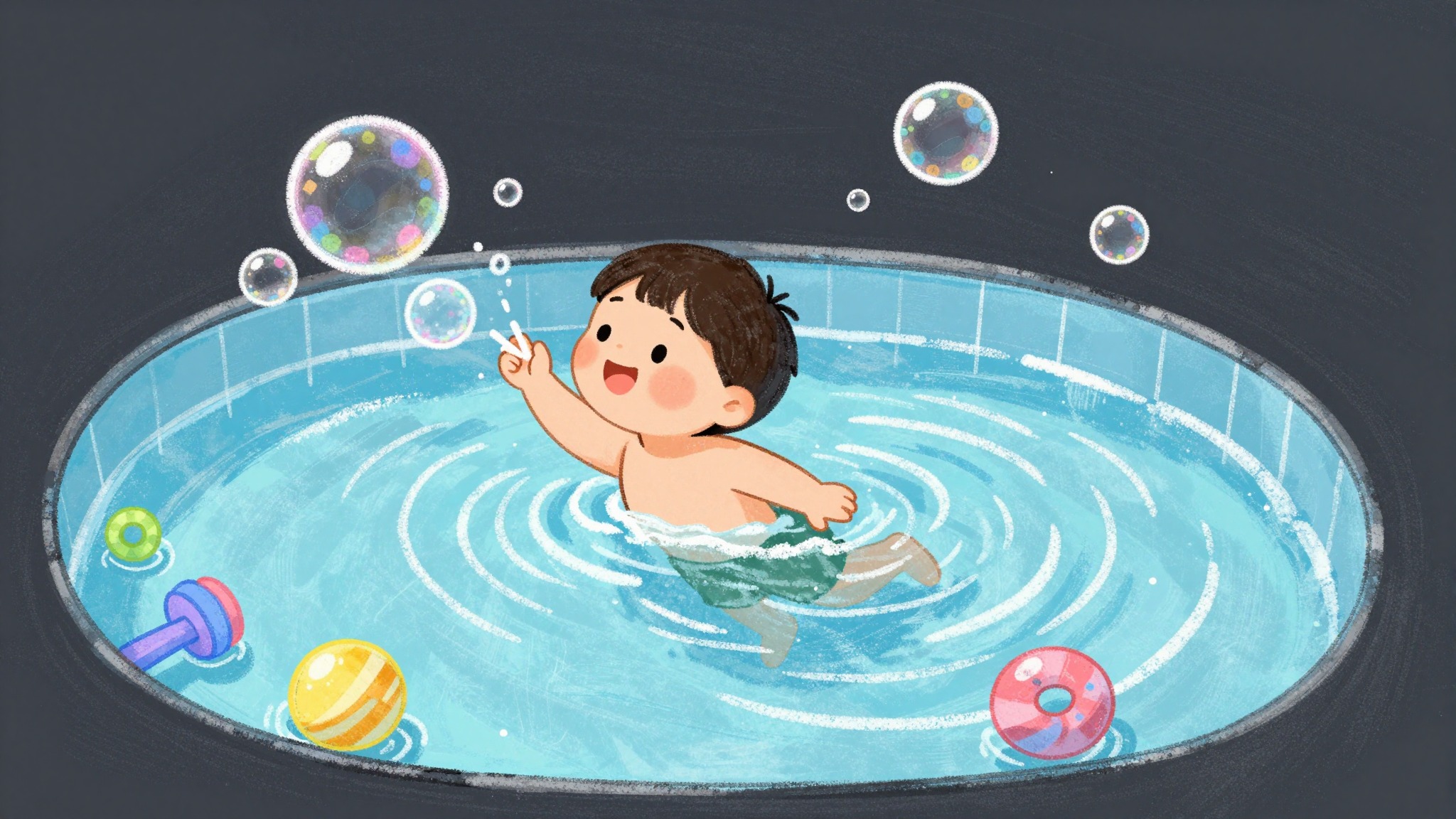
Swimmigo is a free app that allows swimming instructors to track each student's progress per lesson on 86 detailed skills, divided over 7 levels from Red to Gold. For parents, this means you can see in real-time which exercises your child already masters and which are in development. The best part: with children who have fear of water, you literally see the build-up. From "daring to sit on the steps" to "daring to jump off the steps," from "wetting the face" to "head underwater." Every step is a victory you can celebrate together. Swimmigo is available in 5 languages and is used worldwide by swimming schools and parents.
Tips for swimming instructors with anxious children
Patience and positive reinforcement
The golden rule for every swimming instructor working with anxious children: never force, always reward. A child forced into the water does not build trust but rather more resistance. What does work: positively reinforce every attempt, no matter how small. "Good that you dared to sit by the edge today!" Build challenges in tiny steps, where each success feeds the confidence for the next step. Research by Ostrowski et al. (2022) confirms that positive reinforcement is the most effective intervention for swimming anxiety.
Group dynamics and one-on-one moments
Anxious children often thrive better in smaller groups or with short one-on-one moments within the group lesson. An experienced swimming instructor recognizes when a child needs separate attention and plans this into the lesson structure. The visual nature of a student tracking system helps here: you see at a glance which children need extra support and can tailor your lesson time accordingly. This is more efficient than the traditional paper notebook where each child is on a different page.
When does your child need extra help?
Signs that professional guidance is needed
Sometimes fear of water is a symptom of a broader anxiety problem that cannot be solved with extra swimming exercises alone. If your child also shows extreme fear in other situations, such as new social situations, loud noises, or unfamiliar environments, consider consulting a child psychologist or play therapist. Also, if the swimming anxiety remains as intense after 3 months of targeted guidance as on day one, external help is advisable. In many countries, special anxiety treatments are available for this, and more and more swimming schools collaborate with behavioral therapists to offer a combined approach.
Conclusion: Fear of water does not have to be a lasting barrier to your child's swimming lesson progress. With the right combination of patience, home exercises, and good communication with the swimming school, you can break through the fear step by step. Digital tools like Swimmigo make every small victory visible, which strengthens your child's self-confidence and keeps motivation high. Every child can learn to swim; it is just a matter of the right approach at the right pace. In every water, in every country, with the right guidance.
Further reading
- Swimmigo for parents: track your child's swimming lesson progress
- Swimmigo for swimming instructors: free student tracking system
- The 7 Swimmigo levels: from Red to Gold
- Student tracking system for swimming schools: everything you need to know
Frequently Asked Questions
General questions about fear of water and swimming lessons
These questions are asked by parents and swimming instructors alike.
Questions from parents
Practical questions parents ask about the swimming lesson progress of their anxious child.
Questions from swimming schools
Questions swimming instructors and swimming school owners ask about dealing with anxious children.
Sources
- PMC: Individual Determinants as the Causes of Failure in Learning to Swim (Ostrowski et al.) , 2022
- WHO: Drowning Fact Sheet , 2025
- Mulier Institute: Swimming Skills 2024 , 2025
- NRZ: More and more children in the Netherlands obtain swimming diplomas A, B, and C , 2025
- AD: Does your child not want to swim? Often this is related to insufficient contact with water in infancy , 2023
- Felix Swim Schools: Fear of Water, The Hidden Barrier Slowing Swim Progress , 2024

Bob van Soest
As an expert in operating sports facilities (such as swimming pools) and developer of, among others, Swimmigo.com, I am passionately committed to making swimming lessons simpler, more fun and more insightful for parents, swimming instructors and everyone who wants to learn to swim.
Frequently Asked Questions
Related articles
When to Start Swimming Lessons for Optimal Progress
Read from which age swimming lessons are effective for the best results and safety of your child in the water.
Effectively Registering Swimming Lesson Progress from What Age?
Discover from what age it is best to register swimming lesson progress and how to approach it practically.

Efficiently Registering Swimming Lesson Progress per Group
Practical tips for tracking swimming lesson progress per swimming lesson group for parents and instructors.
Discover Swimmigo
The all-in-one app for swimming lesson progress. For parents, swim schools, and adult swimmers.