Failed the Swimming Diploma: How to Help Your Child Pass the Retake [2026]
![Failed the Swimming Diploma: How to Help Your Child Pass the Retake [2026]](/_next/image?url=https%3A%2F%2Fzvblogpostimages.s3.eu-west-3.amazonaws.com%2FAUTOMATISCH_UPLOAD%2F1_27b4c241d1de.jpg&w=3840&q=75&dpl=dpl_HNfPD3TqcZ6YivYMd3CXCgSrAu42)
Summary
- Failing the swimming diploma happens more often than you think; exam anxiety often plays a bigger role than swimming talent.
- A fail says nothing about your child, but something about one moment under pressure, with an audience present.
- The fastest way to a successful retake: ask for concrete feedback, practice exam parts, and schedule a trial exam.
- Diploma A is a milestone; diploma C is the National Swimming Safety Standard, and supervision remains necessary even with a diploma.
The stands are full, the examiner is ready, and your child is swimming their laps. Then it happens: not passed. It is one of the most underestimated moments in the swimming journey, for your child and for you. Yet it happens to many children, and how you react largely determines how the retake goes. Below you’ll read what failing exactly means, how to handle the disappointment, and how to help your child cross the finish line next time.
Failing the swimming diploma happens more often than you think
On social media, you mostly see children who passed with a celebratory ribbon. The children who didn’t make it quietly keep swimming. This makes failing feel like an exception, while in practice it’s quite common. A second attempt is more the rule than the exception at many swim schools.
Passing the exam is an exam, not a regular lesson
A swimming exam moment is different from a lesson. Your child has to show what they can do at a fixed moment, with an unfamiliar examiner present and other parents in the stands. Children who show everything in lessons sometimes freeze at such a moment. The National Council for Swimming Safety (NRZ) sets the requirements for the National Swimming Diplomas; these are the same for every child, but the execution on the day itself varies per child.
What the numbers say
There are no nationwide figures on how many children fail on their first attempt; swim schools do not centrally track this. What is known: many children do not get a diploma at all. In 2022, 13 percent of children aged 6 to 16 had no swimming diploma, twice as many as in 2018. The Mulier Institute saw in 2024 14 percent of children aged 6 to 12 without any diploma, about four children per class of thirty. At the same time, 38 percent of 6 to 12-year-olds now have all three diplomas A, B, and C. Most children eventually get there, but not always in a straight line.
The same problem, in every country
Swimming diplomas and level tests exist in many countries, from the Zwem-ABC in the Netherlands to level programs in Australia, the United States, and Great Britain. The same applies everywhere: children sometimes fail, and drowning is a major risk as long as children do not master the water. The World Health Organization estimates that about 300,000 people drown worldwide annually, and drowning is one of the leading causes of death among children aged 1 to 4 years. In the past decade alone, drowning has claimed more than three million lives worldwide, mostly children and young people. Obtaining a diploma is therefore not a matter of prestige but a matter of safety. That’s why failing feels so heavy, and why a good retake is worth the effort.
Swimmigo · Swim lesson app
Free for parents
Follow your child's swimming progress, see where you stand and report absences in the app.

What failing does and does not say about your child
One thing upfront: a fail on the swimming exam says nothing about your child’s intelligence, perseverance, or swimming talent. It says something about one moment, under pressure, with an audience present.
Exam anxiety is not a swimming problem
Research on test anxiety repeatedly shows that children with high anxiety perform worse than children with low anxiety, even if they know the material. The same happens during the swimming exam: legs tremble, breathing quickens, and suddenly the breaststroke that always worked in lessons doesn’t work anymore. The Child Mind Institute calls this not a weakness but a normal bodily response to stress. The good news: you can do something targeted about it.
Praise effort, not talent
How you as a parent react to failing may be the most important part of the retake. Psychologist Carol Dweck showed in classic research that children praised for their effort after a setback more often chose a harder task and then performed better than children praised for their talent. Children who hear they are smart or a natural talent experience a fail as a judgment on who they are. Children who hear they worked hard see a fail as a signal that they can work even harder or smarter.
A diploma is a milestone, not a finish line
It’s also good to adjust expectations about the diploma itself. With the National Swimming Diploma A, your child masters the skills for a pool without attractions; it is the step towards B and C. Only the C diploma counts as the National Swimming Safety Standard. The NRZ emphasizes that swimming safety is only maintained by continuing to practice. In other words: even a child who passed is not done yet, and a child who fails now is far from hopeless. The NRZ’s National Swimming Safety Plan, which entered a new phase in 2025, focuses on giving all children equal chances to get a diploma, including those who take longer.
The first 24 hours after the bad news
Handle the disappointment without brushing it away
Many parents’ first reaction is to comfort with "it doesn’t matter." That feels like denying the child’s sadness because it does matter, to them. Better: name the feeling. "You’re really upset, I understand. I’m a bit upset too." Then the space for the next step comes naturally.
Don’t compare your child to classmates
"Johnny from school passed" is the fastest way to break motivation. Every child learns at their own pace, and comparing doesn’t help any swimming stroke forward. Compare your child at most to themselves: last month they couldn’t swim 25 meters, now they can.
Focus on the next step
Children recover quickly if there is a plan. Ask the swim school when the retake is possible and set one concrete goal together with your child: the breaststroke with calm breathing, or jumping in from the side without hesitation. A small goal provides support, a big goal overwhelms.
How to approach the retake properly
Ask the examiner for concrete feedback
Most examiners do explain why a child didn’t pass afterwards, but parents often don’t hear it through the disappointment. Ask calmly: what went well, what needs improvement, and how does the swim school recognize that the child is ready? Write it down. This feedback is invaluable for the weeks ahead.
Practice the exam parts, not just the breaststroke
A swimming exam tests more than strokes: entering the water, floating, climbing back onto the side, and performing the parts in a smooth sequence. Children who practice these parts separately at home or in the recreational pool are less likely to get stuck on the day itself. Ask the swim school for the exam program, so you know exactly what to expect.
Schedule a trial exam
Many swim schools offer a trial exam: doing the exam without an official result. This is the best way to reduce tension because the child knows nothing is at stake. Ask about it, even if it’s not standardly offered.
Choose the right moment for the retake
Retaking too soon backfires, waiting too long does too. A retake after three to six weeks is ideal for most children: long enough to practice purposefully, short enough to keep motivation. Don’t plan right after a busy holiday or a period of illness.
Show your child progress
Children who failed often think they are standing still. The antidote is visible progress. In Swimmigo you track what your child can do per exercise, divided over seven levels with a total of 86 skills. After each practice session, you check off what worked, and after a few weeks your child sees with their own eyes that something has changed. That works better than any encouraging words. Swimmigo is free, available in five languages, and used worldwide; on the page for parents you can see how it works.
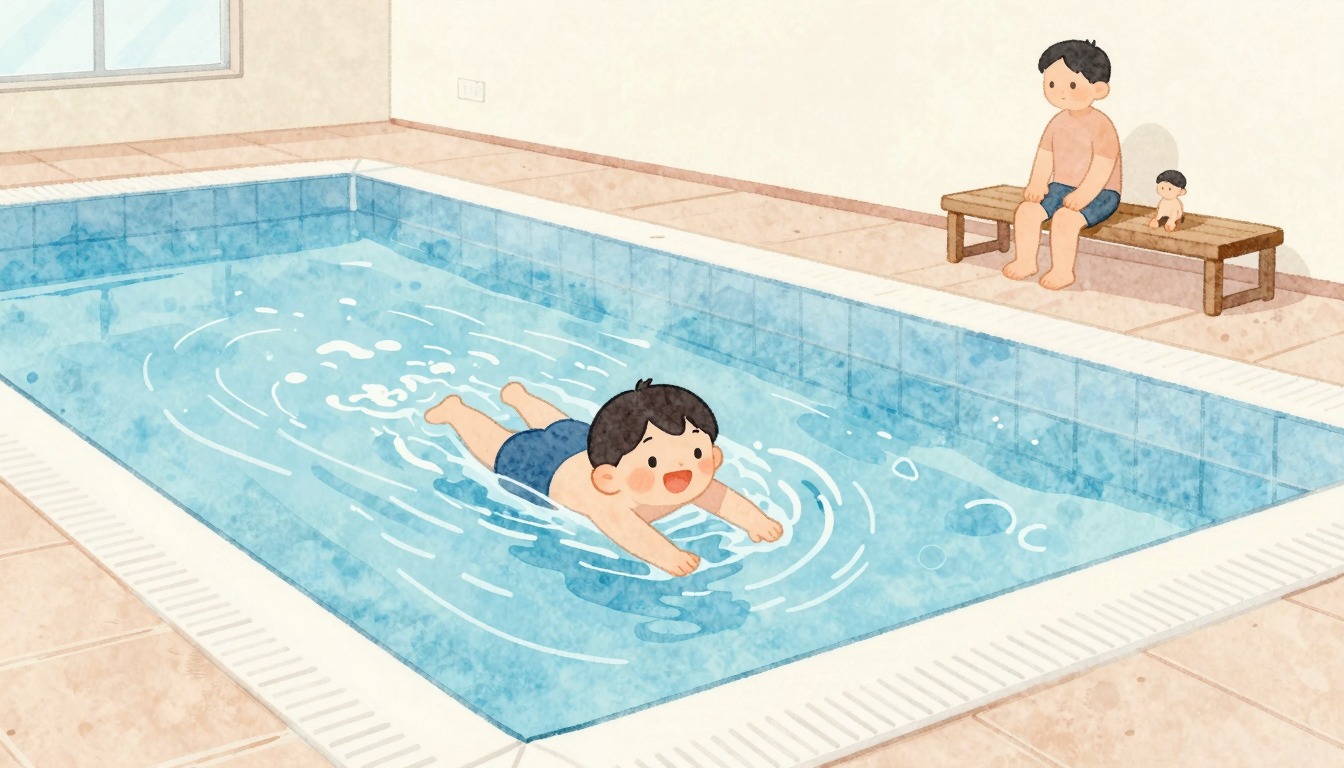
How to tackle exam anxiety in the lead-up to the retake
Relaxation exercises that children actually use
The simplest exercise also works for children: breathe in calmly through the nose, breathe out twice as long through the mouth. Do it together, in the bath, in the car, in the stands. It also helps to visualize the exam beforehand: close eyes, mentally go through the course, reach the finish. Sounds airy, but it’s a technique top athletes have used for decades.
A calm morning does more than extra practice
On the day itself: no rush, no last practice round, but a good breakfast and arriving at the pool on time so the child can get used to the environment. The child psychologists of the Child Mind Institute advise exactly that for test anxiety: a fixed routine and calm, instead of last-minute practice.
Normalize failure
Every swimmer, even at the Olympic level, has lost races and messed up competitions. Failure is part of learning, and your child should hear that. It makes the retake less heavy: it’s not a test of their worth, but a second chance to show what they can do.
When is there more going on?
Persistent anxiety or avoidance behavior
For most children, failing is a setback they quickly grow out of. But if your child refuses swim lessons for weeks, gets stomach aches before every lesson, or suddenly is afraid of shallow water, there is more going on. Then it helps to remove the pressure completely and first bring back the fun.
Talk to the swim school
Swim instructors see children struggling with tension every week. A good conversation with the swim school often yields surprising results: a different group, a lesson at a quieter time, or an adjusted exam moment. You know your child, they know the water; together you usually find a solution.
Conclusion
Failing the swimming diploma is a disappointment, not a verdict. It says something about one moment under pressure, not about your child. Handle the disappointment, ask for concrete feedback, practice the exam parts, and schedule a trial exam, then the chance is high the retake will succeed. And remember: even with a diploma in hand, swimming safety remains a matter of continuous practice, in every country.
Want to know more about how swimming lesson progress works and how to best track it? Check out the seven levels of Swimmigo, read how the student tracking system works, or see what Swimmigo does for parents and instructors.
Swimmigo · Swim lesson app
Free for parents
Follow your child's swimming progress, see where you stand and report absences in the app.
Sources
- National Council for Swimming Safety: Swimming Skills 2022, insight into children’s swimming diploma possession, November 28, 2023
- Mulier Institute: Swimming Skills 2024, factsheet 2025/48, 2025
- NOS: Number of children without swimming diploma continues to rise, 2023
- Netherlands Youth Institute: Fewer children obtain swimming diploma, accessed August 2026
- World Health Organization (WHO): Drowning fact sheet, accessed August 2026
- World Health Organization (WHO): World Drowning Prevention Day 2025, 2025
- National Council for Swimming Safety: Zwem-ABC and other National Swimming Diplomas, accessed August 2026
- National Council for Swimming Safety: National Swimming Safety Plan, 2025
- Stanford: Praising Intelligence, Costs to Children's Self-Esteem and Motivation (Dweck), accessed August 2026
- Child Mind Institute: Test Anxiety Strategies and Study Tips for Kids, accessed August 2026
- Wood et al.: Test anxiety and a high-stakes standardized reading comprehension test, 2016

Bob van Soest
As an expert in operating sports facilities (such as swimming pools) and developer of, among others, Swimmigo.com, I am passionately committed to making swimming lessons simpler, more fun and more insightful for parents, swimming instructors and everyone who wants to learn to swim.
Frequently Asked Questions
Related articles
When to Start Swimming Lessons for Optimal Progress
Read from which age swimming lessons are effective for the best results and safety of your child in the water.
Effectively Registering Swimming Lesson Progress from What Age?
Discover from what age it is best to register swimming lesson progress and how to approach it practically.

Efficiently Registering Swimming Lesson Progress per Group
Practical tips for tracking swimming lesson progress per swimming lesson group for parents and instructors.
Discover Swimmigo
The all-in-one app for swimming lesson progress. For parents, swim schools, and adult swimmers.