Completeoverviewoftrackingswimminglessonprogress:forparentsandswimschools[2026]
![Complete overview of tracking swimming lesson progress: for parents and swim schools [2026]](/_next/image?url=https%3A%2F%2Fzvblogpostimages.s3.eu-west-3.amazonaws.com%2FAUTOMATISCH_UPLOAD%2F1_d7097f3a0452.jpg&w=3840&q=75&dpl=dpl_GWyfLj8UVegbQ18STkVQms8Vj7LD)
Summary
- 300,000 people drown worldwide annually: tracking swimming lesson progress literally saves lives
- Parents often don’t know how their child is doing: 6 out of 10 receive no structured updates from the swim school
- Digital systems like Swimmigo make progress visible in real time for parents and instructors, in 5 languages and completely free
- Instructors save up to 5 hours per week on administration with a student tracking system
- This page is your complete starting point: from paper cards to apps, from diploma timelines to motivation strategies
TLDR
- 300,000 people drown worldwide annually: tracking swimming lesson progress literally saves lives
- Parents often don’t know how their child is doing: 6 out of 10 receive no structured updates from the swim school
- Digital systems like Swimmigo make progress visible in real time for parents and instructors, in 5 languages and completely free
- Instructors save up to 5 hours per week on administration with a student tracking system
- This page is your complete starting point: from paper cards to apps, from diploma timelines to motivation strategies
Why tracking swimming lesson progress makes a difference
Imagine: your child has been taking swimming lessons for a year and a half. The swim school sends a vague note twice a year: "Going well, still working on the breaststroke." What does that mean? Is your child almost ready for the diploma, or stuck at the same level? This lack of insight is not just frustrating: it’s dangerous. The WHO reports that about 300,000 people drown worldwide annually, with children under 5 making up nearly a quarter of all victims. Swimming lessons are not a side issue: they are survival training.
In the Netherlands, according to the Mulier Institute, in 2024 nearly 4 out of 10 children aged 6 to 12 have all three swimming diplomas (A, B, and C). This is progress compared to 2012, but it also means 6 out of 10 children are not yet fully water safe. The CBS counted in 2025 132 accidental drownings in the Netherlands, of which 100 were residents. In every country, in every body of water, the pattern is the same: the better the swimming skills, the lower the risk.
Tracking swimming lesson progress is not an administrative luxury. It is the difference between a child who learns to float on time and a child who silently falls behind. This page is your complete hub: for parents who want to know where their child stands, for instructors who want to save hours of administration, and for swim school owners who want to professionalize their communication. Swimmigo, available in 5 languages and completely free, shows how it can be done.
The cost of not tracking: why paper systems fail
Most swim schools still work with paper cards, Excel sheets, or loose notes on a whiteboard. Conversations with instructors reveal a consistent pattern: on average, 3 to 5 hours per week are lost to administration. Time not spent teaching. Time not spent with children. For independent swim teachers with small margins, this is unsustainable.
From the parents’ perspective, the picture is no better. The National Council for Swimming Safety emphasizes that parental involvement is a crucial factor in water safety. Yet a large portion of parents receive no structured updates. Children tell little to nothing about the lesson at home. The swim school sends at most a semi-annual report. Parents are left in the dark about whether their child is progressing and whether the diploma is even in sight.
What goes wrong without a structured system
The consequences of ad-hoc progress tracking pile up. Instructors forget individual focus points and must reassess each child every lesson. Students silently remain stuck at the same level because no one notices that exercise 4 of the Blue level hasn’t been checked off for 8 weeks. Parents become frustrated and complain, or worse: they withdraw their child. The swim school loses income and reputation.
This is not a Dutch problem: from Australia to Canada, swim schools struggle with the same gap between what instructors know and what parents see. The WHO’s World Water Safety Plan underlines the importance of standardized progress tracking as a pillar of global swimming safety.
What systems exist to track swimming lesson progress?
There are roughly four categories of progress systems, from low-tech to high-tech. Each has pros and cons depending on the size of the swim school, budget, and technical skill of the team.
1. Paper cards and whiteboards: the traditional approach
This is how most swim schools operate: a folder with plastic sleeves, a paper card per child with boxes the instructor ticks off after the lesson. The advantage: no technology needed, no learning curve. The disadvantage: cards get lost, get wet, become unreadable due to pencil smudges, and give parents zero insight. When instructors change, all context is lost: the new instructor must start from scratch assessing each child.
2. Excel and Google Sheets: the semi-digital intermediate step
A step beyond paper: instructors keep a spreadsheet after the lesson. Scores are manually entered, sometimes with colors and formulas. It provides a bit more structure but remains error-prone. Typos, forgotten updates, and version issues ("which sheet was the latest again?") are daily realities. Parents still have no live insight. For swim schools with more than 30 students, this is unsustainable.
3. Paid swim school software: all-in-one but with a price tag
Platforms like Jackrabbit Swim, iClassPro, Sportimea, and Pembee offer extensive functionality: student management, scheduling, billing, and progress tracking. Prices range from €50 to €300+ per month depending on the number of students and desired modules. For medium and large swim schools with budgets, this can be a solution. For independent instructors and small swim schools, the monthly price is often a barrier.
An additional disadvantage: much of this software is only available in English, which is a barrier for Dutch-speaking instructors and parents. Also, parent communication often happens via a separate portal that parents must install and learn to use.
4. Free student tracking systems: Swimmigo as a gamechanger
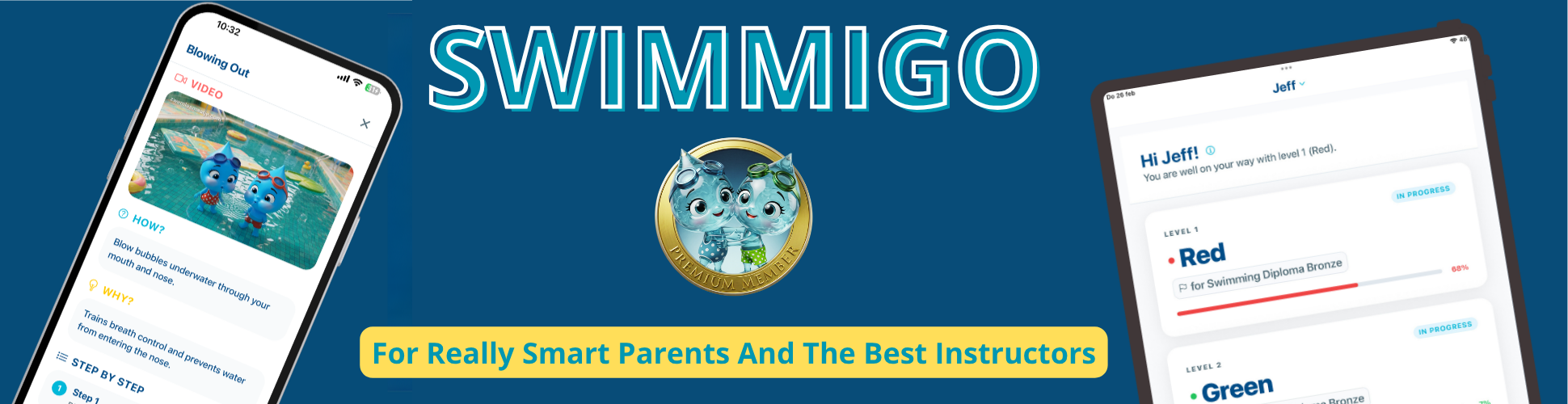
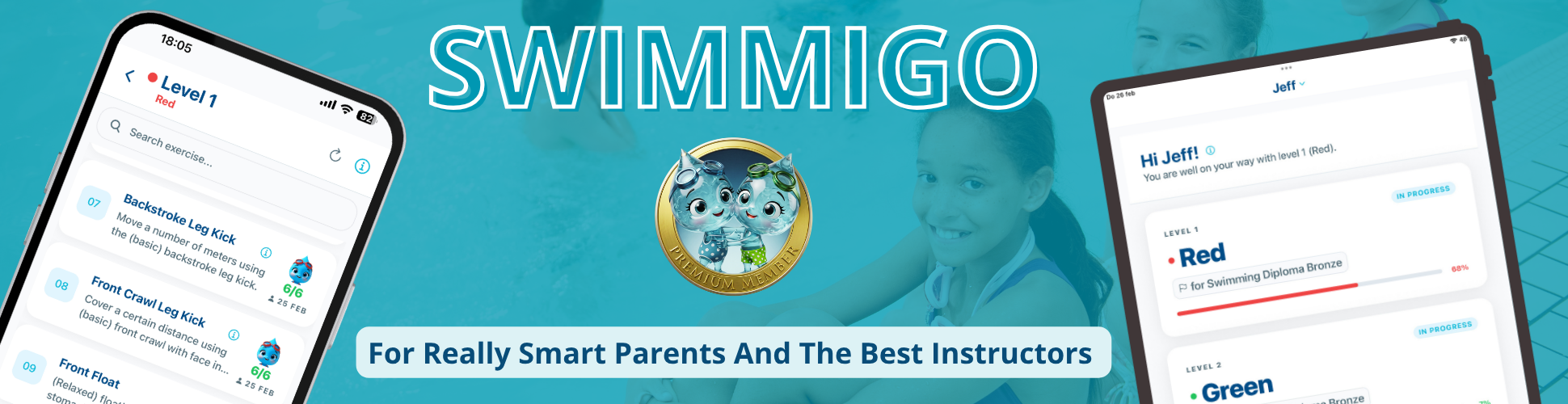
Swimmigo breaks this pattern. It is a completely free app, available in 5 languages (Dutch, English, German, French, and Spanish), that tracks swimming lesson progress in real time. Instructors tap a score from 0 to 6 per exercise using the smiley system. Parents immediately see on their phone which skills their child masters and what still needs work. No more paper cards, no loose Excel sheets, no monthly costs.
The system works with 7 levels (Red through Gold) and 86 detailed skills. From water familiarization and floating to complete swimming strokes and survival techniques. Every score is instantly visible, every level increase triggers a push notification to the parent. At levels 5, 6, and 7, the child receives a personalized swimming diploma with name, date, and level, fully automatically generated.

For parents: how to track your child’s swimming lesson progress
As a parent, you want to know one thing: is my child safe in the water? Everything beyond that is a bonus. Yet the answer to that question is surprisingly often out of reach. Swim schools communicate minimally, children don’t talk about their lessons spontaneously, and you stand on the sidelines with no idea what’s happening underwater.
What every parent should at least know
Every parent should be able to get answers to three core questions: (1) what level is my child at now, (2) which skills does he or she already master, and (3) what exercise comes next? If your swim school cannot answer these questions, there is a structural communication problem. Swimmigo answers all three, in real time, on your phone.
The 7 Swimmigo levels explained for parents
Instead of the traditional A-B-C framework, Swimmigo works with 7 colored levels: Red, Orange, Yellow, Green, Blue, Indigo, and Gold. Each level contains specific skills, from simple (daring to put face in the water) to advanced (30 seconds of treading water with clothes on). The advantage for parents: you see not only that your child is progressing, but exactly which step they have taken. That one exercise your child found scary three weeks ago now shows "4: masters it independently." That motivates both you and your child.
How to keep your child motivated: make progress visible
Children are visually oriented. A green smiley icon next to a newly achieved skill works better than verbal encouragement from the sidelines. The Swimmigo app lets children see their own progress: a visual dashboard with level bars and stars. Parents can scroll through the app together with their child on the couch and celebrate successes. This not only strengthens motivation but also the parent-child bond around swimming lessons.
Research from the US CDC shows that children of involved parents develop swimming skills faster and are less likely to drop out of lessons. Making progress visible is therefore not only fun: it is a proven safety strategy.
What to do during a motivation dip?
Every child sooner or later goes through a phase where swimming lessons are no longer fun. The water is cold, the exercises are difficult, and other children seem to progress faster. This is normal. What helps: don’t focus on the end goal (diploma), but on the small intermediate steps. The app shows that your child was at score 2 last week and now at score 3. That is progress, however modest.
For more in-depth strategies on motivation dips: read our article about what to do if your child wants to stop swimming lessons.
For instructors and swim schools: professional progress tracking without hassle
As a swim teacher, you are not an administrator. You are trained to teach children to swim safely, not to update Excel sheets. Yet administration consumes a disproportionate amount of your time: registrations, cancellations, group divisions, progress cards, parent communication. Swimmigo is built to automate all these tasks so you can spend more time in the water.
From 5 hours of administration to 15 minutes per week
Instructors who switch from paper to Swimmigo report saving 3 to 5 hours per week. The system works with quick swipe gestures: during the lesson you tap a score per exercise, and you’re done. The app remembers everything. Parents get automatic updates. Group divisions are visual and adjustable with drag-and-drop. Multi-instructor collaboration means your colleague immediately sees what you noted, without a half-hour handover conversation.
Also read: how to transfer swimming lesson progress between instructors without information loss.
Multi-location and multi-instructor: one source of truth
Many swim schools operate at multiple locations with different instructors. Without a central system, information islands quickly arise. Instructor A at location 1 doesn’t know what instructor B at location 2 did yesterday. Students moving from one group to another must be reassessed. Swimmigo acts as one central database: every instructor sees exactly the same data, in real time, on any device.
Marketing toolkit: more than just progress
Besides progress tracking, Swimmigo offers a marketing toolkit for swim schools. Generate flyers, social media posts, and professional swimming certificates with one click. Automatically branded with your logo and house style. This is especially valuable for small, independent instructors who have no budget for a marketing agency. In a competitive market with waiting lists, visibility is crucial.
How long does it take before my child can swim? The realistic timeline
This is the most frequently asked question from parents. The answer is frustrating: it depends. Age, lesson frequency, fear of water, motor development, and instructor quality all play a role. Yet there are averages that provide guidance.
The average duration per diploma
For the Zwem-ABC in the Netherlands, approximately:
| Diploma | Median lesson time | Starting age |
|---|---|---|
| Swimming diploma A | 12 to 18 months | 4 to 5 years |
| Swimming diploma B | 6 to 10 months | 5 to 7 years |
| Swimming diploma C | 6 to 10 months | 6 to 8 years |
With one lesson per week, it takes on average 2.5 to 3 years to obtain all three diplomas. With two lessons per week, this can be reduced to 1.5 to 2 years. Note: these are medians. Some children take less time, others more. The Swimmigo app makes it possible to track this timeline per child and adjust where necessary.
For a detailed analysis: read how long it takes to get all swimming diplomas?
International context: tracking swimming lesson progress across borders
Swimming education differs significantly per country. In Australia, they use the Royal Life Saving system; in the United Kingdom, the Swim England stages; and in the US, different states have different standards. What all these systems have in common: they struggle with the same challenge of progress communication to parents.
Swimmigo is designed for this international reality. The app is available in 5 languages, the 7 levels transcend national diploma systems and are universally applicable. An expat family moving from the Netherlands to Germany can simply continue with the same app. The instructor in Munich sees exactly where the child left off in Rotterdam. This is unique in the swimming lesson world.
For more about language barriers: read how expat parents stay involved in their child’s swimming lesson progress.
Safety and privacy: what to watch for in digital systems?
When choosing a digital progress system, safety and privacy play a major role. After all, you share data about children: names, ages, progress scores. Ask yourself: where is this data stored? Who has access? Does the system comply with GDPR?
Swimmigo’s approach to privacy
Swimmigo complies with European GDPR guidelines. Data is stored only on secure European servers. Parents control which data is shared. Instructors have access only to students in their own groups. There is no tracking for advertising purposes and no sale of data to third parties. Because Swimmigo is free, there is no business model based on user data: the platform is funded by Bob van Soest as a public service for the swimming lesson community.
The final step: from progress to diploma
The ultimate goal of tracking swimming lesson progress is not the data itself. It is: a child who is self-reliant in the water. A child who knows what to do if unexpectedly falling into deep water. A child who dares to enter the water with joy, in any country, in any situation.
The Swimmigo app makes this journey visible, step by step. From the first time face underwater to independently swimming 25 meters breaststroke. From the first smiley score to the Gold diploma with name and date. Parents and instructors work together towards one shared goal: a safe, swimming-capable child.
Sources
- WHO: Drowning fact sheet, May 2026
- Mulier Institute: More children obtain all three swimming diplomas, 2024
- National Council for Swimming Safety: Swimming skills research 2020, February 2022
- CBS: Population dashboard, youth, 2026
- KNRM: CBS drowning statistics 2025, 2025
- CDC: Drowning Prevention, 2025

Bob van Soest
As an expert in operating sports facilities (such as swimming pools) and developer of, among others, Swimmigo.com, I am passionately committed to making swimming lessons simpler, more fun and more insightful for parents, swimming instructors and everyone who wants to learn to swim.
Frequently Asked Questions
Related articles

Improving swimming lesson progress at different levels
Practical tips to improve swimming lesson progress for various swimming levels and target groups within swimming education.

Clearly registering swimming lesson progress
Read how swimming schools can effectively and clearly track and manage swimming lesson progress within their lessons.

Insight into swimming lesson progress with practical tool
Discover how as a parent you can clearly and clearly track your child's swimming progress.
Discover Swimmigo
The all-in-one app for swimming lesson progress. For parents, swim schools, and adult swimmers.