Completeoverviewofswimminglessonlevelsandskills:fromwaterfamiliarizationtodiploma[2026]
![Complete overview of swimming lesson levels and skills: from water familiarization to diploma [2026]](/_next/image?url=https%3A%2F%2Fzvblogpostimages.s3.eu-west-3.amazonaws.com%2FAUTOMATISCH_UPLOAD%2F1_c7dd85cb1fc7.jpg&w=3840&q=75&dpl=dpl_GWyfLj8UVegbQ18STkVQms8Vj7LD)
Summary
- The Netherlands has the official Zwem-ABC (A, B, and C) as the national standard for swimming safety
- Swimmigo uses 7 levels (Red to Gold) with a total of 86 skills tracked per exercise
- Parents get real-time insight into progress: per skill, per level, per lesson
- Swimming schools save up to 8 hours per week on administration using the 0-6 smiley system
- Free personalized swimming diplomas at levels 5, 6, and 7
TLDR: Swimming lesson levels in brief
- The Netherlands has the official Zwem-ABC (A, B, and C) as the national standard for swimming safety
- Swimmigo uses 7 levels (Red to Gold) with a total of 86 skills tracked per exercise
- Parents get real-time insight into progress: per skill, per level, per lesson
- Swimming schools save up to 8 hours per week on administration by digital tracking with the 0-6 smiley system
- Free diplomas and certificates: at levels 5, 6, and 7 your child receives a personalized swimming diploma
Why insight into swimming lesson levels makes a difference
Your child has been attending swimming lessons for weeks. At the reception you hear "it's going well," but what exactly does that mean? Which skills has your child mastered, what still needs improvement, and how long until the next diploma? For many parents, their child's swimming lesson progress is a black box. You drop your child off at the pool, wait an hour, and hope for progress. But concrete information often remains absent.
For swimming instructors, tracking 86 different skills per student is a big task. Paper lists get lost, notes are illegible, and at the end of a long lesson day all scores must be retyped. Valuable time is lost that could be better spent with the children.
In this complete overview, we explain which swimming lesson levels exist in the Netherlands, which skills your child learns at each level, how Swimmigo's 86 skills align with the official Zwem-ABC, and how both parents and swimming schools can easily and freely keep track of progress.
The Dutch swimming lesson levels at a glance
The Zwem-ABC: the official national swimming diplomas
In the Netherlands, the Zwem-ABC is the standard for swimming safety. These three diplomas are established by the National Council for Swimming Safety (NRZ) and are recognized by all swimming schools. The goal is simple: every child who obtains the C diploma is fully swimming safe in open water without current. The trajectory from A to C takes on average 2 to 3 years, depending on factors such as age, motor development, and lesson frequency. The National Swimming Safety Standard states that a child is truly swimming safe only after obtaining diploma C.
Swimming diploma A: the foundation of swimming safety
Diploma A is the first official swimming diploma. Your child learns the basic strokes here: breaststroke and single backstroke. At the end of diploma A, your child can swim 25 meters breaststroke, 25 meters single backstroke, and tread water for 5 seconds. Your child also learns to swim underwater through a hole and orient underwater. Most children obtain diploma A within 12 to 18 months after starting swimming lessons. This is the phase where children transition from water familiarization to real swimming skills: a crucial transition that requires a lot of confidence.
Swimming diploma B: building skills
With diploma B, distances are doubled and technique refined. Your child now swims 50 meters breaststroke, 50 meters single backstroke, and learns new skills such as treading water for 10 seconds with both legs and arms. Clothing swimming is also introduced: swimming with shorts, shirt, and shoes. This simulates a realistic fall-into-water situation. Diploma B builds endurance and ensures the basic strokes are correctly executed even under light fatigue. On average, it takes 6 to 12 months from A to B.
Swimming diploma C: fully swimming safe
Diploma C is the crown of the Zwem-ABC. Your child now swims 100 meters breaststroke, 100 meters single backstroke, and treads water for 30 seconds while holding an object. Clothing swimming becomes more challenging: swimming in long pants, long-sleeve shirt, shoes, and a raincoat. This is the ultimate test to see if your child can manage in any situation. With diploma C in hand, your child is ready for open water, such as recreational lakes and the sea (without strong currents). From B to C takes on average another 6 to 12 months.
The 7 levels of Swimmigo: from Red to Gold
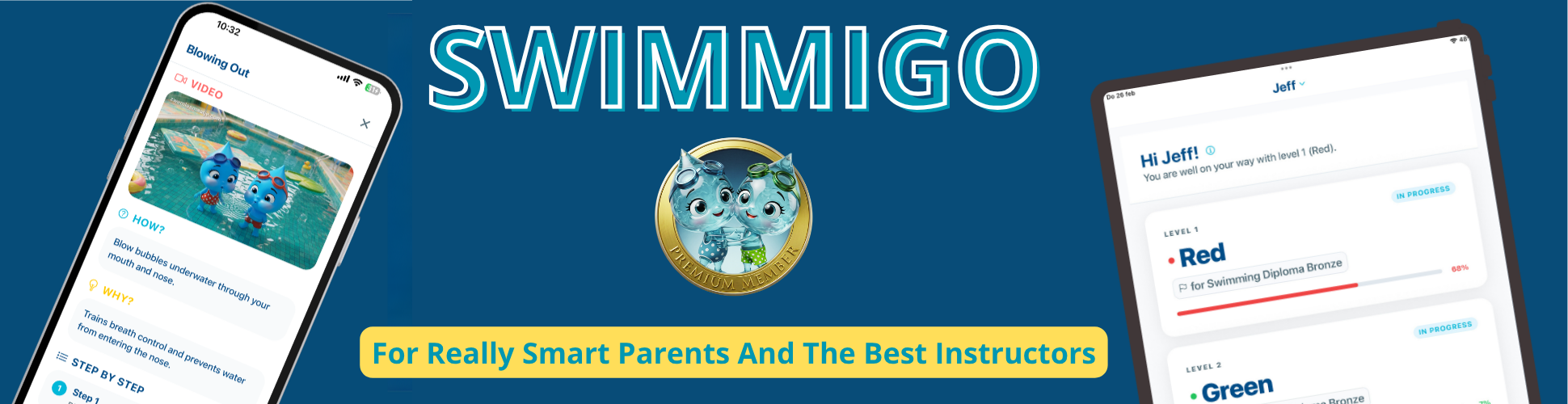
Where the Zwem-ABC has three major milestones, Swimmigo works with 7 smaller levels that map progress in much more detail. Each level contains specific skills, and within each skill the instructor scores using the 0-6 smiley system. This gives parents a much more nuanced picture than just "it's going well." You see exactly which exercise your child masters and where extra attention is needed.
Level Red: getting acquainted with water
Level Red is the starting level. It’s all about water familiarization: the child learns that water is fun and safe. Skills such as putting the face in the water, blowing bubbles, floating on the stomach with help, and jumping off the side are covered. This level focuses mainly on building confidence. Many children aged 3 to 5 start here. The instructor scores each skill with smileys, so parents immediately see if their child, for example, is already comfortable with water on the face.
Level Orange: developing basic skills
At level Orange, the real swimming work begins. Your child learns the first basics of breaststroke: the leg kick, the arm stroke, and the combination. Floating on the back without help and daring to look underwater are also part of this level. The emphasis is on learning the correct technique in a safe, playful environment. Instructors use the Swimmigo app to track progress per lesson: can the child do the leg kick independently, or is support still needed?
Level Yellow: becoming self-reliant
Level Yellow marks the transition from "learning" to "self-reliant." Your child now combines leg kick and arm stroke into a smooth breaststroke and learns the single backstroke. Treading water is introduced for the first time: first 5 seconds, then increasingly longer. Underwater swimming is expanded with orientation exercises. This level is often when children get the A diploma in sight, as most A requirements are taught here.
Level Green: improving technique
At level Green, the focus shifts to technique refinement. Breaststroke becomes more efficient: less splashing, better streamlining, correct breathing. Backstroke becomes stronger and smoother. Distances increase from 25 to 50 meters. New skills such as diving to the bottom and swimming through a hoop are added. For parents, this is an exciting phase: your child goes from 'can swim' to 'swims well.'
Level Blue: advanced skills
Level Blue brings your child towards the B diploma. Distances go to 50 and 75 meters. Treading water is extended to 15 seconds with arms and legs. Clothing swimming is seriously practiced for the first time. Rescue skills such as swimming to the side with an object are trained. This level demands more endurance and mental resilience from your child. The smiley scores in the app show per skill whether the child is ready for the B test.
Level Indigo: endurance and refinement
Level Indigo is the preparation for the C diploma. Your child now swims 100 meters breaststroke and backstroke, trains 30 seconds of treading water, and practices heavy clothing swimming with long pants, shirt, shoes, and raincoat. Technique is further refined and endurance is significantly built up. This is the level where children become truly strong swimmers who can manage in open water. The app often gives the first signals at level Indigo that the C diploma is within reach.
Level Gold: fully independent and swimming safe
Level Gold is the highest level within Swimmigo and corresponds to the C diploma. Your child now masters all 86 skills: from water familiarization to full swimming safety in open water. Upon reaching level Gold, your child receives a truly personalized swimming diploma with name, date, and level. This diploma is automatically generated via the app and is completely free. A wonderful moment for child and parent: proof that months or even years of practice have led to full swimming safety.
What exactly does a child learn at each level?
Water familiarization: the very first steps
Water familiarization is the foundation of all swimming lessons and mainly covers levels Red and Orange. At this stage, it’s not about real strokes but about getting comfortable with water. Your child learns to tolerate water on the face, blow bubbles through mouth and nose, float on the stomach (first with help, later independently), and jump into the water from the stairs or edge. Instructors observe whether a child is relaxed in the water, as tension and fear are the biggest enemies of effective swimming learning. The Swimmigo app records each of these water familiarization exercises separately, so parents can follow development step by step.
Floating and bobbing: confidence in the water
Floating is an underestimated but essential skill. A child who learns to float experiences that water supports. Floating on the stomach with face in the water, floating on the back with ears in the water, and turning from stomach to back (and vice versa) are core skills taught at levels Orange and Yellow. These exercises teach children they won’t sink if they stop moving: a crucial safety realization. The instructor scores each floating exercise with the smiley system and parents see in the app if their child is already comfortable lying on the back.
The breaststroke: the first real stroke
Breaststroke is the most used swimming stroke in the Netherlands and the first real stroke children learn. It starts with the leg kick: the 'frog kick' where the legs move outward and close with force. Then comes the arm stroke: the hands push the water sideways and backward. Only when both are well executed separately does the child combine leg and arm strokes into a smooth breaststroke. This build-up happens over multiple levels: leg kick in Orange, arm stroke in Yellow, and full combination in Green.
The backstroke: swimming on your back
The single backstroke is the second basic stroke of the Zwem-ABC. Your child lies on the back and makes a large circular movement with both arms simultaneously. The legs perform the same frog kick as in breaststroke. Backstroke is initially scary for many children because they see nothing, but it is an extremely important safety stroke: when tired, you can float on your back and breathe calmly. Backstroke is taught at level Yellow and refined at levels Green and Blue.
Underwater: daring and doing
Underwater swimming is an official requirement of the Zwem-ABC and appears in almost every Swimmigo level. From simply putting the face underwater (level Red) to swimming 3 meters underwater through a hole (level Indigo). Children learn to open their eyes underwater, determine direction, and hold breath in a controlled way. Parents see exactly how far their child is in the app: does the child dare to put face underwater? Can they already swim 3 meters underwater? Can they retrieve an object from the bottom? All scored separately.
Clothing swimming: the ultimate test
Clothing swimming is perhaps the most important practical skill of the entire swimming trajectory. Falling into water rarely happens in swimwear. Clothing becomes heavy in water and restricts movement. In the Swimmigo levels, clothing swimming is built up: first with only a shirt (level Blue), later with long pants, shirt, and shoes (level Indigo), and finally with a raincoat added (level Gold). The app records whether your child still applies the correct technique and can cover sufficient distance under these conditions.
Long distance: condition and endurance
From 25 meters to 100 meters: the build-up of long distance happens gradually over levels Green to Gold. Where diploma A requires only 25 meters breaststroke and 25 meters backstroke, diploma C requires 100 meters per stroke. This endurance build-up is essential for real swimming safety: in open water, the shore can be farther than 25 meters. The Swimmigo app shows per skill how far a child can swim and whether technique remains correct over longer distances.
How do you as a parent keep track of progress?
Why traditional methods fall short
At most swimming schools, parents receive a general update every few months: "your child is making progress." That is too vague. Is the breaststroke already good? Can your child already tread water? Is there still practice needed at home? Without detailed information, you as a parent remain in the dark. The traditional paper checklist also provides little insight: it usually just says "passed" or "not passed," but not how well a skill is performed. The question "how is your child's swimming lesson going?" often results in a vague answer.
Digital progress tracking: real-time insight
With the Swimmigo app for parents, you see the current scores after every lesson. Per skill, it is visible how your child scores on a scale from 0 to 6 smileys. A score of 0 means "not started yet," 6 means "skill perfectly mastered." You see at a glance which exercises go well and where extra attention is needed. This not only provides peace of mind ("my child is really making progress"), but also helps you ask targeted questions to the instructor. No more vague answers, but concrete data.
Push notifications on level increases
One of the most appreciated features of the Swimmigo parent app is the push notification when a level is increased. As soon as the instructor indicates your child is ready for the next level, you immediately receive a notification. No waiting weeks until the next lesson, but instant updates. At levels 5, 6, and 7 your child also receives a truly personalized swimming diploma with name, date, and level. These diplomas are free and can be downloaded or printed immediately. For younger levels, free swimming certificates are available.
For swimming schools: how to efficiently register 86 skills?
Paper versus digital: time savings
Independent swimming instructors and small swimming schools recognize the problem: at the end of a lesson day, dozens of score forms need to be retyped. Each student has dozens of skills to track. With pen and paper, this quickly takes 30 to 60 minutes per day, up to 8 hours per week for an average swimming school. With the Swimmigo app, you register scores directly during the lesson with swipe gestures. One swipe from left to right, and the score is set. At the end of the day, everything is immediately available: no retyping, no paper, no time waste.
Scores per skill: the 0-6 smiley system
The heart of the Swimmigo registration is the 0-6 smiley system. Each skill receives a score from 0 to 6, where each step indicates a clear level of mastery. This system was designed with input from experienced swimming instructors and aligns with NRZ standards. The advantage over simply "passed/not passed" is that you see gradual progress: a child moving from score 2 to 3 makes small but important steps, even if the skill is not yet "passed." This motivates children and gives parents an honest picture.
Automatic level calculation
When is a child ready for the next level? At Swimmigo, the app determines this automatically based on the entered scores. As soon as all core skills of a level score sufficiently, the app proposes a level increase. The instructor can confirm this with one tap, after which parents automatically receive a push notification. This prevents children from staying too long at the same level when they are actually ready: the app signals this objectively.
Practical tips for smooth progression between levels
Signs your child is ready for the next level
How do you as a parent know if your child is almost ready for the next level? Watch for these signs: your child performs most exercises without instructor help, swims with visible pleasure and confidence, and asks for more difficult exercises themselves. In the Swimmigo app, you see this confirmed: most smiley scores are 4 or higher. Feel free to discuss this with the instructor: "I see in the app that the breaststroke is already at score 5, do you think my child is almost ready for level Green?"
What if your child stays stuck at the same level?
Some children seem to stay endlessly at the same level. This can have various causes: motor challenges, lack of practice frequency (once a week swimming lessons is too little for some children), fear of specific exercises like going underwater, or simply a temporary drop in motivation. The most important thing is: stay positive and look at the small steps. With the app, you also see subtle progress: maybe the score went from 3 to 4, even if the level seems the same. Discuss with the instructor whether extra practice sessions or a different approach can help.
Practicing at home: what is safe and effective?
Many parents want to help their child with swimming skills at home, but that is not always safe or effective. What you CAN do: blowing bubbles in the bath, putting face underwater under supervision, floating in shallow water, and talking about the swimming lesson ("what did you like most today?"). The vacation mode of the Swimmigo parent app is also handy: during summer holidays you can check off practiced skills yourself, so the instructor sees what has been maintained after the holiday. What you BETTER NOT do: teach swimming strokes yourself. Incorrectly taught technique is hard to unlearn and can actually slow progress. Leave teaching new skills to the professional instructor.
How to get control over swimming lesson progress as a parent or swimming school [2026]
Tracking swimming lesson progress doesn’t have to be guesswork. Whether you are a parent who wants to know how your child is really doing, or a swimming instructor tired of endless piles of paper: Swimmigo’s 7 levels and 86 skills provide clarity. Parents see real-time scores per skill, receive push notifications on level increases, and get free diplomas at levels 5, 6, and 7. Swimming schools register with swipe gestures during lessons, use the 0-6 smiley system for nuanced scores, and save hours of administration. And most importantly: it’s 100% free. No subscription, no hidden costs.
Want to experience how easy tracking swimming lesson progress can be? Discover Swimmigo at swimmigo.nl and start today, completely free.
- Swimmigo for parents: real-time progress, free diplomas, vacation mode
- Swimmigo for instructors: group management, smiley scores, marketing toolkit
- View all 7 levels and 86 skills in detail
- The free student tracking system for swimming schools
Sources

Bob van Soest
As an expert in operating sports facilities (such as swimming pools) and developer of, among others, Swimmigo.com, I am passionately committed to making swimming lessons simpler, more fun and more insightful for parents, swimming instructors and everyone who wants to learn to swim.
Frequently Asked Questions
Related articles
Why Showering Before Swimming Lessons Is So Important
Why shower before swimming lessons? Discover why hygiene and preparation are crucial for the best swimming experience. Read our tips and avoid surprises!
When to Start Swimming Lessons for Optimal Progress
Read from which age swimming lessons are effective for the best results and safety of your child in the water.
Effectively Registering Swimming Lesson Progress from What Age?
Discover from what age you should best register swimming lesson progress and how to do this practically.
Discover Swimmigo
The all-in-one app for swimming lesson progress. For parents, swim schools, and adult swimmers.