Whatifyourchildfailstheswimmingdiploma?Howtosupportyourchildafteradisappointment[2026]
![What if your child fails the swimming diploma? How to support your child after a disappointment [2026]](/_next/image?url=https%3A%2F%2Fzvblogpostimages.s3.eu-west-3.amazonaws.com%2FAUTOMATISCH_UPLOAD%2F1_b977d16e32ee.jpg&w=3840&q=75&dpl=dpl_2Ynk5cY6jv9wUPiBxprwVAgs8ZUK)
Summary
- Thousands of children fail their swimming exam every year; it is a safety choice, not failure
- Your first reaction as a parent determines how your child processes the disappointment: focus on effort, not result
- Ask the swim instructor for specific feedback and make a concrete practice plan together for the retake
- Use home exercises in the bath to reduce water fear and build confidence
- With a digital student tracking system, you see weekly progress; an exam then becomes no surprise
You have been looking forward to this moment for weeks, maybe months. Your child stands at the pool edge, the pool is decorated, grandparents are seated in the stands. Then comes the verdict: failed. Your child looks at you with eyes full of confusion and you feel a mix of disappointment, frustration, and helplessness. Take a deep breath. This happens to more parents than you think and it says nothing about your child's swimming talent.
How often do children actually fail their swimming diploma?
It may sound like everyone passes on the first try, but the reality is different. In the Netherlands, 14 percent of children between 6 and 12 years old have no swimming diploma at all, according to figures from the Mulier Institute from 2024. That is four children in an average class of thirty. And of the children who do obtain their A diploma, not everyone succeeds on the first attempt. Exact pass rates per exam are not centrally recorded, but every swim instructor knows the scenario: some children are simply not ready yet, no matter how much the parents want it.
Internationally, the picture is similar. In countries like Australia, the United Kingdom, and the United States, swimming lesson programs vary greatly by region, and failing is a normal part of the learning process everywhere. For example, Royal Life Saving Australia emphasizes that children need on average 40 to 60 hours of swimming lessons to achieve basic water safety, and repeating levels is more the rule than the exception.
Why failing is not failure but a safety choice
The swim instructor who fails your child does not do it to upset you or because your child is 'bad'. A swimming diploma test is a safety assessment. If a child has not yet mastered the breaststroke well enough or gives up water treading too quickly, it is simply not safe to award the diploma. The National Council for Swimming Safety (NRZ) sets strict requirements for the Zwem-ABC exams, precisely because drowning is one of the leading causes of death worldwide among young children. The World Health Organization (WHO) reports over 236,000 drowning cases worldwide annually, with children under 5 years as the highest risk group. A strict exam committee literally protects lives.
Think of it this way: you wouldn’t want a pilot to get their license if they haven’t mastered landing with crosswinds yet. Swimming is just as serious.
What a failed exam really says about your child
Very little, actually. A swimming exam is a snapshot. It measures how your child performs on that specific day, in that specific pool, under that specific pressure. It says nothing about intelligence, perseverance, or future swimming talent. Research from Understood.org on how children cope with test failure shows that a failed test weighs heavily on a child, but the way parents respond determines how the child processes the experience. Children of parents who shift the focus from 'you failed' to 'you worked hard and keep going' develop more resilience and a healthier learning attitude.
The emotional impact: why your first reaction is crucial
As soon as the verdict is given, your child looks at you. Not the swim instructor, not the grandparents. You. What you say and express in those first ten seconds sticks. A reader of CafeMom described how her daughter failed her swimming level because she was afraid to put her head underwater. The mother felt intense disappointment but held back until they got home. Once calm, they talked and it turned out her daughter was simply afraid water would get in her eyes, ears, and nose. Together they came up with solutions: close eyes, breathe deeply, pinch nose. The retake was a success.
What to say and what not to say after a failed swimming exam
The temptation is strong to complain that the water was too cold or the examiner was too strict. But that sends the wrong message to your child: that the fault lies outside them, or that failing is something to be ashamed of. What does help:
Say this: "I saw how hard you tried with the water treading. That was impressive. Next time you’ll succeed." "Remember last year you didn’t dare to dive, and now you just do it? Progress happens in steps." "I’m proud of you, not because of a piece of paper but because you go to swimming lessons every week and keep practicing."
Don’t say this: "How come, Lisa from your group passed." Comparing to others kills self-confidence. "I sat in the stands all those weeks for nothing." Your child may feel guilty about your time investment. "Then we just won’t go anymore." Threatening to quit only increases pressure.
How to prepare for the retake together
This is the moment to turn disappointment into action. Ask the swim instructor for specific feedback: which exercises went wrong? Was it the breaststroke, water treading, or the clothing swim test? The more concrete you know where your child stumbled, the more targeted you can practice.
Many swim schools offer extra practice sessions between failing and the retake. Use them. And if your child is old enough, involve them in making a practice plan. A child who decides "I will practice putting my face underwater every Saturday in the bath" is much more motivated than a child who has to practice because mom or dad says so.
Home training: what can you do outside the pool?
You can do more at home than you think, even without a pool. The bathroom is your best friend. Let your child practice blowing bubbles through a straw in the bath, holding their face underwater while counting to three, or floating on their stomach in a few centimeters of water. These small, low-threshold exercises build confidence without the pressure of an exam situation.
Also outside the bathroom, keep the conversation going. Don’t ask every day "have you practiced yet?" but ask open questions: "What did you like most at swimming lessons today?" or "Which exercise felt easier today than last week?" This way you stay involved without pushing.

When you should raise the alarm
Failing once is normal. Failing twice happens, especially with younger children or children with water fear. But if your child fails the same level a third time, it’s time for a serious talk with the swim school. Possible points of attention:
Is the group size too large, so your child gets too little personal attention? Does the teaching method suit how your child learns? Some children thrive with playful learning, others benefit from clear, structured instructions. Is there perhaps an underlying issue, such as unspoken fear, or a physical limitation like ear problems when submerged?
Some swim schools offer the option to schedule a few private lessons just before the retake. This can be the push your child needs to get over the threshold.
The impact of group size and lesson time on pass rates
A child swimming in a group of ten or more simply receives less personal instruction than a child in a small group. Observations from swim instructors show that children in groups of up to six progress faster through levels on average, simply because each student gets more turns and direct feedback. This principle applies not only in the Netherlands but in every country where group swimming lessons are given. Weekly lesson time also plays a role: children who swim twice a week generally make faster progress than those who go once a week.
How digital tools improve communication with the swim school
One of the biggest frustrations with failed exams is the lack of clear information. "What did my child fail on?" and "What exactly needs to improve?" are questions many parents don’t get answered well, simply because the swim instructor has to move on to the next group right after the lesson.
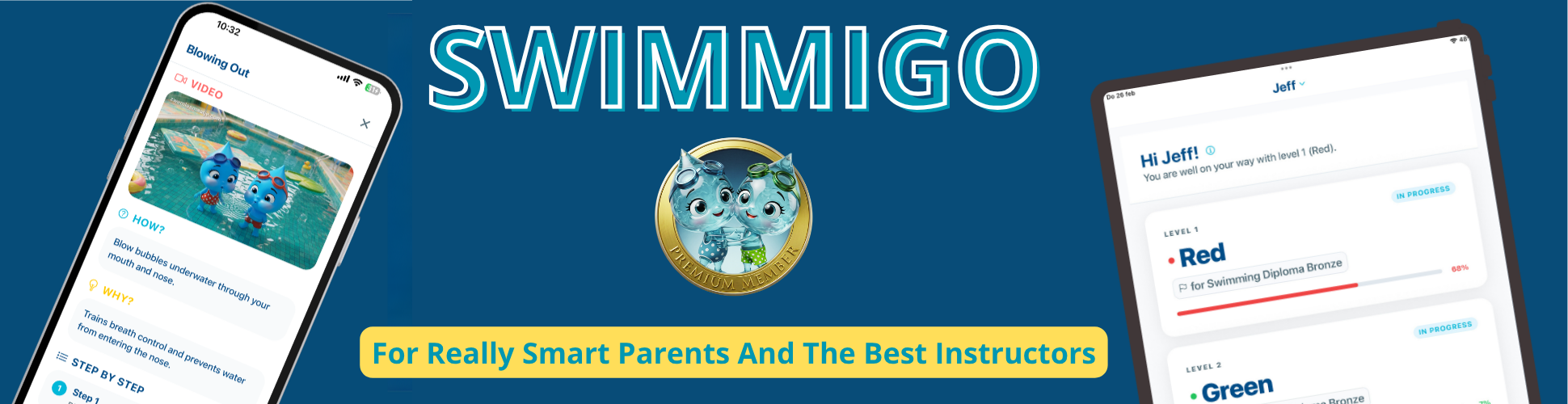
Digital student tracking systems solve this. With an app that tracks progress per skill, you as a parent see at a glance where your child stands. Not only on exam day but every week. This way a failed exam is no longer a shocking surprise but a logical result of a skill still in development. You already knew it, and so did your child. The conversation then isn’t about 'failed' or 'passed' but about 'what will we work on in the coming weeks'.
How to keep your child motivated in the weeks until the retake
The period between failing and retaking is tense. Your child may feel like they are 'behind' friends or classmates. Keep it positive and concrete. Make a countdown calendar together with the retake date. Mark interim successes: "Today you managed water treading for 20 seconds, last week it was only 10!" Don’t make getting the diploma the only goal, but also celebrate the small victories along the way.
A simple visual system often works wonders. For example, a poster on the fridge with the five exercises your child still needs to improve, and a sticker for each training session where an exercise succeeded. These small rituals keep spirits up and make progress tangible.
What if your child doesn’t want to continue at all?
Sometimes the disappointment is so great that a child says: "I never want to go to swimming lessons again." This is understandable and usually temporary. Don’t force anything, but don’t give in immediately either. Take a short break of a week and do something fun in the water during that time. Go to a recreational pool, splash around without lesson goals, remind your child why swimming is actually fun.
Often it’s not the swimming itself the child dreads, but the exam pressure. By bringing back the fun, part of that tension disappears naturally. After a week or two, motivation often returns and your child is open to lessons again.
The bigger picture: life lessons from a failed exam
In the long term, a failed swimming exam may be one of the most valuable experiences your child can have. It teaches that setbacks are part of life, that progress is not linear, and that perseverance pays off. This resilience is relevant in every country and every life phase, from first school exams to job interviews as an adult.
The Swiss swimming education system, for example, has no central exam like the Dutch Zwem-ABC. Children receive a level certificate once they master a skill, regardless of how long it takes. The idea that a child 'passes' or 'fails' on a fixed date is therefore not universal. It is a cultural habit, not a law of nature. What matters is that your child is ultimately safe and confident in the water, not on which date that happens.
A failed swimming exam feels like a big disappointment, for your child and for you. But failing is not the end. It is a safety choice by the examiner, a snapshot, and a chance to show as a parent that you unconditionally support your child, with or without a diploma. Most children who fail do get their diploma on the retake, often with more confidence than if they had passed on the first try. Because something you have to retake and then still pass, that’s something to be truly proud of.
Sources
- National Council for Swimming Safety: More and more children in the Netherlands obtain swimming diplomas A, B, and C, November 2025
- WHO: Drowning fact sheet, 2024
- Understood.org: How to help your child learn from a failed test, 2024
- CafeMom: It Was Hard for Me To Hide My Disappointment When My Kid Failed Her Swim Lessons, February 2022
- Mulier Institute: More and more children in the Netherlands obtain all three swimming diplomas, 2025

Bob van Soest
As an expert in operating sports facilities (such as swimming pools) and developer of, among others, Swimmigo.com, I am passionately committed to making swimming lessons simpler, more fun and more insightful for parents, swimming instructors and everyone who wants to learn to swim.
Frequently Asked Questions
Related articles
When to Start Swimming Lessons for Optimal Progress
Read from which age swimming lessons are effective for the best results and safety of your child in the water.

Effectively Registering Swimming Lesson Progress from What Age?
Discover from what age you should best register swimming lesson progress and how to do this practically.

Efficiently Registering Swimming Lesson Progress per Group
Practical tips for tracking swimming lesson progress per swimming lesson group for parents and instructors.
Discover Swimmigo
The all-in-one app for swimming lesson progress. For parents, swim schools, and adult swimmers.