ADifferentTeacherEveryWeek:WhatChangingSwimInstructorsDotoYourChild’sProgress[2026]
![A Different Teacher Every Week: What Changing Swim Instructors Do to Your Child’s Progress [2026]](/_next/image?url=https%3A%2F%2Fzvblogpostimages.s3.eu-west-3.amazonaws.com%2FAUTOMATISCH_UPLOAD%2F1_9244d02cac8a.jpg&w=3840&q=75&dpl=dpl_GWyfLj8UVegbQ18STkVQms8Vj7LD)
Summary
- Changing instructors slow down swimming lesson progress: children need time to build trust with a new teacher
- Research shows that the relationship between teacher and student directly affects learning outcomes, also in swimming lessons
- The aquatic sector worldwide struggles with high staff turnover: young instructors (18-28 years) quit most often
- Parents can take action: ask for a fixed instructor, track progress digitally, and build swimming confidence outside the lesson
Do you recognize this? Your child confidently enters the water, but every week there is a different face at the poolside
"Mom, why do we have a different teacher again today?" It’s a question many parents of swimming lesson children recognize. Your child just starts to build a bond with instructor Lisa, and the next week Tom is in charge. The week after that it’s Marieke. Before you know it, your child has seen five different faces at the poolside in two months.
It feels uncomfortable. And rightly so, you wonder: what does this do to my child’s swimming lesson progress?
Quite a lot, according to the numbers. Research from Monash University in Australia shows that the aquatic sector worldwide struggles with structural staff turnover. Especially young swim instructors aged 18 to 28 quit quickly, often within a year (Butson et al., 2025). In the Netherlands, the picture is similar: the combination of low wages in the cao Zwembaden, physically demanding work, and often temporary contracts makes it difficult to retain experienced instructors.
This is not a local Dutch problem. From Australia to Canada and from Germany to the United States, swim schools struggle with the same staffing issue. Swimmigo is now available in 5 languages and is used worldwide by swim educators who want to offer their students consistent guidance, even when the team changes.
Why a fixed instructor is so important for swimming lesson progress
A swimming lesson is more than a series of exercises. Children learn to swim in an environment that is physically and emotionally challenging. Water can be scary. A child learning to swim must not only master technical skills but also feel safe enough to make mistakes and push boundaries.
Research from the American Psychological Association shows that positive relationships between student and teacher lead to more engagement, better behavior, and higher learning outcomes (APA, 2025). These principles apply just as well in the pool as in the classroom. An instructor who knows your child understands their fears, which exercises are still difficult, and which approach works best.
With every change, that trust bond must be rebuilt. The new instructor does not know the history, does not know which exercises your child already masters, and does not yet recognize the subtle signs of fear or insecurity. Valuable lesson time is lost on getting acquainted and feeling out, instead of learning and growing.
What happens to the learning process with each change?
Imagine you are learning a new language yourself. Every lesson there is a different teacher in front of the class, with a different teaching method, a different pace, and different expectations. One teacher emphasizes grammar, the other mainly wants you to speak a lot. Sounds confusing? That is exactly what happens to your child with every change of swim instructor.
The first thing that disappears is continuity. Instructor A was working on the kick. Instructor B sees a child struggling with the arm stroke and starts over there. Instructor C wants to first repeat all basic exercises "to see where everyone stands." Your child makes zero progress in three lessons because everyone starts over.
There is also the emotional impact. A child who just overcame their fear of deep water with instructor Lisa stands frozen at the edge two weeks later with instructor Tom. Not because the child cannot swim, but because the safety of that familiar voice and encouragement is missing. For children with water fear, an instructor change is especially harmful: the trust built over weeks disappears in minutes.
And then there is the problem that no one really knows your child. A good swim instructor knows that Sofie from group 3 struggles with breathing underwater, that Milan from group 4 is a perfectionist afraid of making mistakes, and that Noa from group 2 should not be encouraged too strongly. With every new instructor, this knowledge must be rediscovered, with trial and error. And often that does not happen at all.
The numbers: swim instructors leave the sector at a high rate
The swim instructor shortage is not a feeling, it is a measurable fact. The Monash study interviewed 42 current swim instructors and 19 former instructors in Australia. The conclusions:
| Age Group | Turnover Risk | Main Reasons |
|---|---|---|
| 18-28 years | High | Temporary job, no career prospects, low pay |
| 28-45 years | Medium | Physical strain, irregular hours |
| 45+ years | Low | Passion for the profession, but physically demanding long-term |
The researchers identified four main reasons why instructors leave: a negative view of management, underestimation of the work environment, limited career opportunities, and the fact that teaching swimming is a temporary job for many (Butson et al., 2024).
In the Netherlands, the cao structure also plays a role. With salary scales starting at minimum wage level, swim instructor is for many young people a stepping stone job, not a career choice (Ambtenarensalaris.nl).
A universal problem: the teacher shortage in the water sector
Anyone who thinks this is a typically Dutch phenomenon is mistaken. The World Health Organization (WHO) reports that an estimated 300,000 people drown worldwide each year, and that structured swim education is the most important preventive measure (WHO, 2024). At the same time, countries worldwide struggle with a shortage of qualified swim instructors.
In the United States, the American Red Cross reported in 2023 that the nationwide shortage of lifeguards and swim instructors led to pool closures and cancellation of swimming lessons. In Australia, Royal Life Saving Society Australia found that the instructor shortage directly contributes to lower swimming skills among children (Injury Matters, 2024).
The common thread: swim schools worldwide face the same challenge. How do you offer consistent quality with a changing team? The answer lies not only in better working conditions but also in smarter digital tools that record each student’s progress, regardless of which instructor is in front of the group.
What you can do as a parent: 5 practical steps
You cannot change a swim school’s personnel policy. But you can take action to protect your child from the disadvantages of constantly changing faces at the poolside.
1. Explicitly ask for a fixed instructor
Many parents quietly accept that there is a different person in front of the group every week. When registering or during an evaluation conversation, ask if it is possible to assign your child to a fixed instructor. Not every swim school can guarantee this, but if you don’t ask, you certainly won’t get it. You can safely raise the alarm if a swim school says "we always try that" but does not deliver.
2. Track progress yourself
Don’t wait for reports from the swim school. After each lesson, make short notes: which exercises were covered, what went well, where did your child struggle? This may seem excessive, but after four instructor changes you are the only one who knows the full story. Swimmigo offers a free tracking system for this: the app gives parents real-time insight into which skills their child masters and where there is still work to do, completely independent of instructor changes.
3. Build swimming confidence outside the lesson
The more confident your child is in the water, the smaller the impact of an instructor change. Go swimming freely regularly, practice floating and going underwater playfully, and make water fun a positive experience separate from formal swimming lessons. A child who feels comfortable in the water adapts faster to a new instructor.
4. Talk to your child about the changes
Children often experience an instructor change as something they did wrong themselves ("was the previous teacher angry with me?"). Explain that swim teachers sometimes work in another pool or help other children, and that it has nothing to do with your child’s behavior. Give your child the words to tell the new instructor what they find comfortable: "I like it when the teacher demonstrates first" or "I’m not ready to swim without a kickboard yet." This helps your child to help themselves with each new instructor.
5. Choose a swim school that uses digital progress tracking
A swim school that works with an app or student tracking system minimizes the damage of instructor changes. Every new instructor can see at a glance which skills your child already masters, where the focus points are, and what the next goals are. No more lost lesson time with "what can you already?" but immediately working at the right level.
The role of digital tools in instructor changes

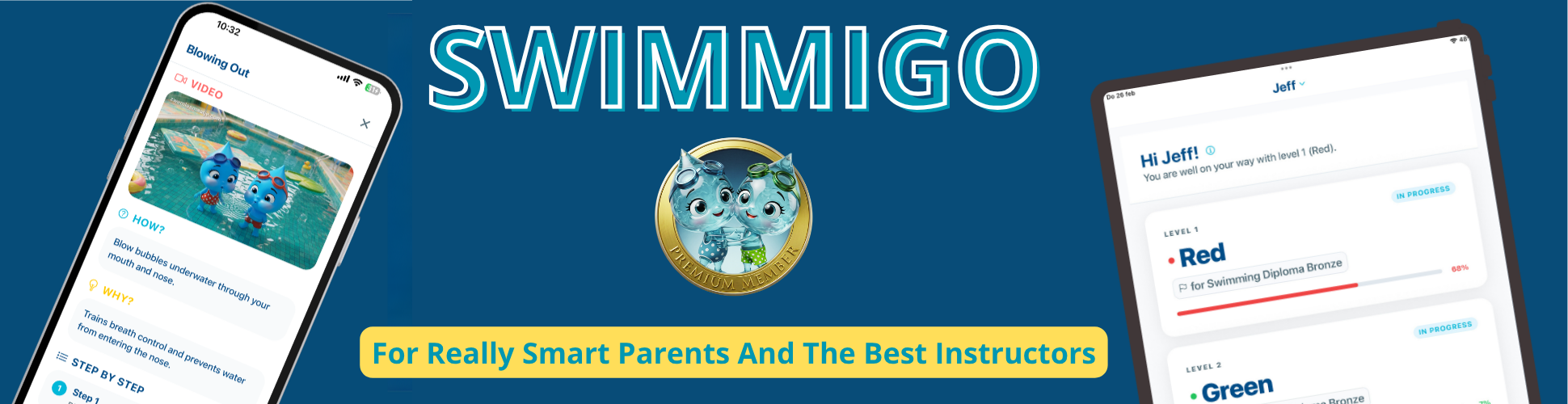
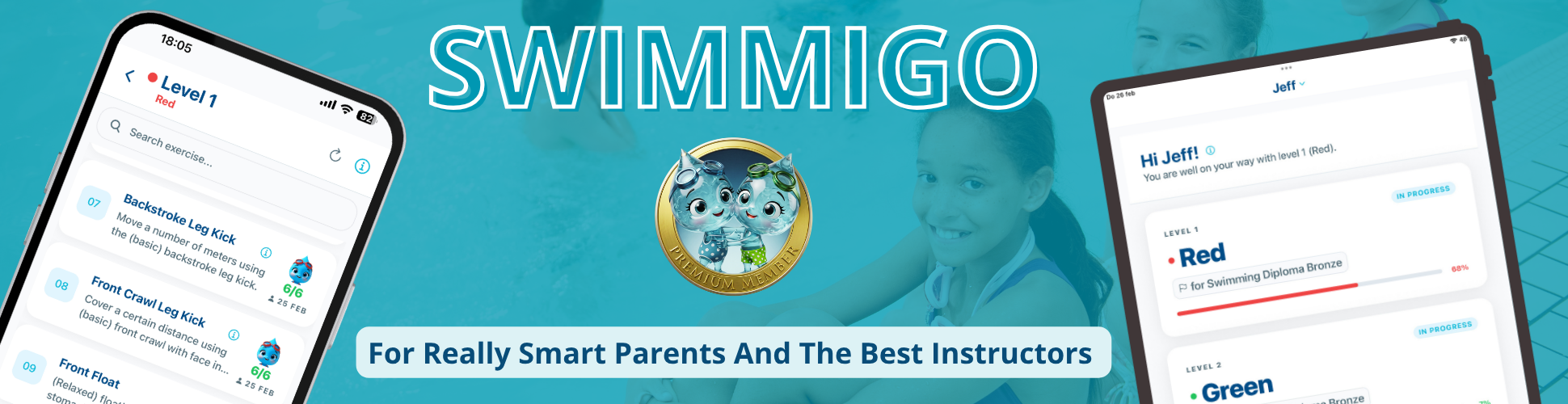
This is where Swimmigo comes in. The app is designed with the understanding that swim schools, big or small, always face changes in their instructor team. Whether due to illness, vacation, or staff turnover: the progress of each student remains centrally recorded and immediately visible to every instructor.
How does it work in practice? After each lesson, an instructor indicates via the app per student which skills were practiced and at what level the child performs, using a clear smiley system. If a new instructor is in front of the group the following week, they open the app, see at a glance where each child stands, and can continue directly where the previous instructor left off. No information loss, no repetition of known material, no frustration for child or parent.
What does research say about consistency in lessons?
The importance of a consistent teacher is strongly scientifically supported. A large meta-analysis in the Journal of School Psychology showed that positive teacher-student relationships lead to higher engagement, better performance, and fewer behavioral problems, and that these effects are strongest in young children (Roorda et al., 2017).
This possibly applies even more strongly to swimming lessons. Unlike in a classroom, the pool is an environment where children are physically vulnerable. They must trust that the instructor will catch them if something goes wrong, encourage them at the right moment, and respect their boundaries. That safety is not built in one lesson.
The Monash researchers conclude that reducing instructor turnover is not only good for the business operations of swim schools but directly contributes to better learning outcomes and lower drowning rates (Butson et al., 2025).
When is a change actually positive?
To be fair: not every instructor change is a disaster. Sometimes a new instructor can bring a fresh breeze through the lesson. A child stuck in a certain approach can benefit from a different teaching style. One instructor is stricter on technique, the other more playful and focused on water fun.
What matters is the frequency and timing. A planned transition from one instructor to another, with a good handover of progress, is fine. But weekly changes without any communication or documentation are fatal. The difference lies in structure and information transfer.
How do you recognize a swim school that handles it well?
When choosing a swim school, look at how they manage their instructor team. A good swim school openly tells who the fixed instructors are and how they cover illness or vacation. "We always manage somehow" is a bad sign. "In case of absence, fixed substitute Sanne takes over the group" is a good sign.
Also ask if the swim school uses a student tracking system. It doesn’t have to be Swimmigo, but black lines on paper are no longer up to date in 2026. A school that invests in digital tools invests in continuity.
Finally, pay attention to the feedback culture. A swim school that actively asks parents for feedback and schedules interim evaluations thinks about quality. Especially if your child has experienced multiple instructor changes, you should be able to raise your concerns here.
Conclusion
Changing swim instructors are an underestimated cause of stagnating swimming lesson progress. The global instructor shortage is not something you as a parent can solve. But you can significantly limit the impact on your own child.
Ask for a fixed instructor, even if it feels uncomfortable. Track what your child learns yourself, so no change erases progress. Build water confidence outside the lesson, because a child who feels at home in the water suffers less from a new face at the poolside. And choose a swim school that takes progress tracking seriously. With Swimmigo, that is free, available in 5 languages, and always up to date, even if the instructor team changes.
Sources
- Butson, M., Du, E., Jeanes, R., & Tower, J. : Human resource retention strategies to reduce swim instructor turnover intention. Managing Sport and Leisure, 30(3), 321-339 : 2025
- Butson, M., Du, E., Jeanes, R., & Tower, J. : Investigating the Causes of Swim Instructor Turnover in the Aquatics Industry. Journal of Park and Recreation Administration, 42(1) : 2024
- American Psychological Association : Improving students' relationships with teachers : 2025
- World Health Organization : Drowning fact sheet : 2024
- Injury Matters : National Drowning Report 2024: Impact of instructor shortage on drowning prevention : 2024

Bob van Soest
As an expert in operating sports facilities (such as swimming pools) and developer of, among others, Swimmigo.com, I am passionately committed to making swimming lessons simpler, more fun and more insightful for parents, swimming instructors and everyone who wants to learn to swim.
Frequently Asked Questions
Related articles

Why Showering Before Swimming Lessons Is So Important
Why shower before swimming lessons? Discover why hygiene and preparation are crucial for the best swimming experience. Read our tips and avoid surprises!
When to Start Swimming Lessons for Optimal Progress
Read from which age swimming lessons are effective for the best results and safety of your child in the water.

Effectively Registering Swimming Lesson Progress from What Age?
Discover from what age you should best register swimming lesson progress and how to do this practically.
Discover Swimmigo
The all-in-one app for swimming lesson progress. For parents, swim schools, and adult swimmers.