Temporarily Pausing Swimming Lessons: What Happens to the Level and How to Restart [2026]

Summary
- Pausing, skipping a lesson, and stopping are three different things: ask your school which applies.
- Without any lessons or practice, children stagnate or regress, even if they could already float and swim.
- Water confidence recovers faster than technique, and the first lesson after a pause says little about what has been retained.
- Ask by email how long your spot remains yours, what you pay, and at what level your child returns.
- For swim schools: choose a fixed term, record progress per skill, and communicate one rule to all parents.
It rarely comes at a convenient time. Your child is just in a group they know, the instructor knows what they need, and then you have to stop. A move, a bill that no longer fits, a job with different hours, a child who starts crying at the thought of swimming lessons.
Pausing then seems like the polite solution: your spot remains, you don’t pay for a while, and after a few months you continue where you left off. Often, it doesn’t work that way. A swim school has a schedule, a waiting list, and an instructor assigned to your child. And a child who stops practicing does not automatically retain what they had. What actually happens, what schools allow, and how to take a pause that doesn’t cost your child months later, is explained below.
Pausing, skipping, and stopping are three different things
Parents and schools often use these words interchangeably, and that’s where misunderstandings begin. At registration, everything sounds like "just not for a while," but administratively they are three different things.
Skipping: missing one or two lessons
You notify the school your child won’t attend, they miss a lesson, and the following week they are back. The group has moved on, your child catches up, and nothing changes about your spot or your fee. This is the simplest form and the only one almost every school allows without discussion.
Pausing: your spot is held for a while
With a pause, the school keeps your child assigned, sometimes for a fee, sometimes free for a few weeks. This is a favor with a limit: a group that remains half-empty because three children are "just pausing" costs the school an instructor and an hour of pool time. How long a school can sustain this varies from a few weeks to a few months.
Stopping: your spot goes to the waiting list
If you stop, the spot is lost. At many schools, this means re-registering later and joining at the back of the line, even if your child is at the same level. Where there is a waiting list, this is not a formality: those who wait half a year for a spot lose that half year on top of the pause.
Ask your school which of the three applies, and ask by email. A verbal "we’ll arrange it" can easily disappear with a change of instructor or administrator.
What a pause does to swimming skills
There is no official number of weeks after which a child loses their swimming stroke. However, there is research on what happens when lessons are missed without anything replacing them.
Without instruction, a child stagnates or regresses
Researchers at Deakin University followed primary school children who received swimming lessons through an intensive annual school program. Children who did not have weekly lessons besides that either stayed at their level or lost part of what they had learned. A year later, most of that group could no longer swim. The same study found that parents overestimated their child’s swimming ability compared to reality.
This second finding is the most important for a pause. Parents who don’t see their child swim for half a year judge them on vacation in a shallow pool with an inflatable ring around them. That is a different situation than a child unexpectedly ending up in cold, deep water.
Water confidence is different from swimming ability
Swim England states this quite directly in its advice to parents: water confidence is not the same as being able to swim. A child who happily walks into the water after a pause may still struggle with blowing bubbles underwater, floating, or turning onto their back. The willingness is there, the technique has faded.
The opposite also occurs, and that is the most troublesome variant: a child retains the technique reasonably well but has lost confidence. They no longer go underwater, don’t want to jump from the edge, and head for the side. Regaining that confidence usually takes more lessons than brushing up an arm stroke.
What fades first
Seldom the condition. It’s the small things: the rhythm of breathing, daring to lower the head, the sequence of a movement that only works after enough repetition. A five-year-old who just learned to float loses more in three months than a nine-year-old who has been swimming for two seasons. Age and experience determine how big the gap becomes.
Swimmigo · Swim lesson app
Free for parents
Follow your child's swimming progress, see where you stand and report absences in the app.

How long a pause lasts and what you arrange
The table below shows the approximate durations swim schools themselves use. These are not measured figures or promises: a child who spends a lot of time in water at home retains more than a child who only sees a pool on vacation.
| Pause Duration | What you usually notice upon return | What you arrange beforehand |
|---|---|---|
| 2 to 4 weeks | First lesson a bit awkward, then usually quickly back to the old level | Unregister for those lessons, no further action needed |
| 1 to 3 months | Rest and routine gone, level usually still present, pace slower | Agree on spot model and a check at the first lesson |
| 3 to 6 months | Skills fade, water confidence may drop | Schedule a level check and keep practicing during the pause |
| Longer than 6 months | Restart at a lower level than where you stopped, sometimes half a level down | Re-register and plan the first four weeks generously |
The first lesson after a long pause says little about what has been retained. Children are cautious then and watch the instructor. Only in lessons two and three do you see what really stuck.
What your swim school allows
Schools differ more in this than parents expect, and it rarely has to do with unwillingness. A group of eight that stays at seven for half a year yields less than a group that is full again.
Not every school has a pause option
Some schools are clear about it. The JCCSF in San Francisco literally states in its lesson regulations that there is no pause option: those who cannot come cancel and re-register later. Medical cases are the exception. That is strict, but it immediately makes clear what to expect.
Your spot in the group is the real negotiation point
The same school sends an email if a child has missed a whole month of lessons and asks for a response to remain registered. If no response comes within the deadline, the spot is lost. For private lessons, the reserved spot goes to the waiting list after two months. On the other hand, there are schools that hold a spot free of charge for a quarter for a child with surgery.
The question is therefore not "may I pause," but "how long does my spot remain mine and what does it cost?"
Tuition fees during a pause
Ask three things: does the fee continue, do you get credit for missed lessons, and does a free trial period continue or stop? With monthly subscriptions, payment usually continues as long as you are registered. If you cancel, payment stops and you lose your spot. That is exactly the trade-off you must make beforehand.
Put the agreement in an email
Five things belong in that email: how long the pause lasts, what happens to the spot during that period, what you do and do not pay, at what level your child returns, and who confirms the agreement. Whoever arranges this verbally at reception late in the afternoon has no proof later if the administration changes.
How to maintain the level during the pause
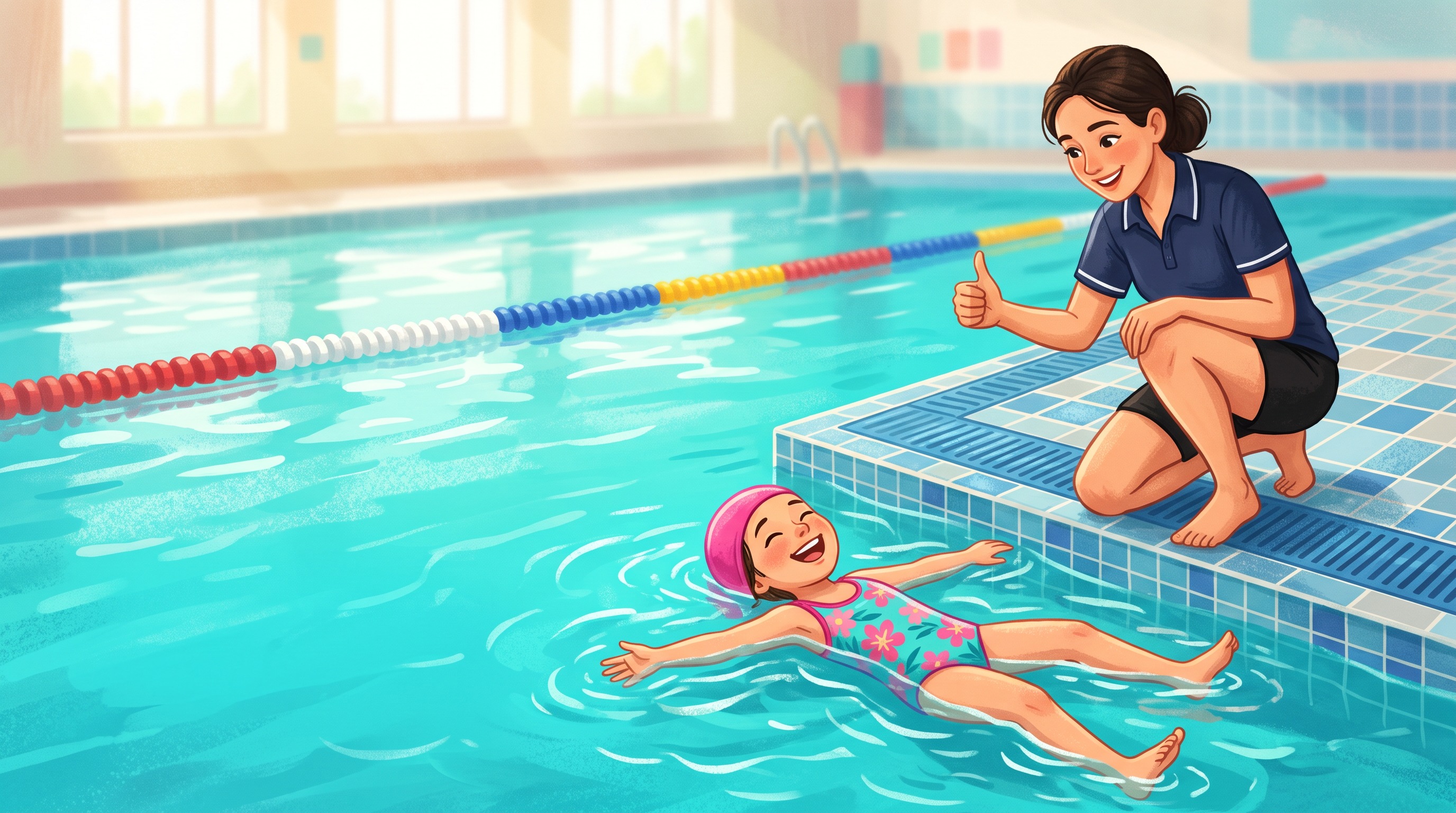
A pause doesn’t have to be a gap. With little effort, you retain more than you think, and the difference between practicing and not practicing shows in the first weeks after the pause.
Maintain a minimum rhythm
One lesson every two weeks retains more than four months of nothing. Ask if a slower schedule is possible: many schools have space during off-peak hours or in a group at a quieter time. If you pay per lesson instead of monthly, this is the cheapest way to maintain progress.
Practice briefly and often, also outside the pool
Three times five minutes in the pool does more than one half-hour session. Practice blowing bubbles with a song and a bowl of water, practice floating in the pool with a hand under the head, and the arm stroke can be practiced dry on the floor. Never leave a child alone in or near water, not even in the bath, and stay with them.
Swim England mentions in its tips for parents something that counts extra during a pause: let your child tell what they did, instead of quizzing them. A child who tells their own story about the lesson keeps the topic alive without it feeling like practice.
Ask for progress per skill, not just the level
When pausing, this is the moment to ask what your child did per exercise. "Level 3" says little about where it goes wrong, while "blows bubbles underwater, does not yet turn independently on the back" tells you exactly what to watch for. In the Swimmigo app, a parent sees per exercise what a child did, and that status remains even if lessons pause.
Plan the return on the day the pause starts
Put the date in your calendar when your child will start again, and set a reminder two weeks before. Pauses often extend simply because no one calls back. The school does not wait to keep a spot open until you remember.
Returning after the pause
The first weeks after a pause require more guidance than the lessons before. Those who expect this make it easier for themselves and their child.
Expect awkwardness, not loss
A child who steps back into the pool after three months is often quieter than usual. They watch first, participate cautiously, and seek the instructor. That is not regression. It is the same adjustment as the very first lesson, only shorter.
Give the instructor one sentence of context
Not the whole story, just the core: "she has been away for four months and does not yet dare to float on her back independently." The instructor adjusts the first lesson accordingly and knows where to start. Without that sentence, a child often starts too high and gets frustrated.
Have the level checked instead of starting over
Many schools automatically place a returning child one level lower as a precaution. That is not always necessary and costs months. Ask for a short assessment in the first lesson, with the old status alongside. For schools, it is the same: a returning child reaches their old level faster than a new student, saving the group half a year.
For swim schools: a policy that works
Pauses are no longer an exception. Those without a rule decide anew each time and do it differently each time. That costs more time than a half-page policy.
Choose your model
There are three workable models. Hold: the spot remains, payment continues, with a maximum of, for example, eight weeks. Slide: the spot goes to the waiting list and the child returns at the first available spot, without priority. Resell: the spot is lost and the child re-registers. All three are defensible if you set them in advance and explain them consistently everywhere.
Set the limit by time, not feeling
A limit in weeks is explainable. "As long as needed" is not, and it creates unfair situations between parents who do and do not insist. Attach a fixed check: does the school call after four weeks, or does the parent receive an email with the spot’s end date.
Record skills, not just the level
For a returning student, the old status per exercise is the only thing an instructor really needs. A level says a child was somewhere halfway, a skills list says where they stopped. Schools that register per exercise can place a child in the right lesson after a pause in one session.
One message to all parents
Put the pause rule in the lesson regulations, the welcome email, and on the website, with the same words. Parents accept a strict rule better than a rule that sounds different per employee. And those who make a medical exception record it in the file so a colleague cannot reverse it.
When it’s better not to pause
There are situations where a pause costs more than it yields. Four of these occur frequently.
Just before the diploma
If your child is two or three skills away from a diploma, a pause is costly. The work you lose must be redone, and a child who was almost ready also loses the feeling that they were nearly there.
When water confidence is just starting to grow
A child who finally dares to jump from the edge after months has just built that confidence. Stopping at that point often sets them back more than the technique. Here, a slower schedule pays off more than a full stop.
When the connection with the instructor is just forming
A regular instructor who knows a child is very valuable. Those who pause and later return to a different group with a different instructor start that part over. Ask when pausing if the return can be with the same instructor.
When the pause is mainly about your schedule
Sometimes the problem is not the child but Saturday morning. First see if another time, another location, or carpooling with another family solves it. Shifting an hour is usually cheaper than six months of stagnation.
During the pause, other layers remain necessary
Swimming lessons are one layer of safety, not the only one. The American Academy of Pediatrics calls lessons a layer that helps prevent drowning, and that layer is never alone. If lessons stop, the other layers become more important.
Concretely: an adult within arm’s reach of children who cannot swim, a fence or lock around a garden pool, and no inflatable rings as a substitute for supervision. The World Health Organization cites teaching swimming skills to school-age children as one of the ways to prevent drowning, alongside fences, barriers, and supervision.
How to make the decision
Three questions, in this order. Can I shorten the pause with another time or a slower pace? If no: how long does the pause really last, and what does it cost me in spot and money? And: what does my child do in those weeks with water, even if it’s not a lesson?
The answers to these three questions determine whether a pause is a temporary solution or a disguised stop. Those who pause for half a year without a plan are practically stopping, with a date on it.
More about what a swim school shows parents is in the overview of swimming lesson planning and software and in relapse after summer vacation. Parents find their side of the story on the page for parents, schools on the page for swim schools.
Swimmigo · Swim lesson app
Free for parents
Follow your child's swimming progress, see where you stand and report absences in the app.
Sources
- Deakin University, Deakin study finds school swimming programs alone not enough to keep kids safe, October 3, 2019
- American Academy of Pediatrics, Swim Lessons for Children: When to Start and What to Consider, updated May 18, 2026
- Swim England, When should my child stop swimming lessons?, September 22, 2017
- Swim England, 7 ways to support your child through their swimming lessons, July 26, 2021
- JCCSF Swim School, Swim School Policies, Processes and Practices, updated March 2026
- World Health Organization, Drowning fact sheet

Bob van Soest
As an expert in operating sports facilities (such as swimming pools) and developer of, among others, Swimmigo.com, I am passionately committed to making swimming lessons simpler, more fun and more insightful for parents, swimming instructors and everyone who wants to learn to swim.
Frequently Asked Questions
Related articles

What to bring to swimming lessons? Practical tips
Discover what you practically need to bring to swimming lessons for a smooth process and comfortable swimming experience.
Adjusting Swimming Lesson Planning for Fear of Swimming
Tips to reduce fear of swimming with home water activities and adjusted swimming lesson planning. Learn how to practice at home and build confidence for safety.

Effective Swimming Lesson Planning for Children in Foster Families
Discover practical tips to plan and manage swimming lessons for foster children clearly and purposefully.
Discover Swimmigo
The all-in-one app for swimming lesson progress. For parents, swim schools, and adult swimmers.