Crash-course swim lessons: what can really happen in a few weeks? [2026]

Summary
- A crash-course speeds up progress for a child who already swims, and is not a route to a diploma for a beginner.
- Count hours in the water: five days of half an hour is two and a half hours, far less than it seems.
- Daily lessons provide measurable gains on basic skills, but no one has measured what remains a month later.
- Ask each day what was practiced and what the next goal is, otherwise you will not know after the week whether it paid off.
- Schedule the follow-up lesson before the intensive week is over.
A crash-course swim program can help your child progress faster. A full diploma in two weeks is not realistic for a beginner, and that is where many providers go wrong. What a short course does is sharpen skills for a child who already swims, or break through a block that stays in weekly lessons.
The request usually comes with time pressure. A holiday approaching, a birthday when the diploma must be ready, a swim school wanting to fill empty pool hours during the Christmas break. That pressure is a poor adviser, because a child learns in hours in the water, not in weeks on the calendar. Whoever understands that difference can judge an offer honestly and will not feel cheated afterwards.
What a crash-course swim program is and is not
Four variants that get mixed up
Under the same name, four tracks hide that have little to do with each other:
- A holiday course of five days, with half an hour to forty-five minutes of lessons each day.
- An intensive program of two to three weeks, daily lessons, often in summer.
- A private block of three to ten single lessons, one-on-one scheduled in a short period.
- A refresher track shortly before the test, meant to sharpen one or two elements.
The first two are for groups, the last two for one child. That difference determines how much attention your child gets per lesson, and therefore what is possible in a week.
Count hours in the water, not weeks on the calendar
Five days of half an hour is two and a half hours in the water. Ten days of half an hour is five hours. A child who has had half an hour of lessons every week for half a year ends up with thirteen hours. That calculation explains much of the disappointment parents report afterwards: the week feels long, the learning time does not.
That does not make a short course worthless. It does matter where your child stands. A child who already jumps from the side, exhales underwater and swims a bit of backstroke can become much sharper in five days. A child who still does not dare to float starts from the beginning in those same five days, and then there is no speed-up possible.
Why a diploma guarantee is a warning sign
Every swim school has its own requirements and must have seen the elements itself before issuing a diploma or certificate. A child can swim well and still fail: ten metres where fifteen are required, a jump that just did not work, a day with little stamina. The Swim England framework says the same in other words, a pupil must meet all goals for a stage before the reward comes, and that pace varies per child.
A provider who guarantees a diploma promises something they do not control. Ask instead what will be measurably different after the week. A concrete answer to that is a better sign than a stamp on the bottom of the brochure.
What research says about swimming lessons in a short time
Five consecutive days, measurable gains on basic skills
A review of swim lesson methods for children aged 5 to 12 describes a Slovak study with sixty children of about eight years old. For five days they received forty-five minutes of lessons. After that week they improved on five basic skills, from jumping into the water and kicking with a board to diving and a short distance of freestyle. The improvement was statistically clear.
What was missing: a control group that received no lessons, a measurement months later and an assessment by someone other than their own instructor. The review mentions that as a weakness of this type of study. The honest conclusion is therefore that daily lessons set something in motion, not that a week is sufficient to learn to swim.
More lessons in fewer weeks makes little difference
Two other studies in that same review compared scheduling. Six lessons in two weeks versus six lessons in three weeks: no difference in achieving the same basic skills. Fifteen lessons of ninety minutes versus ten lessons of sixty minutes: also no difference in breaststroke. How lessons are spread over the calendar therefore made little difference in those studies.
That is good news for schools that want to cluster lessons during holidays, and at the same time a warning for anyone who thinks a tight schedule makes the difference. The calendar therefore does not determine how much a child learns.
What remains after the last day
The biggest blind spot in this research is retention. Most studies did not test what children can do a month or a year later, and the review explicitly notes that. Research on motor learning does point a direction: in a lab study on distributed and massed practice with adults, participants who practiced with intervals were more accurate than those who crammed everything into one session. What that does in the long term was not measured there.
Practically that means two things. Plan a follow-up after the intensive week, whether that is weekly lessons or twice a month practice in a pool. And record at the end of the week what your child could do, so you can compare six weeks later instead of relying on a feeling.
How long a child typically takes for a complete trajectory is shown in the overview on how long swim lessons really take. That is the baseline against which you should set a short course.
Swimmigo · Swim lesson app
Free for parents
Follow your child's swimming progress, see where you stand and report absences in the app.


For parents: how to judge an offer
Five questions to ask beforehand
A swim school that welcomes these questions knows what it is talking about. A school that dodges or answers with generalities has already given you the answer.
- How many minutes is my child in the water per day, and how many hours is that in total?
- How many children are there per instructor in the pool, and is that fewer than in the regular lesson?
- What must my child be able to do at the end, expressed in skills and not in a feeling?
- What happens if my child misses a day, gets sick or does not dare?
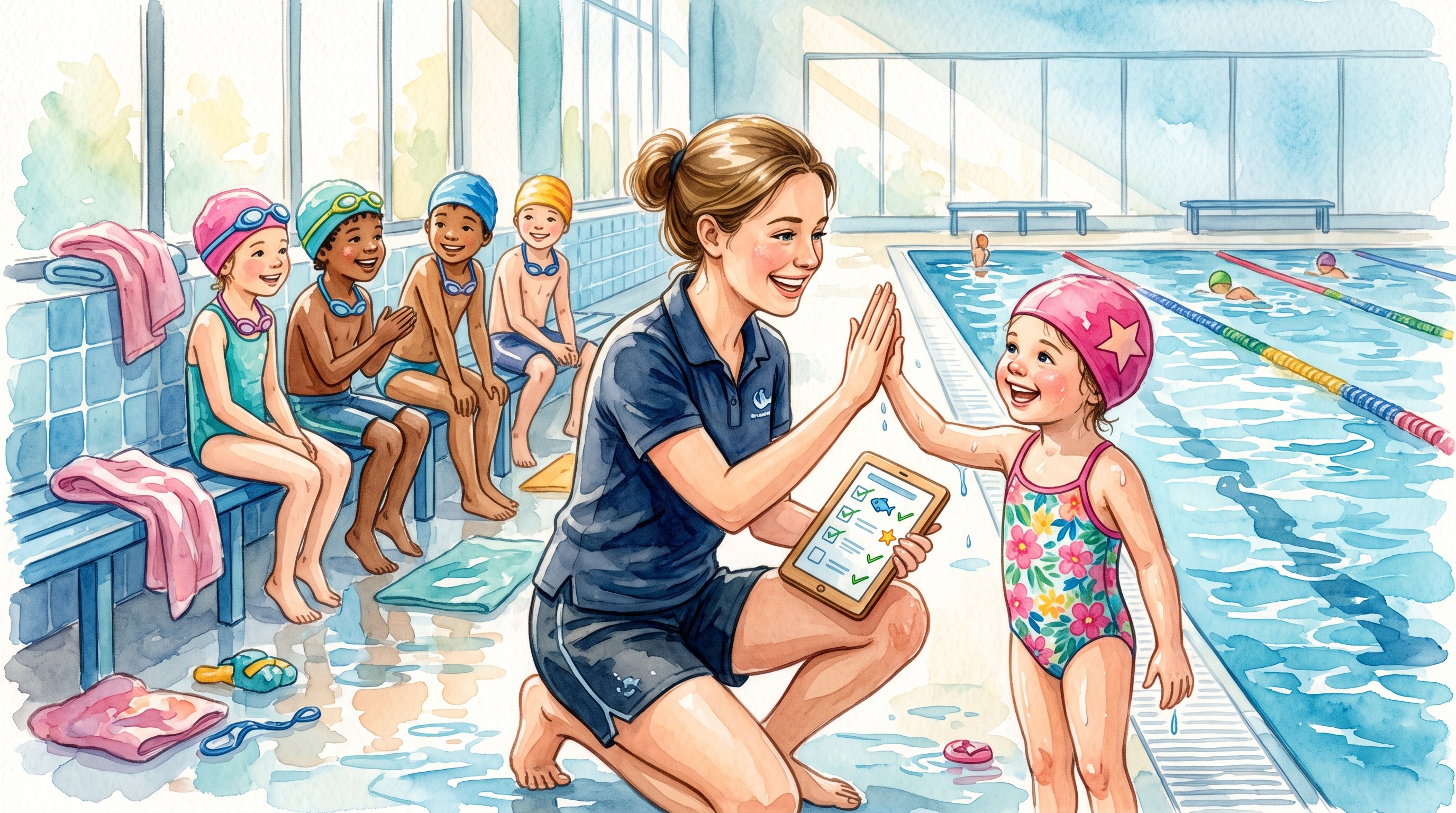
- Do I get daily feedback on what was practiced and where things got stuck today?
What to watch for in the first lesson
Do not look only at your own child. Pay attention to the waiting time before the lesson starts, the temperature of the water and air, and whether someone stands at the edge who does not teach and therefore can keep watch. Also watch how the instructor responds to a child who is afraid: do they push on or do they step back?
A child who no longer wants to continue after three days is not spoiled. Often it is a sign that the pace is too high, that there is not enough sleep or that something happened in the water that no one saw. Ask the instructor and observe the next lesson.
Fatigue, ears and skin with daily lessons
Swimming every day asks more of a child than a normal week. Ensure enough sleep, a proper meal well before the lesson and dry clothes afterwards. With fever, ear pain or a draining ear, a child should not go in the water, even if they seem otherwise fit. Dry the ears well after each lesson and have a child with an ear infection checked by a doctor first, what is allowed with ear complaints is described in the piece about swimmer's ear and ear pain after lessons.
Always check with your own doctor for a child with a skin condition or a previously operated ear. A swim school can tell you what happens in the pool, not what is medically appropriate.
There is also the app, free for parents: you can see per level which skills your child already has and which are still open. What Swimmigo does on the parent side is on the page for parents.
For swim schools: running an intensive week that does not go off the rails
Divide groups and use pool hours
Holiday weeks often have free pool hours, while the regular week is full. That is the space. Group by level instead of by age, keep groups smaller than in normal lessons because there is more repetition per lesson, and schedule children who need a lot of attention early in the day when the instructor is still fresh.
Sign-ups without waitlist chaos
A short registration period works only if everyone gets the same information. Put the days, times, price and end goal in one place, and let parents also see which spots are still available. Whoever calls should hear the same story as someone who reads the site. For schools that have these peaks more often, see the piece on booking software for swim lessons on how to link registration and payment.
Record what is practiced each day
In a week with five lessons, the daily note is the only proof you will have later. Note per exercise and not per child in general, because "doing well" helps no one when a parent asks in September why the diploma is still not there.
In Swimmigo you work with seven levels and 86 skills, with a score from 0 to 6 per exercise. The instructor taps what went well after the lesson, the parent sees that immediately in the app and does not have to ask. For an intensive week that is precisely the difference between reconstructing afterwards and following live. What else is available for schools is on the page for swim schools.
Update parents without extra calling work
One message per day is enough: what was practiced today and what is on the program tomorrow. Include whether there is something to repeat at home, because that is the question parents will ask anyway. In Swimmigo those messages come with read receipts, so you know who saw them, and notifications appear in the language the parent chose.
Diploma or follow-up: managing expectations
Tell parents beforehand what the end point of the week is. Is it a diploma, a certificate for a level or a stepping stone? Swimmigo works with certificates per level and diplomas for Bronze, Silver and Gold, so you can give a child something even if the real diploma is another block away. Schedule the follow-up lesson before the week ends, parents decide more easily on the last day than two weeks later by email.
Costs and how to arrange it
Package price or single lesson
Intensive weeks are usually sold as a package, because the school reserves pool hire and an instructor for the whole week. Per hour in the water a package is often cheaper than single lessons. Do ask what is included: equipment, certificate, an extra lesson in case of illness, and whether the price is per child or per family. Convert the price to cost per hour in the water, then you at least compare apples with apples.
Agreements about unused lessons
Agree beforehand what happens in case of illness, a missed day or a child who stops after two days. A reasonable arrangement is that a missed day is made up in a later lesson or that a credit is given for the follow-up program. Put that in the confirmation and not only in a conversation at reception.
Schools that work with lesson packages can handle payment in the app: parents choose a package and pay with iDEAL, credit card or PayPal, the money goes directly to the school's account and the transaction costs are 7.5 percent. Fair to say, this only works in countries where Stripe is active. Planning, progress tracking and communication in Swimmigo work everywhere.
Safety and group size
Supervision is not the same as teaching
An instructor who explains is not watching the whole group with their eyes. In a holiday week more children are around than usual, often with parents and siblings. Agree therefore who scans and when, and put that on paper rather than trusting everyone thinks the same way.
The WHO names lack of swimming and water skills as one of the causes of drowning, with around 300,000 deaths worldwide per year. For children aged 5 to 14 drowning ranks third among causes of death. A diploma is therefore protection, and at the same time not a replacement for an attentive adult.
When your child should not participate
Fever, a draining ear, active diarrhea, a contagious skin rash or a child who clearly does not feel well: keep them at home. Making up the lesson is always cheaper than a child who drops out for a week because it was pushed too long. If in doubt, call your own doctor and not the swim school.
| Program | Duration | For whom | Realistic result | What to watch for |
|---|---|---|---|---|
| Holiday course | 5 days, 30 to 45 minutes per day | Children who already swim and miss one element | Become sharper on existing skills | Group size and whether there is extra supervision |
| Intensive program | 2 to 3 weeks, daily lessons | Children working toward a diploma | A jump in pace, sometimes an extra level | Fatigue, sleep and whether the end goal is clearly stated |
| Private block | 3 to 10 single lessons | Children who do not break through a block in the group | Learn a specific skill after all | Experience with the issue and a plan per lesson |
| Refresher track | 2 to 4 lessons before the test | Children who can do everything but are nervous | Routine and confidence on the day itself | Whether the test elements are practiced |
Conclusion
A crash-course swim program accelerates progress for a child who already has the basics, and is an expensive disappointment for a child who lacks those basics. Daily lessons have a measurable effect on basic skills, but there is no evidence that more lessons in fewer weeks lead to a diploma. The difference lies in pre-selection, recording progress daily and the follow-up you plan before the week ends. Ask a school about hours in the water, group size and an end goal in skills, and you will know within five minutes whether the offer is any good.
Swimmigo · Swim lesson app
Free for parents
Follow your child's swimming progress, see where you stand and report absences in the app.
Sources
- Minkels, van der Kamp, de Vries and Beek: Learning how to swim in 5- to 12-year-old children, a scoping review of evidence-based motor learning methods, Frontiers in Sports and Active Living, 2025
- Effectiveness of motor sequential learning according to practice schedules: distributed practice versus massed practice, Journal of Physical Therapy Science, 2015
- Swim England: Learn to Swim Framework Stages 1-7, 2017
- WHO: Drowning fact sheet, 1 May 2026

Bob van Soest
As an expert in operating sports facilities (such as swimming pools) and developer of, among others, Swimmigo.com, I am passionately committed to making swimming lessons simpler, more fun and more insightful for parents, swimming instructors and everyone who wants to learn to swim.
Frequently Asked Questions
Related articles

What to Bring to Swimming Lessons? Practical Tips
Discover what you practically need to bring to swimming lessons for a smooth process and comfortable swimming experience.
Adjusting swim lesson planning for swimming anxiety
Tips to reduce swimming anxiety with home water activities and adjusted swim lesson planning.

Effective swim lesson planning for children in foster families
Discover practical tips to plan and manage swim lessons for foster children in a clear and goal-oriented way.
Discover Swimmigo
The all-in-one app for swimming lesson progress. For parents, swim schools, and adult swimmers.